Gene Wilder and Richard Pryor – a dynamic duo stuck in mediocre movies 

Richard Pryor and Gene Wilder are one of the great comic movie duos.

But the strange thing is, as much affection as I have for the Wilder/Pryor team, they never truly made a great movie together – instead, they typically livened up fair to mediocre material with their unmistakable chemistry.

It’s a funny thing – other comedy duos like Laurel and Hardy or Jack Lemmon and Walter Matthau paired for piles of movies, many of them classics, but Wilder and Pryor’s legacy is a paltry four films together – with, really, about 1.75 good movies among those.

Yet a lot of us comedy fans love them – Indicator has just put out a great lavish new box set of three of the Pryor-Wilder movies with the full boutique blu-ray treatment, usually reserved for cinematic masterpieces. Long after both men have died, the Pryor/Wilder team have a reputation that outshines their actual accomplishments on screen. 

Maybe it’s because their pairings always felt sincere – they weren’t doing Abbott and Costello or Martin and Lewis-style “bits,” but Wilder and Pryor took their existing quirks and crashed them together, which at its best created something that felt intimate instead of staged. They were better than their material, and maybe that charm is why we still remember them even when few are calling their movies masterpieces. 

1976’s Silver Streak is a movie I fell in love with after its countless TV screenings back in the day. A feisty homage to Alfred Hitchcock thrillers, it’s amusing fluff which abruptly changes gears more than halfway through its runtime when Richard Pryor pops up in the back seat of a cop car and quickly becomes a sidekick to Wilder’s mild-mannered writer caught up in a vast criminal plot. 
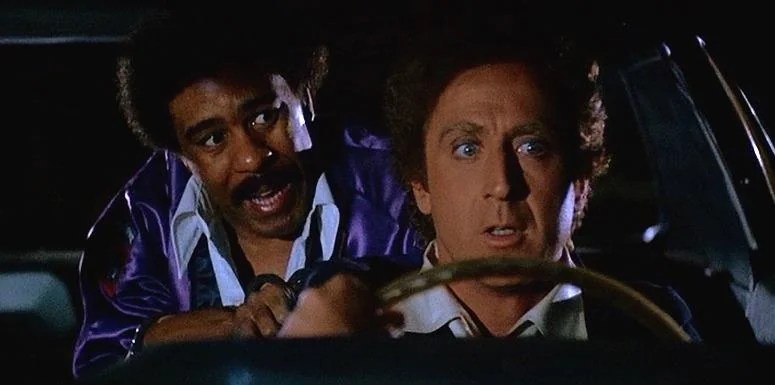
Sometimes movies don’t go how you would expect, and Pryor and Wilder had a seamless energy that immediately pushed all the plots of Silver Streak to one side. I dig Silver Streak in the way you still love any movie you adored as a kid, but it’s a bolted-together contraption that isn’t sure whether it’s a romance, comedy, action movie or a disaster movie with its blow-up-the-train climax. 

Pryor loved to improvise and Wilder, to his credit, just went along with it, which gives their interactions a refreshingly candid feel. The rather dated scene where an on-the-lam Wilder goes full blackface with shoe polish to hide from police was tremendously improved by Pryor’s wry asides and Wilder’s child-like innocence. It’s a dumb scene, sure, but 10-year-old me thought it was hilarious and I still see it as making fun of white folks’ preconceptions as much as it relies on Black stereotypes. That one sequence launched the Pryor/Wilder career, and it came out of Pryor deciding to make the rather racist scene his own. Pryor adds an unpredictable feeling to his every scene in Silver Streak that knocks it out of its comedy thriller cliches. 

Gene Wilder’s schtick was often men who appear soft-spoken and shy but who snap, hilariously, when the pressure comes on. Wilder could be unsettlingly calm and slightly menacing – see his terrific underplaying in Blazing Saddles, his unmistakable Willy Wonka – but in movies with Pryor he plays the gentle man with a manic side. 

Their best film together is 1980’s Stir Crazy, where Wilder’s wide-eyed optimist and Pryor’s weary worrier end up wrongfully sent to prison. Like all their films, Stir Crazy is patchy – there’s wayyyyy too much prison rodeo subplot – but when Wilder and Pryor just riff off each other behind bars, it’s comedy heaven. 

Pryor’s characters toyed with racial stereotypes – he’s usually a hustler or a con man, a cynic without any of Wilder’s naive optimism – but the Pryor/Wilder movies only occasionally made race their main focus. In Stir Crazy, the fact a black guy and a white guy are good pals isn’t anything special – it’s just the way it is. 

I loved Silver Streak and Stir Crazy and watched them constantly as a kid, without ever really realising both Pryor and Wilder had already forged legendary careers of their own. Maybe that’s part of why their team still is so adored today despite a thin legacy together – nobody really thinks about Bud Abbott’s career before he met Costello, but Pryor and Wilder were already groundbreaking on their own before they paired up.

Still, their final two films were both box office misses and didn’t offer much new. 1989’s See No Evil, Hear No Evil has a dated concept that probably wouldn’t fly today – Pryor is a blind man, Wilder is a deaf man, with lots of wacky misunderstandings, and they get embroiled in a comic murder plot. While it’s a steep step down from Stir Crazy it’s absurdly funny at several points, until it meanders off into the dull murder storyline too much. 

While their first three movies are flawed, 1991’s slapdash Another You is just generally a fiasco, with a nonsensical plot and both men showing their age. Poor Richard Pryor – barely 50 years old at the time – was thin and frail, showing the effects of his onset of multiple sclerosis, and while Wilder still summons up that great manic energy, he also feels a bit past his use-by date. You know your movie’s bad when it relies on a yodelling scene for laughs. The highlight is a candid little “farewell” moment by the two men at the movie’s end. 

It’s kind of easy to look at Pryor/Wilder movies and lament their missed potential – poor scripts, needlessly complicated stories, too much of their work coming at the raggedy end of their careers. What could’ve been if instead of jamming them into belabored crime and action movie plots, they just riffed on their two very different characters? Imagine what they could’ve done with their versions of The Odd Couple or Planes, Trains and Automobiles, for instance.

Pryor would die at 65 in 2005, after spending his last several years as an invalid, while Wilder lived until 2016, but Another You was the final movie either men starred in, and a bit of a downer ending to their remarkable screen careers.

Pryor and Wilder weren’t particularly close in real life, which makes their unforced charm together on screen even more remarkable. Sometimes, a spark just happens. Comedy fans recognise the peculiar magic of the Pryor-Wilder combo and even if they didn’t leave the loftiest cinematic legacy behind, what they did leave behind in laughs is pure gold. 

Australia, the forever frontier

I moved to New Zealand years and years ago, but secretly, I’ve had a longstanding crush on Australia. 

I just got back from my ninth trip ‘across the ditch,’ which I guess isn’t a lot compared to many Kiwis, and I feel I’ve only begun to scratch the surface of the vast sunburnt expanses of Australia.

As part of my so-called career, I’ve worked for Australian journalism on and off for more than 10 years now from the comforts of NZ. It’s something that would’ve been impossible in the pre-internet age, but I’ve written headlines and copy edited from Sydney to Cairns, Darwin to Melbourne, Shepparton to Townsville, and “worked” remotely in far more of the places in Australia than I’ve ever visited. It does the head in a bit, actually, to think about this too hard. I’ve worked with a lot of Australians and visited scrappy newspaper offices in rural Victoria and deep in the vast Northern Territory, and it’s always kind of cool to realise journos are basically the same no matter where you go. 

Australia has sparked my imagination since I was a kid, bopping along to Men at Work songs and was caught up in the brief weird wave of Australia-mania in the US in the ‘80s, when Olivia Newton-John, Mel Gibson, Crocodile Dundee and Koala Blue took over. Since I moved to New Zealand, I’ve managed to meet both Midnight Oil’s Peter Garrett and Men At Work’s Colin Hay, both totems of my youthful fascination with all things Aussie, and in my stumbling geeky way got to tell them both how much their music helped shape my brain. 

I first made it to Sydney circa 2007 and if it weren’t for a combination of pandemics, expensive trips back to American family, and juggling life, work and school back here in Auckland, I imagine I might have gone a lot more. Some of those things have changed in recent years and the wife and I are hoping to make hops across the ditch a more regular thing. After a mere three hours or so flight, you can explore a whole different world. Australia contains multitudes, from sprawling big cities to rugged bush to staggeringly beautiful wide horizons. 

Australia and NZ are both allies and “frenemies” and while there’s a lot shared between our two countries there’s a lot of differences as well. Australians are a bit brasher, bolder and louder, with more of that American-style frontier spirit combined with a very Aussie informality, sometimes crudeness. It can, like everywhere, be an ugly place at times and has a rough and raggedy history. Unfortunately, like America, Australia’s indigenous culture was largely suppressed and exterminated for decades, but is still alive in the heart of the Dreaming and it’s not quite like anything else in the world. 

But hey, I’m no expert, mate. I just like it there. I like that you can see these huge iguana-sized water dragons in city parks strolling around, hear kookaburras in the trees, towering gum trees everywhere you look, the rocks in the Red Centre that hum with ancient whispers. I like that for now, Australia still has a robust newspaper industry in the cities even if it’s mostly the Murdoch Empire, I love the scrappy sounds of young Australian punk bands and the writing that tries to capture the mysterious meaning of the bush.

There’s so much more I want to see – I’m desperate for another trip to the haunting Red Centre, want to check out the famed Ghan train ride across the desert, still haven’t been to Adelaide or Cairns, or just wandering along the bush and the Outback and heck, maybe even ridiculously far away Perth. I’m curious about the steamy weirdness of Darwin and really want to check out the Mad Max-style badlands of Coober Pedy and Broken Hill. And Tasmania! What about Tasmania? 

Don’t get me wrong – New Zealand is swell, comfortable for us, with a lot cooler temperatures and a whole lot less creatures that can kill you. But the grass is always a little greener on the other side – or perhaps, the dirt is redder. I’m always excited to explore that forever frontier just across the Tasman Sea. 

Hail to the chiefs: 15 presidential movies to watch instead of doomscrolling

I get it. You’re stressed out. This is life in 2024.

But instead of doomscrolling political news all week, how about taking a break with a presidential movie?

The presidency has been the subject of countless movies, good and bad, from lofty biopics to action-packed romps. Here are 15 movies about American presidents and politics that are worth firing up to divert your brain for a few hours as Election Day approaches.

If you want to feel a little bit of optimism:

The American President (1995): A genuinely sweet romantic comedy about a widowed president finding a new love, starring a luminous Michael Douglas and Annette Bening, and written by Aaron Sorkin, who later went on to create The West Wing TV series.

Lincoln (2012): Daniel Day-Lewis’ Oscar-winning performance takes Abraham Lincoln out of the realm of cliche and makes him a complex human being again, wrestling with how to end slavery in an America torn by the Civil War and trying to do the right thing.

Mr Smith Goes To Washington (1939): Jimmy Stewart’s naive young US senator comes up against Washington corruption. The thing that makes Frank Capra’s classic still relevant today is its fierce determination to make politics better.

If you just want to wallow in political intrigue:

Frost/Nixon (2008): There have been a lot of movies about Richard Nixon, but this tightly focused film sticks to one post-presidential interview where the disgraced president tries to redeem himself. Tense dialogue and terrific acting makes the spectacle of two men mostly sitting in chairs talking seem riveting.

All The President’s Men (1976): Nixon never appears in this Oscar-winning Watergate drama, but hovers over it like a malignant ghost as journalists Robert Redford and Dustin Hoffman uncover a labyrinthine scandal that led to America’s first and only presidential resignation.

JFK (1991): Oliver Stone’s mammoth three-hour epic is a twisted knot of conspiracy theory, paranoia and grifters, so it’s a perfect vibe for Election 2024. It’s a complicated, indulgent sprawl of a movie that’s still somehow fascinating, with an all-star cast.

If you think politics is ridiculous:

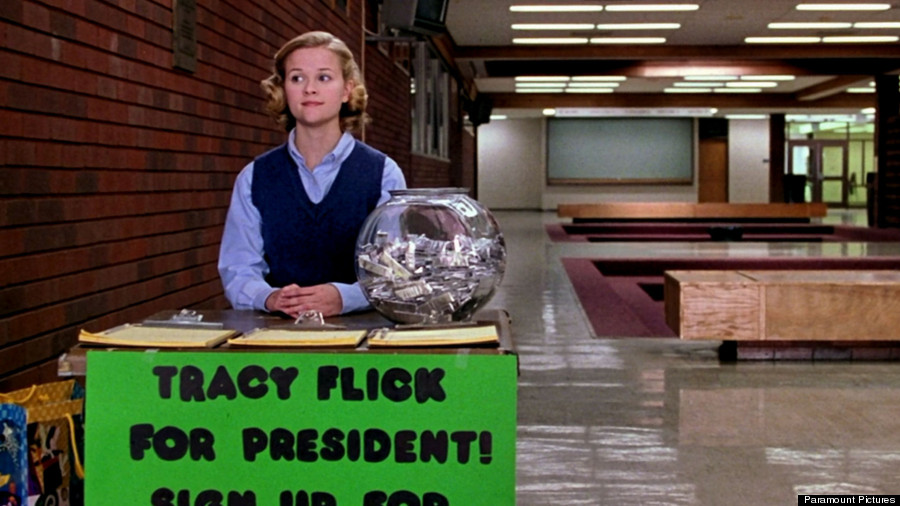
Election (1999): Strictly speaking, not quite about a president, but this classic story of an American high school student election that goes horribly awry sums up how much the desire to win can eat away at a person. With a never-better Reese Witherspoon and Matthew Broderick.

Don’t Look Up (2021): The US hasn’t had a female president – yet – and they’re pretty thin on the ground in movies, too. (Television is a different story, where women presidents have been seen on Veep, Scandal, Homeland and many other shows.) This hit-or-miss satire about panic over a comet destroying Earth has its amusing moments and features Meryl Streep as the president – unfortunately, she’s a shallow, poll-obsessed fool who bungles the end of the world badly.

Mars Attacks! (1996): Love Beetlejuice? Tim Burton’s underrated comic book epic features a rogue’s gallery of oddball Americans battling Martians, and one of the funniest turns is Jack Nicholson as a vaguely sleazy, cocky and utterly unprepared president.

If you’ve given up all hope on America:

Dr. Strangelove, Or How I Learned To Stop Worrying And Love The Bomb (1964): Stanley Kubrick’s Cold War satire still stings today, with the magnificent Peter Sellers in multiple roles, none quite so indelible as the wishy-washy President Merkin Muffley, who very apologetically starts a nuclear war.

Vice (2018): Christian Bale makes an unlikely Dick Cheney in this biopic of George W. Bush’s vice president, which in a broadly comic way shows just how much ambitious power can be wielded behind the scenes.

Civil War (2024): A movie about a traumatised band of journalists travelling through an America torn by an unspecified civil war, it’s not one to watch if you want to feel cheerful about the possibilities of the USA, with Nick Offerman as a crazed, out-of-his-depth president presiding over the country’s collapse.

If you just want a president to kick butt:

Air Force One (1997): Harrison Ford lives the American dream – that is, the dream of being a take-charge military hero who also happens to be president and fights back against terrorists on his own airplane.

White House Down (2013): Mix Die Hard with Air Force One, shake, stir and settle in for explosions and gunfire at the White House as terrorists attack and only the humble everyday policeman Channing Tatum can save the day.

Abraham Lincoln: Vampire Hunter (2012): Sure, you’ve seen a president fight terrorists, but how about vampires? This very silly alternate-history horror movie takes itself far too seriously, but does provide some ridiculous, bloody laughs as Honest Abe stakes blood-suckers. Considering how bizarre the 2024 election campaign has been so far, this might just not be the strangest thing about American presidents you see this week.

This one also appears in slightly different form over at Radio New Zealand!