
*Spoilers* galore for a 50-year-old movie series ahead!
I first stumbled across Planet of the Apes in an after-school TV marathon of the original movies in the early ‘80s sometime. It’s no exaggeration to say they kind of blew my little human mind. And the thing that struck me the most, as I gulped down Planet, Beneath The Planet of the Apes, Escape From The Planet of the Apes and Conquest of the Planet of the Apes in a single week, was that there were no happy endings in this ape-filled apocalypse.
Everyone knows how Planet ends, with Charlton Heston wailing alone in the sand of a shattered world. Pre-internet, pre-memes, I was just raw enough to be stunned by the gorgeous tableau of a broken Statue of Liberty, and how Heston’s cynical, alpha-male astronaut finally runs up against an obstacle he can’t bully or bluster past.

Yet it was the impossibly bleak sequel, Beneath The Planet of the Apes, which made me an Apes-man for life. An immensely weird and surreal movie, it introduced peeled-face human mutants, horrifying visions of crucified apes and bleeding statues, and oh yeah – the destruction of planet Earth, blown to bits by a leftover atomic bomb in a struggle between apes and mutants. The final 20 minutes or so of Beneath is as dark as it gets, with Heston (who barely appears in the sequel) shot, mortally wounded and in his final moments, slumping to his death to trigger the apocalypse with what still seems to me like a sigh of relief. The screen fades to black, and we’re told: “In one of the countless billions of galaxies in the universe lies a medium-sized star. And one of its satellites, a green and insignificant planet, is now dead.” And the kicker – this movie was rated G.
As Beneath faded to black, the first time I watched it as a kid, I was filled with a bone-deep chill of horror that left me feeling very, very small in a vast universe. And the thing is, I liked it. It made the open-ended Empire Strikes Back’s bleak ending, so daring-feeling at the time, seem like a Care Bears cartoon.
Improbably, they managed to make three more Apes sequels after they blew up the whole world, by throwing in a little time-travel. 1971’s Escape From The Planet Of The Apes lures us in by being the most overtly comic of the series, with charming Cornelius and Zira catapulted back to a groovy ‘70s America, but soon, the darkness inherent in the series seeps back in with an ending that almost tops the nuclear doomsday of the last movie. In its final moments, the two ape refugees and apparently their infant child are shot to death under brilliant sunny California skies, their attempts to escape the end of the world fruitless. There is no way out of doomsday, Escape tells us.
But of course, there would still be another Apes sequel, this time picking up with Cornelius and Zira’s son Caesar – still alive, with another poor little chimp baby shot down in his place! – in what I’ve come to think of as the second best of the series, 1972’s Conquest of the Planet of the Apes. Set in some dystopian fascist 70s-style future where apes have replaced house pets and Caesar rises to lead a revolution, Conquest isn’t subtle in its Nazi imagery and racially charged metaphors, but I forgive it all for the cathartic carnage of its final scenes, where Caesar leads a mob that begins the dark process of overthrowing mankind that ultimately leads it to where it ends up, mute, naked and afraid in the original Planet of the Apes.

This movie’s ending was deemed so dark that it was edited into something more optimistic for its original release, and Caesar’s final speech ends in a note of possible peace. Forget that and go for the unrated original version seen below, where Caesar’s blood-and-vengeance preaching has the punch it was meant to, and we end for the fourth movie in a row with a dark, dark ending – a city in flames, a brutalised race rising up and the future looking, once more, very, very grim for humanity.
It’s hard to think of a non-horror movie series that ends on such downers for four successive films. (The fifth and by far least of the original series, Battle For The Planet of the Apes, suffered from huge budget cuts and a rather disposable plot set sometime between Conquest and the original on the timeline. It ends without mass bloodshed, but still with a vision of a statue of Caesar weeping, knowing that things will soon get much, much worse.)
Even in more modern Apes movies, you won’t get hug-filled happy endings. Tim Burton’s misbegotten 2001 remake was mostly awful except for the makeup effects, but did end on a darkly dumb note echoing the original movie. The terrific latter-day Apes trilogy all tend to end on less utterly nihilistic points than the original series. Yet each one of them has a more quiet note of rising dread in their climax, a sense that things are only, ever, going to get worse before they ever get better – if they ever do. This Apes fan is pretty excited for next year’s Kingdom Of The Planet of the Apes, the 10th (!) Apes film, but they better not cop out and give us too happy of an ending.
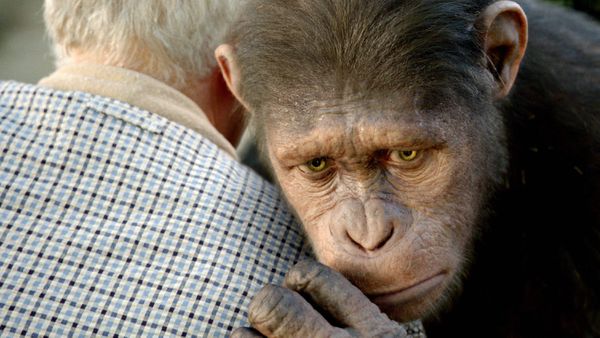
By forcing us again and again to look at the possible end of all things, the Apes movies have had the curious effect of making me look back at the real world with a different eye – appreciating the fragility of it all, the impermanence and the tiny little beautiful moments, whether it’s Cornelius and Zira exchanging a look of love, little Caesar’s love for his adoptive human family in the 2011 Rise of the Planet of the Apes, or even Charlton Heston and his mute mate Nova, alone on a horse through a blasted landscape, a bleached and battered world that still has a hint of dark beauty amongst all the ruins.
On all the planets of the apes, there is very little optimism, but yet, we keep coming back, again and again, hoping to find it. I guess that’s what makes us human.

 Nik Dirga
I wish the musical from the Simpsons was a real thing.
LikeLike