Kamala-mania and looking for a sense of optimism in America again 

Hey, remember when we all thought the 2024 presidential race would be a dire, dull rematch?

The last two months or so of US politics has been a head-spinning whirl, and watching Kamala Harris take to the stage and deliver a confident, concise acceptance of the Democratic presidential nomination this week has capped off the frenzy nicely. 

I’ve been an American political convention tragic for far too many years, dating back to the Reagan era. They’re bombastic commercials and insanely wasteful propaganda, but they also do sometimes provide unforgettable moments. They’re a snapshot of where the country stands every four years, and how it’s looking ahead. 

The Republican convention with its Hulk Hogans and the Democratic convention with its Oprah Winfreys set the stage for November’s battle between Harris and Donald Trump. They also had very different vibes. For my day job I ended up exhaustively live blogging both convention speeches, and while some years people say the candidates are all the same, you couldn’t get much different than Harris and Trump in both approach and message. 

Even the speech lengths were a contrast – about 40 minutes for Harris vs more than 92 minutes for Trump (the longest convention acceptance speech of all time, apparently).

I admit my biases: I found the Democrat convention more hopeful, and more representative of the multicoloured, freedom loving America I want to believe in. There was simply a sense of joy, a word everyone from Tim Walz to Bill Clinton has attached to the Democratic campaign this year. I’ve watched lots of those endless state roll call of delegate votes at conventions, where dull guys stand up and say things like “From the great state of Idaho, home of the nation’s finest potatoes and the world’s biggest ball of twine, we proudly cast our 27 votes for….”

But I have never, ever seen something at a convention as effortlessly silly and cool as Lil Jon introducing Georgia’s roll call at Chicago this week:

I have to admit I’ve watched this clip a good dozen times because there’s something so overblown and yet quintessentially American about it all. A bit irreverent? A bit egocentric? Sure. But also, it was fun as hell. “Fun” is a vibe that seems sorely lacking in American politics the last eight years. 

In my political lifetime, the candidate who was more optimistic and, for lack of a better word, cheerful, has typically won. It’s not even a party thing – Reagan’s sunny demeanour overwhelmed Jimmy Carter, as George W. Bush’s down home aw-shucks vibe took down Al Gore and John Kerry’s patrician sternness. Bill Clinton’s good cheer beat the first President Bush while Joe Biden’s warmth edged past Trump in 2020. Joe Biden, for all his merits, was a shaky deliverer for the joy vibe these days, while his vice president seems to have easily stepped up to the task. 

I mean, I’m in a bubble. We’re all in bubbles, really, so the world I’m seeing maybe isn’t what a Trump supporter in Mississippi is. But, it’s hard to envision the Republican nominee smiling so easily, playing baseball, petting a dog, embracing his children, all those everyday things that make up most American lives away from the echo chambers. 

I have lost a lot of faith in my home country these last few years, to be honest. Perhaps it’s being an American who’s lived abroad nearly 20 years now, but I often felt like I didn’t recognise it anymore. The whitewashing spin of what happened January 6, 2021 and the ensuing forgiveness and rehabilitation of Trump by too many people who should know better was the final straw for me. I felt baffled. 

I don’t make firm predictions about US politics anymore, because it’s too easy to get your heart broken. I know what I would like to see happen in November, but I’m very aware that it could go either way still. I don’t think America would simply die if Trump was re-elected, after everything we’ve seen, but what a big bloody wound that would be.

I saw a lot of optimism this week that I’d like to believe in myself. A sense of hope might go a long way in this election, particularly when the other side seems mired in conflicting messages and a consistent willingness to bemoan everything, blame everything on other factors and make apocalyptic prophecies. 

I sure would like to see something to chip away at the endless tension and anger infecting so much of America these days, although you might only get there by deleting the internet and the algorithm-fuelled outrage machine of social media, to be honest. 

In the end, what sways things might be this – do you want a smile or do you want a glower? I just want my country of birth to be a place again that looks forward, rather than backward, one where a sense of fair-minded kindness drowns out the endless hate. Will we get there? Stay tuned. 

Big Star and how to make a song you never get sick of

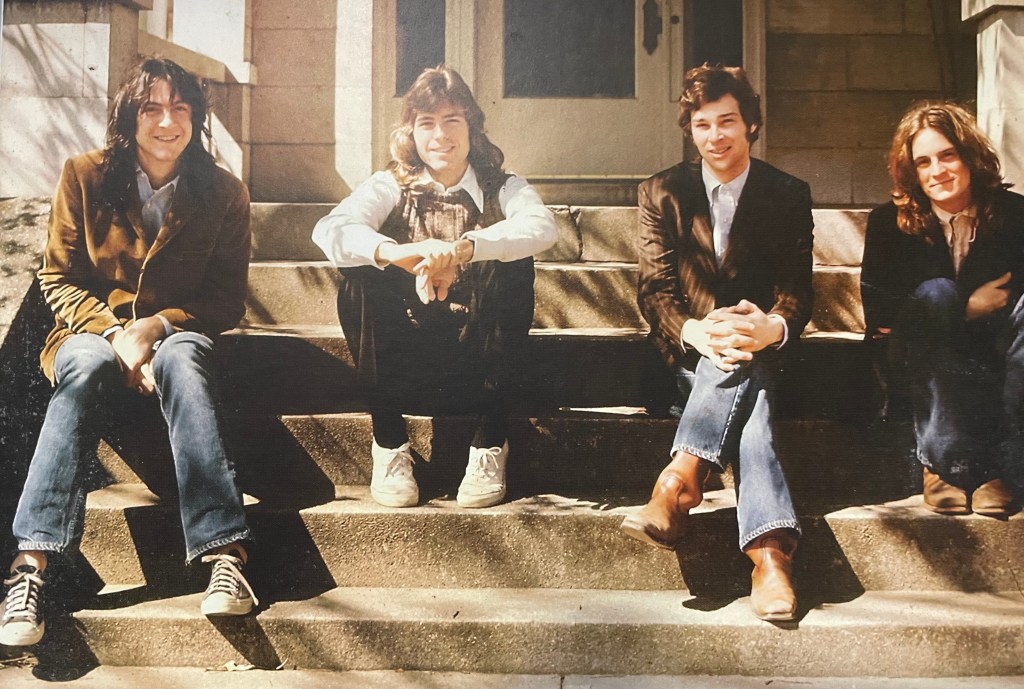
I’ve loved the sounds of Big Star and Alex Chilton for years, and the simple glittering heartbreak of their best songs still gets me with every single listen.

How often can a song do that after dozens, maybe hundreds of spins?

Those Big Star songs shimmer, 50 years on now after the fall 1974 recording of what ended up their final album, Third/Sister Lovers

I can’t listen to the ringing chords of “September Gurls”, without summoning up visions every teenage love affair there ever was, of the burning intensity that, maybe, your life can never quite reach again after 18 years old. The words are deceptively simple – “September girls / Do so much / And for so long / ‘Till we touched.” But the vibe, man, the vibe – that’s eternal.

The genius of Big Star was the utter lack of rock star swagger in their boy-loves-girl pop, a kind of bemused casual sincerity that never really seems to age. Their feelings tapped into the universal, girls, cars and nights of confusion.

Take “Thirteen”, written by Chilton and poor doomed Chris Bell, who left the band after their first album and died in a car wreck at just 27. A fragile and trembling little song, in its first little conversational couplet it sums up a whole world of teenage hopes and dreams – “Won’t you let me walk you home from school? / Won’t you let me meet you at the pool?”

A buried gem for me has always been “Life Is White,” which contains the entire frustrating agony of a breakup in its simple words – “Don’t like to see your face / Don’t like to hear you talk at all.”

Written down, their words don’t exactly leap off the page, but between Chilton and Bell they feel real, in a deeper way than the stadium rock and pompous prog lyrics of the era. 

The true art of Chilton’s lyrics was their plain-spoken language. “Hanging out / down the street” is hardly Shakespeare, but it’s a word picture that worked so well that That ‘70s Show used it to be the theme song for the entire decade. (Still annoyed they drafted Cheap Trick to cover it, though.)

Of course, part of Big Star’s charm is their found mystery – barely registering while they were briefly a band, three albums and done, and only slowly growing in cult power years later. (I first discovered them myself in the early 1990s, when a series of Rykodisc CD reissues hyped up this old forgotten cult band from Memphis, an hour’s drive up the road from where I was going to college. And for once, a band lived up to the hype.) Everybody loves to think they’ve discovered a hidden gem, and Big Star was one of the shiniest for a power pop lover back in the day. 

I’ve written about my love for Alex Chilton’s epic disheveled and messy solo career that unspooled post-Big Star before his sadly early passing in 2010, but while Big Star were sometimes low-fi and unadorned, they were never sloppy. They meant every word, while Chilton in later years would kind of lean into a debauched troubadour vibe, singing songs with a wry smirk. 

I sometimes think that Chilton maybe felt he’d perfected pop music with Big Star so much that he became bored by it, that he never wanted to take a song quite so seriously again. 

There’s a reason people still listen to Big Star more than 50 years after the boys from Memphis started doodling out songs. They strike a chord, and every time I hear that clarion call of “September Gurls” glittering out of the speakers, I hear it ringing still. 

I’m still bummed we don’t get any more Adrian Mole

For a little while there, I was sure I was Adrian Mole. I got a copy of The Secret Diary of Adrian Mole, Aged 13 3/4 from my parents after they took a trip to the UK, and it was one of the best gifts I ever got. 

I started reading Sue Townsend’s Adrian Mole books when I was about 13, the same age as the fictional Adrian, and while I wasn’t quite as awkward and pretentious I was probably a close second. Adrian’s chatty diaries spoke to me, of his dreams of literary greatness, quickly rising and falling passions and his unspeakable social awkwardness. While I was a kid in sunny middle class California and he was a battler in Thatcher’s grey Britain, I felt a kinship with Adrian.

Adrian didn’t become a literary superstar, but over the course of several books he’d become a chef, a TV personality, an activist, a bookstore worker and more, surrounded by a cast including his dysfunctional parents, his strange romantic pairings and eventually his children, and always, the love of his life Pandora, his teenage crush grown up into a headline-grabbing Labour MP. 

Townsend followed Adrian well into the next century in titles like Adrian Mole: The Cappuccino Years and Adrian Mole And The Weapons of Mass Destruction. The satire got broader on topics like the Gulf War and the books generally got a bit less realistic compared to the early teenage angst years, but they were still fun, with Adrian’s distinct combination of snobbery and naivete always amusing. 

Townsend, long in failing health, died in 2014. The series came to a halt with Adrian Mole: The Prostrate Years in 2009, as Adrian’s marriage breaks up and he discovers he has cancer. 

It ends on an optimistic enough note, with Pandora once again popping into his life and a reminder in its final pages that no matter what, life keeps moving along: “Diary, my first thought that I couldn’t possibly be a grandfather, I was only forty years old. My second thought was that I wanted to live long enough to see this child grow up. I had a lot to teach it.” 

There were rumours Townsend was working on another book but 10 years after her death nothing has ever been published. I miss Adrian Mole a lot. 

There’s something about following a character over the span of a lifetime that makes a book really come alive. I would have liked to see Adrian continue to grow old and cranky and what he would have had to say about Brexit, Trump, Covid and social media. (I’m quite certain he would have fallen for every conspiracy theory there is, actually.) The Secret Diary of Adrian Mole, aged 57 3/4? I’d love to see it. 

A book series that ends too soon feels a bit like an entire world has been lost. 

The late Octavia Butler was one of our most fascinating sci-fi writers and futurists before her untimely death at just 58. Her “Earthseed” series – Parable of the Sower and Parable of the Talents – follows a young Black empathic woman in an America that is rapidly falling to pieces. Written in the 1990s, it’s gained a new audience in recent years because so much of it seems uncannily prescient  – beginning in 2024, it features climate change disruptions, violent inequality, and a presidential candidate whose slogan is “Make America Great Again” (!!!). The two books are excellent reading, and a third book, “Parable of the Trickster,” would have taken the series into the stars, but got mired in writer’s block before Butler died. The whole Earthseed series was building toward leaving Earth, so it’s a real loss we never got to see what Butler had in mind. 

I worry about projects where the driving force is aging as they strive to complete it, like Robert A Caro’s magnificent epic biography of President Lyndon B. Johnson, which is four volumes and 3000 pages in and one of the finest biographies I’ve ever read. Caro has been working on the fifth and final volume covering the final decade of LBJ’s life ever since the last one came out in 2012, but, he’s also now 88 years old. It seems selfish to root for someone to stay with us so you can read a book, but that’s how good Caro’s series is. I’m sure even if Mr Caro does pass away, as we all must in the end, the final LBJ book will come out in some form or another, but us Caro-fans are still a bit nervous. 

And unlike friend Bob, I have to admit I’ve kind of long given up on George RR Martin ever finishing the Song Of Ice and Fire series, going on 13 years now since the last book, long enough that the entire TV series adapting it came and went. The dragons were cool, but I have to admit Adrian Mole always spoke to me a lot more than Tyrion Lannister. 

There’s many a movie or music project that have ended up in “development hell” and never eventuated but it’s not quite the same as a book series. Unfinished book series seem almost like a personal loss, perhaps because you invest more of yourself in thousands of words following beloved characters, and leaving the characters or subjects hanging just reeks so strongly of the endless void.

An empty page is both promising and terrifying, and it’s a loss when you know there was surely more to come, if only things had been a bit different.

Flashback 1994: Life in New York City, part two – the daily struggle 

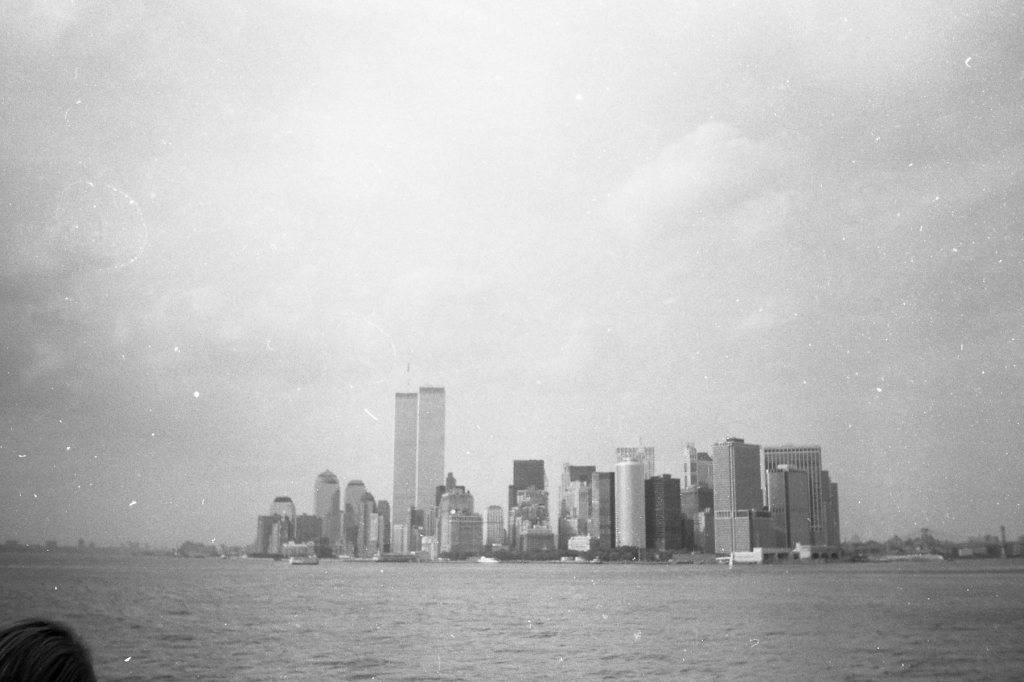
Moody black and white shot of Manhattan, 1994, by someone who had clearly seen Woody Allen’s Manhattan a few too many times.

Part one of this thrilling blog post here!

I had always wanted to live in New York City. I’d seen Woody Allen movies, I’d been addicted to Seinfeld, I’d watched Ghostbusters and King Kong and Do The Right Thing. 

But actually living in New York City was a wake-up call to a young Mississippi journalist. 

The internship at Billboard magazine was great fun, but living in New York City as a perpetually broke 22-year-old? It was a bit scary. I was put up at New York University dormitories in the East Village, as part of my internship. I was stuck in a utilitarian multi-bedroom apartment with a few other starry-eyed interns, although my actual roommate ended up being a friendly Black 40-something military veteran. I didn’t spend a lot of time in my room, really – there was too much to see and do. 

My late dad was very smart with how he taught his spendthrift son to spend money, although it took me years to realise this. He’d never let me starve to death, but neither would he give me an infinite line of credit to spend on books ’n’ CDs and delicious knishes.

So with the paltry paycheck from Billboard and a limited allowance from Dad, I got by. I ate an awful lot of Top Ramen and peanut butter some weeks, as my bank account regularly dropped to two figures. Truth be told, I couldn’t imagine how one could actually afford to live in the city without being a millionaire. 

Times Square, where I went to work each day, hadn’t been quite so gentrified then, and was a buzzing, sleazy place with wide-eyed tourists mingling with businessmen, hookers and panhandlers. Cheap trinket shops mixed with fancy Broadway theatres and bizarre shadowy tombs showing all kinds of porn. 

In those pre-digital, pre-streaming glory days, New York was a wonderful arcade of eccentric gritty book stores, record stores and junk shops. I discovered the amazing sprawling Strand Bookstore not a few blocks from my dorm room and fell in love in the intense way that only a really good used bookstore can make you feel. 

I spent a lot of time in the East Village, where a dirt-poor intern on his days off could just spend the days people-watching in Washington Square. I sat listening to a cassette of Elvis Costello’s Get Happy on my Walkman and reading a paperback of cheap Chekhov plays and imagining how cool I must be. Sitting on the edge of the fountain I’d see people of all races and colours and lifestyles washing by, a far cry from college in rural Mississippi. 

The city could be scary at times, but I was six foot two, able to fake an intimidating stare for strangers and knew enough not to take dumb chances. 

The author, far right, wearing what history would judge, poorly, as quite possibly the most incredibly 1990s bohemian outfit of all time – tie-dyed shirt, black vest and most likely cut-off jean shorts as well.

But I also had friends there – pals I’d made in the small press community I got to hang out with for the first time – jumpin’ Joe Meyer, trippy Tim Kelly, amicable Amy Frushour and several more who helped guide me around the crazy, confusing labyrinth of New York. We ate cheap Sbarro’s pizza and wandered the endlessly fascinating streets doing cheap things and visiting museums. I marvelled at the World Trade Center, not knowing it’d be gone in seven years. 

It was a summer that felt filled with weird coincidences. My oldest childhood friend happened to be touring the country post-college and we met up and climbed the Empire State Building together. On a busy random Manhattan street corner, I literally ran into an acquaintance from Mississippi. On a train heading upstate, the woman sitting next to me was a young writer I knew at Billboard.

I kick myself today over missing some things – never made it to the Statue of Liberty, never got to Harlem or Brooklyn, didn’t have the money to bounce to all the hip clubs and shows that were going on all around me. I was 22, and I didn’t know all the things I could have been doing. I’m sure I missed a lot. 

In hindsight, I wish that maybe I’d seen more and done more in my time in New York – not knowing that 30 years later, having moved to the other side of the world, I’d still never have returned there. Maybe I shouldn’t have bought so many dog-eared paperbacks at the Strand and bought so many CDs at St Mark’s Sounds. But heck, that was part of the experience, wasn’t it?

I was young and naive and the city was a playground of novelties. But it was also exhausting in a certain way, and after three months I longed for a little Mississippi calm and the sound of crickets on a humid Southern night. I didn’t become a seasoned, sarcastic Manhattanite like I’d imagined I might, but I had a taste of the city that never sleeps. That was enough, and 30 years on, unforgettable. 

Flashback 1994 – Life in New York City, part one: The internship

Somehow, 30 years ago this summer, I had my New York City adventure, a near-college graduate from Mississippi who ended up working at a major international magazine. 

In my last few months of university, I stumbled into an internship with Billboard magazine, the music industry bible. I’d been signed up for a “trade magazines” internship program and apparently the few awkward music reviews and pieces I’d slapped together as clippings was enough for me to get a three-month tour aboard one of the industry’s biggest magazines. (Later, I met other people who were part of the same trade internship who ended up at magazines with titles like Tractor Parts Weekly, and who were a bit jealous of my fumbling luck getting a “cool” internship.)

For a college boy from Mississippi, it felt like I’d dropped into another world. I had never been to New York City or even America’s East Coast, and suddenly I was tossed into a real Manhattan magazine office which was both more and less than I expected. It had the warren of cubicles like you’d see on TV and movies, the bustle of constant weekly deadlines, but while it was magical, it was also sometimes mundane and in the end, a place where people just worked. 

Each day I would put on presentable clothes (the tie and slacks, I discovered in the very first week, were a bit much) and take the subway from my dorm room at NYU up to Times Square, where I’d grab a New York Daily News and coffee and head up to the Billboard office. 

In 1994, the music industry was a very different place than it was in 2024. Sure, you still had hustlers and hopefuls all angling to make it big, but there was no Spotify, there was no social media. There was cold black ink on glossy magazine print worth its weight in gold to any musician. Billboard told the world what the number one song was, what the biggest selling album was. It mattered, in an age before media splintered into a million subsets. 

The CD was king, and it’s hard to explain now how these shiny disposable discs were valuable hard currency to music lovers for a while there. We’d get dozens of CDs a day from bands hoping for a line or two of print, and each day, dozens of them that the editors were either done with or never listened to at all would be “dumped” on a small “free” shelf right across from my cubicle. Like a dinner bell ringing, the “dump” would be accompanied by other office workers scurrying to the shelf from all over the building, scooping up the glorious free music, no matter what it was, hoping to find treasures. 

I ended up with several boxes full of CDs stamped with “promotional copy” on the front to ship back to Mississippi. That summer I discovered bands I would love for years to come – the surreal rock of Guided By Voices, the lonesome beauty of Freedy Johnston, the Britpop charms of Blur – along with dozens of other bands whose names I’d soon forget, whose CDs I’d eventually trade in for credit somewhere. 

I worked, briefly, with some music legends there who are now all gone, like the warm-hearted late Irv Lichtman, a true New Yorker to his bones, or Eric Boehlert, a genial young editor only a handful of years older than me who went on to become a fiery critic of online misinformation before his terribly early death in an accident in 2022. The Billboard editor-in-chief, Timothy White, was a bow-tied wearing blur who zipped past my desk several times a week. We exchanged maybe a dozen sentences but that was enough for a striving wanna-be journalist to soak up. He was hugely respected in the industry, but died suddenly of a heart attack at only 50 years old a few years later.

Billboard was full of kind and crusty journalists in equal measure – one of the editors never addressed me with anything more than a grunt, while another often took me out to lunch and once regaled me of tales of the interview he’d just had with Erasure’s Andy Bell that morning. One rain-soaked weekend half the staff went upstate to Woodstock ’94 and I vicariously took in all their madcap stories of this rather muddy fiasco the next week. I was an observer on the edge of it all, but it confirmed for me this weird, pressure-filled life of journalism was where I wanted to be. 

Please note my magnificently disheveled makeshift cubicle at 1515 Broadway, Times Square complete with prominent trash can and empty bag of bagels.

I lived the true intern’s life of being the office errand boy, in that pre-digital era – helping sort the massive sacks of mail of review CDs and books that were dumped out daily, answering phones, working in a tiny storeroom jammed with file cabinets to organise the horrifyingly cheesy band photos sent in by every would-be superstar in the land, and sometimes, getting to write short pieces.

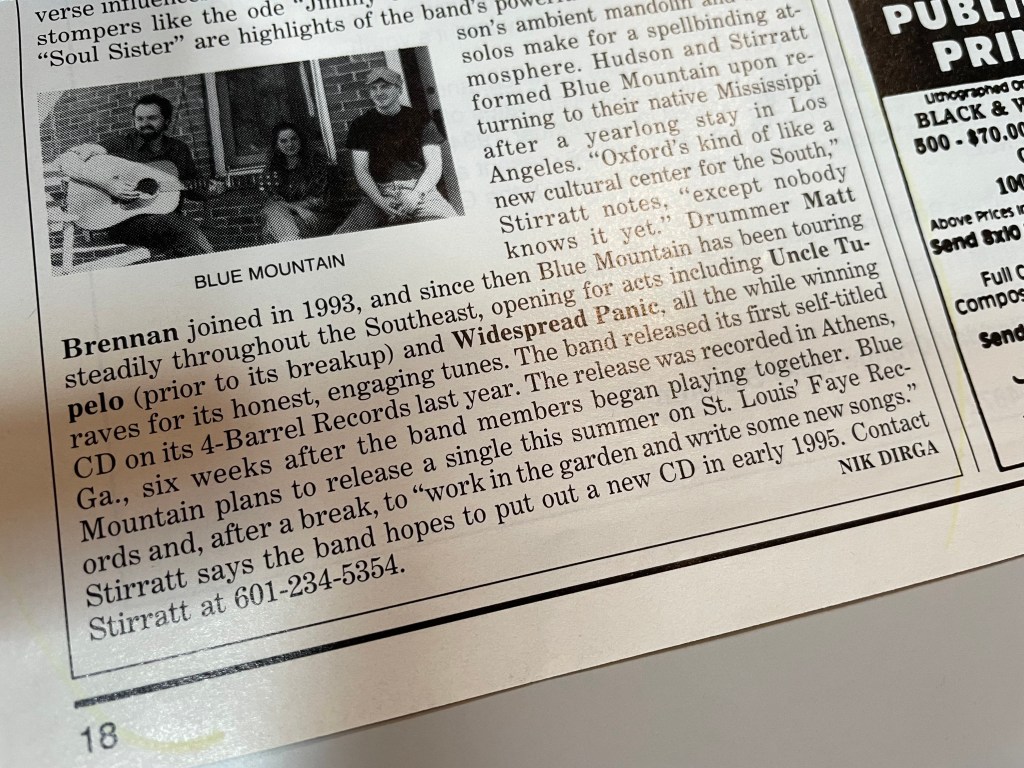
I had maybe 10 bylines in Billboard that summer, each one feeling hard-won. 

An article on Oxford, Mississippi band Blue Mountain was a Billboard highlight for me.

I was briefly, part, of a newsroom and a team, and all the years since then I’ve found myself drawn to that weird companionship of the news. It gets in you.

I never got a front-page scoop or anything. I was an accessory, a kid learning the ropes. One tangled industry piece I did ended up being rewritten so comprehensively that I think I recognised a dozen syllables as my work in the final product, but I took it all in – you were there to learn, after all, and the 22-year-old intern couldn’t afford to get angsty about credits. 

I did not end up staying and working in Manhattan – I had one semester of college to finish, and ended up getting hired by the local Mississippi paper that fall and working there for a few years before fleeing back to my native California and continuing my quixotic career.

Since the summer of ’94, I have never been back to New York City, and now live almost on the opposite side of the world. I’d like to go back, someday.

But it was enough to be there, for a summer in Manhattan, walking through Times Square every day eating a bagel and feeling like you were part of something greater. 

Next: Part two: Living in the city