
Richard Pryor and Gene Wilder are one of the great comic movie duos.
But the strange thing is, as much affection as I have for the Wilder/Pryor team, they never truly made a great movie together – instead, they typically livened up fair to mediocre material with their unmistakable chemistry.
It’s a funny thing – other comedy duos like Laurel and Hardy or Jack Lemmon and Walter Matthau paired for piles of movies, many of them classics, but Wilder and Pryor’s legacy is a paltry four films together – with, really, about 1.75 good movies among those.
Yet a lot of us comedy fans love them – Indicator has just put out a great lavish new box set of three of the Pryor-Wilder movies with the full boutique blu-ray treatment, usually reserved for cinematic masterpieces. Long after both men have died, the Pryor/Wilder team have a reputation that outshines their actual accomplishments on screen.
Maybe it’s because their pairings always felt sincere – they weren’t doing Abbott and Costello or Martin and Lewis-style “bits,” but Wilder and Pryor took their existing quirks and crashed them together, which at its best created something that felt intimate instead of staged. They were better than their material, and maybe that charm is why we still remember them even when few are calling their movies masterpieces.
1976’s Silver Streak is a movie I fell in love with after its countless TV screenings back in the day. A feisty homage to Alfred Hitchcock thrillers, it’s amusing fluff which abruptly changes gears more than halfway through its runtime when Richard Pryor pops up in the back seat of a cop car and quickly becomes a sidekick to Wilder’s mild-mannered writer caught up in a vast criminal plot.
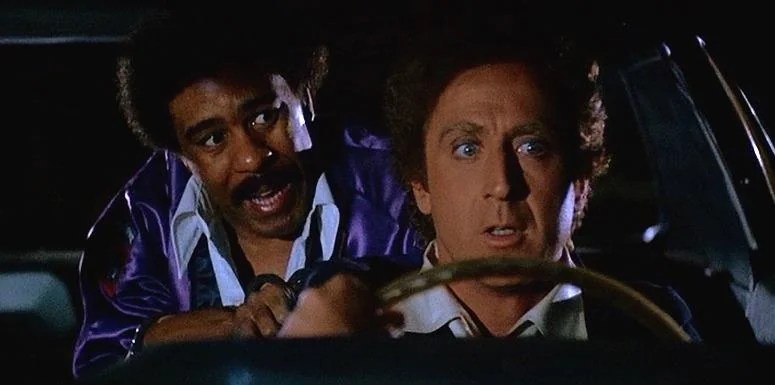
Sometimes movies don’t go how you would expect, and Pryor and Wilder had a seamless energy that immediately pushed all the plots of Silver Streak to one side. I dig Silver Streak in the way you still love any movie you adored as a kid, but it’s a bolted-together contraption that isn’t sure whether it’s a romance, comedy, action movie or a disaster movie with its blow-up-the-train climax.
Pryor loved to improvise and Wilder, to his credit, just went along with it, which gives their interactions a refreshingly candid feel. The rather dated scene where an on-the-lam Wilder goes full blackface with shoe polish to hide from police was tremendously improved by Pryor’s wry asides and Wilder’s child-like innocence. It’s a dumb scene, sure, but 10-year-old me thought it was hilarious and I still see it as making fun of white folks’ preconceptions as much as it relies on Black stereotypes. That one sequence launched the Pryor/Wilder career, and it came out of Pryor deciding to make the rather racist scene his own. Pryor adds an unpredictable feeling to his every scene in Silver Streak that knocks it out of its comedy thriller cliches.
Gene Wilder’s schtick was often men who appear soft-spoken and shy but who snap, hilariously, when the pressure comes on. Wilder could be unsettlingly calm and slightly menacing – see his terrific underplaying in Blazing Saddles, his unmistakable Willy Wonka – but in movies with Pryor he plays the gentle man with a manic side.
Their best film together is 1980’s Stir Crazy, where Wilder’s wide-eyed optimist and Pryor’s weary worrier end up wrongfully sent to prison. Like all their films, Stir Crazy is patchy – there’s wayyyyy too much prison rodeo subplot – but when Wilder and Pryor just riff off each other behind bars, it’s comedy heaven.
Pryor’s characters toyed with racial stereotypes – he’s usually a hustler or a con man, a cynic without any of Wilder’s naive optimism – but the Pryor/Wilder movies only occasionally made race their main focus. In Stir Crazy, the fact a black guy and a white guy are good pals isn’t anything special – it’s just the way it is.
I loved Silver Streak and Stir Crazy and watched them constantly as a kid, without ever really realising both Pryor and Wilder had already forged legendary careers of their own. Maybe that’s part of why their team still is so adored today despite a thin legacy together – nobody really thinks about Bud Abbott’s career before he met Costello, but Pryor and Wilder were already groundbreaking on their own before they paired up.
Still, their final two films were both box office misses and didn’t offer much new. 1989’s See No Evil, Hear No Evil has a dated concept that probably wouldn’t fly today – Pryor is a blind man, Wilder is a deaf man, with lots of wacky misunderstandings, and they get embroiled in a comic murder plot. While it’s a steep step down from Stir Crazy it’s absurdly funny at several points, until it meanders off into the dull murder storyline too much.
While their first three movies are flawed, 1991’s slapdash Another You is just generally a fiasco, with a nonsensical plot and both men showing their age. Poor Richard Pryor – barely 50 years old at the time – was thin and frail, showing the effects of his onset of multiple sclerosis, and while Wilder still summons up that great manic energy, he also feels a bit past his use-by date. You know your movie’s bad when it relies on a yodelling scene for laughs. The highlight is a candid little “farewell” moment by the two men at the movie’s end.
It’s kind of easy to look at Pryor/Wilder movies and lament their missed potential – poor scripts, needlessly complicated stories, too much of their work coming at the raggedy end of their careers. What could’ve been if instead of jamming them into belabored crime and action movie plots, they just riffed on their two very different characters? Imagine what they could’ve done with their versions of The Odd Couple or Planes, Trains and Automobiles, for instance.
Pryor would die at 65 in 2005, after spending his last several years as an invalid, while Wilder lived until 2016, but Another You was the final movie either men starred in, and a bit of a downer ending to their remarkable screen careers.
Pryor and Wilder weren’t particularly close in real life, which makes their unforced charm together on screen even more remarkable. Sometimes, a spark just happens. Comedy fans recognise the peculiar magic of the Pryor-Wilder combo and even if they didn’t leave the loftiest cinematic legacy behind, what they did leave behind in laughs is pure gold.


 Nik Dirga
I loved See No Evil, Hear No Evil as a kid, but yeah, probably not great to revisit now
LikeLike