Clippings: Collected Journalism 1994-2024: Free sample 5, the grand conclusion!

Here’s the final Clippings Mondays, as I promote my new book of collected journalism and scribblings all through March! I’d sure be obliged if you consider grabbing this hefty compendium of 30 years’ worth of journalism and heck, if you’ve got one, drop a review to help me go viral and become an influence. It’s now available on Amazon as a paperback for a mere US$14.99, or as an e-book download for just US$2.99

This one comes from a period of time when I wasn’t writing as much journalism and got lost in the labyrinthine mazes of management work. From the “Places” section of ‘Clippings,” I attempted to put down some words to capture one of the most remarkable holiday experiences I’ve ever had, and hopefully I got some of the feeling of what it was like to stand on top of a mountain with lava bouncing around your face!

Standing on the edge of a volcano

October 2014

As you climb up to the rim of a very active volcano, it’s hard not to feel a little bit like a human sacrifice in the making.

Vanuatu’s Mount Yasur is one of the scariest places I’ve ever been.

It’s one of the most accessible volcanos in the world, but it’s still not all that easy to get to Yasur. It’s located on one of Vanuatu’s southernmost islands, Tanna, meaning a jaunt on a small plane from the capital Port Vila and then another two to three hours of bumpy four-wheeling across jungle and ashy volcanic plains.

At 361m, Yasur towers over the low-lying Tanna plains. You see it long before you get there.

Many ni-Vanuatu live here in the shadow of the volcano – groups of teenagers idly walking in its vast shadow like they’re on a trip to the mall.

Climbing up some of New Zealand’s dormant or extinct volcanic cones, it’s easy to forget about the staggering power that they can have. Yasur won’t let you forget that for a moment, burbling and billowing like a bull chained.

The final walk up to the rim is humbling and eerie – you are able to basically get as close to the volcano as you want to, although nobody sane would venture past the rim edge around it. There are pretty much no safety precautions or ropes besides a sign saying “THINK SAFETY.”

It is impossible to capture in photos or even words really the experience of being up there.

The first thing that hits you is the sound, an endless chest-shaking booming and roaring.

My small group stood on the rim and watched the smoke rolling forth, punctuated by sudden and scary rolling booms and lava actually erupting out in “small” bursts. As darkness began to fall, the colour and mood of the volcano changed. Clouds of sulphuric smoke washed over us, the colour changed from a white to orangey glow out of the crater and we were favoured by a massive bang that filled the whole crater in front of us as we neared total darkness. We stood as night fell, on the edge of the infinite.

Tourists have been killed here by volcanic “bombs” of rock hurled into the air. These days close seismic monitoring keeps an eye on volcanic activities, with a scale of 0 (low activity) to 4 (run for your lives). Yasur was at Level 1 when I was there, and access to the crater is closed when it hits Level 2.
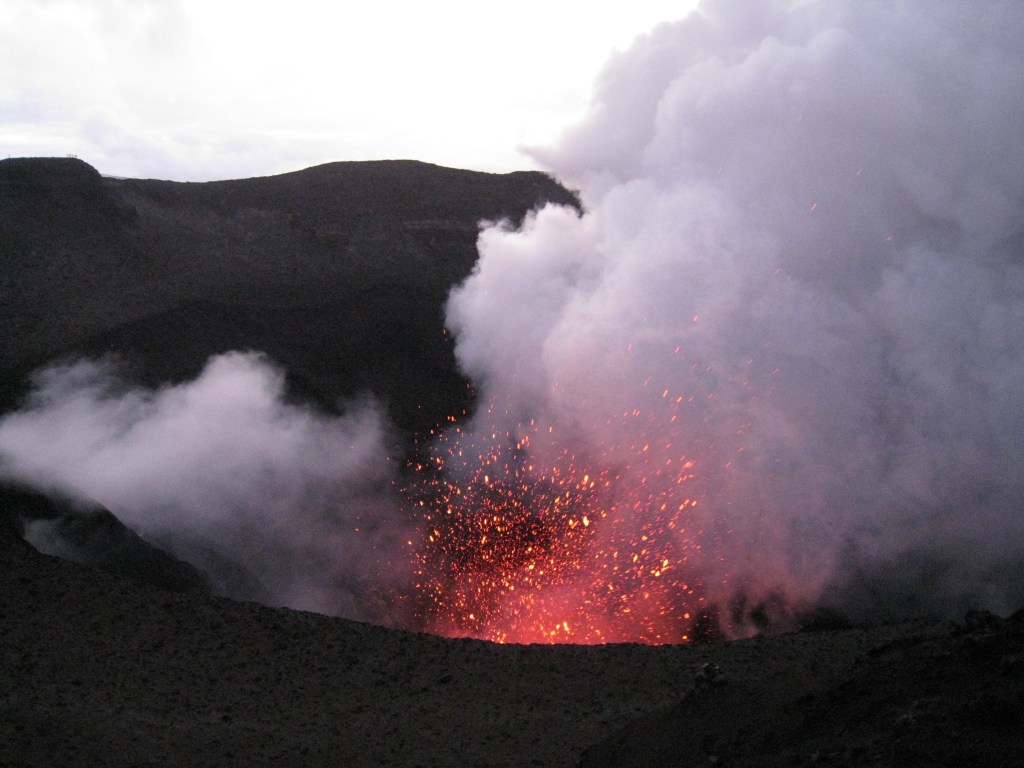
Watching the pretty scarlet rubies of molten rock tossed into the air like a Guy Fawkes’ fireworks show, it’s hard to imagine that a single piece of that red-hot debris would kill or cripple a person.

There was a bit of dark comedy in realising when darkness fell us that the half-dozen or so of us up there had no idea where the trail back to the ride in the parking lot was – despite flashlights, the trail wasn’t marked clearly enough to be that visible and it was very dark, with no light other than the volcano crater and a stray beam or two of light in the distance. We kind of gently ambled downwards (firmly away from the glowing crater, as that was the one direction we all knew not to go in), finally managing to find our main trail and the carpark again.

Think safety.

It was very easy to see how you could end up making a horrible mistake and getting lost for days up there. People have died at Yasur by making very bad choices.

There are few places where one can feel so small and so big at the same time than the lip of an active volcano on an island somewhere at the bottom of the world.

Read this piece of adventurous foolhardy behaviour and much more in my new book Clippings: Collected Journalism 1994-2024

My favourite Roger Corman – X: The Man With X-Ray Eyes

Soon, I’ll be able to see what no man has ever seen.” – Dr James Xavier 

When the great movie producer and director Roger Corman died last year at 98, he left one hell of a legacy for film lovers, schlock fans, drive-in movie buffs and anyone who enjoyed the dirt-cheap, hugely entertaining corn he specialised in.

Everyone has their favourite Corman – my first was the Star Wars/Seven Samurai ripoff Battle Beyond The Stars, which was repeated endlessly on cable TV when I was a kid. There’s the colourfully gory adaptations of Poe tales starring Vincent Price. His producing the first films by Martin Scorsese and Francis Ford Coppola. The sexy trashy Big Bad Mama starring Angie Dickinson. The Ramones trashing the joint in Rock ’n’ Roll High School. Peter Bogdanovich’s startlingly still relevant Targets with Boris Karloff. The utterly insane Judge Dredd meets Mad Max dystopia of Death Race 2000. So much more, much of it sexploitation and exploitation and just general titillation.

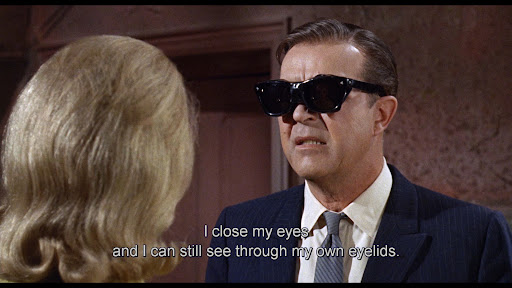
But my favourite film Corman directed has always been the more restrained and oddly haunting X: The Man With X-Ray Eyes from 1963, starring one-time Oscar winner Ray Milland as a scientist determined to break through the barriers of dull ordinary human vision and see… well, everything. 

It’s got a big fan in none other than Stephen King, who wrote about it in his book Danse Macabre as “one of the most interesting and offbeat little horror movies ever made.”

X is typical Corman with a low budget and ultra-basic stripped-down production values, but there’s something about it that grabs me. It’s got your typical scientist who is determined to explore the unknown whatever the cost, with Milland as Dr James Xavier, whose research into unknown spectrums of vision (“I’m blind to all but a tenth of the universe!”) has him experimenting on himself with dangerous eye drops.

At first, Xavier gets X-ray vision just like in the comics (yep, there’s a goofily fun nude scene, one of the movie’s few lighter moments), but then things get … darker. It involves accidental murder, a sequence as a carny attraction (featuring a rare early serious supporting role by Don Rickles, of all people) and Xavier’s vision gradually changing, with sunglasses and freaky contact lenses giving us a hint of what must be going on behind those eyelids. 

The “special effects” that allow us to see the world through Xavier’s eyes are mostly dime-store gimmicks and blurry psychedelic colours, and yet, their vagueness allows us to imagine what Xavier is actually seeing out there. 

Milland, always a sturdy authoritative presence in movies, gives X a helping of emotional depth as the movie explores questions of morality, religion and hope in its brisk 79 minutes. While Corman’s movies are often a lot of fun, this is the one that always leaves me thinking a bit. What would it be like to see truly everything out there? How much of the world do we miss on a daily basis? And is there some things man is not meant to see? 

Spoiler alert: X ends on a famously bleak note with Xavier, unable to control his increasingly chaotic visions, tearing out his own eyeballs in a shock-cut freeze frame. The story jerks to a halt, the screen frozen in a moment of utter infinite horror. 

King in Danse Macabre went on to claim there was a great lost coda to that scene: “I have heard rumours – they may or may not be true – that the final line of dialogue from the film was cut as too horrifying. …. According to the rumour, Milland screams: I can still see!” 

Now that’s terrifying. Although, nobody has ever really confirmed it existed. Corman himself on the DVD commentary thinks he might have shot that ending, but then again he might not. It’s a cool idea, but even without that lost final twist of the knife, X: The Man With X-Ray Eyes is worth seeing. There’s been talk over the 60 years or so since it came out of a remake, but the creepy and sparse tone of the original is hard to imagine beating. Even the cheapness of the special effects adds something to it all. 

It’s that whiff of cosmic, unknowable horror that makes X: The Man With X-Ray Eyes linger in my mind, I guess. There is no true villain here and there is no hero. Only a strangely pitiable mad scientist, determined to broaden his horizons until he realises much too late there is no end to these horizons. 

“I’ve come to tell you what I see. There are great darknesses. Farther than time itself. And beyond the darkness… a light that glows, changes… and in the center of the universe… the eye that sees us all.” – Dr James Xavier 

Meanwhile, elsewhere on the internet…

So it’s been ten years this month since Netflix streaming came to New Zealand, the tipping point that changed how we watch so-called “TV” forever down here at the bottom of the world. New by me over at Radio New Zealand, a look at how life’s changed in the streaming wave – go read here!

How a decade of Netflix has changed how we watch TV in New Zealand forever

Clippings: Collected Journalism 1994-2024: Free sample 4!

It’s Monday here in New Zealand and that means it’s time for Clippings Mondays, as I promote my new book of collected journalism and scribblings all through March! If you haven’t yet, now’s your chance to nab a copy, now available on Amazon as a paperback for a mere US$14.99, or as an e-book download for just US$2.99

This here essay is one of the oldest collected, from way back in 1994 and my days writing a column for The Daily Mississippian in my final year at university. I was still learning how to write columns that weren’t just rants or jokes, but were observations about the world around. Writing a good column is sometimes about just paying attention to what’s happening around you, in all its weird details. A chance meeting with one of my favourite writers, even if he wasn’t at his best, prompted this one:

Fear and Loathing in New Orleans

The Daily Mississippian, May 2, 1994

Well, I finally made it down to the Big Easy weekend before last. And what a wonderful town it was. Went down there with Melanie for the dreaded “meet-the-parents” ritual (which came off very well, thanks for asking).

We went to Jazzfest ‘94, an annual musical extravaganza at the New Orleans fairgrounds — tons of music, people, beer and booths hawking everything from dashikis to handmade jewelry to exotic knives. There was aural candy for any taste, from Boz Scaggs to Dr. John to Jimmy Buffett.

While wandering around the booths, Melanie and I found a little book tent. Exploring the place, I found a notice announcing some of the authors who’d be doing book signings at the tent that day. Among the names was the familiar one of Dr. Hunter S. Thompson.

The Doctor! Father of the esoteric, reviled and idolized field of Gonzo Journalism! One of my personal literary idols and a true crazy man to boot. I. convinced Melanie that it’d be a nifty thing to let me go and meet him, to get the Doc to sign a just-repurchased copy of Fear And Loathing In Las Vegas. I’ve always been a fan of Thompson’s bizarre anything-including-the- kitchen-sink style of reporting, the coverage of events ranging from the history of the Hell’s Angels to the 1972 presidential campaign — his style so out there that half the time you lose sight of the line between fact and fiction.

So we went to the booth about 2:45 or so for the 3 o’clock signing. There was already a sizeable line for this unpublicized event. Melanie took my camera and got a good spot in the shade while I met a burly gent named Gil who proclaimed that Thompson was “the king of all things Gonzo!”

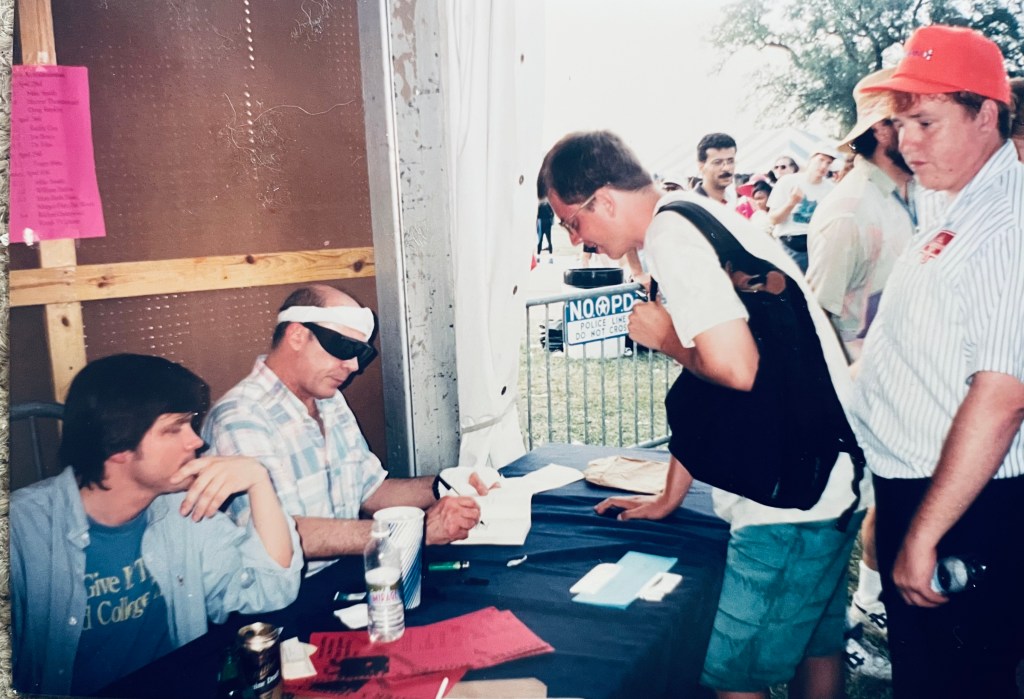
Melanie enjoyed the shade and met some Canadians while I listened to Gil hold an impromptu belching contest and slowly watched the sun burn me a nice shade of obsidian. Thompson finally showed around 4:30, large bandage wrapped around his left hand and a beer in his right. Enormous beetle-like sunglasses obscured his eyes completely. I crumbled into a pile of charcoal under the sun’s onslaught and the line inched forwards.

The author, centre, with a clearly unimpressed Dr Hunter S Thompson, 1994.

At this point, the Jimmy Buffett show was about to kick off. Thompson signed books at an agonizingly slow pace — rumor had it he was deeply distraught over Richard Nixon’s death that Friday. It seemed odd, that a man who once compared Nixon to Adolf Hitler should be so broken up over his death. His “periodic medical breaks” over his hand — treated by the administration of several strange vials of liquids — slowed things down even more.

There was the wit in line who called out, “Dr. Thompson! How do you feel about Nixon?”

Thompson answered in his trademark indecipherable mumble, “I loved the man.” And that was all he had to say on the subject.

I finally made it to the front of the line, several shades darker than I’d been at the start, and handed over my book for him to sign. In my best fanboy mode, I stammered out to him how much I enjoyed his work.

Thompson shook his head a bit spastically, and muttered something about “bats” and “gummo wedder t’day nahw eh?” He scribbled “to Nick [sic] – HST” with a ballpoint pen, and then immediately afterwards took another extended medical break. The smell of that joint was nearly overpowering.

There’s nothing quite like meeting your idols – if only to discover that they’re just as screwed up as the rest of us. I’m not saying I regretted meeting HST — in fact, I got a rather masochistic joy out of it, sunburn and all.

And Melanie, bless her, wasn’t terribly irate about spending two hours indulging her companion’s whims.

This sunburned piece and much more can be found in my new book Clippings: Collected Journalism 1994-2024
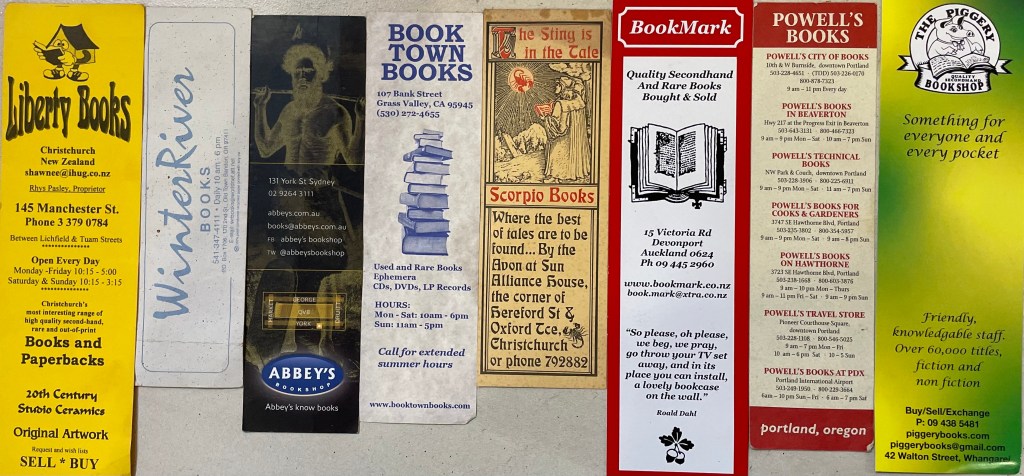
X marks the book: Bookmarks I have known 

I never really intended to start collecting bookmarks, but somehow I’ve accumulated quite a little stack of them over the years. After a while, you keep some things long enough, I guess they become sentimental by default.

So it is with bookmarks – for a long time, I’ve made a habit of grabbing a free bookmark if a book store offers them on the counter – and really, all the best bookstores do that, because what bibliophile can resist a nifty little souvenir to jam into their freshly opened tomes? 

From Alaska to New York to Oregon to Auckland to Australia, I’ve ended up with quite the burgeoning pile of bookmarks now, even though I know I may never use some of them for their intended purpose. 

But they keep me company – and remind me of book memories, which are some of the best kinds of memories to have.

I keep almost all the bookstores of my life in my mind and have written about them before. Whether it’s familiar neighbourhood haunts or world-famous icons, they stick in my mind: The nameless bookstore somewhere in Montana I stopped at during a cross-country trip where I could barely afford petrol, but of course I bought a few books. The cheap paperback exchange in Oakdale, California that kept me alive that 8 months or so I worked in the most boring town I’ve ever lived in. The cavernous, overstuffed and cobwebby Book Barn south of Christchurch or the hip oasis of City Lights in San Francisco.

Book stores I was just passing through like ones in Bandon, Oregon; Alice Springs, Australia; Christchurch, New Zealand; Fairbanks, Alaska. If you visit a town and don’t try to check out the best local bookstore, are you even a tourist?

Sometimes I can still remember what I bought at them – I know I picked up a William Randolph Hearst biography at the Alaska one, 25 or so years ago, although I often cannot remember what I had for breakfast today. 

The bookmarks I have remind me of spots like immortal Powells Books in Portland Oregon, still probably the best book store on the planet. I have dreams about it to this day.

Quirky ones like a souvenir of a great Salvador Dali art show in Melbourne, or a gift from an appearance by the Dalai Lama in Auckland I somehow ended up at. 

Tokens of long gone stores I used to visit like Black and White Books in Reno or the fine art book speciality shop Parsons in Auckland or Jason Books in Auckland, the last one just shuttered in the last few months. 

They’re just flimsy scraps of paper, mostly, some getting battered enough that I should retire them into a drawer so they don’t crumble to bits entirely. 

But they’re part of my life in books, and that’s not a bad thing to keep hold of. 

Clippings: Collected Journalism 1994-2024 – Free sample 3!

Hey, it’s your weekly reminder I’ve got a new book out! For the release of my new collection of the so-called ‘best’ of 30 years of journalismClippings, every Monday in March I’m spotlighting one of the more than 100 pieces by me gathered up in this hefty tome. I hope you’ll consider grabbing a copy, now available on Amazon as a paperback for a mere US$14.99, or as an e-book download for just US$2.99

This one actually comes from right here on this here website back in the long-ago days of 2021. It’s a sample of the ‘Criticism’ section of the book which gathers up piles of pop culture ruminations I’ve done over the years. Inexplicably, this post about Yoko Ono remains one of the most popular I’ve ever done. I’d flatter myself it’s about the quality of my prose, but more likely because I put Yoko Ono and ‘sorry’ in the headline and it’s hitting some Google sweet spot. Sorry, Yoko haters, but this isn’t a piece about Yoko Ono being sorry she broke up the Beatles!

Why I’m sorry I ever laughed at Yoko Ono

Read it right here!

You’ll find this piece and far, far more collecting 30 years of journalism in my new book Clippings: Collected Journalism 1994-2024. Order it today, baby needs a new pair of shoes!

Clippings: Collected Journalism 1994-2024 – Free sample 2!
In celebration of my new collection of the so-called ‘best’ of 30 years of journalismClippings, each Monday in March I’m spotlighting one of the more than 100 pieces by me gathered up in this hefty tome. I hope you’ll consider grabbing a copy, now available on Amazon as a paperback for a mere US$14.99, or as an e-book download for just US$2.99

I randomly divided this collection up by themes – Profiles, Places, Criticism and the like, and then there was a random selection of more goofy pieces I figured I’d just file under “humour.” This recollection of my very first job in journalism written while I was working at Lake Tahoe is, as best as I can recall, almost entirely true.

Scenes from the route

North Shore Truckee ACTION, September 2, 1998

I have edited newspapers and I have written for newspapers, but my first “real” job in this world was to deliver them.

I was a squirrelly, zit-faced and longhaired 13 going on 14, and I did it for about a year, delivering the Grass Valley Union from door to door in a square mile area several blocks from my home.

The Union is an afternoon paper, and so each day after school I would return home to find a bundle of Unions in our driveway, tightly bound. After an afternoon snack I would kneel busily on our dark garage’s concrete floor, taking my fifty or so papers and wrapping them with rubber bands. If it rained, you had to put them in orange plastic bags first.

The rubber bands sometimes snap if you rush things, and they twang off about the room spastically. Once one smacked me right in the cheek, raising a really embarrassing welt.

Your fingertips become black with ink as the headlines leave a bit of themselves on your skin. The day’s happenings are compressed into a small, dense cylinder of pulp that you lift and hurl repeatedly, trying to achieve a passable imitation of grace with each throw.

It was then, likely, that I began to stumble down the career path I follow tenaciously to this day. I was immersed in the smell of the hot paper, sometimes still steaming with the heat of the press, fascinated with the way the ink can cling to you.

I would ride down my route on my battered yellow bike, the newspaper bag carefully balanced on the handlebars, getting lighter with each block.

It was my first real job, and no one forgets the way that is – the strange freedom I felt riding my bike in the late afternoon on days that always seem cloudy in hindsight, the wind rustling the newspapers in my bag. I delivered news of President Reagan and “Peanuts” cartoons and what was on sale at Lucky’s, and I felt a part of some great system that pulsed beneath my 13- year-old world, a system I was just then beginning to perceive dimly.

I delivered newspapers and took inventory of my customers, the yards with plastic toys and broken bicycles in them, the houses with immaculate hedges and shrubbery whose porches I always aimed for with care.

The most difficult part of being a Union paperboy was collection time. At the end of each month I would go door to door on my route, getting $5.50 per customer per month to ensure they kept receiving their daily dose of news.

Portrait of a young hustler, mid-1980s

It was here you begin to encounter the world beyond lifting and hurling newspapers, and these days I’d dread somewhat. Demanding money from strangers was intimidating – looking briefly inside the anonymous homes I threw papers at, the couches where they read their Union each day.

I rapidly began to learn the language of excuses and rationale used so well in the grownup world.

“I paid you last month, boy, what are you tryin’ to pull?” one beefy guy who always wore too-small t-shirts would say to me every time I came by. And every time I would explain to him that he had to pay every month, he would mutter about what a rip-off it was, and he would finally pull five greasy dollars and fifty cents out of his pocket.

I learned how people wheel and deal, and I learned how people live without luck.

There was a cat woman. Every town has the cat woman, the twisted old lady who lives in a shack with a hundred stray cats. This woman’s house was crumbling and rotten, about to slide down an embankment onto the freeway overpass below. She had no teeth and no hair, and always wore a filthy Oakland A’s baseball cap. She would never have her $5.50 at the end of the month, and would gummily offer me excuses as ten of her bedraggled cats meowed and hissed around her legs. The cat lady had only one eye.

The cat woman would occasionally leave a folded dollar bill for me in her mailbox, toward paying off her slowly rising newspaper debt. I did not know what she did with her Union each day, if she read it or merely used it to line her floors inside what was surely one giant litter box.

And then there was “the towel lady,” as she would be enshrined forever in my pubescent memory. Each and every month when I would come by to get my $5.50, this highly attractive young lady, in her mid-twenties or so I’d imagine, would answer the door wearing a pink towel.

Just a pink towel.

You can imagine the fireworks this would set off in your typical 13- year-old paperboy.

Each month this woman would come to the door wearing just her towel, and she would give me my five-fifty and smile and I would melt into a giddy puddle of goo right on her doorstep.

I never could figure it out. If the towel lady wore just a towel once, I’d understand – she just got out of the shower or something, right? But each month, November or May or August, the towel lady would answer the door in her towel, and I would mature just a little bit faster.

The towel lady probably kept me doing the paper route a few months longer than I would have done – I was entering high school soon, and paper routes seemed too grade-school for my elitist brain then.

But I labored on with the route a few months into my freshman year of high school, always looking hopefully forward to my monthly visit to the towel lady.

The odds of gravity and physics were with me, I knew. That towel had to fall off eventually.

It never did, of course, except in my dreams.

This ink-stained confession and much more can be found in my new book Clippings: Collected Journalism 1994-2024
Ten great underrated Gene Hackman movies 

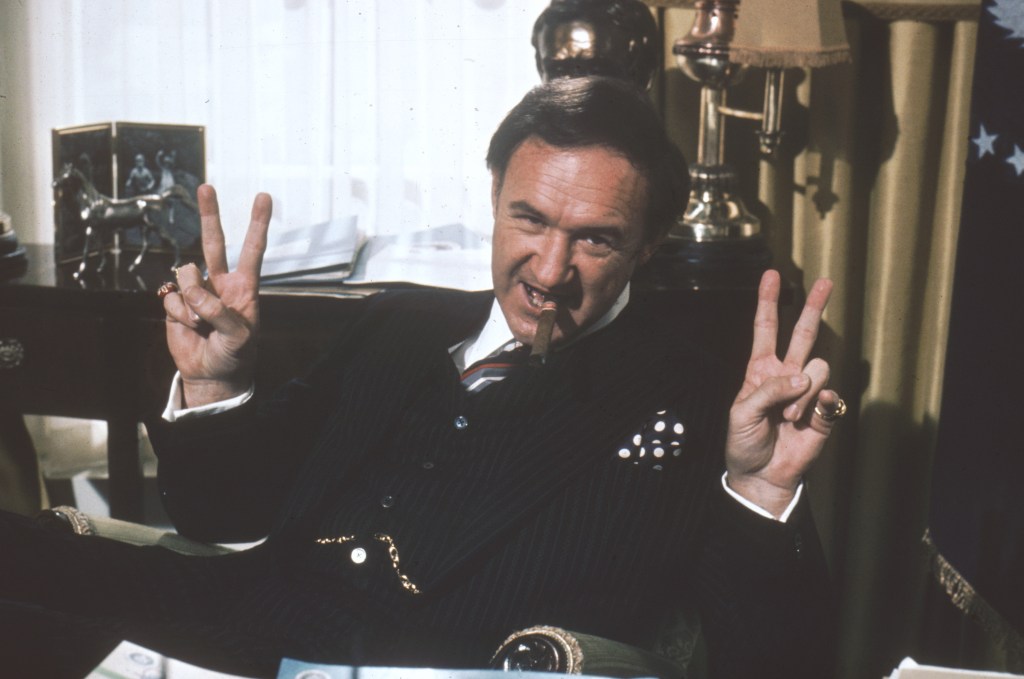
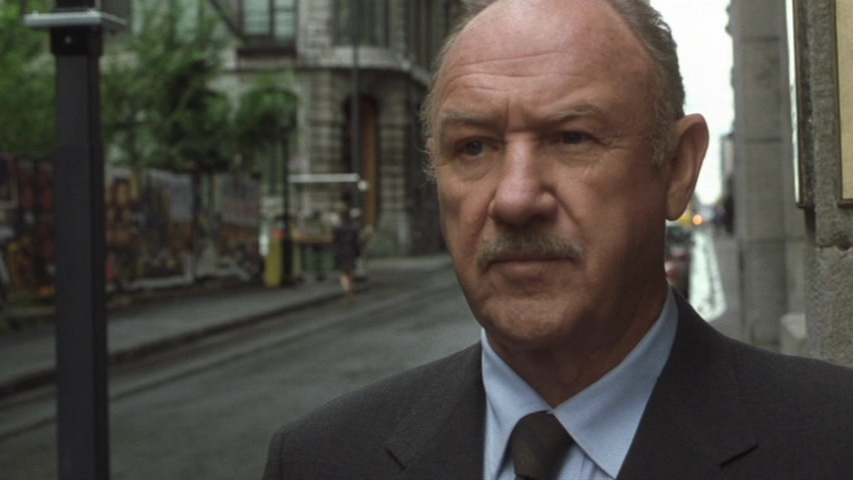
If I had a nickel for every time I saw Gene Hackman called an “everyman” in the past week or so, I’d be rich. But Hackman – easily one of my top half-dozen or so favourite actors – was no everyman, really. He was less instantly dazzling than a golden god like Robert Redford or Warren Beatty perhaps, but he was magnetic nevertheless. He packed a quiet authority into every performance while keeping his characters relatable and real. He could play thieves, cops, cowboys and con men, and the only thing ‘everyman’ to me about his acting was his sheer versatility. 

It’s sad that the dramatic circumstances of his and his wife’s deaths kicked off the kind of tabloid frenzy that you know Hackman would’ve hated. Gene Hackman is gone at 95. It’s the work that remains, and endures. 

Obituaries were quick to mention all the unmistakable masterpieces he was involved with – The French Connection, Bonnie and Clyde, The Conversation, Unforgiven, The Royal Tenenbaums. But Hackman’s long career is full of gems.

He was the kind of actor who kicked even the most mediocre of movies up a notch through his presence. Since the news of his death broke, rather than wallowing in morbid details of his death, I’ve been celebrating Hackman’s life on screen. Here’s 10 of my favourite somewhat underrated Gene Hackman films well worth seeking out: 

I Never Sang For My Father (1970) – Hackman received an Oscar nomination for this melodrama about a troubled son trying to connect to his difficult father, and it’s one of his finest roles, but nearly forgotten today (I blame the kind of terrible title). This one digs into complicated relationships with aging parents with a kind of brutal honesty that’s still pretty stunning today. Playing a repressed and conflicted ordinary joe, Hackman shows how much he can do with just his eyes and furrowed brow. 

Prime Cut (1972) – This bitterly black and mean piece of farm noir stars Lee Marvin as a grim mob fixer and Hackman as a sleazy Kansas cattle rancher who also dabbles in sex slavery and gruesome murders. Despite his kind of limited screen time, Hackman’s grinningly amoral slimeball is a nasty delight – “Cow flesh, girl flesh … all the same to me.” 

The Poseidon Adventure (1972) – Titanic without all the sappy romance nonsense, this rip-roaring disaster epic was a huge hit back in the day, and a big part of that is thanks to Hackman in a firm leading man action hero role – as an iconoclastic free-thinking priest, of all things. It doesn’t get mentioned in the same league as grittier stuff like The French Connection, but it’s anchored by Hickman’s charisma and prickly guts. Big and bold fun, it’s corny and yet riveting 50-plus years later, and it’s impossible not to cheer for Hackman as he single-handedly tries to save the survivors on a quickly sinking cruise ship. 

Scarecrow (1973) – The only movie that paired acting legends Al Pacino and Hackman, as two wandering vagabonds making their way from California to the East Coast. Hackman’s gruff and sullen character pairs well with Pacino’s fidgety, chatty loser, as what starts off as an odd couple buddy comedy turns into a heartbreaking little gem about failure and optimism. 

The French Connection II (1975) – Somewhat overshadowed by its Oscar-winning predecessor, this sequel takes Hackman’s brute cop Popeye Doyle down into the abyss. It picks right up from the first movie with an obsessed Doyle travelling to France to track down the drug dealer who got away. Cannily undermining sequel expectations, it features a long, riveting sequence where Doyle is captured and addicted to heroin. Like the first, it’s a kind of anti-cop story that lingers in the brain. 

Night Moves (1975) – I love me some “sweaty noir,” and this steamy Florida mystery delivers sex, death and malice in equal measures. Hackman is a hapless private detective who gets wrapped up in a missing persons case that slowly submerges his entire life. A movie that’s soaked with a sense of anxiety and despair all the way through, somewhat forgotten but now getting its due

Superman II (1980) – I’m pretty sure the first time I ever saw Gene Hackman on screen was his oily, confident turn as Lex Luthor. He’s great in the first movie, too, but for me, Superman II will always be my favourite, as Luthor sidles on in about halfway through and tries to play both sides in Superman’s battle against Zod. The scene where Luthor swaggers on into the Daily Planet and attempts to charm three insanely powerful alien psychopaths through sheer force of will is peak Hackman to me. “Kill me? Lex Luthor? Extinguish the greatest criminal flame of our age?” It’s easy to dismiss his Luthor as a work-for-hire gig (especially when you look at the woeful Superman IV) but there’s frequently a sparkle in Hackman’s eye that shows how much fun he was having. 

BAT-21 (1988): Hackman, a former Marine himself, played lots of military men. He shines here as a cerebral Air Force navigator shot down in Vietnam and trying to stay alive. This one got kind of lost in the flood of Vietnam movies of the late ’80s like Platoon, but is worth revisiting. His hero is no Rambo – he’s a desk jockey trying to stay alive who’s never actually experienced war up close – and Hackman’s thoughtful, restrained performance gives it more depth than your usual gung-ho war picture. 

The Quick And The Dead (1995): Sam Raimi’s delightfully campy western boasts a murderer’s row of talent – Leonardo DiCaprio, Russell Crowe, Sharon Stone – but Hackman’s smiling psychopath John Herod is a scenery-chewing delight, a brasher and wilder take on his Oscar-winning Unforgiven killer. 

Heist (2001): Hackman was surely made to rattle off David Mamet’s whip-smart dialogue, and in one of his last films before retiring, he’s perfect as an ageing thief looking to make one last score. While its tangled heist plot is an echo of many other movies, it’s just a pleasure to watch Hackman and a motley crew of great actors doing crimes and cracking wise. 

Thanks for the movies, Gene. You were no everyman to me.

Clippings: Collected Journalism 1994-2024 – Free sample 1!

Hey, did I tell you I made a book? But did I tell you ten times yet?

In celebration of my new collection of the so-called ‘best’ of 30 years of journalism, Clippings, each Monday throughout March I’ll spotlight one of the more than 100 essays in this hefty tome. I hope you’ll consider grabbing a copy, now available on Amazon as a paperback for a mere US$14.99, or as an e-book download for just US$2.99

It was interesting combing through piles of yellowing clippings and old computer files and trying to figure out what to include in a survey of my so-called career. But this profile from when I worked in Oregon circa 2002-2006 was a definite. As a kid, I always wanted to be a zookeeper, until one day I realised that would involve a lot of blood and animal feces. But getting to shadow an actual wildlife park vet around for a day was pretty darned cool, and one of my favourite job assignments. 

The zebra veterinarian 

The Roseburg, Oregon News-Review, May 2002 

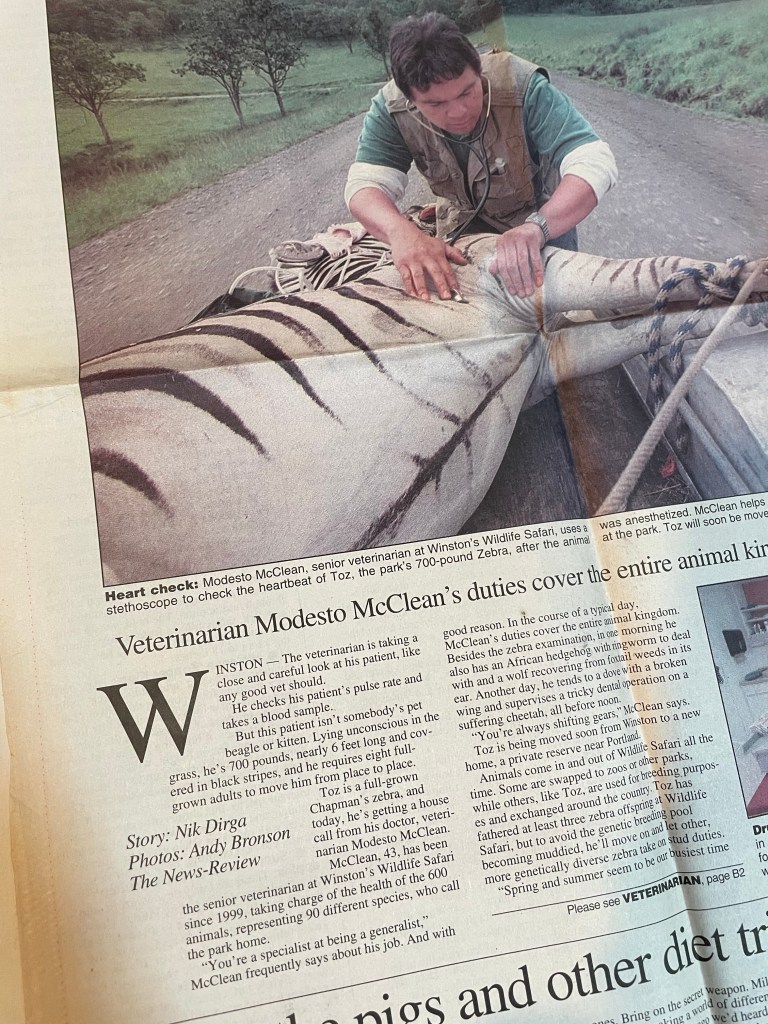
WINSTON, Oregon — The veterinarian is taking a close and careful look at his patient, like any good vet should. 

He checks his patient’s pulse rate and takes a blood sample. 

But this patient isn’t somebody’s pet beagle or kitten. Lying unconscious in the grass, he’s 700 pounds, nearly 6 feet long and covered in black stripes, and he requires eight full-grown adults to move him from place to place. 

Toz is a full-grown Chapman’s zebra, and today, he’s getting a house call from his doctor, veterinarian Modesto McClean. 

McClean, 43, has been the senior veterinarian at Winston’s Wildlife Safari since 1999, taking charge of the health of 600 animals — representing 90 different species — who call the park home. 

“You’re a specialist at being a generalist,” McClean frequently says about his job. 

And with good reason. 

In the course of a typical day, McClean’s duties cover the entire animal kingdom. Besides the zebra examination, on this morning he also has an African hedgehog with ringworm to deal with and a wolf recovering from foxtail weeds in its ear. Another day, he tends to a dove with a broken wing and supervises a tricky dental operation on a suffering cheetah, all before noon. 

“You’re always shifting gears,” McClean says. 

Toz is being moved soon from Winston to a new home, a private reserve near Portland. 

Animals come in and out of Wildlife Safari all the time. Some are swapped to zoos or other parks, while others, like Toz, are used for breeding purposes and exchanged around the country. Toz has fathered at least three zebra offspring at Wildlife Safari, but to avoid the genetic breeding pool becoming muddied, he’ll move on and let other, more genetically diverse zebra take on stud duties. 

“Spring and summer seem to be our busiest time (for moves),” said Deb Ryan, Wildlife Safari’s assistant curator. “Within the next month we’ll probably move 10 animals out, and probably move five to eight in.” 

Toz has to be examined for his health and for a lingering lame leg prior to the move. Bringing the zebra in for an examination isn’t as simple as putting him into a pet carrier. Most wild animals must be sedated before they can be safely examined or treated. 

“The toughest part of zoo medicine is the anesthesia,” McClean said. 

“Zebras are very aggressive,” Ryan added. A variety of drugs are used as tranquilizers, some of which are highly dangerous if not handled carefully. 

“A few drops more and I’m going to kill the animal,” McClean notes as he carefully mixes the solutions together into a dart. It takes a steady hand when dealing with the drugs. They can be administered with a dart pistol, a blowgun or an air gun, depending on the size of the animal and the thickness of their hide. 

A zebra has tough skin — “I say zebras are like horses on steroids,” said McClean — so a rifle is used to administer the knockout punch today. 

Every animal must be handled differently, McClean says. Originally from Southern California, his career has taken him to treat animals he might never have imagined he would. He’s worked with dolphins and chimpanzees, and even anesthetized a towering giraffe — “probably the hardest anesthesia in all of medicine,” he says. 

McClean first came to Wildlife Safari in 1995, where he trained under the previous park veterinarian. He was educated at California Polytechnic State University in San Luis Obispo and Oklahoma State in veterinary medicine, and also served an internship in primate medicine and surgery at Yale University. 

He has also consulted in private veterinary practice for several years. McClean came back to Wildlife Safari in 1999 when he became the park’s senior veterinarian. 

Because the animals mostly roam free at Wildlife Safari, McClean and park keepers have become experts at what they call “binocular diagnosis,” where they carefully observe the animals to detect any sign of a possible medical problem. 

“I don’t have time to go every day to check every animal, so I rely on the keepers too,” McClean says. 

Toz the zebra has been moved out of the park’s general population into a small, half-acre enclosure to prepare him for his move. It also makes it easier for him to be drugged, because Wildlife Safari staff won’t have to chase him down. 

“Some people think hoof stock aren’t all that smart, but they know what a gun is,” McClean says as he watches Toz nervously gallop away from him. 

The doctor raises the rifle, takes careful aim at the retreating zebra, and fires the dart, which brings him to the ground in under five minutes. 

Once McClean is sure he’s fully unconscious, the staff gets to work, popping in an intravenous tube dispensing solution, as well as injections of atropine to keep his heart rate up. A monitor is hooked up to his tongue to check his vital functions, and an oxygen tube is placed in his nostrils. McClean checks out the zebra’s leg, which has been treated previously for weak tendons, and finds that his hoof is suffering some obstructions which he removes. 

While Toz is out, a pint of blood is also taken from him. The blood will be checked and then frozen, kept in store for possible transfusions. 

“This blood someday will save another small zebra,” McClean said. 

Any small checkups that can be done on the zebra are also taken care of. One park employee uses a tool belt set of pliers to scrape a buildup of tartar off the zebra’s large teeth, each the size of a man’s thumb. 

It takes eight park employees to transport the drugged Toz onto an open trailer for his move across the park. He is lifted onto a rubber mat, as one employee holds his IV and McClean monitors his vital signs. Toz is taken to a holding stall where he will live and be watched closely for a few weeks before his trip to Portland. 

The entire procedure, from the dart being fired to Toz waking up in his new quarters, has taken just under an hour. 

“I’m going to rate it as for a zebra, an excellent anesthesia,” McClean says. 

The rest of this delightful yarn and much more can be found in my new book Clippings: Collected Journalism 1994-2024