How I became a journalist who doesn’t drink coffee

Coffee and journalism generally go together like fish and chips. But somehow, I’m slowly becoming a journalist who doesn’t drink coffee.

Not to get all medical on you, but I’ve had irritating recurring problems with Laryngopharyngeal Reflux or LPR the past year or so, and it’s been increasingly obvious to this middle-aged git that I need to reconsider things I used to eat or drink without even thinking about it. 

Troubling things like raw tomatoes or bacon have slowly slid from my diet, but I was reluctant to give up coffee because it was a habit, and we love our habits. But back in January I made the call to give up coffee and see how I did.

It hasn’t erased the problem, which is irritatingly random at times, but it’s definitely made a little bit of a difference. 

The surprising thing for me is that I haven’t really even missed the actual drink all that much. I had expected coffee having been a regular part of this journo’s diet since about 1990 or so would be like oxygen or sunshine, something I’d wither up and die without. 

But instead, I’ve discovered that I rather enjoy green tea for a caffeine hit, or a can of my once-beloved Pepsi a couple times a week (which also isn’t great for me, admittedly). I have had mornings where the foggy whispering in my brain takes quite a while to recede, but I’ve had other mornings where I felt fairly human from the start. And it’s definitely helped my throat issues.  

I know coffee is a fetish in this problem-plagued world, but the abstinence has made me realise I didn’t really crave the coffee itself. Perhaps it’s because I’ve had more than my share of truly awful coffee – most of the newsrooms in America I worked in over the years specialised in grimy coffee machines exuding a watery brown gruel that probably led to the gradual erosion of my esophagus decades later. Newsrooms, at least in the bad old days, had horrible coffee. Despite that, I used to suck down three, four, five cups a day but for a long time now my max had been two cups, tops.

And of course, if something you’re used to starts to make you feel like garbage, it can take a while to break the habit, but in the end, I didn’t love coffee enough to put up with everything else that came with it for me. 

When I’ve had a truly good coffee, I appreciate the skill that goes into it, but in retrospect, I guess I’ve never really fallen in love with it – more than anything I just liked the caffeine jolt. (I have literally never understood the reason for the existence of decaffeinated coffee. What’s the point?)

I stopped my daily coffee in January and dipped briefly back in a few weeks ago just to see if it really was problematic for me. Both mornings my throat swelled up to the point where I started to wonder if I was actually allergic to the blessed bean now. I don’t think I am, but it was enough to make me think I’d stick to tea, like a good New Zealander, for the duration. 

I can still do journalism without coffee, it turns out – case in point the rather frantic events of Easter Monday when I was running the Radio New Zealand website and about an hour before the scheduled end of my shift, Pope Francis died. Once upon a time I would’ve grabbed a few cups or cracked open some Pepsi to get through it all, but instead I let the adrenaline breaking news buzz – still the best pick-me-up there ever was – carry me through.

We pick up lots of habits in life and then you hit the point where you have to start to give up these habits to ensure an easier go of things. I don’t think I miss my morning cup all that much, but I guess I miss the idea of it. But I’ll get used to it.

Watching Robocop with my Dad

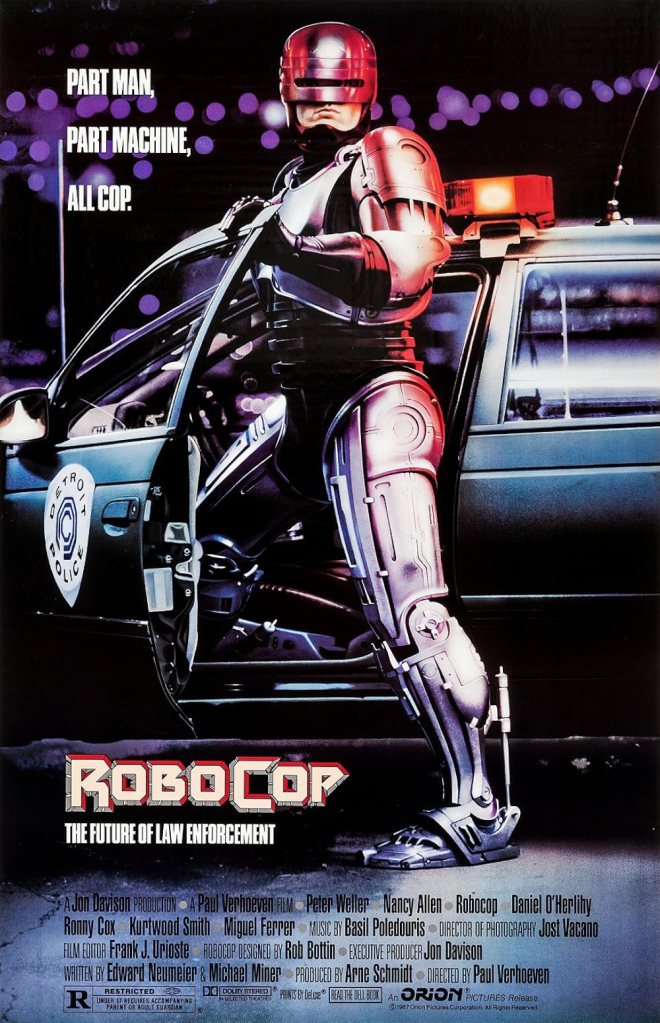
The very first R-rated movie I ever saw in a theatre was Robocop, with my Dad and a buddy. 

It was a pretty full-on choice – Robocop goes hard and never stops, but it’s also one of the most brilliant and satirical action movies of the 1980s. Of course, I didn’t have much cinematic expertise then, at the age of 15 or so. We just saw the poster and TV commercials for this heavy-metal policeman and thought, that looks awesome!

Getting into your first R-rated movie as a teenager was a moment. My pal Nate and I tried, on our own, but were embarrassingly turned down by a snarky cashier only a few years older than us when we tried to see Eddie Murphy’s Coming To America

So when it came to Robocop, we somehow talked my Dad into taking us.

Well over 35 years ago now, I can remember cringing a little over the explosion of profanity and violence that pepper Robocop with my Dad sitting next to me. The opening half hour or so, as eager cop Murphy is brutally mown down in torturous detail by cackling psychopaths, is hardcore to watch even today. 

My dad was a good-hearted, church-going and genial guy whose tastes I think ran a little more to Roger Moore James Bond and Tom Clancy books, not splattery sci-fi like Robocop, but he took me anyway. I don’t know quite what he thought as Clarence Boddicker spat invective and people died in inventively bloody ways, but I don’t think he hated it. 

Dad’s been gone nearly a year now, and of course I think about him all the time. 

I re-watched all three Robocop movies recently in a bit of a binge (The very goofy and violent Robocop 2 and the kid-friendly Robocop 3, which I’d actually never even seen, are serious steps down from the flawless polished gleam of the original, of course, but they do have their moments). 

And as memory does, it floats around in your head unasked, and I kept straining to recall that long, long ago afternoon in a movie theatre in ’80s small-town California, watching Robocop with my Dad. It was a very small moment of my time with him over more than 50 years, I know. 

I honestly can’t remember much at all other than how cool Robocop was, but I guess that’s not important. I remember my Dad was there for me, and even if he perhaps quietly thought Robocop was a bit much for his nerdy 15-year-old son, he was pretty cool, too. 

Why I kind of want to live in a western movie town

I’ve been on a Sergio Leone kick lately, watching Clint Eastwood and Henry Fonda stalk impassively through vast open landscapes and ramshackle settlements. Sure, the action is great, the iconic soundtracks slap and even in this highly dubious time in American history, the mythic weight of the western is still strong.

…But half the time I watch westerns, I keep looking at the houses and what it’d be like to live in those sun-bleached outposts, 150 or so years ago now. I study the clattery wooden sidewalks, the creaky balconies dotting the streets (the better for a guy to be shot and fall out of, of course), the home-spun yet vaguely desperate vibe of those infinite saloons poised for violence. 

It’s an odd fixation to have, but as I’ve written before, I grew up in a once-upon-a-time western Gold Rush town, after all, and I think perhaps some part of me is tinged with vague nostalgia for the imagined west I never really saw.

I watch Clint Eastwood and Lee Van Cleef face off in a battle of flinty egos but I also think, gosh, I like the way the grain of the wood sticks out on that old blacksmith in the background, I wonder who’s living behind the faint lights in the windows, I admire the lonely architecture of all those balconies and horse railings, the forlorn ‘Hotel’ sign swinging in the western skies.

Heck, I know half these movies weren’t even made in America or were filmed on studio lots, but it’s the idea that counts.

Of course there’s all the cultural and colonial baggage of America’s settlement to reckon with, and I’d say at least 75 percent of movie westerns are just vaguely one-dimensional frothy cowboys ’n’ indians soap operas. But the ones that aren’t – the Leone, The Searchers or The Wild Bunch or Tombstone or Unforgiven or McCabe and Mrs Miller – they get at the contradictory and violent bloody heart of a nation. The best westerns tell us what America really is, not what it pretends to be. And those long lonesome dirt road main drags lined with hotels and bars and barbers and perhaps a jail or two always evoke a weird yearning in me. 

During my years in America I have been to many famed western towns and they of course are never quite like you’d imagine – there’s no high noon showdowns except for tourists and the quaint shops are all filled with garbage keychains and fart-joke keepsakes now – but if you squint, you can still see a hint of the old dusty ways in places like Tombstone, Arizona, Deadwood, South Dakota or Virginia City, Nevada, I think. You can strain to feel the wind roaring over the plains and deserts and sometimes it feels like a memory. 

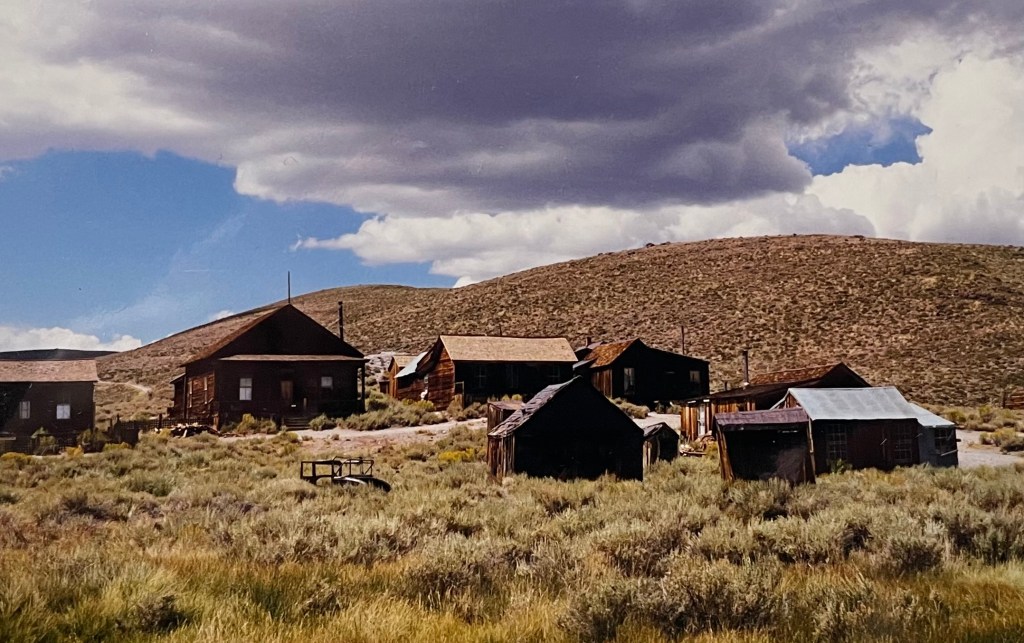
You visit an actual abandoned western ghost town like the crepuscular remains of Bodie, California, high up in the mountain plains, and it’s not quite like anything else. 

Bodie, California, sometime in the early 2000s

It’s probably just me, but when I watch those westerns, there’s the story unfolding in front of us, and the second story of the silently evocative imagined past spread out all around the background on every scene.

Would I want to actually live there, 150 years before wi-fi and refrigerators and comfortable tennis shoes? Probably not, but I still fall a little in love with every knot and whorl in those claptrap movie towns, where it’s always high noon somewhere. 

Val Kilmer’s very human Batman

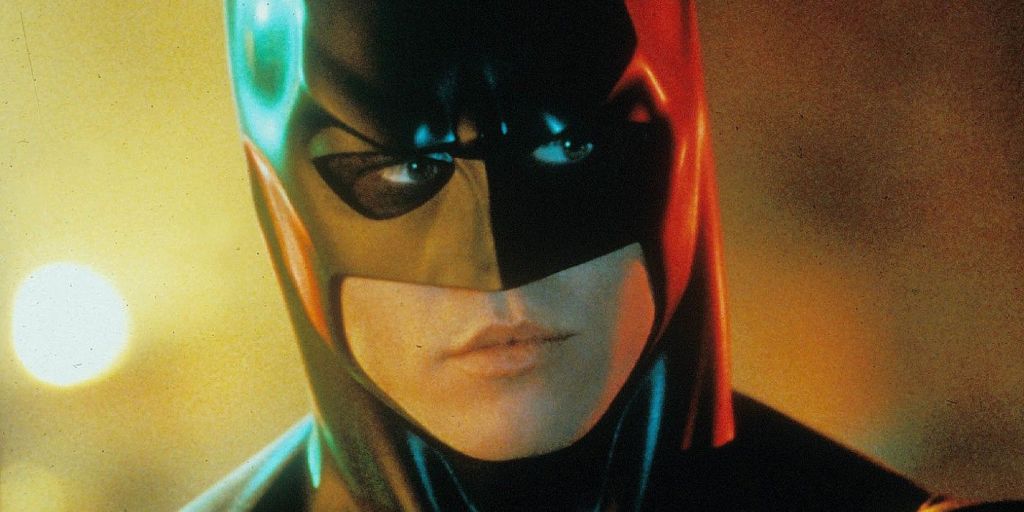
Val Kilmer was a complicated guy, but he left behind a lot of indelible movie performances. Nobody would ever call Batman Forever a good movie, really, but despite all the missteps and terribly 1990s trappings of it all, there are moments when I do think Kilmer’s Batman is one of my favourite takes on the caped crusader.

Kilmer, I think, was the funniest Batman other than ’60s icon Adam West. That’s not exactly something that fans of none-more-dark Dark Knight takes might appreciate.

As a Bat-fan, I’ve always liked the Batman who was a little more human, the one we’d see running around in Brave and Bold comics in the 1970s tossing quips about with Green Arrow and Kamandi. A Batman who is so utterly bleak gets a bit old. 

Director Joel Schumacher took all the gothic weirdness and carnival humour of Tim Burton’s first two Bat-movies and exploded it into full-on camp and neon garishness. Batman Forever, turning 30 in 2025, was a huge hit, lest we forget, the #1 movie of the year. But it all came crashing down with 1997’s flop Batman and Robin, this time starring a far too-glib George Clooney as Bats and ramping up the colourful kitsch about 500% more. Few people look back at Schumacher’s Batman as a peak for the character now. 

And Batman Forever is a mess, don’t get me wrong. It might just boast the two most annoying comic book movie villains of all time in Jim Carrey’s insufferably twitchy Riddler and Tommy Lee Jones’ frantic and undignified Two-Face, who spends most of the movie cackling, grunting and wahoo-ing. The movie shoehorns in an origin for Chris O’Donnell‘s totally ’90s Robin, an incredibly sexed-up Nicole Kidman as a love interest and a kind of incoherent plot about brain-stealing technology.  Whenever I watch it I have to fight the urge to slap Carrey so I can focus on the bits that do work. 

It starts off clearly stating it isn’t going to be Keaton/Burton’s Batman, with fetishistic shots of Kilmer donning the Bat-gear and the first lines of dialogue being a lame joke about Batman getting drive-through for dinner. (Cue that McDonald’s ad, of course.) 

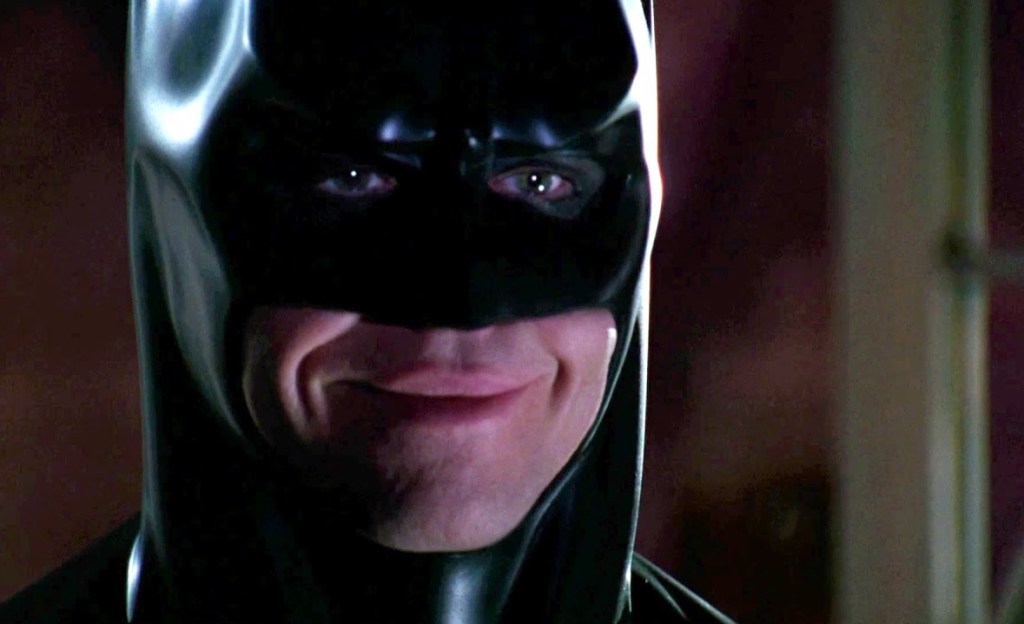
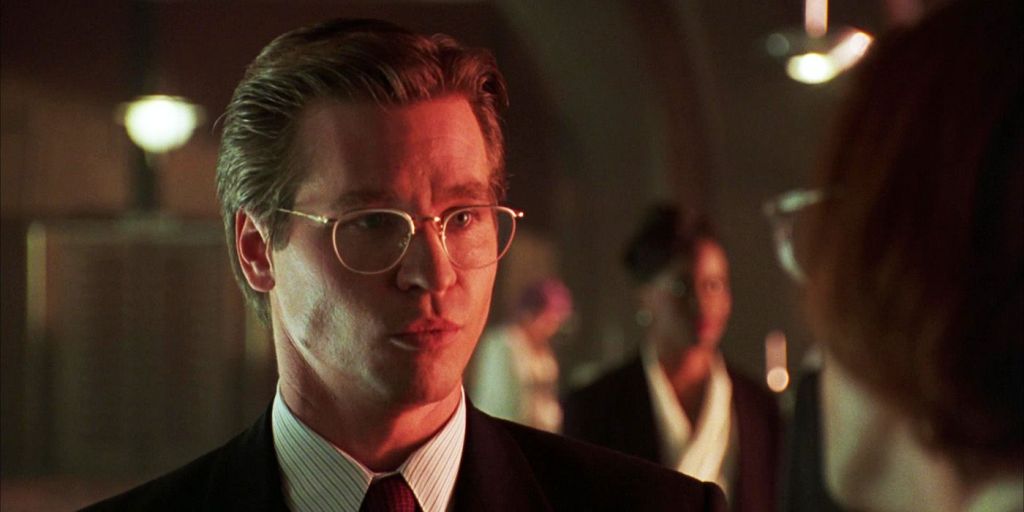
And yet, I like Kilmer as a blonde Bruce Wayne/Batman. There is a sly wit to Kilmer’s performance, which gives us a Batman with a sense of humour without being quite as lightweight as Clooney ended up. Little tics linger like his Bruce Wayne constantly fooling about with glasses (does Batman wear contacts?). His Batman smiles broadly in one memorable scene, which could be cheesy but Kilmer makes it a little, well, charming and sincere. Why can’t Batman smile, occasionally? It ain’t always dark.

His Bruce Wayne is courageous and not just a playboy – brawling with villains without a costume in several scenes, focused with a whiff of arrogance, and smart but also a little scared. 

Michael Keaton was a tense and wiry surprise as Batman (it’s easy now to forget his casting was hated by pre-internet fandom once upon a time) and Bale, Pattinson and Affleck have all given us variations on a very serious, stern Bruce Wayne/Batman. But I still think Kilmer’s Batman is the only one who seems kind of like a Batman you’d want to hang out with, really. 

Kilmer navigates Batman’s dual nature fairly well in Batman Forever – haunted by his past, but wanting to have a life of his own outside Batman. The rickety script doesn’t really serve him well – at one point Batman quits, only to unquit about 30 seconds later – but Kilmer sells story beats like his mentorship of the angry young Robin and his attraction to Kidman’s ridiculously horny psychologist character.

He cracks a few jokes, but he never makes Batman the joke. Kilmer’s movies like Tombstone and Top Secret and Kiss Kiss Bang Bang were great, but his underrated Batman manages the trick of making a mediocre movie almost worth liking. 

Review: The Sex Pistols, Auckland Town Hall, 2 April

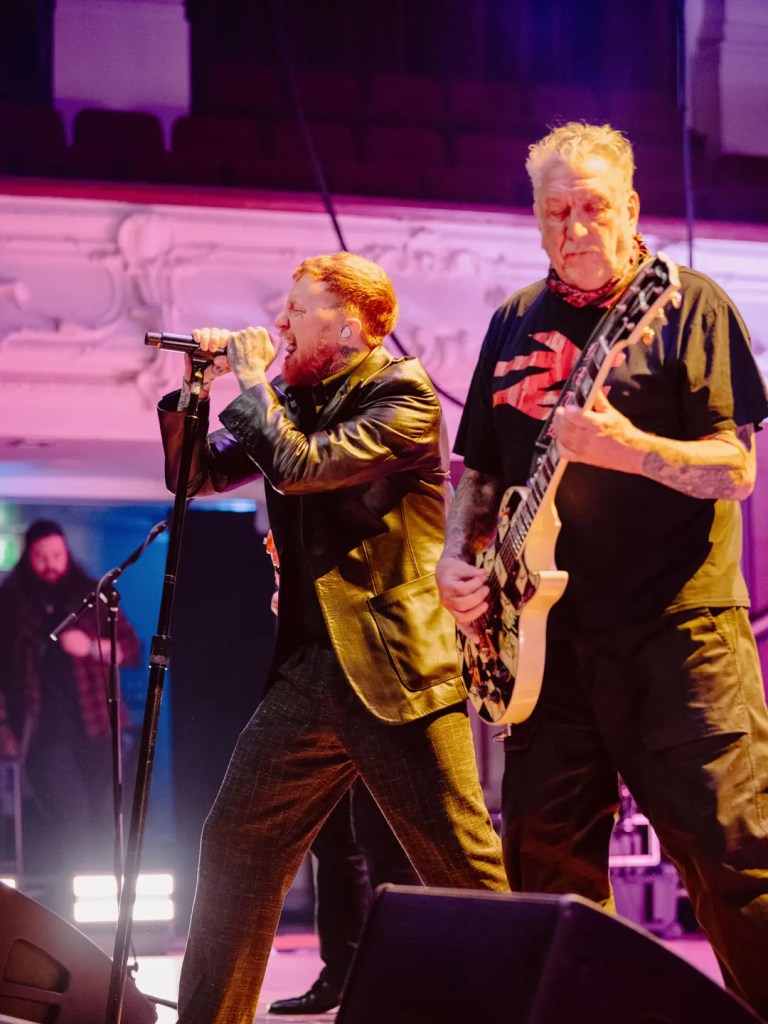
The Sex Pistols perform at Auckland Town Hall, March, 2025.
@yeatesey

I did say a while back that 2025 is my year of punk rock and so it’s proved. So I couldn’t pass up seeing one of the first and best punk acts of all time, or at least 75% of the founding members.

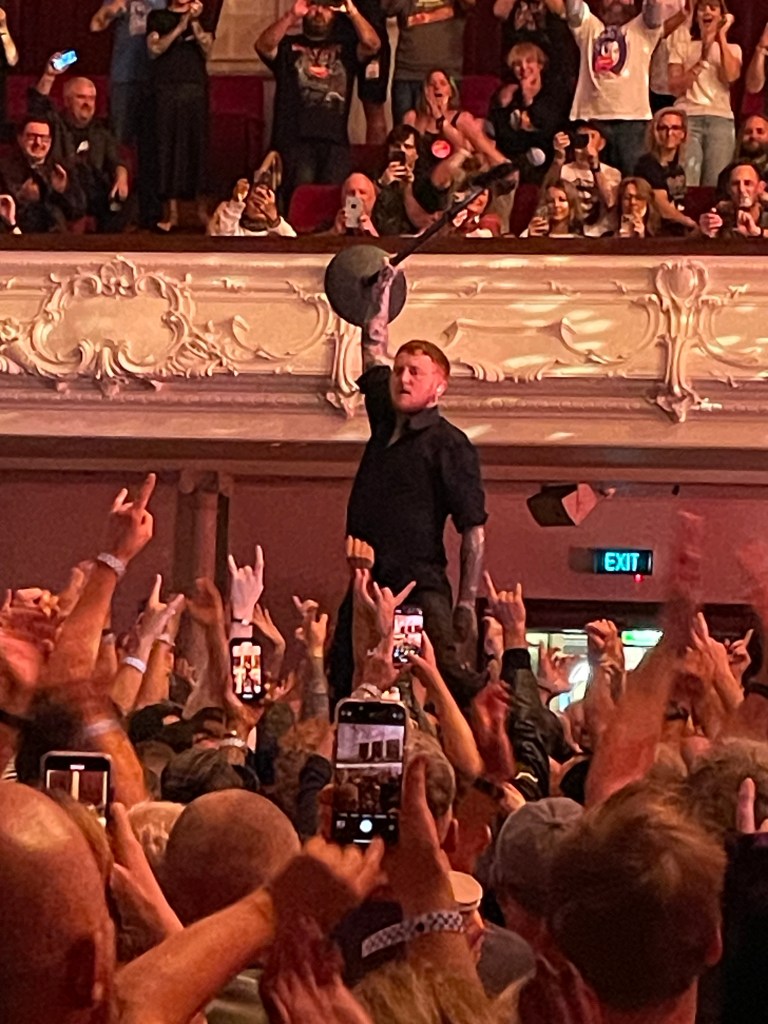
It may be 50 years after they first formed, but I finally got a chance to catch The Sex Pistols live with frontman Frank Carter. Turns out it was a punk rock delight!

Here’s my review over at Radio New Zealand:

The Sex Pistols at Auckland Town Hall prove punk is not dead

Anarchy!!