Once upon a time, when I was a young card-carrying Official Handbook Of The Marvel Universe-reading fanboy, I could’ve told you every single superhero who had been a member of the Avengers.
These days, pretty much every Marvel character other than Aunt May has been an Avenger (and she might’ve been, for all I know) and there’s been regular Avengers, Secret Avengers, Space Avengers, Young Avengers, X-Men Avengers and oh, so many more.
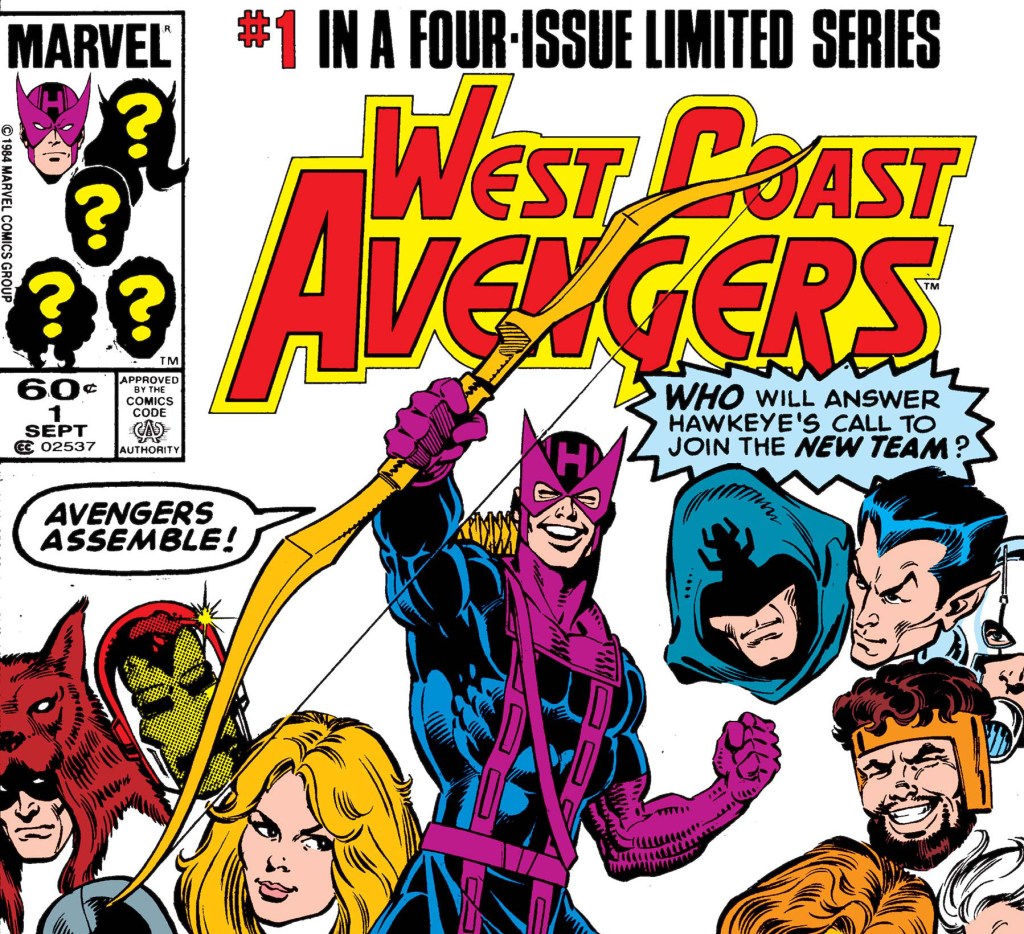
But 40 years ago, the very first Avengers spin-off team took off in their own ongoing title. The West Coast Avengers debuted in 1984 in a miniseries, and in mid-1985 their own 102-issue run began.

And man, I was a West Coast Avengers fanboy from the start. The idea of spin-offs of a superhero team was a novelty then, and best of all, these Avengers lived in California. Hey, I lived in California, too! It’s a common complaint that 95% of DC and Marvel superheroes seem to live in New York or elsewhere on America’s East Coast. West Coast Avengers was a rarity – a reminder that the rest of the country existed. Sure, it was set in a laid-back Hollywood version of the Marvel Universe, but it still was somewhere I’d actually been.
There’s something about the West Coast Avengers that has lured a cultish fandom ever since – and I like to think it’s because it was almost always a team of underdogs, of B-listers and troubled superfolk who had something to prove. It’s a lot harder to be underdogs when Captain America and Thor are running around like on the main Avengers team.
The team was originally led by charming mook Hawkeye and his new bride Mockingbird, self-doubting hero Wonder Man, twitchy cat-woman Tigra and Iron Man at his most disheveled. Later on, more flawed heroes joined up – former Ant-Man Hank Pym, desperately needing redemption; arrogant Captain America substitute the USAgent, and the poster child for superhero mental issues, Moon Knight.

Hawkeye, to me, is one of the main disappointments of the Marvel Cinematic Universe. The comics character has always been a bit of a ratbag, arguing with Captain America, getting into punch-ups with teammates and always pushing back against authority. Nothing against Jeremy Renner, who did what he could, but reimagining him as a kind of stoic secret agent married with children took away Hawkeye’s bratty appeal. Part of the novelty of West Coast Avengers was finding this character – who literally spent years telling others how to run the Avengers – put in a position of power for the first time. Hawkeye was a loveable jerk, and his struggles in the top job gave West Coast Avengers an edge the more polished main Avengers team lacked.
Superheroes had been arguing and had their issues for a while – that was Marvel’s whole point of difference, really – but the struggles of the West Coast Avengers still stood out. You had Tigra battling with her feline side, Iron Man being filled in for by future War Machine James Rhodes due to Tony Stark’s alcoholism, or Wonder Man’s endless fear of death. (Don’t worry – Wonder Man’s been killed several times since. It’s really the main thing he’s remembered for.)
WCA was written in the early years by Steve Engelhart, a veteran Avengers writer who could sometimes be workmanlike, but had a nice eye for character and soap opera melodrama. Dialogue was sometimes cringe, but that kind of fit in with this team of second-chancers. And for ‘80s mainstream comics, Englehart pushed at boundaries, tackling Hank Pym’s attempted suicide, or in a particularly raw storyline, Mockingbird being sexually assaulted. The execution could be awkward, viewed 40 years on, but the heart was there.

The two best eras of West Coast Avengers were #17-24’s “Lost In Space-Time,” a sprawling classic time-travel epic that split the team all through Marvel history and had an unpredictable novelty to it all, and John Byrne’s shortened stint as writer/artist from #42-57.
After the time-travel epic, the title began to fall into aimlessness, and then superstar Byrne suddenly came along and amped up the excitement. Byrne was a bulldozer – he tore apart the Vision and Scarlet Witch’s amiable marriage and it’s never actually been the same since, and he abruptly left the book in the middle of a storyline (also one of Byrne’s bulldozer skills). But for a year or so there he made West Coast Avengers stylishly cool and energetic, with his dynamic, chunky art the best the series ever had.
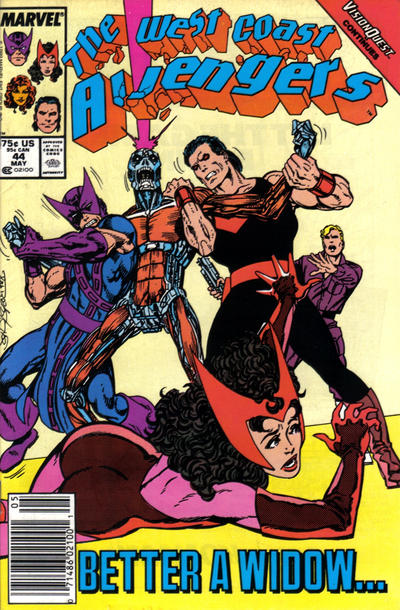
After Byrne left with #57, it was a long slow slide down for West Coast Avengers. Changing the title around #50 to the more generic Avengers West Coast was a sign. There were some terrible fill-in issues, including one issue which killed off several characters only to go with the hokey “it was all a dream” ending, which I still remember as one of the worst comics I ever read. Journeyman Roy Thomas took over writing and there were a few good moments, but bores like Spider-Woman (the second, painfully bland one) and Living Lightning added little to the team, all those 1990s endless crossovers started seeping in, and some diabolical 1990s Image-style artwork erased any attempt for the book to actually look like it was set in California.
West Coast Avengers died at #102, long after I stopped reading it regularly, and there was a brief oh-so-‘90s “extreme” attempt to keep some of the group going called Force Works that is just plain awful. There’s been a couple of brief revivals of the book in years since that never understand its fundamental appeal or are too gimmicky.
But for a while there, the West Coast Avengers were good comics fun. I’d never say it was another Watchmen or anything, but it took the age-old dream of going to California to reinvent yourself and gave us a bunch of second-tier superheroes grooving away under that endless sunshine.
They may not have been the best Avengers, but they were my Avengers.


 Nik Dirga