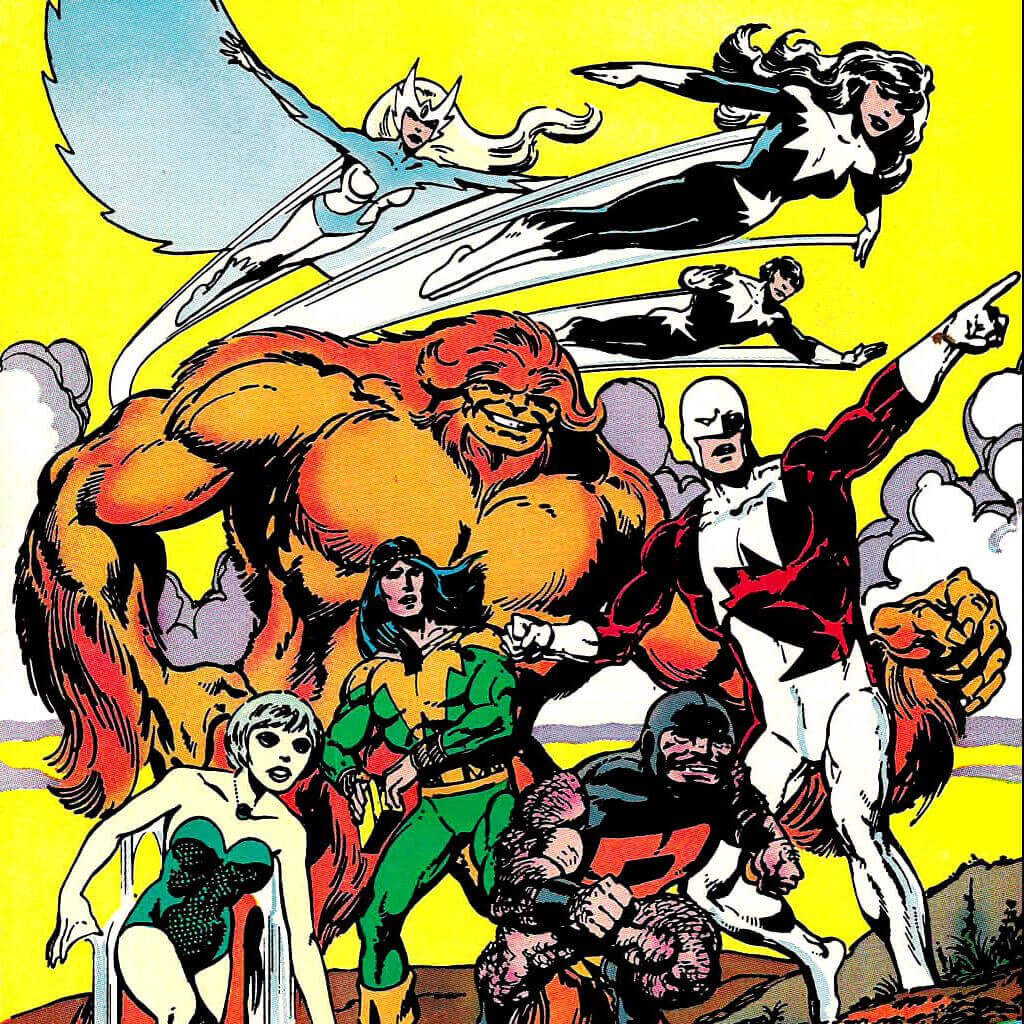
In his white-hot comics run through the 1970s into the 1990s, John Byrne was always one of my favourite writer/artists – his bold dynamic style felt to me like the platonic ideal of what good old-fashioned superhero comics could be. And I’ve got a special place in my heart for his run on Alpha Flight, a Canadian superhero team who debuted fighting fellow Canadian Wolverine in an issue of X-Men and were spun off by Canadian-raised Byrne into their own book.
I loved Byrne’s classic takes on Fantastic Four, Superman, X-Men and the like, but there was a rather raw edge to his Alpha Flight run that holds up well. Byrne fielded an oddball group of Canadian stereotypes, with Captain America fill-in Guardian, hulking Sasquatch, French-Canadian twins Aurora and Northstar, Native American Shaman and wilderness spirit Snowbird, the dwarf Puck and aquatic Marrina.
Alpha Flight was a curious book about a team that wasn’t really ever a team. Marvel’s The Defenders tagged itself as the “non-team,” but for most of Byrne’s run, the entire team of Alpha Flight was rarely assembled together, and the book focused on a series of solo tales or small pairings of team members. It felt a bit exotic to me with its name-drops for Winnipeg and Quebec and glimpses of a culture alien to this small-town California kid.
Canada was an unusual setting for superhero stories, and Alpha Flight was a superhero series that seemed unpredictable and energetic. It was no Watchmen or Dark Knight, of course, it didn’t deconstruct the medium – but it stood out on the comic racks to me in 1983 when it premiered. Byrne himself doesn’t think much of his Alpha Flight run and calls the characters two-dimensional, but I think he cuts himself short.

(SPOILERS for 40-year-old comic books follow)
Because Alpha Flight were hardly top-tier characters, there was a real sense that anything could happen during Byrne’s run. The most notable was the still-shocking death of team leader Guardian in #12, which came as an accidental tragedy – Guardian’s damaged battle suit explodes when he’s distracted at a critical moment by his wife Heather Hudson. It was cruel and sudden, no heroic death but just one of those terrible things that sometimes happen.
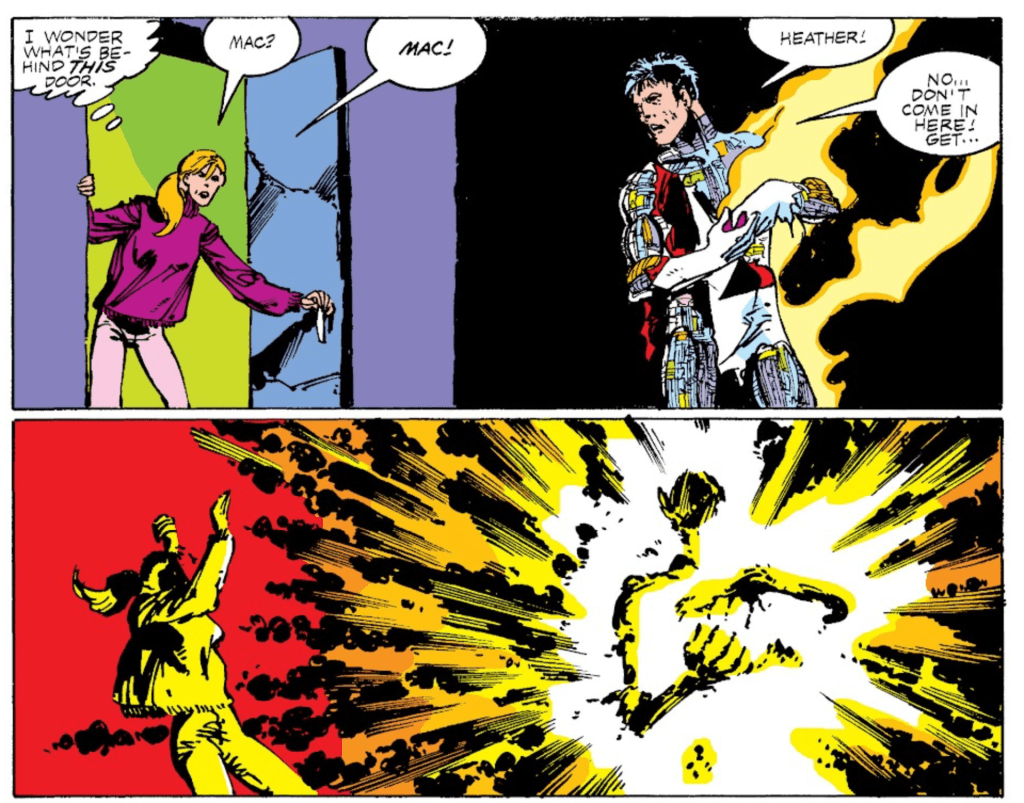
In the pre-internet age where nothing was spoiled, Alpha Flight #12 was stunning, and left teenage comic reader Nik feeling like the world was suddenly a far more shaky place. If you could kill off the leader of a superhero team, was anyone safe?
Byrne’s run constantly rocked the boat on the idea of a “Canadian Avengers” team. In the very first issue the team has been defunded by the Canadian government and broken up, and while they briefly reunite, in the first two dozen or so issues of Alpha Flight there’s only a few times all the members are together at once. In the second issue, the sprite-like aquatic member Marrina turns out to be an alien invader and nearly kills Puck. A few issues later, the sibling team of Northstar and Aurora have a brutal feud and break up. The burly Sasquatch loses control of himself constantly. There’s always a sense in Alpha Flight that everything is about to fall apart. Is there such a concept as an “anti-team” superhero comic?

John Byrne’s work has often had a bit of a dark side and it is fully unleashed in some storylines that felt very brutal at the time – the villainous Master recounts being tortured and dissected alive by alien machines for thousands of years, the creepy Gilded Lily is basically a dessicated corpse kept alive by machines and sorcery, Sasquatch’s battle with Super-Skrull leaves a group of innocent scientists brutally murdered. Aurora battles a multiple-personality disorder, Puck is wracked with chronic pain and most of the team don’t seem to actually like each other that much. It feels like Alpha Flight rarely save anybody and it’s a real surprise late in Byrne’s run when the team battles a run-of-the-mill hostage-taking supervillain for the first time rather than malicious gods and murderous aliens.

Byrne has a long history of leaving series abruptly, sometimes in mid-storyline, but his Alpha Flight feels more or less complete. It did end in a cliffhanger handed off to new writer Bill Mantlo after #28, but that was intentional.
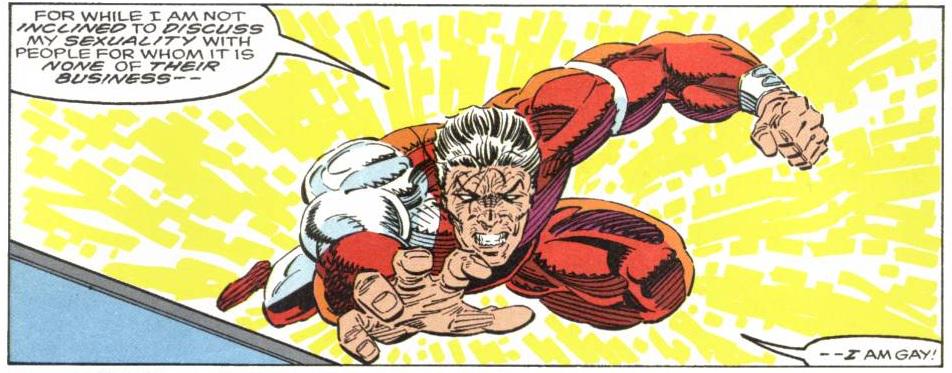
Byrne’s work kind of peaked by the late 1980s and hasn’t really felt as fresh for a long time. Alpha Flight carried on for a good hundred issues after Byrne left and I periodically checked in, but the book was really never very good again. The non-team was quickly turned into yet another standard superhero team, Wolverine kept showing up, and the inspiringly “normal” Heather Hudson immediately became a superhero wearing her dead husband’s costume. (The worst was Bill Mantlo turning Puck from a fascinating dwarf character into the subject of some inane ancient curse that made him a dwarf, although the gay character Northstar’s legendarily ham-fisted coming out story with some of the worst most 1990s comic art ever is a close second.)
They even brought Guardian back to life a couple of times, negating the stunning power of Alpha Flight #12. So it goes.
I guess Alpha Flight are pretty much C-list Marvel characters these days and I couldn’t even tell you who’s dead or alive or resurrected or whatever. They haven’t shown up in the MCU yet and nobody is rocking Sasquatch T-shirts (although really, they should). But for a couple dozen issues before Byrne wandered off, they felt like one of the more exciting books in Marvel Comics – where anyone could die at any time, and where the bonds of the team itself were constantly breaking apart. In their chaos the comic felt weirdly alive. Not bad for a bunch of Canadians, eh?

 Nik Dirga