Why sometimes we all feel like Lloyd Dobler’s girlfriend’s dad

Cameron Crowe’s Say Anything is a great movie and one of the best teen romance movies ever made – quirky yet sincere, witty yet honest. John Cusack’s Lloyd Dobler and Ione Skye’s Diane Court feel real in a way so many ‘80s teen movies never manage to. I saw it at least three times in the theatre back in 1989 when I was deeply underwater in my own series of doomed high school love affairs and I love to revisit it in the years since.

And yet – I think just about my favourite little moment in the movie, even more than that whole iconic boombox scene, isn’t anything to do with teen romance at all.

Instead, it’s Diane’s father Jim, played by the late great John Mahoney, singing alone in his car off-key along to Steely Dan’s “Rikki Don’t Lose That Number” just before his life is about to fall apart. 

Poor old Diane’s dad has been defrauding the rest home he manages and will soon be arrested, and it’s a tragic little twist in the movie that the father she idolises turns out to be an inept con man. At this point, Jim probably knows there’s bad things coming, and they do, but just for a moment, he’s in a car and Steely Dan comes on the radio and that’s everything. 

Diane’s dad sings happily along with Steely Dan with all his heart, not caring that he sounds awful, but the music has snagged something deep inside of him and it won’t let go. Sometimes a song gets you like that, usually when you’re alone, and you feel it pulling you inside whether you want it to or not. I have a frickin’ awful singing voice, but sometimes you move on sheer primal instinct. 

Music hits on a different level than most things, and it can break you open in new ways when you least expect it. 

A song by the great Neutral Milk Hotel came on Spotify while I was out exercising a year or so back, and Jeff Magnum’s strained and aching voice hit me hard, bringing to mind all the love and loss we go through and the things we just can’t fix. Almost unconsciously I started singing along with “In The Aeroplane Over The Sea” and damn it, the lines “How strange is it to be anything at all” got me suddenly choking up in the middle of a suburban walk, sucked in. It felt wonderful and painful all at the same time, in an inchoate way I can’t even fully explain.  

Or the other day that ‘80s chestnut “Head Over Heels” by Tears For Fears came on and for some reason this time the chorus got me, and I began singing along alone in the car, ecstatic and sad and nostalgic and hopeful in all the ways a good song can unearth in you. And don’t even get me started about Peter Gabriel’s “In Your Eyes” also featured so prominently in Say Anything… that song contains entire multiverses for me.

There’s a part of everyone that sometimes is just like Lloyd Dobler’s girlfriend’s dad, singing along by yourself about Rikki, hoping she doesn’t lose that number, knowing she probably will, but maybe she’ll send it off in a letter to herself. 

There’s a beautiful loneliness to Jim Court’s car singalong, but there’s also the music, keeping him company and for just a few seconds, making everything all right again. 

The Spectre is the most heavy metal of superheroes

How do you write good comics about a being that’s essentially invincible, a force of nature incarnate?

The Spectre is one of those heroes who’s been hanging around DC Comics almost since the beginning. He was introduced in 1940 as hard-as-nails cop Jim Corrigan, who is murdered by criminals but brought back to life given a chance to serve as the “wrath of God,” the Spectre. 

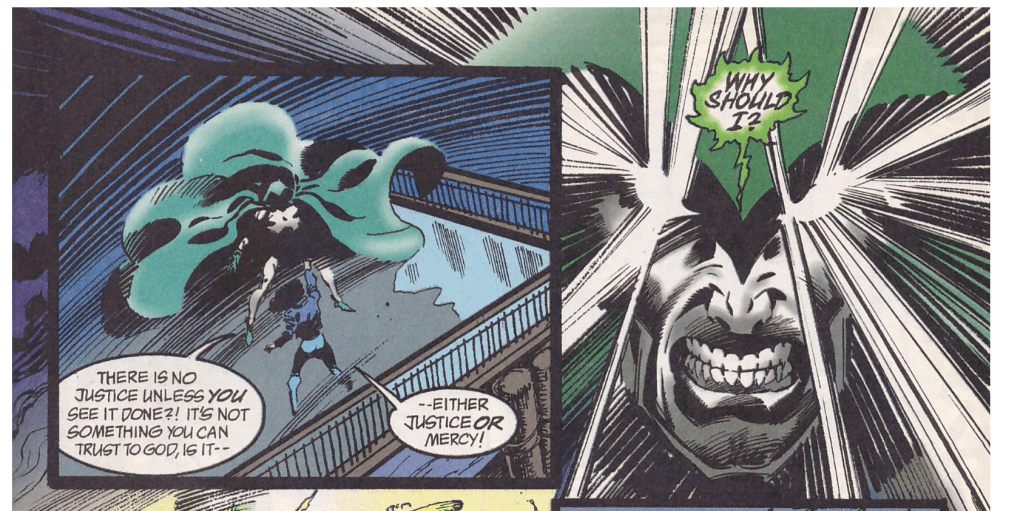
His schtick was punishing criminals in gruesomely inventive ways, such as just full on skeletonising one particularly unlucky bad guy in his very second story:

He was made a bit friendlier over time (including a very goofy era when he was basically the sidekick to the dorky “Percival Popp, Super Cop”) and even joined the Justice Society of America, but the Spectre never quite fit in as one of the superhero crowd. He represents something far bigger, more cosmic. When he was brought back in the 1960s, his short-lived solo book had him wrestling bad guys by smacking them in the head with whole planets, because the Spectre always goes hard. But it was hard to make the character relatable when they’re that far beyond humanity, and the run didn’t last long. 

I first encountered the Spectre in his brief appearances in Alan Moore’s essential Swamp Thing, where the character was portrayed as an unknowable, awe-inspiring presence, one that reduced your average metahumans to stunned silence. 

There was also a great short run by Michael Fleisher and Jim Aparo in the 1970s in Adventure Comics which made the Spectre into a full horror movie villain, punishing the guilty with some insanely creative kills – turning a man into wood and putting him through a woodchipper, or chopping him up with giant cartoon scissors, for instance. There wasn’t a lot more to the stories than “how will the Spectre kill this guy?” but they were a lot of gruesome fun. 

The problem with the Spectre is how do you really write such a character? “Embodiment of the wrath of God” doesn’t give you a lot of room for nuance. He’s had comics runs that played up the mystic angles and supporting cast and turned him into a kind of Dr. Strange character, but then he just blends into the wallpaper. Some stories had Jim Corrigan definitely part of the Spectre, others had the Spectre as a separate being hosted by Corrigan. 

Enter John Ostrander, who married the gnarly punishments with real character work on the Spectre and Jim Corrigan and their peculiar, never-ending bond. His superb 62-issue writing run in the 1990s was peak Spectre, with a comic that was both bombastic and over the top and yet fiercely humane. It embraced the duality of long-dead angry cop Corrigan and the barely contained rage of the Spectre entity for some absolutely banger stories. It richly expands the history of the Spectre entity and its origins in one of the best underrated comics runs – the first half recently was reprinted in an excellent new omnibus. 

This Spectre run cobbled together all the bits of the character over the years and spun it into a dense, melancholy epic, interrogating again and again what it actually means to be the “wrath of God” and what good vengeance can actually serve. In one story, we see the Spectre brutishly pushing forward to avenge a woman’s murder – in the process driving other innocent people he accuses to suicide. 

At one point the Spectre slaughters the population of an entire country torn by civil war – see it as an allegory for the Balkans, or Rwandan genocide – declaring angrily that “no one is innocent!” It’s a key moment that breaks the character free from the giddy righteous cathartic gore of the Fleisher and golden age comics and makes you realise that when you start punishing, it’s pretty hard to stop. 

In the end, Ostrander’s Spectre run is about the fluid toxic nature of hate, and how far it can spread and how much it can control even the most cosmic among us. 

There’s an operatic excess to Ostrander’s writing, aided by Tom Mandrake’s anguished and dynamic artwork. You can’t go small with the Wrath of God as your lead character. It’s also the rare comics series that actually builds to a firm ending, with Jim Corrigan finally allowed to go on to his reward in the masterpiece last issue. (Of course, being comics, this great ending has been fiddled with a fair bit since that 1998 “last issue,” but it’s still a great story.) 

The Spectre hasn’t always been the best fit for good comics and DC is always failing upwards by trying to reinvent the wheel with him (we won’t even talk about that time that, bizarrely, they turned Green Lantern Hal Jordan into a new Spectre for a while), but over the last 85 years, he’s starred in some remarkable stories.

Ostrander’s run is a reminder that you can take a heaven-sent angel of death whose life feels like the chorus to a hundred Black Sabbath songs and still turn it into compelling storytelling. Now, that’s totally metal. 

There’s more than one edge of the world

I’ve always been fascinated by the edge of the world. 

Regrets, I’ve had a few, but one of them is that I’ve never travelled as much as I would like. In my free-wheeling 20s I was dead broke, and then marriage, parenthood, et cetera. Now, I’m teetering on the edge of old. But when I do travel, I’m always interested in those spaces that feel like the edge of the world.

New Zealand is all edge, really, a handful of wee islands bobbing away out there on the far reaches of the South Pacific, surrounded by wide wide seas on every side. I’m always vaguely aware that hunched on the horizon below us like a yeti is Antarctica, which is a mere 2500 or so kilometres (1500 or so miles) to the south. 

We took a recent road trip around the very bottom of the South Island recently, a place I hadn’t been to in far too many years, all mountains and long empty roads and sheep, everywhere sheep. We stopped for a visit at Slope Point, a stark little bit of cliffside that happens to be the southernmost point in mainland New Zealand. You cross a sheep paddock and brave never-ending winds to stand there on the edge of all things, a lighthouse and scrubby plant growth for company. If you’re lucky like we were, you get to experience it by yourself, only the jaunty yellow directional sign pointing out you’re closer to the South Pole than the Equator.

You can’t see Antarctica, of course – it’s still very far away – but you can feel it, lurking like a Norse ice giant. That’s what I mean by edge of the world. 

I’ve been to several places I would consider edges, even if they aren’t next to the ocean. Places that feel ancient and pre-civilisation, bigger than our squabbly little day-to-day human concerns and doomfears. Uluru, perched in the Red Centre of Australia, is definitely one of them, magical and awe-inspiring even with other tourists wandering about in the hot desert emptiness. 

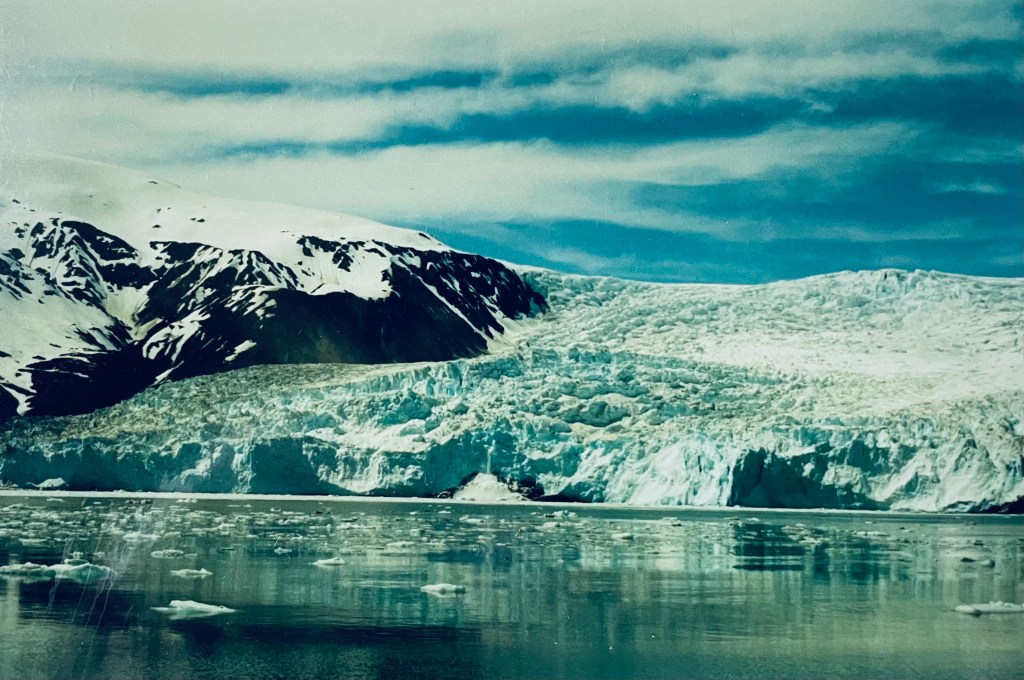
Another is Alaska, the place I was actually born half a century ago at an icebound Air Force Base. I’ve only been there once since I was a toddler, but it was enough to feel the edges that exist everywhere there in the last frontier, watching a glacier slowly rumbling into the sea, dropping chunks of ice the size of houses in the frozen ocean.

Or the Badlands in South Dakota, another spot that feels untroubled by the world of humans, rippling and strange.

Or New Zealand’s northernmost point, Cape Reinga, which is where it is said spirits of the Māori dead begin their journey to the afterlife by leaping off the edge of the shore. I like that image – on the edge, a new beginning.

The thing about an edge of the world is that it should make you feel proper small, a speck of dust floating around in a world far bigger than we can ever really comprehend.

Mucked up as life often seems these days, there’s still an awful lot of world edges out there. I hope to get to more of them and teeter happily on the abyss a few more times in this brief little life we get. 

Sometimes all you want is a medley of the hits, right? 

While foraging at the groovy local record emporium last weekend, I stumbled across a CD single I’d never seen by Prince, Purple Medley. I snatched it up instantly, because I’m a sucker for the cheesy medleys, and a medley of Prince’s golden era is not to be missed. 

OK, I’ll admit – medleys sit at the bottom of the ladder of musical melding, while a little higher up there’s remixes and at the top, skilled sampling. Medleys are the Cousin Oliver or Poochie of pop music, bastard children that nobody really respects. Yet there is a party-down energy to a good medley, which at its best feels like a song of “all good bits” and no boring bits. Medleys are proudly basic – a chorus bashing into another refrain slipping into a good drum solo, with little layering or dissection. 

On Purple Medley there’s goofy fun in hearing “Little Red Corvette” push into the sultry chorus for “Cream,” or the raunchy opening power guitar chords of “Batdance” swerve into the bouncy intro to “When Doves Cry.” It never replaces the Olympian Prince originals, of course, but sometimes all you want is a medley.  

You can’t think “medley” without going past the kitschy world of Stars On 45, the Dutch tinkerers who used knock-off soundalikes to bash out a stew of Beatles ’n’ disco ’n’ Star Wars and much more in the early 1980s. In that distant pre-internet age, such repurposing of well-loved hits felt a bit startling, like a glimpse of the future. It wasn’t much fancier than splicing, but a good medley always carried an element of surprise. 

I always dug Weird Al’s delirious silly “polka medleys” on his albums slapping together a half-dozen or so hits into a crazed Looney Tunes-style joy ride, and I’ll admit, guiltily, to playing Jive Bunny and the Mastermixers’ eminently dopey cassette single for “Swing The Mood” an awful lot back in the day. Jive Bunny turned canned nostalgia into a brief viral sensation by giving old chestnuts like “Rock Around The Clock”, “Tutti Frutti” and Glenn Miller a hip-hop spin. It’s music as party wallpaper, no depth required. 

I won’t argue these are great art, and in fact a lot of the times they’re just awful. But other times, the  appeal of the medley is hearing the bits you know spliced and diced into something new.

It’s not really the same as sampling, which actually is an art form – the bits are shattered into many smaller shards in a sample, chopped up so far that they become building blocks for something new. A lot of great music has been created from the once-maligned art of sampling, from the Beastie Boys’ Paul’s Boutique to J Dilla to DJ Shadow to The Avalanches and many more. The samplers take it further, but the medley-making mix masters like Jive Bunny are all about sticking to the surface, cutting and pasting a collage of all the things you already know. 

To my embarrassment, I dabbled in splicing together medleys myself for a spell my freshman year of college – in between the drunken escapades and studying I sometimes found myself playing around with my old-school double tape deck and CD player, painstakingly pressing “record” and “stop” again and again to put together a just-for-me melange of clips from my tape and CD collection of Depeche Mode, cartoon sound effects, Men At Work, Survivor’s “Eye of the Tiger,” Prince, Aerosmith, Robert Plant’s “Tall Cool One,” Iron Maiden, quotable bits of movies and TV shows all mashed up with excerpts from dire “comedy” cassettes my teen friends and I made. 

I spent an awful lot of hours in that weird time pressing “stop” and “record” to slap together a half-dozen or so silly medleys, but to me at the time, it felt kind of comforting to see the pieces of my past in new ways. I could see the appeal of getting inside sounds. 

Medleys are hacked together for sheer consumerism but sometimes they can feel like a bit of accidental art. Prince didn’t have a thing to do with putting together “Purple Medley” far as I can tell, but it’s still all about echoes of his art. And of course, a medley doesn’t erase the original songs.

One could even argue that it’s a heir of William S. Burroughs’ “cut up” techniques of random art generation, with Jive Bunny part of a long line of iconoclastic innovators. 

…Or maybe not. Perhaps I’m just basic in my occasional need for a medley. But y’know, that “Purple Medley” is pretty darned cool.

Star Trek: The Next Generation, my ultimate comfort watch 

I’m not a big one for massive binge re-watches of television shows. There’s always so much other stuff to watch, for one thing. So when I see people say that they’re watching all of Friends for the 42nd time, I don’t really get the appeal.

And yet… when I just want to zone out in front of a familiar face, I often find myself stepping aboard the good old starship USS Enterprise NCC-1701-D. I like a lot of Star Trek, even the current stuff  (let’s not talk too much about Discovery, though), but for me, Star Trek: The Next Generation is the home I keep returning to again and again, more than 30 years after its final episode. There’s a lot of Star Treks now, but TNG will always be my Trek.

There is something very soothing about boldly going where you’ve already gone before. On a recent holiday night at a hotel, we somehow burned through four classic TNG episodes in a row without even meaning to. That’s the TNG spell for you.

The show ended in 1994 and yet Jean-Luc Picard and crew just keep sailing on those voyages long after the actors entered retirement age. All 178 episodes form a comforting narrative that remain eminently watchable – mostly self-contained, with those occasional dazzlingly energetic two-parters to shake things up. (Yeah, OK, the first two seasons are pretty middling, but by mid-season 3, TNG hit its stride and even the dud episodes – I’m thinking of pretty much any one that focuses too much on Deanna Troi – have their moments.)

Perhaps I’m viewing it all through the retro-futuristic zen of a late 1980s imagining of a better tomorrow that didn’t quite work out the way we imagined. TNG posits a world that still has a lot of conflict but rarely feels weighed down by the dystopian tech-troll world of existential loathing we appear to have gotten for our future instead of Vulcans and holodecks. Watching the best TNG episodes over and over again, you know they’ll sort it all out in the end, that Picard will get un-Borged, that Riker will still define space-sexy masculine goofiness, that Worf will be grumpy and Data will be endlessly curious. 

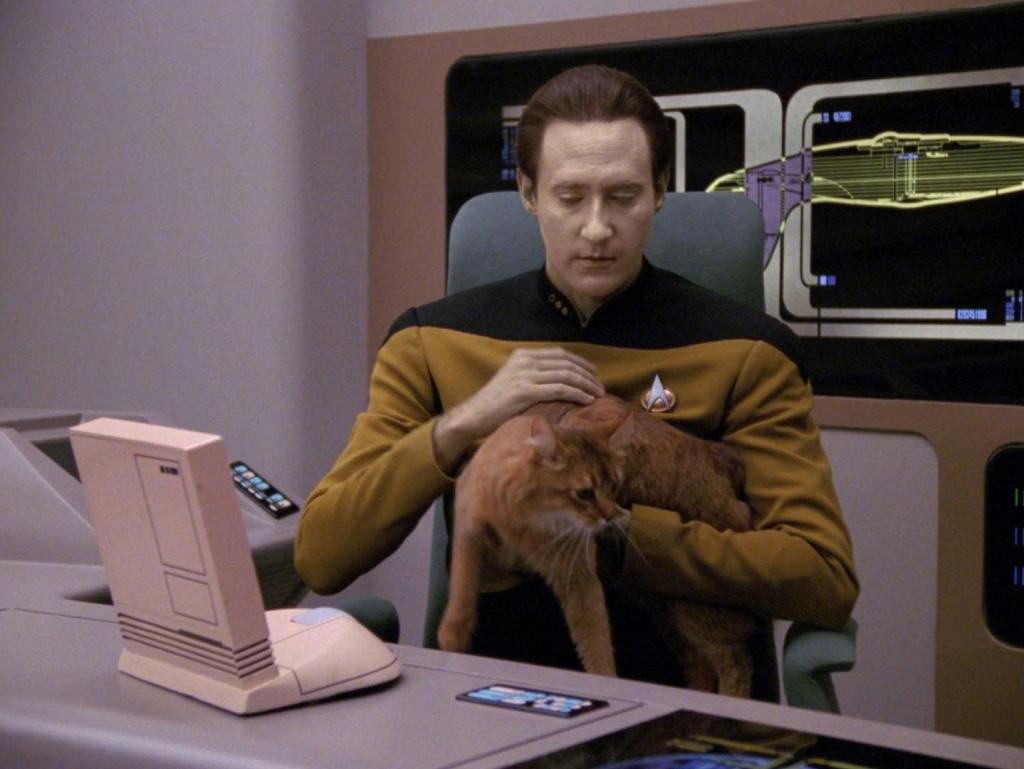
One of TNG’s strengths is its willingness to indulge in quieter moments – Data playing with his cat, Picard drinking tea, Beverly Crusher putting together her awful plays. You get a sense of real life in these glimpses at life aboard the Enterprise, in a way that a lot of other sci-fi shows and even other Star Treks never quite settle down enough to showcase. Who wouldn’t want to hang around playing cards with Riker and the gang at the end of a long day battling Romulans? 

Terrible things happen all the time on Star Trek, of course – you can get turned into a Borg, trapped in a space-time anomaly, accidentally turned into a child in a transporter accident or Sherlock Holmes’ nemesis might come to life on the holodeck and take over the ship. Every problem can be solved by a generous helping of techno-babble and Patrick Stewart’s soothing narration. 

There’s a vaguely cozy vibe to even the very bleakest of TNG scenarios, when you watch them again and again. The NCC-1701-D is ‘90s kitsch of what the future might look like, bold primary colours and a starship full of liminal spaces. It’s never seemed quite as dated to me as the original 1960s series does, and its blandly functional professional aura isn’t as idiosyncratic as Star Trek: Deep Space Nine or Voyager, which tried to shake up the five-year mission assignments a little more and threw in a lot more interpersonal conflict. 

The Next Generation cast moved on to movies after the series ended and I generally like them all too. And while the recent Picard series was a fairly mixed bag, an old TNG fanboy like me still dug seeing the old Enterprise gang coming together one last time in the final season.

Yet none of the continuations ever really hit that blissfully comforting zone that the 178 original episodes of TNG do. Every episode is reset Groundhog Day style, as we hear the latest captain’s or crewman’s log and the crew of the Enterprise get set to go about their business, again and again. 

Watched from our jittery world of 2025, there’s a relaxed pace to TNG that feels like a nice cup of tea at the end of a long day. Even when characters lose their temper and shout a bit, it still all feels, well, calm. You just don’t lose your shit on Jean-Luc Picard’s ship, no matter how wacky things get. And when the real world feels crazier than any science-fiction scenario, a little interstellar comfort food is sometimes all that you need.

God love a duck: My favourite cartoon ducks of all time

Who doesn’t like ducks? It’s the time of year here in New Zealand when the ducks roam the footpaths, with little baby ducks trailing after them. It reminds me of how versatile the plucky duck is in the world of comics and cartoons. There’s been many a duck star in fiction, but only some of them can be the top ducks. Here’s my 10 favourite fictional ducks! 

1. Daffy Duck – There’s nobody more despicable than Daffy Duck, who woo-hoo’ed and bounced his way through the very best of Looney Tunes cartoons – the perfect counterpoint to sly Bugs Bunny or naive Porky Pig, an unrepentant greedy ball of ego and id who will never quite win, but who will amuse the heck out of us while getting there. The platonic ideal of a cartoon duck, and while there’s been a lot of ducks who quack me up, there’s only one Daffy. 

2. Uncle ScroogeCarl Barks turned Uncle Scrooge into one of the most fascinating characters in comics – a tightwad capitalist with a slight warm streak, a daring adventurer at odds with his own selfishness. Sure, he’s a duck, but Uncle Scrooge is also refreshingly human, and starred in some of the best comics of all time. 

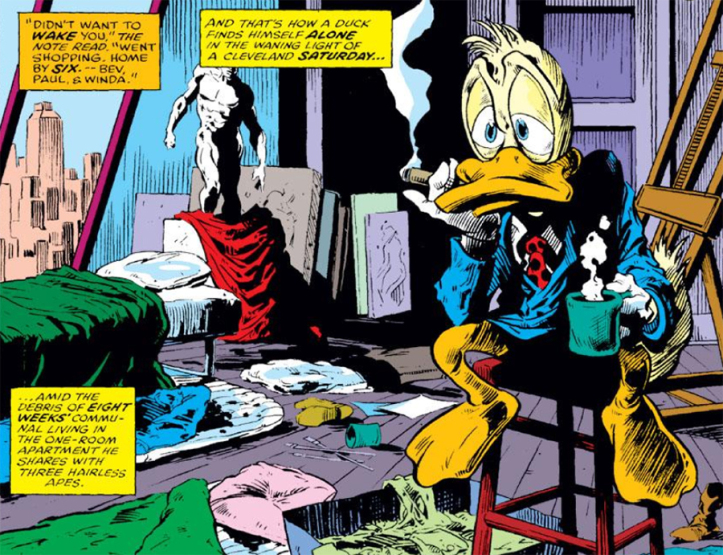
3. Howard The Duck Steve Gerber’s twisty, wordy and satirical comics were a surprise hit in the late ’70s – Howard even ran for President! – but the duck’s name was long marred by the weirdly sloppy 1986 Howard The Duck movie, which missed most of the comic’s subtlety. The movie has its moments (hellooooo, Lea Thompson) but go back to those original comics and you’ll find a dense, philosophical soup of goofy comic book parodies, existential meandering and always, a simmering sense of anger at an unfair world. They are a product of their time but honestly the yearning at the core of Gerber’s writing still resonates strongly today. 

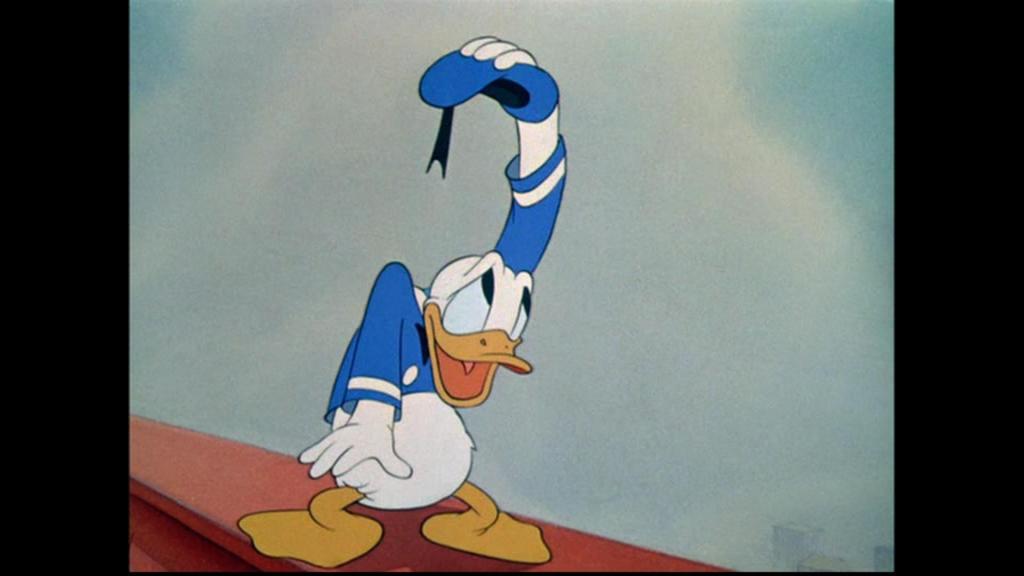
4. Donald Duck – I know, Donald Duck at number four?! But here’s the thing – I just don’t think Donald Duck’s cartoons were anywhere near as good as Daffy’s, and that frickin’ cartoon voice is just annoying. Now, in the comics, Donald Duck is a lot more fun, a short-tempered adventurer whose ego always gets in the way. But… Uncle Scrooge remains an even better character, and as great as Carl Barks’ immortal comics are, they’re ultimately more of an ensemble act that Donald is part of. I do love Donald, don’t get me wrong, but that doesn’t change that there’s a few greater ducks in this here flock. (To avoid a flood of Disney ducks, I’m only listing two here, so sorry, Darkwing Duck, Daisy, Launchpad McQuack, Huey and Dewey and everyone else. Not Louie, though, he sucks.) 

5. Destroyer Duck – Born of outrage, Destroyer Duck was created by Steve Gerber and the legendary Jack Kirby in protest over comics creators’ rights and stomped his way through a half-dozen or so issues published by Eclipse Comics in the early ‘80s. It’s an exceedingly bitter comic book with lots of swipes against the industry and Gerber’s satire and Kirby’s dynamic artwork are an interesting combination. However there’s one big flaw – Jack Kirby, godlike as he was, simply could NOT draw a duck bill to save his life. His Destroyer Duck often looks a little too awkward. 

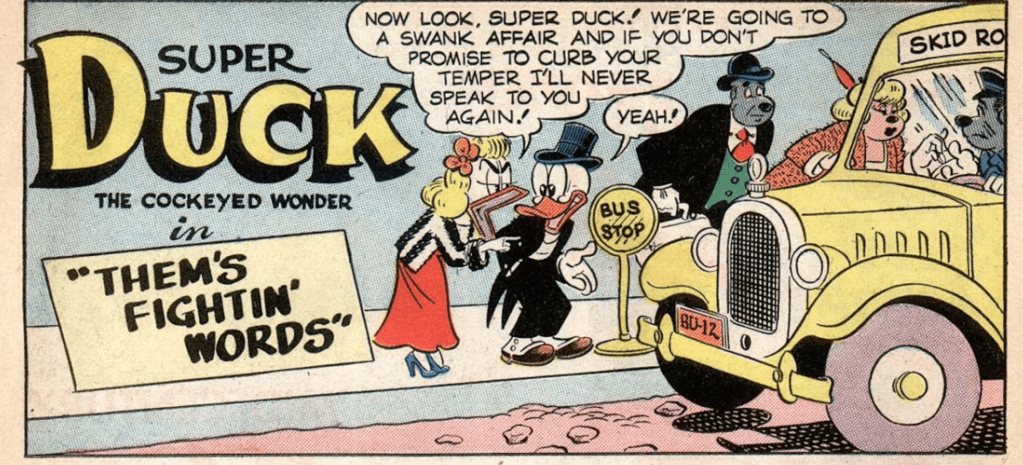
6. Super Duck – This fella was a weird kind of rip-off of Donald and Daffy published by Archie comics for a surprisingly long time. His appearance changed an awful lot over his career but I first came across him in some old Archie reprint digests. He had this strange off-brand Donald Duck look with an insanely big head and “cockeyed” expression that made him look perpetually deranged. Oh, and he often wore lederhosen. But his adventures were pretty funny, for a B-level runner-up kind of waterfowl.

7. Dirty Duck – This nasty fellow was a creation of the great underground comics artist Bobby London of Air Pirates and Popeye fame. Dirty Duck cartoons are scrawly, foul-mouthed countercultural fun in a style that’s heavily influenced by George Herriman’s Krazy Kat cartoons and very much a product of the groovy, acerbic ’70s. Unfortunately they’re hard to find these days other than some scraps online, although London has been promising a collection of the classic strips for some time. I’m down for it, whenever it happens.

8. Duckman – And what about those adult ducks? Jason Alexander voiced Duckman as a kind of rude and crude mallard version of George Costanza filled with outrage and self-loathing in this long-running adult cartoon, which boasted an edgy alt-duck design I’ve always liked. The cartoon was hit or miss for me, but I do like Duckman as a character. 

9. Dippy Duck – Yet another dimwitted cartoon duck, but this one boasts the unique pedigree of being created by none other than Stan Lee and the extraordinarily versatile artist Joe Maneely just before Marvel Comics became a thing and Maneely died tragically young. I rather like how this scruffy, silly duck DOESN’T represent the 1000th ripoff of Donald’s design and the unique look old Dippy has. Only one issue was ever published, though. 

10. Buck Duck – Oh, we’re in the dregs now. Yeah, this guy kind of sucks, OK? Buck Duck can stand for the flood of generic cartoon ducks that swamped kids’ comics back in the ‘40s and ‘50s, all rote rip-offs hoping to be the next Donald – your Dizzy Duck, Dopey Duck, Lucky Duck, the off-puttingly creepy Baby Huey and all the other wild amuck ducks out there. Not every duck can be a dynamo. But that’s cool – there’s more than enough great ducks for everybody.