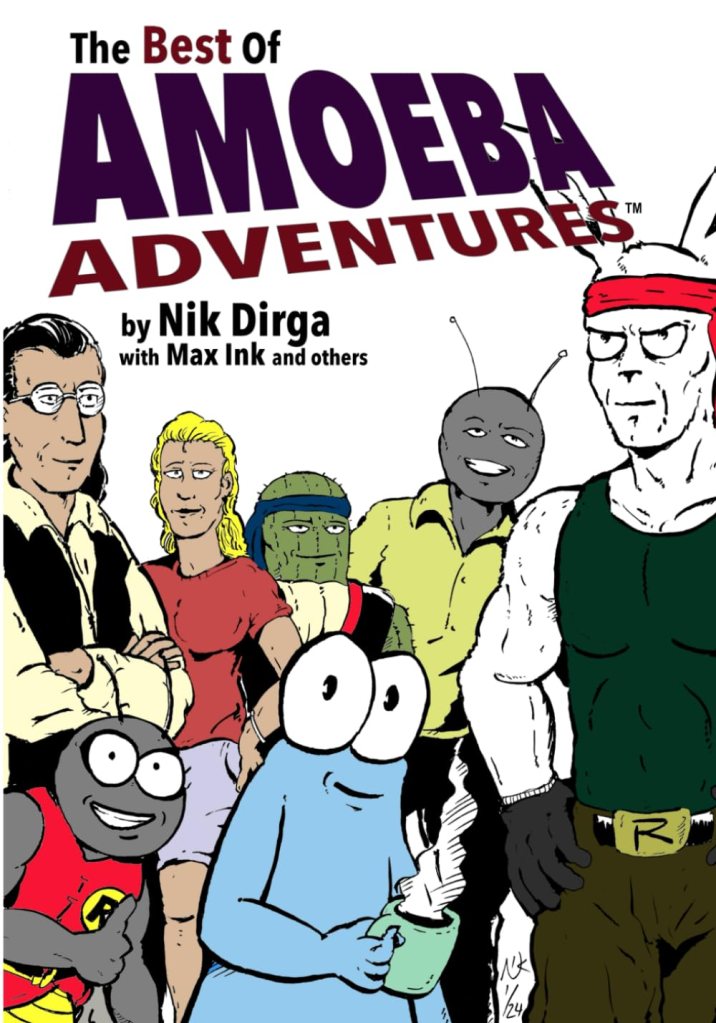
Here’s what I did over my Christmas vacation: I’m happy to announce the release of a new book containing nearly 350 pages of classic Prometheus the Protoplasm stories from the 1990s, THE BEST OF AMOEBA ADVENTURES!
Back in print for the first time in decades, it’s my curated pick of more than a dozen of the greatest Amoeba Adventures stories dating from comics I did in high school all the way up to the award-winning small press era!
It’s available right NOW worldwide over on Amazon in a gorgeous paperback for a mere US$19.99, and for the fancier folks there’s a hardcover variant for US$29.99. An e-book will be available soon.
Nik Dirga’s Amoeba Adventures was one of the most critically praised small press comics of the 1990s. Now, for the first time, the best of long out-of-print stories by Nik with additional art by Max Ink are collected along with bonus rarities and more, including guest pin-ups by Dave Sim, Sergio Aragones, Matt Feazell and Stan Sakai. Dive on into the story of Prometheus the Protoplasm, Rambunny, Spif, Ninja Ant and Karate Kactus, and meet some of the strangest heroes and villains of all time as they battle toxic mushrooms, gorilla gangsters, time travel to the dinosaur age and even appear on David Letterman! Collecting material from Amoeba Adventures #1, 4, 5, 8, 9, 11-13, 16, 17, 21, 22, 27, Prometheus The Protoplasm #4, Prometheus: Silent Storm; Prometheus Saves The Earth and Amoeba Adventures Fifth Anniversary Special.
Buy it now, buy two and invest in the future, buy three and pay for my mortgage!
Dick Waterman and Son House. All photos C the estate of Dick Waterman.
Mississippi blues writer, photographer and keeper of the flame Dick Waterman has died, one of the most extraordinary columnists I ever worked with in all my years in journalism. He was 88.
This picture of Mississippi John Hurt is probably my all-time favourite photo of a musician. C Dick Waterman.
There will and should be some fine obituaries taking in the whole sweep of his career. (Such as this excellent Washington Post one or this fine one in The New York Times) But when I met Dick Waterman, he was a columnist for the weekly newspaper I started working at in 1994, Oxford Town. It was the very beginning of my post-college career and I knew everything and nothing. The editor Chico had hired him and it was one of the best things he’d ever done.
Almost every week Dick would drop these fascinating columns and stories about his life in music, tales of the legends and the forgotten geniuses, peppered with his gorgeous black and white photos. His columns were candid, backstage stories of what the blues legends were really like, or about his own life. When I was asked to take over as Oxford Town editor, visits from Dick were always a highlight.
Not that it was always smooth – Dick Waterman would turn in his column as late as humanly possible, shuffling into the old-school layout room close to midnight with a sheath of pages, while the pressmen could be heard loudly grumbling in the back. Once he discovered fax machine technology he pushed it even further. I attribute my skill at editing some copy very, very fast to some of his columns.
But he was unfailingly gentle and kind, with a bit of the “distracted professor” vibe around him. His photograph stash was an astonishing treasure trove that he had really just started to understand and promote in the 1990s. At one point he let us use an amazing photo of B.B. King on the back of an Oxford Town t-shirt.
B.B. King, 1968. C Dick Waterman
I was just a rather self-important and fumbling 25-year-old editor dude at the start of my own weird journalism career but Dick was always good to me, and honestly, it took me a long time to fully understand what an amazing “six degrees of Kevin Bacon” type character he was in the ‘60s music world. I’ve never met Howlin’ Wolf or Muddy Waters or Arthur “Big Boy” Crudup, but hell, I knew Dick Waterman.
R.I.P. my friend Dick Waterman (1935-2024), who played a key role in the careers of Son House, Bonnie Raitt, and others.
When I left Oxford Town around 1997 to sow my wild oats back in California, Dick Waterman for some reason singled me out in his column in what is still, coming up on 30 years on, one of the kindest single acts of writing anyone has ever done for me. I include it not to brag, but to show what kind of man Dick Waterman was.
He wrote about a Mississippi journalism award I won and said, “For the second year in a row, the Best General Interest Column was won by Oxford Town editor Nik Dirga. To appreciate this feat, you have to understand that he doesn’t even think about his own column until the rest of the paper has been completed. Nik has already announced that he is leaving in a few weeks and my sadness at his departure is mixed with the joy of having had the pleasure of working with him.”
“If Tiger Woods is the best golfer in the world at the age of 21, I can only hope that I stick around to see what literary accolades will come forth for Nik Dirga. The best part of working with Nik is that he honestly does not know how talented he really is. I am over twice as old as Nik Dirga and he is the best editor with whom I have ever worked.
“I wish him well in his travels and know that I will be reading his byline out there somewhere.”
He didn’t have to write all that about me, I know now, and I’m sure no Tiger Woods. But he did write it.
I wish you well in your own travels now, Dick, where ever they may take you.
Mick Jagger. C Dick Waterman
Photos from Dick’s website and the excellent book collecting his photos and essays that used much of the material from his columns, Between Midnight And Day: The Last Unpublished Blues Archive.It’s an absolute treasure of a book. A very good full biography of Dick was also written a few years ago, Dick Waterman: A Life In Blues, which filled in many of the gaps for me about Dick’s life.
It’s Oscar nominations day! Let us share in the joy of headlines that aren’t full of sadness, despair and such and celebrate what was actually a pretty good year for film. In my status as Radio New Zealand Official Academy Awards Correspondent (TM) here’s my take on the nominees and a look at a few New Zealand-linked possible winners:
He fought Dracula. He was a dashing international spy. He invented a time machine. He wrestled mummies, battled Martians, dropped a choke-hold on a werewolf, and inexplicably became a 19th century cowboy. And he did it all while wearing a shiny silver wrestling luchador mask that he never, ever took off in his films.
I’m talking of course about one of the world’s most famous action movie stars of the ‘60s and ‘70s – El Santo, “the Saint,” aka Mexican wrestler Rodolfo Guzman Huerta, who parlayed his career into the ring into starring in a flurry of more than 50 movies between 1958 and 1982. While he is a cult attraction in the US, he was the king of the hugely popular lucha libre genre in Mexico, the MCU of its day.
Santo did it all – the titles of some of his flicks are like little tastes of what to expect: Santo vs The Evil Brain. Santo vs Blue Demon In Atlantis. Santo In The Revenge of the Vampire Women. Santo In The Wax Museum. Santo Vs Frankenstein’s Daughter. Santo And Blue Demon Vs Dracula and The Wolf Man. (Take that, modern-day multiverses!)
Santo In the Treasure of Dracula is a fine example of the lunacy of Santo’s world. Clad in a flashy suit and his omnipresent mask, crimefighter Santo has somehow invented a time machine (Austin Powers fans will quickly note its design) and to test it out sends his girlfriend back in time, where she ends up meeting Dracula and falling under his power. It all ends up with a wrestling match battle against Dracula and his minions in the modern day to save Santo’s girlfriend.
I’ve only seen six or seven of the more than 50 Santo movies so far, but they’re addictive goofy fun. You can see how the Santo factory became such a strange low-fi phenomenon in Mexico. Santo fits anywhere, whether it’s fighting drug lords or beating up vampires or just fighting all the monsters.
A key element in every Santo film is that other than a stray remark or two, nobody really blinks an eye about this stocky bruiser in a wrestling mask walking about fighting evil. It’s part of the Santo charm to see his silver mask blend in with spies or cowboys or government officials, simply part of the furniture like Batman. In Santo Vs The Riders of Terror, for instance, he simply shows up in an old-fashioned Western, unquestioned, helping the townspeople against a gang of bandits and lepers (!).
They’re not exactly great movies, but they’re fast moving pulp, and kind of exotically charming to someone who grew up on a steady diet of American action movie junk food. Some of the many movies filtered over to America, and have been coming out in several nice littleboutique blu-ray editions recently, while dozens more flicks can only be found by hunting the internet.
And of course, like how a Rocky Balboa movie has to include a few ring matches, Santo movies will almost always find a way to include a professional wrestling match or two, in addition to Santo himself putting the smackdown on whoever his latest foe of the day is.
Santo himself is a calm zen centre at the heart of these films. Rather than camping it up, Huerta was relentlessly calm and focused as his saintly alter-ego, which adds to his mysterious allure.
Despite Draculas and Frankensteins and mummies running amok, Santo simply is and always will be himself. He rarely shows anger or any signs of a real inner life outside his battles.
In many ways, the Santo films feel like they were made by a talented 10-year-old boy deciding what would be the coolest movies ever made and executing his ideas.
And you know, that’s sometimes all you want out of cinema, isn’t it?
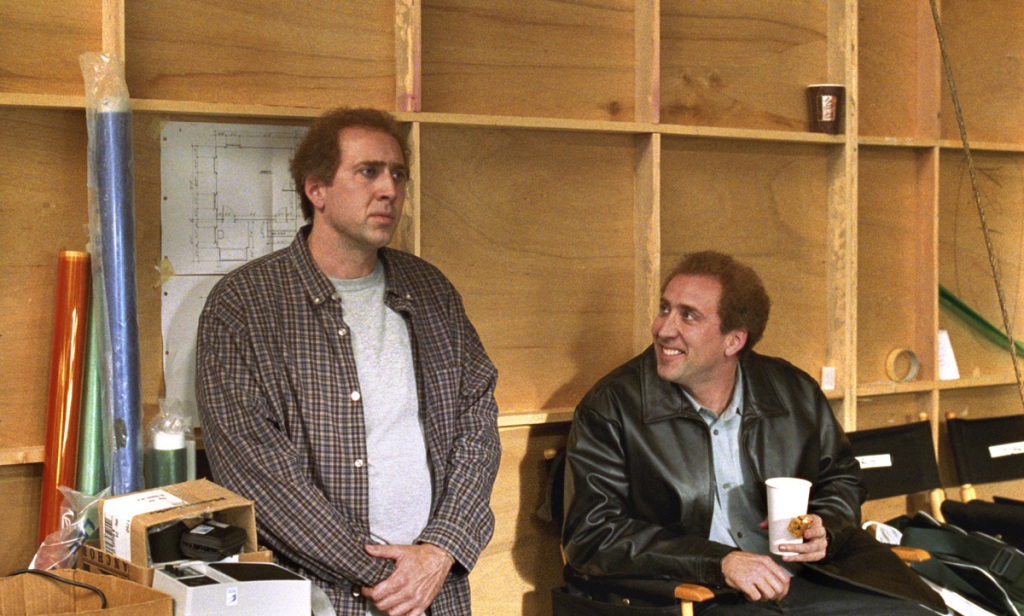
There are movie stars, and there are character actors, but in my mind the best are those who combine the two, and few actors have carved out as inimitable a career as Nicolas Cage, who turns 60 years old today.
Cage’s star has risen and fallen and risen again over the years, but in my mind, even in the worst movies he’s starred in – and there’s a LOT of movies, over 100 – he’s almost always watchable, and more often than not, he elevates the material.
He’s been a meme, an indie film superstar, an action hero, an Academy Award winner and nominee, a comic genius and a steady presence in an awful lot of disposable ‘video on demand’ drek with one-word titles like “Arsenal”.
In my younger, svelte days he’s the only movie star I’ve been vaguely told I resembled (it’s probably just the Nik/Nic names). I watched Vampire’s Kiss and Raising Arizona on VHS tapes and wanted to know who this guy was. I cheered when he brought his oddball sensibility to ‘90s actioners like Face/Off and The Rock. And I still will hit the cinema for most of his major movies, from his recent excellent loosely themed apocalyptic series of films to catching the trippy Dream Scenario just a few weeks back.
To celebrate ol’ Saint Nic’s 60th, here’s my pick for 25 of my favourite Nic Flicks in chronological order:
1. Valley Girl, 1983 – All eyeballs and nose, an 18-year-old Cage kicks off his career subverting ‘80s teen comedies in this sweet goofy treat.
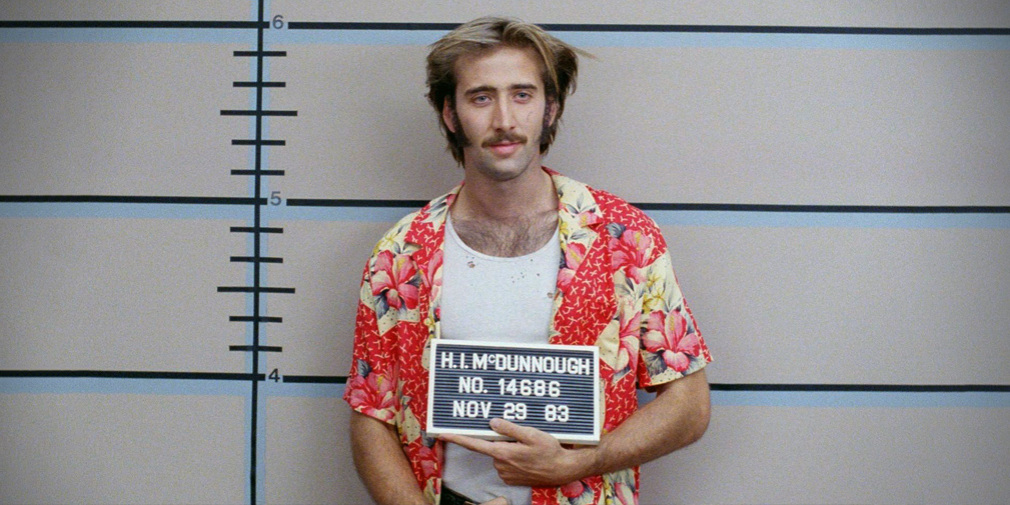
2. Raising Arizona, 1987 – I don’t think I’ve ever watched a Cage movie as many times as this Coen brothers masterpiece. “You ate sand?” “We ate sand.”
3. Vampire’s Kiss, 1988 – In which Cage, as a man who thinks he’s a vampire, decides that you can never go too far over the top.
4. Wild At Heart, 1990 – David Lynch meets Elvis meets Wizard of Oz meets Cage. Neon noir carnage.
5. It Could Happen To You, 1994 – Gentle romantic comedy is something Cage is actually pretty good at, and he’s got great charisma with Bridget Fonda.
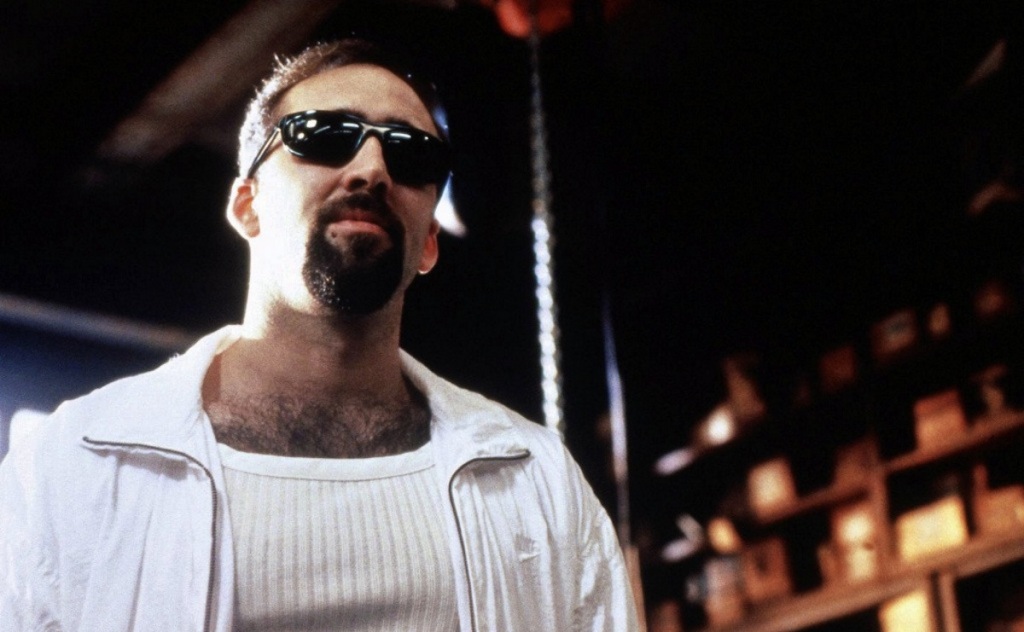
6. Kiss of Death, 1995 – In a bulked-out, goateed supporting role, a terrifying villainous Cage steals the show.
7. Leaving Las Vegas, 1995 – Unlike most Cage movies, there’s no humour in this one, but his Oscar-winning performance is a heartbreaker.
8. The Rock, 1996 – The reign of Cage, unorthodox action star, begins, and his three-picture run of Rock, Con and Face defines some of the beautiful excess that a great action movie can be. It isn’t easy to upstage Sean Connery, either.
9. Con Air, 1997 – Insert Nicolas Cage hair blowing in breeze gif.
10. Face/Off, 1997 – It is a ridiculous movie, but it’s also John Woo’s Hollywood peak and so damned much fun.
11. Snake Eyes, 1998 – Brian De Palma meets Cage, and this one is worth it for the bravura showmanship of the one-take opening scene alone.
12. Bringing Out The Dead, 1999 – Martin Scorsese meets Cage in their only collaboration to date. Underrated and tense.
13. Adaptation, 2002 – Oscar-nominated again for playing twins in a topsy-turvy meta delight.
14. Matchstick Men, 2003 – A black comedy con-man yarn with surprising heart.
15. National Treasure, 2004 – Another try at blockbuster success, amiably corny Indiana Jones/Da Vinci Code style fun.
16. Lord Of War, 2005 – This tale of a Ukrainian arms dealer has only gotten more relevant with age.
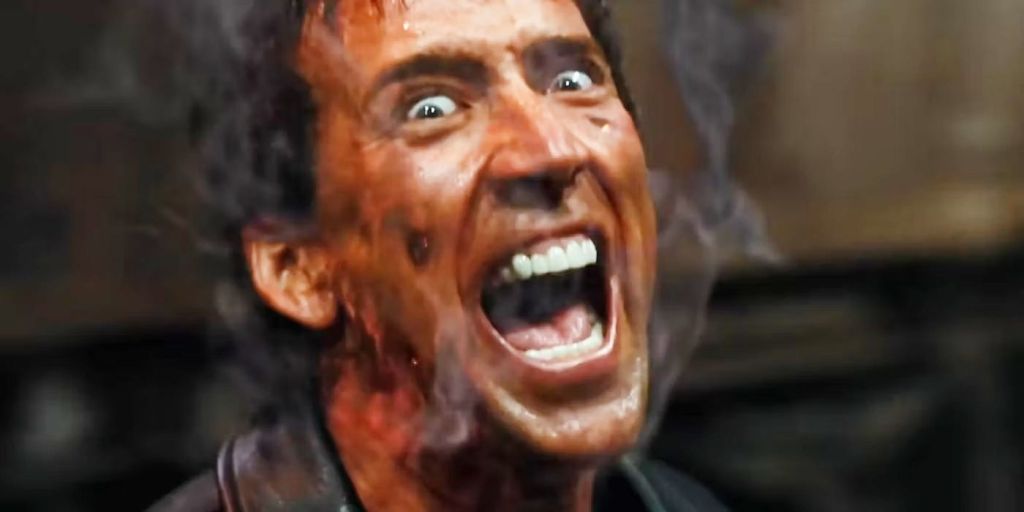
17. Ghost Rider, 2007 – It isn’t a GOOD movie by any means but watching Cage overact his heart out turning into a superhero with a burning skull head is my idea of cinema.
18 Bad Lieutenant: Port Of Call New Orleans, 2009 – Cage unleashed as one of the most corrupt cops ever seen on screen.
19. Drive Angry, 2011 – Nicolas Cage returns from Hell to save his granddaughter in this insanely goofy potboiler.
20. Joe, 2013 – Evocative Southern Gothic based on a novel by the late great Mississippi writer Larry Brown.
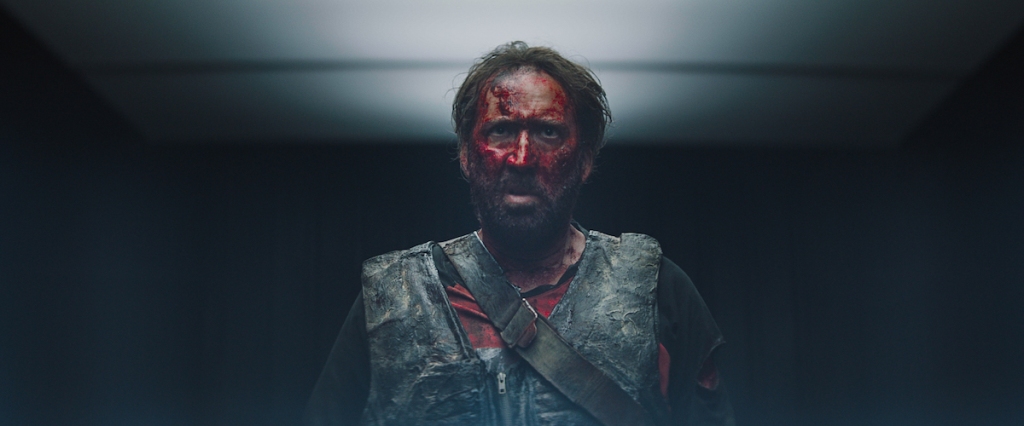
21. Mandy, 2018 – Heavy-metal ultraviolent psychedelic revenge, and the beginning of a welcome new experimentalism in Cage’s picks.
22. Color Out Of Space, 2019 – The cosmic horror of Lovecraft’s short story finds a welcome interpreter in Cage.
23. Pig, 2021 – Just when you think all Cage does is go to 11, he delivers a wonderfully restrained and existential movie about a lonely man who loses his pet pig.
24. The Unbearable Weight of Massive Talent, 2022 – Cage embraces the memes. Chaos ensues.
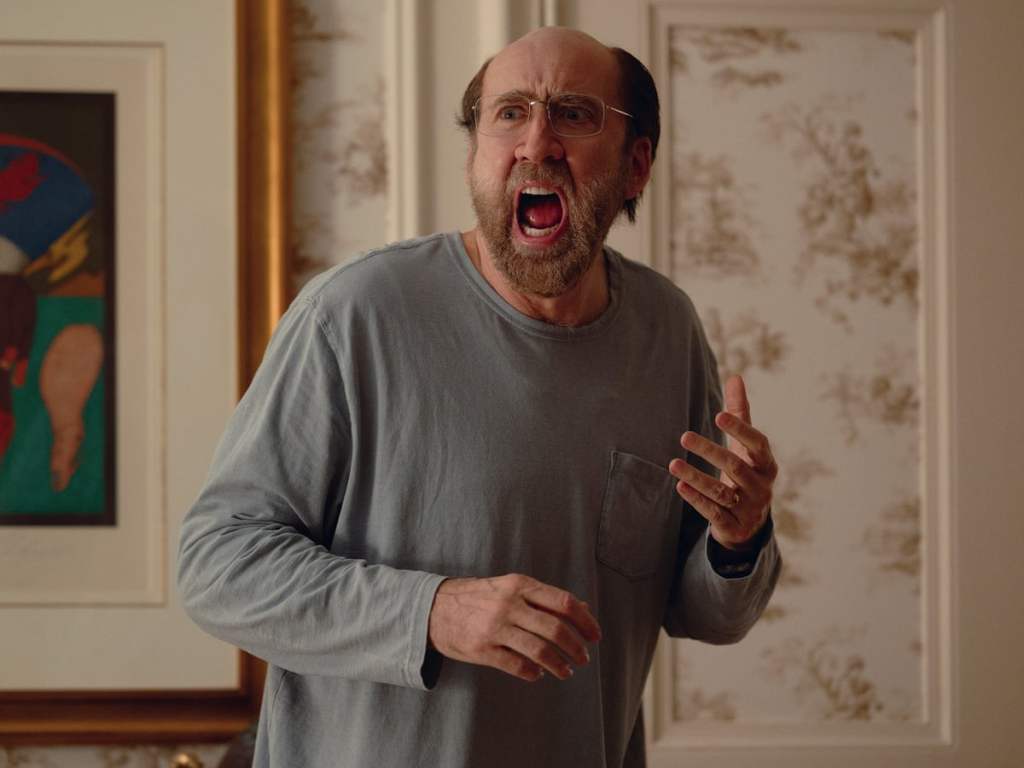
25. Dream Scenario, 2023 – In a movie that really should earn him another Oscar nomination, Cage channels Freddy Krueger, kind of.
Celebrate the tidings of the season by picking your favourite Nicolas Cage joint and giving it a spin. What’s your top Cage Day pick? Comment if you’re keen below.
It’s a new year, a fresh start, a hope this year is maybe a bit less suck than the last one! I’ve complained enough about the year that was, so instead let me dive back to look at ten musical, cinematic or literary experiences that rocked my world in ’23:
Go back to those Gold Soundz: I didn’t check out a lot of live music last year, but what I did was superb, led by the old guard showing they can still blast with the best of them. Indie icons Pavement put on a superb reunion show that left me humming the chorus to “Gold Soundz” for weeks, while I finally saw punk/post-punk legends The Damned for the first time on the back of their excellent Darkadelic album, and they melted my face. And my ears. I don’t quite know if my hearing has ever been the same.
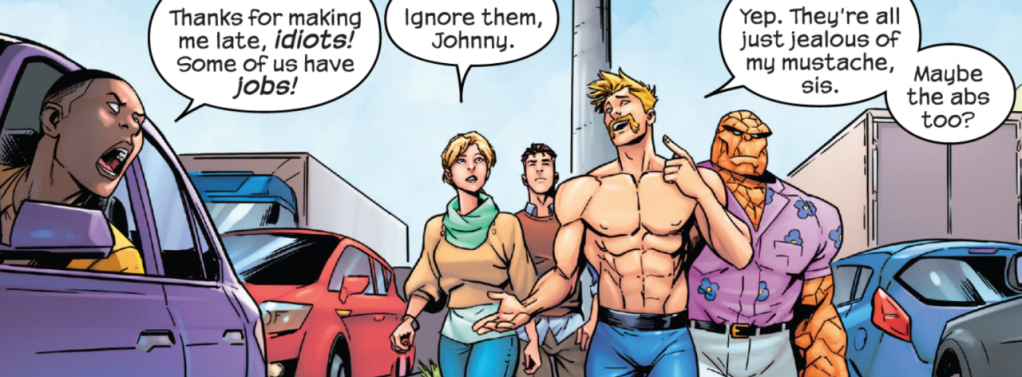
Tonight, a blind woman and a monster came to town: I’ve been getting fewer ongoing monthly comic series these days, but one that’s on my must list is Ryan North’s brainy, witty take on Marvel Comics’ Fantastic Four, which is inventive science-bro action combined with the family heart that is key to the FF. It’s just darned fun, good comics that (so far) don’t have to be part of some sprawling pointless multi-comic company crossover to feel epic. It’s the best the Fantastic Four has been in ages.
A long long time ago, when I was a little chick: I wrote a whole story recently asking local book lovers for their favourite New Zealand books they read and it reminded me of what an excellent year it was for NZ fiction, led by Eleanor Catton’s wickedly fun satire Birnam Wood and a two-fer by Catherine Chidgey – The Axeman’s Carnival, an amazing novel about a bird who becomes a social media celebrity, and the nearly as good teenage angst thriller Pet. Go team NZ!
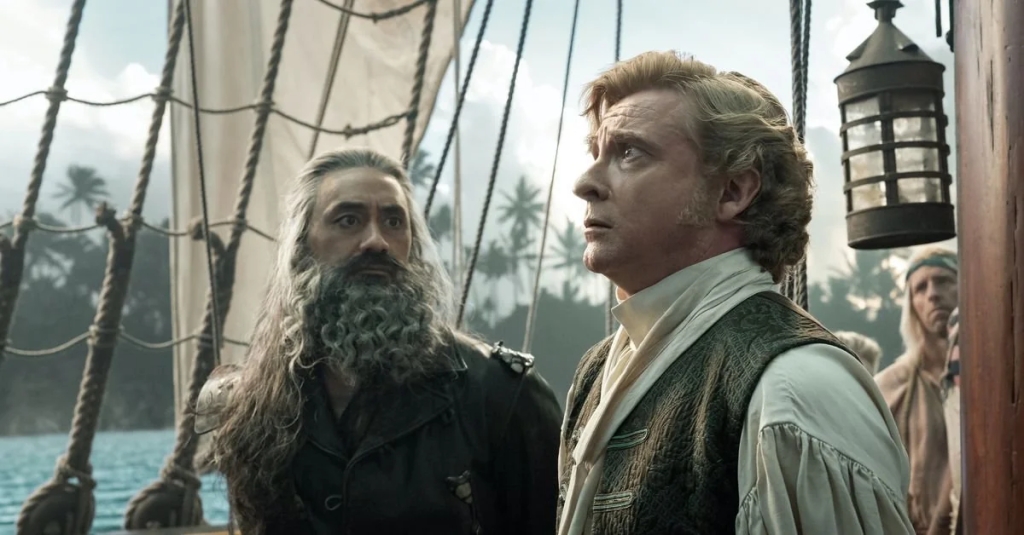
You don’t know the first thing about piracy, do you?: There was a lot of great TV in ’23 – Reservation Dogs, that banger final Succession run, Poker Face, and I’m only just now discovering how fantastic The Bear is – but the one that sticks with me the most is Taika Waititi’s unexpected gay pirate comedy Our Flag Means Death, which in its NZ-filmed second season truly transformed into a delightfully sweet romance mixed with swashbuckling pirate fun. A gem.
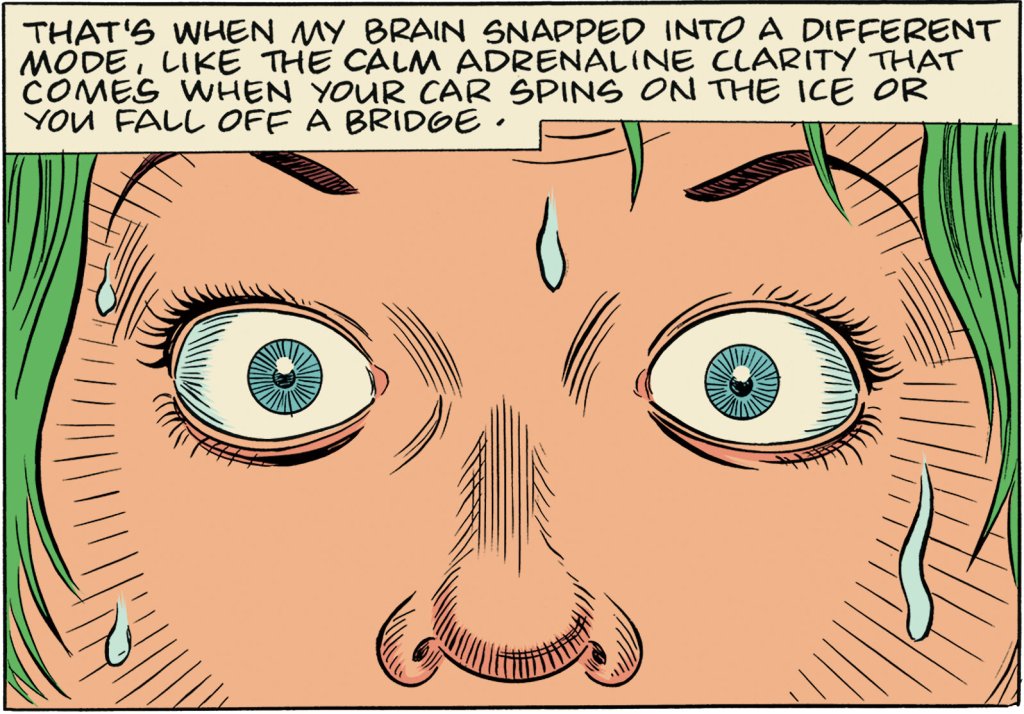
And in an instant, I know I’ve made a terrible mistake: Daniel Clowes has been blowing my mind since long ago when I first stumbled on an issue of Eightball. His comics are less prolific than they once were but they’re worth the wait, with this year’s graphic novel Monica (art at top of post) quite possibly his masterpiece. A sweeping story of one woman’s exploration of her own mysterious past, it’s a technically dazzling (those colours!), assured and layered work that you’ll keep churning over in your head for days afterwards. It’s not a speed-read like many modern comics, but an experience that might just leave you feeling like the world is a slightly different place when you’re done.
All my life I’m looking for the magic: Yeah, I know, physical media is dying, bla bla blah, but while I’m definitely a bit more choosy about what I buy in the age of internet abundance, I can’t pass up a good mix, and UK record label Cherry Red constantly is putting out fantastic CD box sets of eclectic punk rock from 1977-1982, power pop from the UK and US and ’80 synthpop that spans my mid-1970s to late-80s sweet spot. Sure, you can find a Spotify playlist, but I enjoy the curated, elegant physicality of these great boxes and the buried treasure they contain. Each set is hours and hours of gems waiting to be rediscovered and if I close my eyes I can almost pretend it’s coming from a cassette mix tape as I drive my old Volkswagen Rabbit around town.
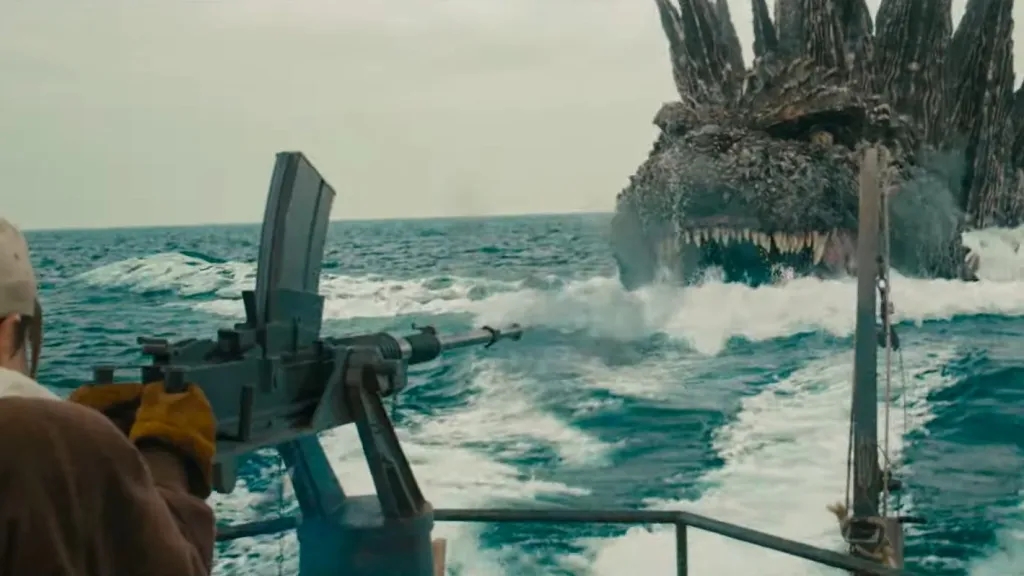
That monster … will never forgive us: This was the year comic-book movies stumbled and became just as cliched as the Will Smith and Tom Cruise action movies they replaced. But look across the seas to Japan and some of the year’s best blockbusters came from there, with kaiju instead of capes in the terrifically oddball Shin Ultraman and the bizarre Shin Kamen Rider and best of all, the monumental reimagining of the biggest beast of all with Godzilla: Minus One. There were decent superhero moments this year, but not one of them compared to the kinetic thrill of watching Ultraman or Godzilla stomp on buildings with fresh energy.
Dear Allen, thanks for your letters. I was glad to hear from you: William S. Burroughs was not a decent man. A drug addict, the accidental murderer of his first wife, homosexual in a repressed era, his twisted, tormented writings are decidedly not for everyone. And yet, and yet. This year I found myself once again reading Burroughs’ books like The Soft Machine and turning to his nonfiction writings, particularly his collected letters, because the nonfiction shows so well what went into his far-out fiction. The Letters of William S. Burroughs 1945-1959 fascinated me because it revealed the real person behind the sneering, sinister king of debauchery Burroughs became. It’s extraordinary to read how human and lonely Burroughs is in these letters, wrestling with unrequited love, addiction and ‘normal’ society, and his determination to find new shadowlands behind the world we live in. A stoic mask soon settled over his public face, but here we learn how he got there.
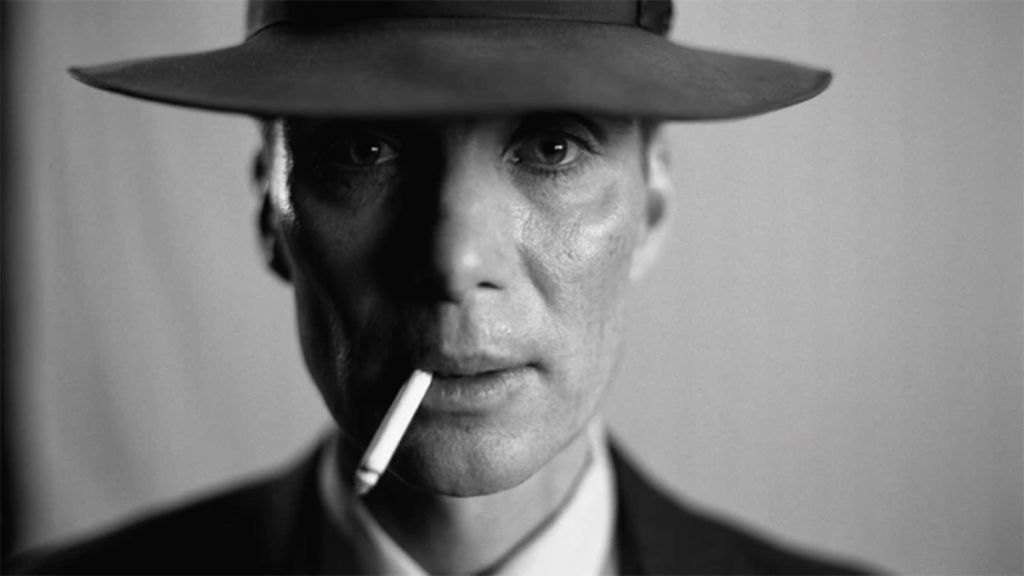
To be honest, when I found out the patriarchy wasn’t just about horses, I lost interest: “Barbenheimer” might have been a marketing technique gone viral, but it was a heck of a lot of fun and rewarding to see two very good movies leading the summer box office and showing up the latest dusty, unnecessary franchise-extender Indiana Jones sequels and the like. Barbie was a huge hit, but it was also just subversive enough to charm all but the most cynical, while Oppenheimer was Christopher Nolan’s best movie yet led by a dazzling Cillian Murphy and sequences on the iMAX screen downtown that melted my face nearly as much as a Damned concert.
The meat goes into the oven: This one’s a bit self-indulgent, but I had a very good year stretching my feature writing muscles this year in my paying gigs, between several book reviews for the NZ Listener magazine and writing for Radio New Zealand about stuff I love like barbecue restaurants,fans of weird movies, used book fairs, film festivals and more. Turn your passions into words, folks, and let’s all have a fine 2024!
In an age where most social media has turned into a bilestorm of nastiness, I find it’s generally a fun space to spend a bit of time, with lots of thoughtful film reviews – and lots of incredibly goofy, snotty one-liner reviews as well. It’s a mix of snark and sense.
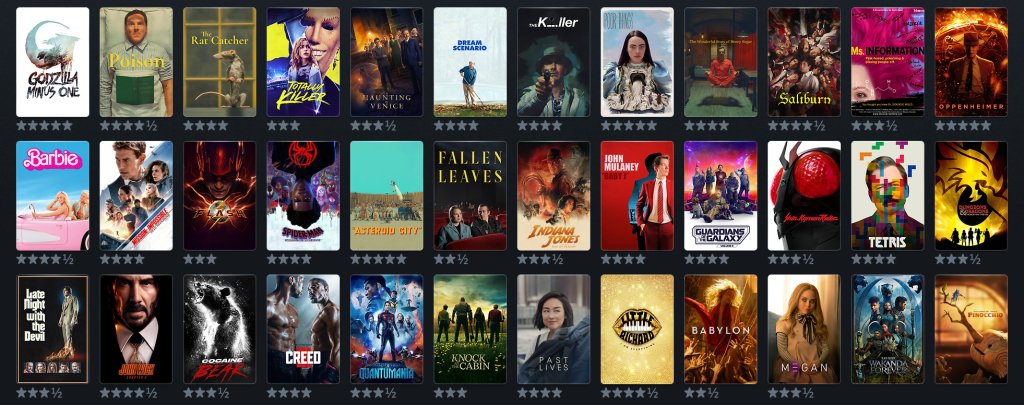
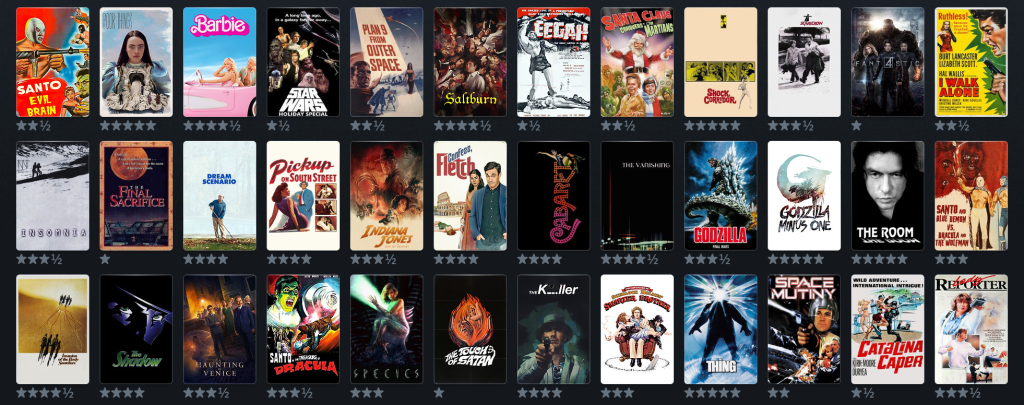
I’ve been using Letterboxd for a while but this year for the first time I thought I’d challenge myself by also doing ratings for the movies I logged – you have the option of ranking movies from five stars to no stars. I hadn’t done it before because there’s an easy tendency to let thinking about the ratings overwhelm the film experience itself – you spend too much time obsessing over what you might rate something. There’s an awful lot of Letterboxd cultists out there who seem to spend an awful lot of time obsessing over their “rating curve” for movies or asking everyone on Reddit to rank their rankings, and it can all get a bit performative.
Eh. I don’t care that my movie curve “leans” toward higher ratings. I mean, life is short and you should generally watch stuff you like or reckon you might like, right? Still, I have tried to be restrained when it comes to awarding five stars. It’s been an interesting experiment this year because it makes you truly think, how has this movie landed with me? What’s the difference between the film as a film and my experience of it? Why do we rate things the way we do, anyway?
For instance, objectively, it’s insane to rate Tommy Wiseau’s legendarily awful sex thriller/comedy/drama The Room as five stars, isn’t it? But, I saw it at a packed 20th anniversary showing with the whole family featuring co-star Greg Sestero (who wrote The Disaster Artist book about the making of The Room), there were skits, making-of-stories, plastic spoons flying, and honestly, it was one of the most fun times I had at the theatre this year. The right experience can make a bad movie seem good, I reckon.
In the end, a star is just a designation that might well change based on my mood or the atmosphere or the configuration of the stars in the sky itself. There’s a LOT of movies that I gave 4 1/2 stars to that might on a different day or second viewing rise up, so in the end you have to take any movie ratings with a grain of salt.
The majority of my “five star” ratings for 2023 were movies that I had, of course, seen before, because honestly, I think you tend to truly love a film more upon repeat exposure. But not always – there was some excellent new to me stuff this year that dazzled from the first few frames.
I logged a rather solid total of 228 movies seen in 2023 (trust me, I’m apparently a total amateur compared to some Boxd-heads). In the end, I gave 24 films five stars.
The ones I saw for the first time:
The Misfits (1961) – As noted here, this final film from Marilyn Monroe and Clark Gable blew me away.
Shock Corridor (1963) – So this is where David Lynch and Martin Scorsese were born. Pulp melodrama at a mental hospital that is absurd from a plot standpoint but hypnotic in style and execution.
Thief (1981) – James Caan, Michael Mann, neon-lit neo-noir, thieves and cons – inject it right into my veins!
The Hit (1984) – The Limey is one of my all-time favourite crime flicks and this underrated gem starring Terence Stamp and a wonderful John Hurt is like the prequel I never knew I needed. Look, I like movies about hitmen starring great actors, OK?
Asteroid City (2023) – Wes Anderson goes full Wes Anderson and either you get it or you don’t.
Poor Things (2023) – Filthy, funny, fantastic femme fatale Frankenstein.
Oppenheimer (2023) – I mean, duh.
Repeat viewing offenders – Beloved film friends I watched again this year that were confirmed in my mind as film classics, from Claude Rains spooking everyone with his invisible powers to Ben Kingsley spooking everyone with his cockney gangster accent:
The Invisible Man (1933); Singin’ In The Rain (1952); All That Heaven Allows (1955); 12 Angry Men (1957); Blow-Up (1966); The French Connection (1971); Fist of Fury (1972); Stardust Memories (1980); The Thing (1982); Videodrome (1983); Sexy Beast (2001); The Room (2003); Rise of the Planet of the Apes (2011); John Wick (2014); The Sparks Brothers (2021)
Look, I’m sorry to harsh the pre-Christmas buzz, but 2023 was pretty lame, right?
My wife went through breast cancer surgery and treatment (she’s doing a lot better, thankfully). Other family members have been battling ill health and the upheaval of change. We lost our family beach house in a cyclone as the climate crisis hit NZ hard. Hell, even our beloved old cat friend Bowie died, and the world seemed to continue its headlong lurch into fascism, internet-fuelled conspiracy-land, ignorance, pointless culture wars and hate. Get in the bin, 2023, I’m done with you.
So, what do you do? For the last several pandemic-tainted years I’ve done up a playlist of songs to survive, because art helps. Music helps, good books help, great movies help. Drawing two issues of my comic book Amoeba Adventures helped. I don’t think I could survive in a world without some kind of art.
Back in the days of ornate mixtapes, you could sweat over the proper order of songs for ages, crafting the perfect vibe. This year, I just kind of threw it all in a blender, from Kiwi pop to thrash to old favourites to new artists I literally discovered a week ago. It’s all music. It’s all good, you know?
Here’s nearly 3 hours, 40+ songs that helped me survive 2023. Shuffle away and listen to it in any order, or let it flow as it is.
Wherever you are, have an excellent Christmas, and whoever or whatever you believe in, let’s all hope for a little more peace on earth and goodwill to all in the days to come.
What is it? …So, what makes a bad movie? Is it ineptitude, or arrogance, or both? Marvel’s Fantastic Four comics have now been adapted disappointingly into movies four times – a very, very low-budget never-officially-released 1994 Roger Corman schlock-fest, two mildly successful family-friendly 2000s movies by Tim Story, and an outright bomb in the dark, dreary 2015 Josh Trank film. It shouldn’t be this hard to adapt one of the great superhero comics to cinema, but somehow, it keeps missing the mark.
The Fantastic Four are a family – Reed Richards and his (eventually) wife Sue Storm, fiery Johnny Storm and tragic Ben Grimm, the Thing. They’re adventurers and explorers and Stan Lee, Jack Kirby, John Byrne, Jonathan Hickman, Mark Waid and others have written countless great comics starring them.
Yet Fantastic Four 2015is a joyless slog, in love with its own seriousness in a story that should be about wonder and adventure, more Indiana Jones than X-Men. The movie spends far too much of its runtime setting up young genius Reed Richards (an uncertain Miles Teller) and childhood pal Ben Grimm (woefully miscast Jamie Bell) getting involved in a secret cosmic teleportation experiment with scientist Sue Storm (Kate Mara, serious and dull), her daredevil brother Johnny Storm (Michael B. Jordan, showing little of the charisma he brought to Creed and Black Panther) and Victor Von Doom as a spoiled, egotistical scientist (forgettably generic Toby Kebbell). The experiment changes them all, giving them strange powers in a movie that seems determined to play that as Cronebergian body horror, they end up fighting Victor Von Doom who’s gone evil for… reasons, and then it’s the end.
Like far too many superhero movies it’s all about setting up for imaginary sequels, and Trank plays it all stonefaced straight. Tim Story’s 2005 and 2007 Fantastic Four movies were kinda clumsy and cheap, but one thing they got right was the essential light touch a FF story needs, the banter and the camaraderie. Not a single character in Fantastic Four 2015 is really that likeable.
A fifth Fantastic Four movie, finally meant to be part of the Marvel Cinematic Universe proper, is set to arrive in 2025. Will it break the curse?
Why I never saw it. Look, as a wee young boy superhero movies were few and far between, and I gamely saw flops like Howard The Duck and Superman IV: The Quest for Peace in theatres. But in the last 20 years we’ve been deluged with comic content and when a movie bombs as hard as FF15 did, you know, you tend to skip it until you get bored enough one night. Bad movies have their own twisted charm, and I figured it was time to see if this was as bad as everyone said it was. (Should I do Morbius next, or can my heart take it?)
Does it measure up to its rep? An anemic 9% positive reviews on Rotten Tomatoes. A 1.3 star rating out of 5 on Letterboxd. A (rather too generous) 4.3/10 on IMDB. Yep, I’d say it measures up to those. It is indeed as bad as everyone said it was.
What depresses most about Fantastic Four 2015, besides the utter miscasting of pretty much everybody involved and its relentless dour tone, is how so many wrong choices by Trank show he fails to get what has made the Fantastic Four work for 60 years. The first misstep was relying on the 2000s “reboot” comic Ultimate Fantastic Four as your source material. It’s one of those peak “edgy” decompressed reimagining of beloved characters with then-hip lingo that ages like cheese left out in the sun, and far inferior to the energetic original Lee & Kirby Marvel Comics.
What makes a bad movie is the sense the filmmakers don’t care about their story or their characters. Trank has the team as brooding teenagers, manipulated by the sinister government and missing the spirit of plucky individualism that drove Lee and Kirby’s original comics. Make Ben Grimm’s mutated Thing, famous for his gritty wit and gruff everyman charm in the comics, into a sullen government assassin? Also make the Thing disturbingly naked instead of wearing his trademark blue trunks? Check. Have Sue Storm be an adopted orphan from Kosovo for no particular reason? Check! And once again mangle the character of Doctor Doom, one of comics’ most revered villains, turning him into a whiny loser mutated by cosmic energy and quite possibly the most visually ugly interpretation of a comics villain on film outside of Zach Snyder’s Justice League? Double check! (Doom has now fallen short in FOUR movies, which has to be some kind of record in a world where people playing the Joker have won two Oscars.)
Worth seeing? We live in an age where third-tier comic book characters like Groot, Blue Beetle, She-Hulk and Agatha Harkness are all well-known. Yet, somehow, film still hasn’t quite cracked the secret of how to adapt one of the greatest comics of all time to film. It’s no wonder it took me eight years to get around to this one. By far the worst of four cinematic attempts at the quartet, Josh Trank’s Fantastic Four is exactly as misguided and depressing as the reviews back in 2015 made it sound. If you’re a fan of the comic, like I am, Fantastic Four 2015 feels like an intentional insult. At least we’ll always have the comics, eh? Flame on!






 Nik Dirga