Can you really watch too many kung-fu movies?

I’m not a violent man. I’ve been in like three actual fights in my life, and think I lost 2.5 of them. But I do love a good ass-kicking on the screen, the weird poetry of movie violence. 

In the pandemic era, there’s been no steady flow of blockbuster superhero epics and action flicks to look forward to. So I’ve been spending an unseemly amount of time diving into the past in search of an adrenaline fix, and eventually asking myself: Can one watch too many kung-fu movies?

I dig a good flying kick to the face, and have long loved the acrobatic chaos of Jackie Chan or the slick killer grace of legendary Bruce Lee. The scarcity of cinema visits and new movies to watch the last year or so has led me to dive even deeper into the wonderful, wacky bottomless world of martial arts cinema, a true “shared universe” of peak human suffering and mythological endurance, where men are battered, beaten and rearranged into new shapes without the benefit of CGI. There are literally thousands of movies churned out by Hong Kong and other studios in the ‘60s, ‘70s and ‘80s, and for every gem I’ve seen I discover another half-dozen I haven’t. 

There’s something visceral and exciting for me about seeing that Shaw Brothers studio logo opening up a film, a sign that the story ahead will provide epic action and mythic storytelling — maybe not so much character development or realistic human interaction but hey, that’s not why we’re here. Betrayal, vengeance, revenge and redemption – that covers the vast majority of themes, dressed up with an infinite number of brutal actions. 

I slid into the habit of watching more and more kung-fu flicks in recent months as a remedy to the chaos of the outside world – here, all problems can be solved by a good backwards kick-flip.

I drank in more classic kung-fu movies I’ve long meant to see, like The Prodigal Son, with Yuen Biao and the wonderful late Lam Ching-ying in one of the best zero-to-hero storytelling arcs; Sammo Hung’s hilarious bulky grace in The Magnificent Butcher and other films, the bloody King Boxer/Five Fingers of Death with its ripped eyeballs and music so memorably sampled by Quentin Tarantino; endearingly awkward Jimmy Wang Yu’s One-Armed Boxer and One-Armed Swordsman; the immensely creepy Mr. Vampire with its gloriously weird hopping “jiangshi” Eastern-style vampires. 

More recently, there’s the amazing work of Donnie Yen in films like the awesome Ip Man series and insanely intense battles in Kung Fu Killer or SPL (Kill Zone). Yen combines Clint Eastwood’s stoic Man With No Name allure with a dazzling speed and grace that’s made him one of the most exciting action heroes to watch perform in ages. 

Not every martial arts movie is equal – the attempts at humour in many “kung fu comedies” is often very broad, dated and sexist and too frequently, rather rapey for my tastes. The cheaper and goofier the movies are, the more raw and silly the experience. The cheapest kung-fu flicks like this massively fun bargain-basement box set I got a while back are watched more as archaeological experience than anything. 

Still, as much as I love these movies, one can overdose. When I start imagining everything in subtitles and every interaction involving duel of honour kicks and punches, I’ve got to back off sometimes and watch something which features actual human beings having actual conversations. The heightened, performative world of martial arts movies is such a self-contained world that it’s a shock to the system to see people in another movie going out to dinner without tables being overturned and bodies flying over the buffet. The pleasures of a good kung-fu flick are endlessly simple joys for me, but it’s never good to dine too much on just one thing. You can’t live on potato chips alone.

When I find myself with idle images of Jackie Chan somersaulting over furniture or Donnie Yen working the wing-chun dummy dancing in my brain at bedtime, it’s a sign to back off a little bit. But I always know I’ll be back, primed for yet another tale of endlessly acrobatic human beings and the damage they can do. 

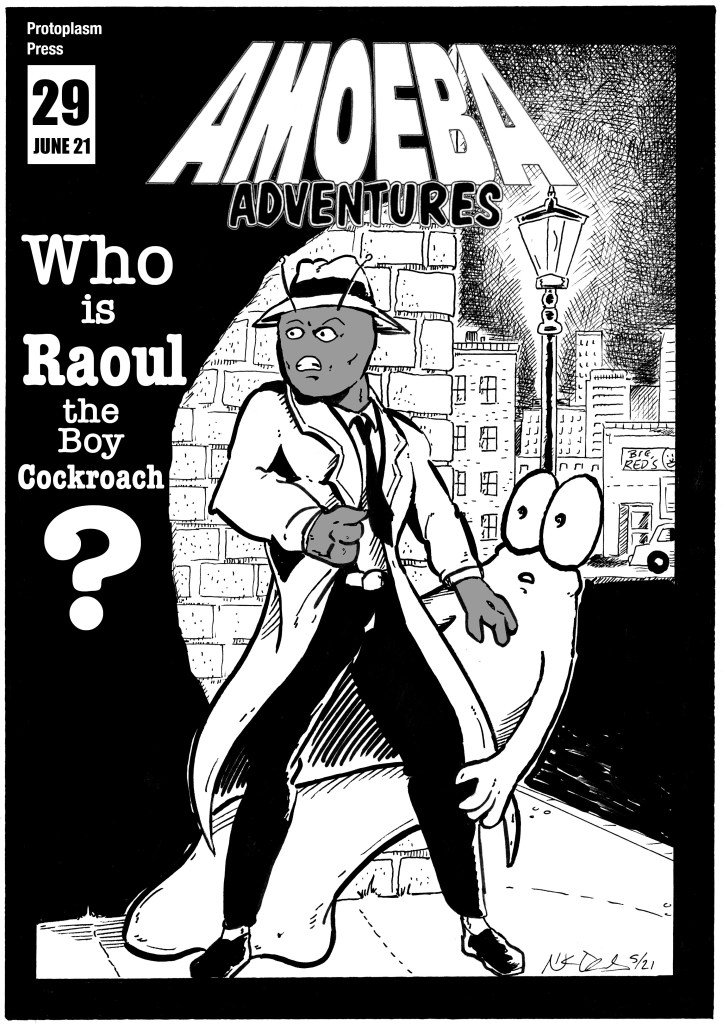
Sneak preview: Amoeba Adventures #29!

Hey, it’s time for an Amoeba Adventures update!

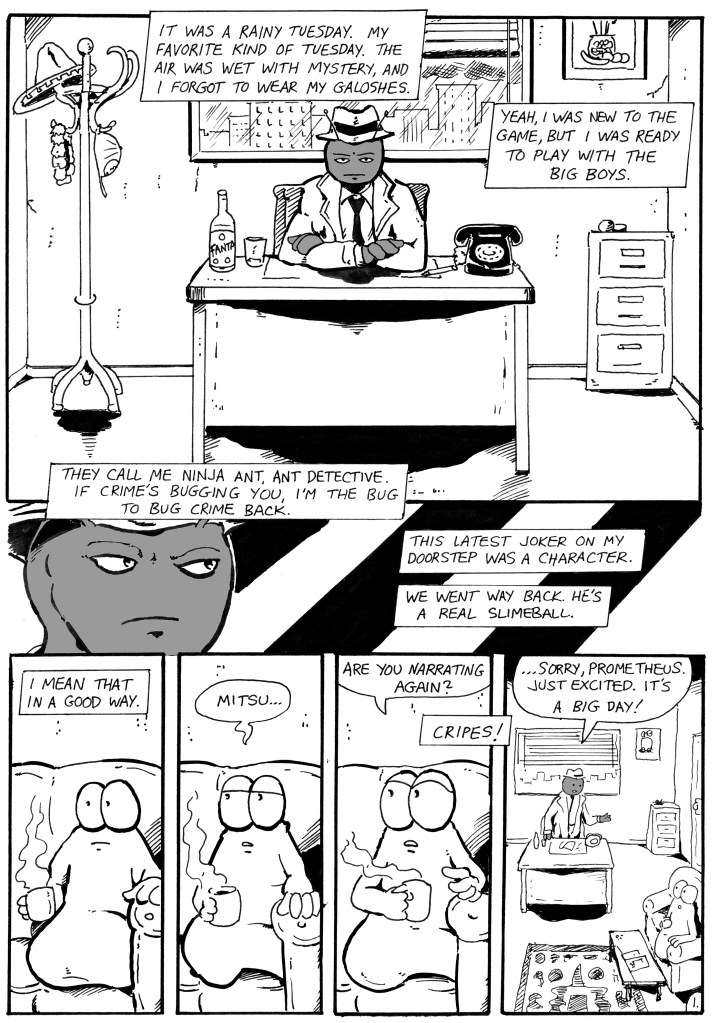
It’s been a few months since Amoeba Adventures #28, but I’ve been busy – Amoeba Adventures #29 is all pencilled and lettered and will be 24 pages of all-new wacky adventures featuring twists, turns and shocking returns with Prometheus and Ninja Ant together in one wild detective mystery.

Look for it to premiere both digitally and with a limited-edition print version hopefully sometime in June! In the meantime, here’s a sneak peek at my old-school pencils and lettering:

And remember that all 28 previous issues of Amoeba Adventures are available right over here as free PDF downloads. As always, give the Facebook page a like if you haven’t already!

Movies I Have Never Seen #9: Zardoz (1974)

What is it: The one where the late, great Sean Connery spends most of the movie wearing nothing but a giant orange space diaper. A rather big flop on its release in 1974, it’s generally regarded as one of the strangest science-fiction movies that came in that weird time in between 2001: A Space Odyssey and Star Wars, when science-fiction movies turned into cosmic head-trips, equally rich in big ideas and spaced-out nonsense. How weird is Zardoz? It starts off with a floating giant stone head descending into a crowd of gun-waving savages, and delivering this speech: “Zardoz your God gave you the gift of the Gun. The Gun is good! The Penis is evil!”

Why I never saw it: Zardoz is on the obscure side. Director John Boorman delivered the hillbilly hit Deliverance, and this was his follow-up, in the days when directors got to do whatever crazy shit they dreamed up if they scored a big box office winner. So Boorman (who co-wrote, produced and directed this passion project) came up with a lofty tale set in the distant year of 2293, where what’s left of the human population is divided into the feral “Mad Max” style “Brutals,” and the hippie immortal “Eternals,” who live in their own closed-off world. When “Brutal” “Exterminator” Zed (Sean Connery) ends up infiltrating the Eternal world, it sets up a culture clash between enlightenment and instinct, life and death, and also lots of Sean Connery doing stuff you never saw Sean Connery doing anywhere else. At first, you think this will be some kind of weird post-apocalyptic Western, but it gradually turns into a darkly funny weird riff on “Tarzan” before swerving into another bleak and nihilistic direction entirely at the climax. The movie was a bomb at the time, and post-James Bond Connery never did anything quite so strange again. But Zardoz is kind of a cult fetish object now, although still on the obscure side, and even today, its odd pace, fractured hallucinogenic narrative and overstuffed philosophy make it a bit demanding on viewers. It strives for the profundity of 2001 or Tarkovsky’s Stalker, but falls a little closer to the cheeseball fest of Logan’s Run

Does it measure up to its rep? Absolutely, in that it’s frustrating, weird and sometimes slow and yet full of more searching ideas and deep thoughts than pretty much the entire Star Wars franchise post-1983. The experimental science fiction of the 1970s – 2001, Solaris, Soylent Green, Logan’s Run, THX1138, The Man Who Fell To Earth – led to many spiritually-tinged, oddball narratives that weren’t just about people having wars in spaceships. They aren’t all successful, but there’s a fevered, inventive passion to them that is sadly missing in a lot of science fiction since. Connery’s character is curious – a monosyllabic brute at the start who gradually becomes more and more talkative and curious as he turns the tables on the “Eternals.” He’s hugely unsympathetic, raping and murdering at will, but then again the aloof Eternals are pretty flawed themselves. It’s hard to quite figure out what Boorman’s point ultimately is with the shapeshifting script, but despite all that, there’s a lot of startling images in Zardoz – the remarkably ominous floating head, groovy prisms, mirrors and colours galore, the dazed and ruined world of the Eternals, and a startling time-lapse shot at the very end that’s unsparingly brutal. 

Worth seeing? If you want your mind blown and to see Sean Connery’s least flattering wardrobe since the blue terrycloth jumpsuit in Goldfinger, Zardoz is definitely worth a look. Heck, Zed’s bizarre look was so iconic it even inspired a Superman frenemy I rather dig. It’s a movie that really is trying to make a statement, and even if in the end that statement is rather half-baked and obscure to me, it’s worth the weird, wild ride. 

Why George Harrison is my favourite Beatle these days

Asking someone about their favourite Beatle is always a kind of litmus test. Are you more of a John, or a Paul? A George or even a Ringo? 

But sometimes, the Beatle you love changes. When I was a younger, angrier man, like an awful lot of people, John Lennon was my favourite Beatle. I listened to the stark anguish of Plastic Ono Band a lot and thought that “God” was like, deep, man. I still love that album and I still love John Lennon, but due to his untimely death, the story of John Lennon’s solo career will always feel a little unfinished to me. 

The first Beatle whose solo album I actually bought was George Harrison’s 1987 chart-topping comeback Cloud Nine, with its kitschy-yet-cool bop MTV-friendly “Got My Mind Set On You” all over the place in those days. The rest of the cassette tape I scrounged my pennies together to buy was pretty good, too – it was an optimistic yet contemplative groove, smooth with an ‘80s sheen thanks to producer Jeff Lynne. “When We Was Fab” was a colourful ode to the Beatles whose own work I was just beginning to discover thanks to the CD reissues of their albums, while songs like “That’s What It Takes” and “Fish On The Sand” summed up George’s vibe – searching, yet determined. 

It’s twenty years now this year since George left us at the too-young age of 58. These days, I find myself turning to George’s solo work far more than any other of the Fab Four.  

Harrison always seemed to be looking for something in this life, and he found it mostly in the embrace of Indian music and an intense spirituality that in some folks’ view helped bring world music to a bigger audience, but other people felt it turned him into a humourless scold. 

1970’s All Things Must Pass is widely regarded as the best Beatles solo album, and it’s still a masterpiece of symphonic, elegant and yet deeply personal pop bathed in Phil Spector’s “Wall of Sound”, with Harrison showing once and for all he wasn’t “just” the third Beatle, but an incredible songwriter in his own right. It’s incredibly lush, carrying on all the sweeping soundscapes the Beatles pioneered on albums from Revolver on to Abbey Road and it’s something that few of the other Beatles’ solo albums ever were – epic in its ambition. 

Yet when you peak with your first solo album and were once in the biggest band of all time, it’s hard not to have everything else afterward seen as a letdown. And no, Harrison never quite equaled All Things again, but he still put out some stellar solo work, including its immediate followup, Living In The Material World, which continued to explore George’s obsessions – inner peace, giving up your anger, and moving on (and occasional cranky rants, like “Sue Me Sue You Blues”). 

The rest of his albums never quite get as noticed now, but even the weakest has a few good tracks to recommend. 1974’s exhausted-sounding and rushed Dark Horse might be his nadir, but an obscurity like the underrated 1982 Gone Troppo has a relaxed, chilling on the beach vibe, harking back to the doo-wop and early rock and roll that the Beatles grew up adoring. The later albums George Harrison and Somewhere In England also marry George’s wry humility with hummable tunes. As he became mired in lawsuits and battles with his record labels, George’s solo career was mainly a product of the 1970s. After 1982, he only released one proper album, Cloud Nine, and the groovy collaborations with the all-star Travelling Wilburys. His long, long in the works next album, the valedictory and blissful Brainwashed, came out in 2002 after his death. 

Harrison sometimes has a reputation as the grim, silent Beatle, but many of his albums like Cloud Nine feel bathed in happiness. It felt like George was at peace. 

There’s a unified theme amongst his albums, which is something none of the other Beatles really managed in their solo work. McCartney has carried on his quest to write dozens more perfect pop songs but his work is often lacking in a vivid personal voice for me. While he’s been by far the most prolific solo Beatle, the sheer flood of albums dilutes the quality a little too often. Lennon wrestled with the demons of his past in a few great albums, was equally as questing as George but far more self-destructive, too. He then went silent for years, and his promising comeback was cruelly curtailed. Ringo was… well, he was Ringo, good-natured and always keeping the beat. 

Lennon inherited the fierce restless intellect and urge for experimentation of the Beatles, while McCartney got the gift for melody and craftsmanship. Harrison represented something else more intangible, something I might even call the Beatles’ heart. In the best of his solo work I find that all-encompassing warm feeling that I get when I hear the heavenly harmonies of “Within You Without You,” the solos that make “Something” soar far higher than most sappy ballads ever could, the distinctive single guitar chord played by George that opens up “A Hard Day’s Night.” In other words, listening to George Harrison makes me feel better about life, the universe and everything. 

George Harrison could certainly be preachy, I’ll admit. Harrison was looking for transcendence, and the older I get, the hope in something more to this life seems to resonate. I’m not talking about organised religion, really, but just the idea that you can find a calming peace by letting go of some of your baggage and flowing like water. The world is full of mystery. George Harrison never stopped trying to understand it.

George’s biggest song was “Something,” a tune that sums up his eternal questing and curiosity in its few minutes.  Is there something out there? I sure as hell don’t know. But the idea of being at peace with yourself and finding that inner calm that George spent much of his too-short life seeking isn’t the worst goal to have in this life. 

Listening to George Harrison makes me feel better about everything, and that’s why in these often-troubled days he’s my favourite Beatle. 

Review: Godzilla Vs. Kong, the monster mash we all needed

In a way, I’ve been waiting for this rematch most of my life. I grew up watching and rewatching 1962’s King Kong Vs. Godzilla on a battered Christmas gift VHS tape, my first exposure to classic kaiju movies. 

I won’t claim that ‘60s clash of the titans is an objectively good movie, but man I loved it back in the day, watching rubbery Godzilla and Kong stomp on model houses all over Japan. The Kong in that movie is awful looking, like a hairy Danny DeVito who was hit by a truck, but that didn’t really matter. It was all about the spectacle.

I’ve been a fan of Godzilla movies ever since, as I’ve written about before, and so decades after that VHS tape went to pieces, I went into an advance screening of the long-awaited Godzilla Vs. Kong this week with a kid’s eager anticipation. I was seeing it on the IMAX screen, really the only way to watch such a movie, and I left with my ears ringing and a mild headache after nearly two hours of chaos and carnage. It was loud, ridiculous and utterly fantastic. 

Look, you know going into a kaiju movie what to expect – lots of city-crushing action, some human melodrama, and a willing suspension of disbelief. By all those standards, Godzilla Vs. Kong succeeds admirably. They’ve been building up to this “Monsterverse” clash since 2014’s Godzilla reboot. Without spoilers, they create a good reason for the monsters to battle, throw in a few welcome surprises, and director Adam Wingard nicely straddles the line between kitsch and combat in a very fast-paced ride. Godzilla is the meaner, far more alien monster, and Kong is the more relatable human surrogate, but in the end they’re both just giant creatures smashing up everything in sight. 

Spoiler alert: The monsters do fight in two epic battle scenes, and it’s quite a sight. (The movie’s first clash, a battle at sea, is an all-time kaiju clash highlight.) Although I’ll always have a sentimental attachment to the 1962 flick, the action in this remake blows it out of the water. While these more recent Monsterverse movies can have an annoying tendency to have battles happen at night/in the rain, Godzilla Vs. Kong mostly stages them cleanly and coherently. The special effects work to bring Kong to life is particularly good, giving the big lug a real sense of personality. You could argue that maybe Godzilla isn’t in the movie enough, but actually, he usually racks up less screen time than you’d think if you look at charts like this uber-geeky fan study. The point is the impact he makes when he’s on screen. 

Godzilla Vs Kong actually reminds me a lot of the movies in Japan’s utterly bonkers Millennium series circa the year 2000, which married the zaniness of the original ‘60s Showa era movies with a slick, modern vibe and special effects, and a madcap “anything can happen” feeling. You can do a gritty realism version of Godzilla but you’ll never really better the dark Cold War paranoia of the original 1954 classic.

The key really is to not take these movies too seriously – a flaw that the sluggish Godzilla 2014 was particularly guilty of, while the underrated Godzilla: King of the Monsters managed to be a bit more interested in smashing over hushed awe. GvK takes on a Jules Verne-esque vibe that embraces the mysteries of lost worlds, a theme which we also saw in the great 2017 Kong: Skull Island (still the best of these “Monsterverse” movies, I think). 

The humans are mostly there to fill the gaps between battles, and medium-famous names like Alexander Skarsgård, Millie Bobby Brown and NZ’s own Julian Dennison get the job done. Those “family drama” issues that hobbled King of the Monsters are barely sketched in with each human just getting one or two character traits (scientist has a dead brother; woman adopts troubled orphan; guy loves conspiracy theories). The humans in GvK are almost shorthand approximations of human beings, but who goes to these movies for the humans? You have to just accept that in any realistic kaiju movie the human characters would be dead in the first five minutes and move on, rolling over the implausibilities and basking in the spectacle. 

And boy, there’s a lot of spectacles in Godzilla Vs. Kong. It’s the cinematic equivalent of three energy drinks and a bucket full of M&Ms, and it might leave you with a bit of a sensory overload hangover, but in 2021, there’s no blockbuster I’d rather see than a giant monkey punching a giant lizard right in the face. 

Review: Crowded House, Auckland, March 21, and we’re all in this together

The first time I heard Crowded House was on a fuzzy mix tape from a high school girlfriend. 

She put most of their entire second album Temple Of Low Men onto this tape, and it felt strange yet familiar. Neil Finn’s voice was gorgeous yet kind of tense, and songs like “Into Temptation” and “I Feel Possessed” felt like a secret code to me in the age of MTV and Bon Jovi. Finn’s lyrics marry the universality of the Beatles with a wry Kiwi humility and eye for detail. The music felt wiser, older somehow than the typical ‘80s pop hits I usually listened to. It felt built to last.

Ever since I think of rainy afternoons, fumbling teenage heartbreak and the impossible fragility of things when I hear Crowded House. 

I barely knew what New Zealand was, and Neil Finn and company were my first introduction to the place I’d one day end up living. 

I moved to New Zealand 15 years ago, the place that hissing cassette spoke of. I’ve now seen Neil Finn a live a few times solo and with other acts, even run across him in the crowd at other shows (it’s a small country, you know), but I never did see Crowded House live. 

Last night, I entered an arena and stood 25 feet or so in front of Neil Finn and the reunited House in one of the only countries in the world such crowded stadium shows can still happen these days. Like the best of Crowded House’s music, it was broad and intimate at the same time. 

Neil and the band, now joined by his amazing sons Liam and Elroy, put on a soaring, cathartic show, doubled in strangeness by seeming so normal with much of the rest of the world still howling in the heart of the storm of COVID-19. All around me, people kept looking at the nearly full arena, almost 12,000 people unmasked and very grateful to be here. 

The lovely little earworms have turned into national anthems – “Better Be Home Soon,” “Don’t Dream It’s Over,” “Something So Strong” – and it was kind of beautiful to have them become stadium sing-alongs. Sometimes the crowd sing-alongs are pretty cringe stuff, but it’s been a weird year or so and it felt good to be part of a crowd. We’re all in this Crowded House together. 

I’ve been here 15 years ago now and so I know what Neil’s singing about in “Four Seasons In One Day” when he talks about “the sun shines in the black clouds hanging over the Domain,” because I’ve walked the grassy fields of the Domain probably a hundred times now. 

And there were the deeper cuts that I’ve listened to over and over through the years – a mesmerizing “Private Universe,” the sultry “Whispers And Moans,” a right fierce bang-up on “Knocked Out,” or a marvelous cover of David Bowie’s “Heroes” dedicated to all the front-line workers here and everywhere who’ve made New Zealand a safe island in a world of worries. 

That lovestruck teenager playing that cassette tape over and over couldn’t have imagined how things would end up. The teenage girlfriend and I didn’t last long, but the music echoed forever. 

Neil Finn was singing last night to a very crowded house, yet he was also singing to me, alone in my room a million years ago, listening to gorgeous lonesome pop music and never imagining where he’d end up in this life. 

It’s literally been decades since I got that mysterious mix tape that introduced me to Crowded House, and I’ve got no idea what happened to the quirky and cool girl who gave it to me.

If I could, I’d tell her how I saw Neil Finn sing those songs last night, about the wonderful Kiwi woman I ended up marrying, how strange it was that I ended up in the place that all that haunting music came from, that I’m doing OK and that I hope she’s OK too.

Manimal, where the idea was better than the TV show

A TV producer named Glen A. Larson was responsible for an awful lot of the schlock I adored in the 1980s – Battlestar Galactica, Buck Rogers, The Fall Guy, Knight Rider, Automan and perhaps my most beloved short-lived TV series, the eternally mocked Manimal

Larson was the go-to for cheesy action shows with a ‘hook’ that ripped off other movies (Automan might have well as been called Almost Tron). Larson pumped out an awful lot of hits before his death in 2014, but his fair share of misses, too.

As a kid, I didn’t realise Larson was kind of scorned by the critics. I remember being totally into the original Battlestar Galactica when I was a wee idealistic young thing, and it took my several years to realise that the show was actually kind of a critical punching bag, that lots of folks thought it was just a rip-off of Star Wars, and so forth. I still don’t agree, but do admit Galactica had many creaky spots. (They were all completely right about Galactica 1980, though. Phew.) 

Which brings me to Manimal, a show that I know intellectually is not all that good but I kind of adore it. Poor Manimal only lasted a mere 8 episodes in the fall of 1983, and god help me, I watched every one of them at the time. Manimal was the tale of Dr. Jonathan Chase (Simon MacCorkindale), a playboy British dude who thanks to some vaguely explained exotic foreign training could turn into any animal he chooses. Naturally, he ends up fighting crime, joining the police department as a vague “consultant”, like Sherlock Holmes with fur, and paired with a perky young detective (Flash Gordon’s Melody Anderson). Lately, I’ve been rewatching the brief run on a cheap DVD I picked up (you won’t find something this obscure on streaming) and while adult me sees the plot holes and cliches galore, Manimal is still a kind of goofy retro treat. Come on, how can you NOT like that opening theme? 

Look, the show was cheese, boilerplate ‘80s cop storylines enlivened by the guy who could turn into animals – mostly a black panther and a hawk, although once he turned into a snake. The transformation sequences were goofy but cool stop-motion special effects, although they were largely repeated in every single episode. The budget and desire for innovation was clearly minimal – you hear the same panther roar sound effect about 1000 times in the eight episodes – and one of the more ridiculous side effects was that every time Jonathan transformed into an animal, tearing apart his clothing Hulk style, he somehow ended up instantly back in a stylish three-piece suit at the end of every animal change. Back in the day, David Letterman got a lot of mileage out of Manimal mocking. Really, I can’t blame him. 

And still – MacCorkindale is an engaging leading man, endlessly confident in his own abilities and making Jonathan Chase more likeable than he could’ve been. (Sadly, MacCorkindale died of cancer at just 58.) And Anderson, who was a frequent guest on all kinds of ‘80s TV shows, is an enjoyably cynical sidekick. The rest of the stock characters – the token Black partner who never gets much to do, the always angry police boss – fare less well, and honestly, the scripts on Manimal’s 8 episodes are barely mediocre. The good doctor’s backstory is never really explored, nor is the potential of his powers.

Larson was known for knocking ‘em out and having some good hooks, but the execution is probably where much of his reputation for mediocrity came from. Other than the guy who turns into a cat once or twice a show, it’s cliche cop show 101. But it was Manimal’s core concept that hooked me as an animal-obsessed kid – a guy who can turn into any animal! – and that I still kind of love today.

I don’t know if I really want to see a Manimal reboot – they’ve been threatening one for years, which would probably end up starring Will Ferrell or Jack Black or something – but at the same time it probably wouldn’t have the awkward low-budget charm of Glen A. Larson’s short-lived TV show. I’ll take my poor neglected Manimal just the way it is.

Lou Reed, and loving someone even if they’re kind of a jerk

Today would’ve been Lou Reed’s 79th birthday, and I still miss his battered, cynical voice in this troubled world. 

He’s still the only artist whose lyrics I’ve got tattooed on my arm, and I’d easily put him in my personal top 5 pantheon of musicians I return to again and again. But he wasn’t easy – Bowie or Prince could challenge but they never really scared you; Dylan and Costello have taken missteps in their career but never quite sabotaged it as badly as Lou could (Dylan’s born-again phase comes close, though). 

Yet he was also an amazing next-level jerk an awful lot of the time, as even a cursory read through Lou biographies and many rather tense interviews will attest. He would not put up with fools, or even innocent questions, and there’s a bloody battlefield of journalists mauled on the field by Lou Reed who didn’t all deserve their wounds. Whatever demons drove him in life led him to lash out a lot, too. 

But boy, Lou Reed could write a song, whether it’s the clatter and loneliness of the Velvet Underground or the brief moment he spent as a pop star with “Walk On The Wild Side”; the anguished family dynamics of Berlin or the strutting prophet of New York.

And there’s Magic and Loss, his 1992 song-cycle about death and dying that is honestly one of my favourite albums of all time – and yes, I’ve got words from the title track tattooed on my arm, and yes, I’d be happy enough from the great beyond if someone cranks that epic title song up at my funeral. Lou was kind of a genius, you know?

I only saw him live once, from a distance in Seattle, but as much as I love Lou Reed’s music that’s probably as close as I wanted to get. I’d probably have been a suffering fool in his eyes. 

Lou Reed offended, an awful lot of time, from the Velvet Underground singing about heroin to an album full of feedback to the rather ear-scraping and awkward collaboration with Metallica that was his abrasive final work. Sometimes it felt like he was just playing a role, a demented character he’d created. Sometimes it didn’t. But he did mellow out in his final years before his death in 2013 (I’m thinking the zen calm of his wife Laurie Anderson helped a lot). 

We live in an era where a lot of past behaviour is being questioned and analysed through new eyes. That’s a good thing. There’s a murderer’s row of celebrities who have been shamed and scorned and sometimes even jailed.

Some of these fallen stars I stopped caring about the moment their misdeeds came about, others I have made the decision to continue reading/listening/watching their work in full awareness of how flawed they were. That’s the choice any of us make when we consume art. A lot of artists are jerks, or worse. Lou Reed never hid his cantankerous side and it’s certainly not breaking news. Lou Reed wasn’t a nice guy an awful lot of the time, but he made some beautiful music for me. 

In the end, you take what you want to take and leave what you want to leave. There’s a bit of magic in everything. Lou Reed left me a lot. 

WandaVision and at long last, the redemption of Monica Rambeau

Look, it’s been a long time since the last Marvel movie came out in theatres, so you had better believe I’ve been soaking up those WandaVision episodes to fill that spandex-shaped hole in my heart. 

I’ve always loved the Scarlet Witch and the Vision’s tragedy-tossed romance in the comics, and even though the portrayal on screen is pretty different, it still hits the spot mostly. But I’m not here to gossip about Wanda and the Vision, or to speculate on all those plot twists and spoilers. (Although if you’ve been a comics fan for decades like me, things that are obscure to many viewers are less of a surprise, unfortunately.)

No, I’m here to sing the praises of WandaVision supporting character Monica Rambeau, played excellently so far by Teyonah Parris. For those of us who grew up at a certain time in the mid-1980s, she was OUR Captain Marvel – not that guy, not that guy, and no, not that lady either. Without giving too much away about WandaVision so far, it’s clear that the TV show’s Monica is heading toward converging with her comics namesake in many ways. 

Monica Rambeau was “Captain Marvel” for about 6-7 years from 1982 to 1988, and unfortunately her story is one of the saddest stories of mislaid potential in comics to me. She made a dynamic debut in Amazing Spider-Man Annual #16 as a woman with mysterious energy powers, written by Roger Stern, who’d go on to chronicle her in Avengers as well.

I remember well picking up that Spider-Man annual and young Nik being dazzled by the splash page debut of this new Captain Marvel, standing tall and proud on the Empire State Building. Even in 1982, she was a striking character – a strong, confident Black woman from New Orleans who managed to utterly avoid a lot of the cliches about Black heroes – she wasn’t “angry” like Luke Cage or mysteriously foreign like the Black Panther. She was relatable in a way many previous Black heroes weren’t. She wasn’t quite like anybody I’d seen in comics before, which were still a pretty lily-white area in 1982. 

She joined Roger Stern’s Avengers shortly after her debut – the first Black woman Avenger! – and a common subplot in his stories was about her adjusting to superhero life and her powers and juggling a career and life back with her family in New Orleans. None of it was groundbreaking stuff for comics at the time, but this Captain Marvel always held my attention.

Captain Marvel gained in confidence and experience and eventually rose to become the leader of the Avengers, breaking a glass ceiling I applauded. And then everything went rather wrong. Roger Stern was sacked as Avengers writer, and a misguided storyline by the next creative team saw Rambeau constantly, obsessively questioning her leadership skills, then suffering the indignity of being both depowered and mind-controlled and essentially forced off the team by everyone’s least favourite Avenger, Doctor Druid. It was a real betrayal of her character and while I don’t think it was intentional, it was kind of offensive that the first Black woman Avenger was written off so abruptly. 

Marvel didn’t die and she got her powers back, but honestly, she’s never been quite the same character since. Marvel Comics didn’t seem to know what to do with her. She gave up the Captain Marvel name, which she had well and truly earned, to yet another Captain Marvel. She popped up in many Avengers tales, with vaguely generic new superhero names like Photon, Pulsar, and Spectrum. She just became another one of Marvel’s many, many superheroes rather than the captivating self-made woman who blazed through the 1980s in a sizzle of light.  

A wisecracking, cynical version of her later appeared in Warren Ellis’ very funny 2006 superhero parody NextWave. It wasn’t hard to imagine this was a rather meta Monica Rambeau, pissed off as hell at the world of comics after rising so quickly and then falling into obscurity. Eventually Carol Danvers became the “official” Captain Marvel and well, she’s probably got the title for life now. 

So you’ll forgive me if I’m excited about Monica Rambeau showing up, apparently gaining powers and wearing an outfit that harks back an awful lot to her first appearance in the latest WandaVision. I’m really enjoying her role in the show and her likely further appearances in the Marvel Cinematic Universe, even if I know she won’t be called Captain Marvel there.

It’s been a long road for redemption for Monica Rambeau’s character, who deserved better as the first Black female Avenger. She deserves this shot, and more. 

‘Invisible Men’ brings Black comics history into the light

February is Black History Month, and a great new book sheds a much-needed light on the hidden history of Black golden age comics creators, mostly ignored or suppressed in their time.

There’s a lot more diversity in the comics field today than there once was. It really took until the 1980s and 1990s for things to open up some – for instance, despite comics as we know them debuting in the 1930s, it wasn’t until the 1970s that Black superheroes really came into their own. The first Black superhero was of course, The Black Panther, but the first to get his own book was Luke Cage, Hero For Hire in 1972.

There was a mini-boom in Black heroes in the ‘70s (pretty much every one of which got the word “Black” in their superhero name). I was always fascinated by the 1970s adventures of Luke Cage, the short-lived Black Goliath, The Falcon, DC’s Green Lantern John Stewart, Tony Isabella’s street-level hero Black Lightning, and of course, the Black Panther. 

Reflecting the industry at the time, the ‘70s Black hero adventures were pretty much always written by white men, although the late Black artist Billy Graham played a pivotal part in Luke Cage and Black Panther adventures. And sure, these comics overplay the “angry Black man” trope a bit, but they’re also very much a product of their protest-filled era. 

Before that, there were few brief sightings of Black leading characters in comics – the interesting short-lived western curio Lobo for instance – but much of Black comics history remains frustratingly obscured. The new book Invisible Men: The Trailblazing Black Artists of Comic Books by Ken Quattro attempts to correct that, with an excellent compilation of essays about and excerpts from Black-created comics from the 1930s on up to the late 1960s. 

Here you’ll find the life stories of a dozen Black men who blazed trails in comics, often discriminated against, sadly too often forgotten (women of any colour were exceedingly rare in Golden Age comics). You’ll meet Elmer Cecil Stoner, Owen Charles Middleton, Elton Clay Fax, Matt Baker and many more. 

Matt Baker is probably the best known Black comics artist of the Golden Age, a creator of spectacularly sexy 1950s “good girl” art with characters like Phantom Lady. Yet despite his amazing talent, Baker and his Black identity were obscure until long after his early death at just 38. 

Other Black artists edged their way into comics working on mainstream characters like Blue Beetle or Spy Smasher, while others attempted to tell stories about Black history or were pigeonholed into the “jungle comics” genre. Some of these artists only dabbled in comics and went on to far greater success in illustration, painting or other art endeavours, such as Alvin Carl Hollingsworth

Invisible Men includes an essay on and excerpts from the Black-created All-Negro Comics #1 – a title which admittedly is pretty problematic in 2021 – but in 1947, this short-lived title attempted to be a landmark showcase for Black cartoonists with characters like “Ace Harlem” and “Lion Man.”

Quattro’s done an excellent job of excavating the obscurest of historical details to fill in the lives of creators who in another era, might’ve been the next Christopher Priest or Denys Cowan. 

The history of Black comics artists in the Golden Age isn’t always uplifting – for every Matt Baker there were dozens of frustrated artists locked out of the medium – but Invisible Men is essential reading. The creators here paved the path for things like black-controlled Milestone Comics, for the Black Panther to star in one of the biggest movies of all time … and for a world where far more people are able to be visible instead of invisible.