At long last, I’ve got my ROM action figure

It took me 46 years, but I finally got my ROM toy. 

As young fanboys turn into old geeks, we often fantasise about the childhood toys we once had, or the ones we never had at all. 

I’ve written before about how addicting action figures could be and how, despite being a bit more flush of cash than I was when I was 11, I try to be a little more restrained these days. I’ll still buy one here or there, but they have to be special. 

Like ROM. 

Growing up in the late 1970s I was a vagabond child, and spent much of my eighth year travelling in a campervan in Europe with my family. I’d see comic book ads for things like Micronauts or Shogun Warriors or those new-fangled Star Wars action figures but I sure as heck wasn’t going to find them in Luxembourg or wherever the heck we were that week.

We couldn’t get a lot. One toy my parents got me somewhere in Europe which sounded cool was the Amazing Energized Spider-Man (TM) with web-climbing action, who rather lamely turned out to be an utterly immobile statue of Spidey with a perpetually raised left arm, who would get hoisted up by his little energized web winch thing. It wasn’t terrible, but there wasn’t a lot you could do with a Spider-Man toy who always looked like he was hailing the cross-town bus. 

But one enticing toy I kept seeing in the American comic books I foraged from military base PXs in that distant world of 1979 was ROM. The ads blared, “ROM HAS COME … EVIL IS ON THE RUN!”

The ad boasted of “the greatest of all spaceknights”, who was premiering in a cunning case of cross-synergy with an electronic action toy by Parker Brothers and a new Marvel comic book series. Who was ROM? Heck if I knew, but I wanted to know. 

Of course, I eventually picked up those ROM comic books, which are still a favourite of mine. Over a 75-issue run well into the ‘80s, ROM’s surprisingly good comic lasted a lot longer than the toy ever did, thanks to the energetic corny delights of Bill Mantlo’s writing and Sal Buscema’s reliably expressive artwork.

Over several years Mantlo spun a story of ROM, who sacrificed his humanity to battle the evil Dire Wraiths. It was never revolutionary comics but it was always good fun, and unlike so many comic book series it actually had an ending, which I really appreciated. 

I loved those ROM comics, but I was never able to find myself a vintage ROM Parker Brothers toy. They kind of flopped and you never saw them at yard sales or swap meets and there wasn’t an internet to search then. These days, you could drop a few hundred bucks for one on eBay, but I’m not that dedicated to reliving my childhood fantasies of having all the cool toys. 

But then the other day, I saw a new Marvel Legends ROM action figure for a decent price online – sure, it wasn’t the 13-inch tall “electronic action toy” of yore but it was pretty darned shiny with all ROM’s fancy accessories and that glam silver iconic spaceknight sure did look appealing. (And to be totally honest, it’s a much better looking action figure than the somewhat awkward 1979 toy.)

So I bought my ROM.

And gosh darn it, he is still pretty cool, I think. 

Maybe next I can find a cheaper modern version of those super cool 24-inch tall Shogun Warriors toys that the kid down the road had. After all, a spaceknight’s work is never done. 

Because it is hard: For All Mankind and dreams of space

Lately, I’ve been dreaming of the stars. 

I’ve been feverishly catching up with the four seasons to date of Apple TV’s For All Mankind, after putting it off for ages. One of the things that appeals to me about it is the insistence in this space exploration epic of dreaming big, daring big, in a way that our somehow smaller world doesn’t feel like it does any more. 

I’m a sucker for alternate histories, and For All Mankind paints a compellingly fascinating picture where the Soviets landing on the Moon before America does has a ripple effect on global history.

It’s a world where there’s no Watergate, 9/11 attack or assassination of John Lennon. Instead, Margaret Thatcher and Pope John Paul were both killed!

It’s a world where Presidents Ted Kennedy, Gary Hart and Al Gore all end up in the mix of history with Reagan and Nixon. Oh, and there’s no public internet or social media, which actually might not be a bad thing when you think about it. 

This alternate reality also proves itself to be somewhat more progressive than the real one, although not without its speed bumps. After Russia lands a woman on the Moon, a spooked NASA assembles a crew of women astronauts to one-up their rivals, decades before women actually went into space. For All Mankind also dips into race and sexual equality – in this world, the Equal Rights Amendment passes, one of the top astronauts is a Black woman (an excellent Krys Marshall), and gay equality unspools in startlingly different ways than it has here.

The real-world President Kennedy’s famous quote – “We choose to go to the Moon in this decade and do the other things, not because they are easy, but because they are hard” – sums up the vibe of For All Mankind, of the hopeful engineers still beavering away in real-life space programs, and in a hundred other wide-eyed speculative fictions about man in space. It shows a world where striving to do the hard thing fundamentally changes the course of history. 

Like many of us, I’m drawn to the idea of man out amongst the stars, even if in reality it seems as far away as ever. I read Kim Stanley Robinson’s terrific Mars trilogy a few years back, and recently just devoured the excellent non-fiction Space Race: The Epic Battle Between America and the Soviet Union for Dominion of Space by Deborah Cadbury, which sheds a lot of light on the early years of the space programme and particularly the terrible price Soviet citizens paid to try and stay in the game. 

There’s a lot of dark, bleak science fiction out there, of course, and there’s certainly a place for it, but at the moment, give me some optimism things might get better. Good science fiction, at its best, gives us something to dream about – as in the endearingly dorky future of Star Trek, or the colourful chaos of Guardians of the Galaxy. I like watching aliens eat people’s faces as much as anyone but also, I like the idea of boldly going where no one has gone before.

Idealism seems pretty passé in 2025, where even lofty talk of utopian futures is usually tempered with a healthy dose of talk of vengeance on your enemies and crushing dissent. In a world that feels like it’s getting a little more unhinged by the week, I like to imagine missions to Mars and cruising amongst the asteroids.  

We haven’t been to the moon since 1972, before many people today were even born, and only four men who walked on the moon are still alive. In amongst all the stunning incompetence of American politics at the moment, it looks like another mission may finally come soon, more than 50 years later — which would be something to see, wouldn’t it? 

For All Mankind isn’t a rose-coloured look at the future – its alternate history is drenched in plenty of blood and horror, terrorism and distrust, where man (spoilers ahead!) does make it to the Moon and even Mars but constantly comes up against the same conflicts that keep screwing us all up on Earth. But through it all, even at the worst moments, there is the desire to dream big, and do big, hard things. 

For All Mankind does get a bit goofy and far-fetched the further ahead into its alt-history it goes, with some of the more daring episodes approaching Star Trek levels. Some of the characters become annoyingly soap opera-ish over time. Lead actors Marshall, Joel Kinneman and Wrenn Schmidt are generally terrific, even as their characters get slathered in awkward makeup as decades pass on the show, but some of the other actors play with a broad bluntness that verges on the cartoonish. 

None of that really matters, though, when the space race kicks in and For All Mankind’s vision of a different, more adventurous world kicks in — when the doing hard things is just what’s expected. Go hard, go big, just go there.

You know it’s bad when they start going after the court jesters

…I really don’t write much about America these days, and the way the place I called home for 35 or so years no longer makes sense to me.

I don’t have the spleen to be filled with outrage 24 hours a day any more, only a deep kind of sadness and the quote from the R.E.M. song (via the Linklater classic Slacker, of course) perpetually pinballing around my brain: “to withdraw in disgust is not the same as apathy.” I find my peace in a bit of grim distance from following every dismal development, and appreciating all the other ways life is still pretty darned good away from the bad news machine. 

But this week, when they really started going after the court jesters, it made me feel like things are even a little more apocalyptic than the current end times vibe.

For decades, the late-night TV show hosts, the Carsons and Lettermans and Lenos and kindred spirit Saturday Night Live, they were the court jesters on the American political scene. They would mock mercilessly Ford, Reagan, Bushes and Clintons and the like, for their real failings and their merely human missteps. They were a central part of the culture, with entire books written about their doings and in-fighting,  or one of my favourite TV shows being set entirely in the world of late night.

I caught the very tail end of Johnny Carson’s everyman years, and was a faithful watcher of David Letterman in his heyday, of SNL many years ago. I’ve watched a fair bit of Colbert and The Daily Show although I honestly don’t think I’ve watched more than a few minutes of Jimmy Kimmel, Seth Meyers or Jimmy Fallon, the current crop of hosts.

Dave could make fun of George H.W. Bush vomiting at a state dinner or Johnny could dress up as a fumbling Ronald Reagan. It was taken as a kind of point of pride that in America where the right to free speech is the very first amendment to the Constitution that you could mock the dear leader of the day, without fear of being forced off the airwaves by a carefully orchestrated tsunami of outrage. 

Let’s be clear – they weren’t always actually that funny, to be honest. Political humour of the day has a perhaps 25 percent hit rate that fades quickly over time, and Jay Leno’s Lewinsky ‘jokes’ had a shelf life of about .005 nanoseconds.

Letterman and Conan and the like were always a lot funnier when they followed their own weird muses rather than the headlines, but that wasn’t the point – the point was that they could make lame jokes about the man in the White House and the American political scene without fears the President himself would start screeching for their cancellation or calling the very idea of criticism against him “illegal.” 

The center did not hold, and the culture now revolves around a million very different siloed off entertainments and satirists than it once did when Johnny, Dave and Jay strode around on network television, the very height of celebrity in a world where nobody knew what an influencer was. Their time is fading, not entirely due to the current US administration, but they’re sure helping shove the stragglers out the door.

Instead of court jesters, we’re getting satire only tailored to existing beliefs or dizzyingly insular memes as the world drowns in a sea of doomscrolling and performative outage. In all the old sci-fi films, we imagined the end coming in a million ways, but few of them imagined a culture subsiding into the sea as we were all off inhaling TikToks and YouTube videos whilst sucking on cherry vapes with an Ozempic chaser.

I’ve got absolutely no good ideas, no hot takes about where all this goes from here.

But when you clear out the court jesters, it usually turns all you can hear is the king chortling to himself, self-satisfied, in a court where the only other sound is his laughter being echoed right back to him by a room full of sycophants. 

The Evil Dead and the evolution of Ash, from shy boy to demon slayer

I love the original Evil Dead trilogy and its splattery slapstick charms, so you’d better bet I was down for a marathon of the whole shebang at the legendary Hollywood Avondale this weekend, featuring an introduction by producer and honorary New Zealander Rob Tapert.

Tapert was right there, along with his mates director Sam Raimi and star Bruce Campbell in the Tennessee woods when the extremely low-fi 1981 original was shot, and has since gone on to be a producer of many great flicks in the years since – and also created a little character called Xena The Warrior Princess and married a Kiwi named Lucy Lawless, so he’s got some serious Kiwi bona fides.

Watching five hours of Evil Dead flicks on a rainy, windy Saturday night is my idea of a good time. Evil Dead (1981), Evil Dead II (1986) and Army Of Darkness (1992) form a trilogy which starts off as a group of young folks facing evil in a cabin in the woods and ends up with an army of skeletons battling knights in armor while a blustery guy with a robot hand eggs them on. 

I recommend a strong stomach and plenty of caffeine if you’re going to mainline all three movies at once, but it’s also fascinating to watch how different they are – the original is more straight existential horror, while the second almost remakes it but with a much more comic eye, while the third almost abandons horror and gore entirely for a straight out slapstick parody of all those old Ray Harryhausen flicks with sword-fighting skeletons. In these days of carefully plotted cinematic universes and decade-long “phases,” the Evil Dead trilogy is a monument to just making up shit as you go along. 

The only constant through it all is Ash, swaggeringly portrayed by Bruce Campbell. Images of Ash with a shotgun in one hand and his chainsaw taking the place of his other hand are iconic in comic horror, and his adventures have continued long after the original trilogy in plenty of comic books and videogames – and the surprisingly great 2015-2018 Ash Vs Evil Dead series that gave us everything and more the long-promised Evil Dead IV could have. 

Continuity is not a strong suit in the Dead trilogy – the success of the dimestore-cheap production of Evil Dead led Raimi and company to make a sequel, but it’s kind of bolted together with what Tapert called a “condensed” recap of the original in the first 10 minutes or so that reimagines the movie and streamlines it, then picks it all up again with Ash still battling those demons in the woods. 

And yet, watching the whole trilogy is also like watching Campbell and Ash find their way into a character. The catchphrase-shouting arrogant Ash we all “think” of when we think of Evil Dead only really comes into focus halfway through Evil Dead II, and becomes his most ideal self in Army Of Darkness.

When we first meet Campbell in Evil Dead, he’s a bland non-entity sitting in the back seat of the car heading to that infamous cabin in the woods, a sidekick to his more extroverted pal Scotty. You think Scotty’s going to be the big hero but then it’s quiet background Ash who ends up the “final girl.” It’s always a shock rewatching Evil Dead to see an almost shy Ash at first, who barely cracks a joke and who becomes the series’ focus only by his lucky knack for surviving the demonic chaos that consumes his friends. 

How did Ash go from shy boy in backseat to the alpha male in Army Of Darkness spitting out lines like “Gimme some sugar, baby” and “Yo, she-bitch! Let’s go!” The endearingly choppy nature of storytelling in the Evil Dead trilogy ignores rather than tries to fill in the contradictions of how Ash became, well, Ash, but in my own mental backstory I like to paper in the cracks of it all to be a tale of how Ash survives the incredible trauma of having his girlfriends, best pals and total strangers literally torn to pieces in front of him, of having to chop off his own demon-possessed hand and horrors that would drive anyone bonkers. 

In my head canon, Ash was the shy college boy when all the Deadite doings started – he’s actually repeatedly rather a coward in the climax of the original Evil Dead – but when the evil never stopped, he forces himself to become what he thinks of as a hero. Trauma remakes Ash, body and soul.

By the time Army of Darkness rolls around Ash is stranded in the year 1300 surrounded by “primitives,” and has completely reinvented his own personality to be the hero he probably saw in lots of late-night zombie movies. You can’t imagine Evil Dead 1981 Ash lecturing crowds of peasants about his superiority like Army of Darkness Ash does. He spouts bull-headed cliches and romances the pretty girl and stomps around with his “boomstick” but it’s all a bit of an act, really. He’s putting on the Ash, savior of humanity act to survive. 

That’s my theory, anyway. It could also be that the Evil Dead trilogy, as wildly entertaining and inspirational to creative folks as it is, is also just a slapdash bag of gags, gore and grit stapled together from film to film with no real deep concerns about how the cliffhanger end of Evil Dead II and Army of Darkness literally don’t mesh together at all, or whatever happened to Ash’s friends in the car in the first movie who’ve been erased from history by the second. I thought as I watched all three movies back to back that if they’d come out in this social media age of endless fanboy dissection, every clickbait website in the cosmos would be bashing out hate essays about the canon “mess ups” and “Evil Dead contradictions EXPLAINED!!!” videos. 

But whether or not it all makes a lick of sense or not, I do love how Bruce Campbell turned the gawky background guy in the back seat into a towering icon of horror movie heroism. As he’d put it – it’s pretty groovy. 

Always looking for that good line

Art by Darwyn Cooke

You can’t beat a good line. 

One thing I’ve grown to appreciate more and more these last, lo, 40+ years of my comic book obsessions, is the elegance of a good line of artwork.

I’ve watched comics go through phases from the powerful dynamism of John Byrne or Neal Adams to the over-etched details of the Image Comics house style to today’s computer-augmented slick comics art style. Some I like, some I don’t. (I can rarely pick up a Marvel Comic from the mid-1990s without an involuntary shudder at the sub-Liefeldian scratchiness of it all.)

Harvey Kurtzman

But a good line – well, that’s timeless. 

In my own feeble comic book scribblings it’s taken me a long time to learn that less can mean more – like many, back in the 1990s I quickly became enamoured of the Image comics “lots and lots of lines” school of art for a while there, and while I love the artists who can do amazing intricate detail – I’m thinking of Barry Windsor-Smith here, or the remarkable Gerhard’s impossibly grandiose cross-hatched background work on Dave Sim’s Cerebus – I also can now see the beauty in a single few flowing and infinite lines.

It took me a while to realise you don’t need to fill every millimetre of a panel with artwork. 

Will Eisner

I favour a little minimalism now, whether it’s old or new – the retro cool of Darwyn Cooke, the masterful hand of Will Eisner, Jeff Smith’s dynamic humour in Bone, the cool and elegant indie hipness of Daniel Clowes or Adrian Tomine, the chunky power of Harvey Kurtzman war comics, Frank Miller’s noir slashing brutalism in Sin City (before his artwork got too abstract for its own good), the gorgeous lines swished together with a lot of chiaroscuro shadows in Sean Phillips’ latest excellent crime thriller joint with Ed Brubaker, The Knives

There’s something to be said in just considering the lines in artwork, the way a skilled artist can fluidly widen or shrink his line with a dash of the brush, or sketch out a world of emotion in a few quick strokes. I like to sometimes just marvel at the arc and curve of a good line, and the talent involved in making it bend just so.

Sean Phillips
Jeff Smith
Adrian Tomine
Daniel Clowes

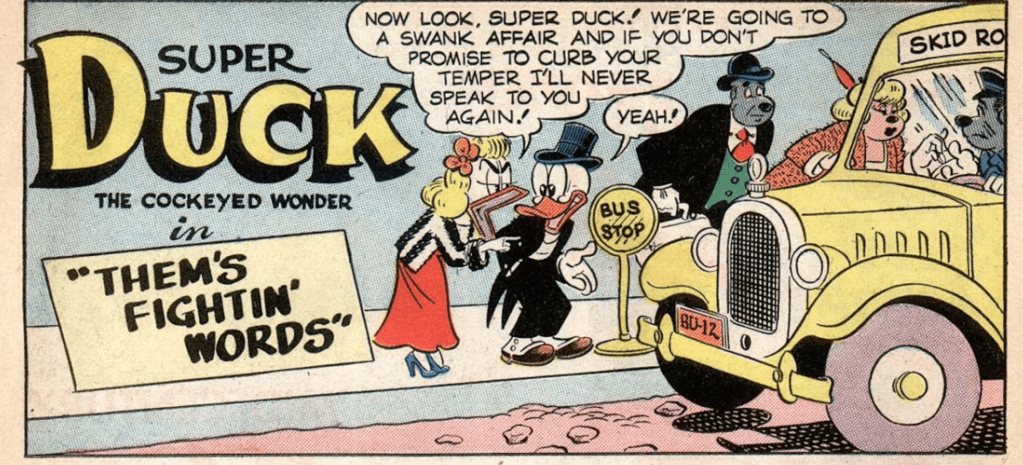
And oddly, perhaps in my kind of second (or third) childhood, I’ve become a big fan of “kiddie comics” the last few years and seeing with a new eye the astounding talent that you find in Carl Barks, John Stanley’s Little Lulu, Al Wiseman‘s Dennis the Menace, even Hot Stuff and Richie Rich. 

And heck, Archie comics, which have always been looked down a bit by comics snobs, have some of the crispest linework and designs in the business, especially when they were drafted by dazzling Dan DeCarlo. I grabbed a handsome art book of his Archie and other work recently and can pore over it endlessly, admiring all those beautiful, beautiful lines. There’s so much a brush can do, eh?

Dan DeCarlo
Dan DeCarlo
Dan DeCarlo
Ernie Colon – I think

Comic art can take a million different forms and that’s cool – I can still handle a Jim Lee Batman drawing with all those fiddly little lines delineated for every muscle in Bruce Wayne’s face, but sometimes, you just want to soak up a good, bold line. 

Sean Phillips

The Toxic Avenger, still the world’s most disgusting superhero

For a series that literally stinks of radioactive ooze, the Toxic Avenger sure has had a long half-life. 

The Toxic Avenger movies are often objectively terrible films, working hard to be as nasty and dumb as they can be, and yet the franchise has somehow lasted more than 40 years and now is reborn in a moderately big-budget Hollywood movie.

I first came across 1984’s The Toxic Avenger at a high-school late-night party devoted to cheesy movies like Attack Of The Killer Tomatoes and Night of the Lepus. It’s an airhorn blast of crude comedy and gore, the story of a screeching nerd who’s bullied relentlessly and falls into a vat of toxic waste, transforming him into the Toxic Avenger, “New Jersey’s first superhero.” Armed with a janitor’s mop, he dispatches crowds of bad guys in nastily inventive ways, with splattery violence and slapstick lowbrow humour all crashing together into a swampy mess. 

Within the first 10 minutes of The Toxic Avenger a bunch of thugs run down an innocent teenager on a bike in sick, lingering detail, played for comedy, and you know what kind of trash-flick you’re in for. It feels like the only proper way to watch these movies is on a battered VHS tape in your Mom’s basement, hopped up on Nerds candy and Jolt cola. 

Troma, the studio behind Toxie, made its calling card its splattery punk-rock ethos B-movie horror comedies, calculated to outrage and offend.

 And yet, there’s a bit of ugly charm to some of the Toxic Avenger series if you’re in the right twisted frame of mind. It’s got this “let’s put on a show” amateur enthusiasm that evokes the days I’d spend as a pre-teenager hacking together terrible comedy cassette tapes with pals, or scribbling my early comic books. It’s the appeal of doing something, anything, even if it isn’t very good.

The first movie is so in-your-face with its offensiveness and broad comedy that it’s curiously watchable, but the three sequels spewed out from 1989 to 2000 are generally a case of diminishing returns (and they’re also all way too long – 87 minutes is the scientifically correct length for this kind of movie, not nearly two hours).

Toxic Avenger Part II takes our hero to Japan for some amusingly silly equal opportunity offensiveness, while in the proudly inept Toxic Avenger Part III: The Last Temptation of Toxie, our hero battles Satan himself. Both of these movies – shot at the same time and even oddly duplicating a few scenes – are choppily directed, terribly acted and gleefully stupid, although the sleazy sheer malice of the first movie fades away for a bumbling sloppiness. I gather Troma was trying to “mainstream” Toxie a bit – heck, there was even a short-lived Saturday morning cartoon and a Marvel comic book of this most un-mainstream saga. 

Ultimately, the twistedness all comes roaring back with 2000’s Citizen Toxie: The Toxic Avenger IV which is easily the grossest, most offensive movie of the franchise, ramping everything up to 11. A mad story that claims to be the only “real sequel,” it’s about Toxie and his evil alternate universe doppelgänger, and overflows with bodily fluids, gratuitous nudity, rape, rancid racial stereotypes and gore, to the point where the satire gets pretty lost in the sheer ugliness. Maybe I’m a snowflake, but lingeringly gross scenes showing a school shooting in a classroom of mentally disabled students or riffing on racist hate crimes just go too damned far. I get what they’re going for, but not sure I want to go there. Citizen Toxie is definitely an experience, but also an endurance test for most people. 

After the nihilistic stench of Citizen Toxie it’s strange indeed to see the character “redeemed” in a way with the new moderately gentler, family-focused reboot.

It’s strange to contrast director Mason Blair’s The Toxic Avenger 2025 with its predecessors. It’s far more of an actual movie, for one thing, with decent special effects and recognisable stars like Peter Dinklage, Kevin Bacon and Elijah Wood. It’s got gore and a few raunchy bits but held up against the sleazy originals, it feels positively tame. While it follows a similar arc – bullied Winston Gooze (Dinklage) is transformed into a working-class deformed hero taking on corrupt businessmen – it’s all slicker and less eccentric. 

There’s a core sense of sadism to much of the Troma Avenger years that simply doesn’t fly for many viewers in 2025. It’s funny to me that apparently the new Toxic Avenger, which was first released in 2023 but only now hitting cinemas, couldn’t find a distributor because it was “unreleasable” due to violence. Honestly, it’s about 1/10th as offensive and gross as Citizen Toxie. Times change. 

Toxic 2025 is still a pretty good time, although ultimately it’s far more conventional and lacks the outsider-art reek of the original movies. In the first four Toxic Avenger movies, everyone is pretty loathsome, even our hero (the incredibly unappealing performance by Mitch Cohen as the nerdy pre-Toxie in the first movie honestly makes you want to root for the bullies). It’s a world that feels tangibly rotten, with cackling moronic extras, gibbering villains and bumbling anti-heroes. 

Dinklage’s excellent performance here fills you with actual sympathy for his Toxie, and his relationship with his bullied son (a great Jacob Tremblay) gives the movie some serious heart, while Bacon and Wood have a lot of fun playing the sneering bad guys. There’s righteous vengeance and over-the-top villains (my favourite was the endlessly parkouring thug), but also a bit of a moral about acceptance. 

I can’t say I would ever feel the urge to rewatch anything but the first and most recent Toxic Avenger movies, to be honest, but I am oddly captivated by the strange longevity of Toxie’s warped world, where everything is shit, even the superheroes. The original Toxic Avenger series doesn’t have a serious bone in its body, mocking everything from the blind and disabled to the very concept of heroism. The new movie ends with a father bonding with his defiantly different son, on a kind of elegant note of optimism despite all the chaos that came before. 

As nice as all that feels – and it doesn’t leave you feeling like you want to wash your hands afterwards like the Troma movies do – it’s also not very Toxic, I guess. Then again, the world is a toxic enough place these days as it is, isn’t it? Perhaps a gentler Toxic Avenger is the hero we need. 

Still sticking up for Phil Collins after all these years

Musical tastes change with age, I get it. But no matter how cool you think you get, the stuff you loved when you were 14 years old will always be your secret love.

So it is with me and Phil Collins, whose best work I’ve always got time for, no matter how much other stuff I listen to. 

Phil’s third and best solo album No Jacket Required came out 40 years ago this year, and 1985 really was the peak of Phil-mania or Collins-palooza, whatever you want to call it. The guy was everywhere for a year or so there. And boy, some people hated that. Not me. 

In the summer of 1985, I nerdily rocked out to Genesis’ later albums with Phil and company and the gloriously cheesy video to “Don’t Lose My Number.” There was something about the best of Phil’s songs that excited me – perhaps it was the way Phil’s sincere voice always made everything sound so darned dramatic, or his drummer’s sense of rhythm pushing along the tunes. 

I wouldn’t classify Phil as an innovator, but when it came to pop hooks, the man could cook. That unforgettable drum burst with “In The Air Tonight,” the melodramatic urgency of “Don’t Lose My Number”’s chorus, the soaring keyboard riff that opens the banger Philip Bailey duet “Easy Lover.” Even the annoyingly catchy chorus of “Sussudio,” a song folks love to hate, is a bona fide earworm of amiable gibberish. 

I think what struck me all those years ago on MTV was Collins’ seeming normalcy in the heart of pop stardom. Balding and ordinary, he was the odd man out against flashier, more innovative stars like Prince, Madonna, Michael Jackson or Springsteen. He wore Members Only jackets and had a mullet. He’s a history nerd who collected Alamo relics. He felt relatable. I’d never be a George Michael, but maybe I could be a Phil. 

And even though I’m a diehard Peter Gabriel fan until the end, I’ll quietly under my breath admit that when it comes to Genesis, I kind of listen to the radio-friendly Phil years more than I do the proggy Gabriel era. Listening to the vaguely proggy Abacab at a church ski camp felt slightly subversive. And none-more-’80s blockbuster “Invisible Touch” for the win, man. 

Unfortunately there’s a kind of weakness in Collins’ work that only increased with age – his tendency for mawkish ballads. His solo albums tended to be a mix of ballads and rockers – some very good ballads too, like “Against All Odds” or “Take Me Home”, but somewhere around the unfortunately foreshadowing album But Seriously… Phil got more sappy and less sassy, singing about poverty and apartheid instead of Sussudios. 

By 1993’s Both Sides album he slipped mostly into bland soft-rock territory and the hooks of his grand early solo run faded away. He left Genesis and did Disney movie soundtracks and kind of like Billy Joel, he left the work that made him famous for different territories. 

These days he’s basically retired at age 74 – Collins’ health has been notoriously poor the last few years, a lifetime of hardcore drumming catching up with him. Recent reunion tours saw him sitting down the whole show. 

Still, from Face Value through that 40-year-old banger No Jacket Required, Phil Collins was an unlikely arena-filling superstar. And I have to admit a little bit of my love for classic Phil is sticking up for the underdog. Collins became a bit of a piñata for critical beatings over the years, even with “In the Air Tonight” becoming a classic across generations. Even in his breezy autobiography Going Back, you get the sense he sees himself as a little unappreciated. 

Listening to Phil grounds me and reminds me that sometimes it’s just about whether or not the music moves you, not what the in crowd says. Even though I don’t listen to a lot of today’s pop – sorry, I’m still agnostic on the Taylor Swift question – my Phil-fandom means I try not to sneer at anyone else’s tastes too hard. If you like it, you like it. 

Collins’ songs didn’t change the world, but I also can never quite entirely get them out of my head. For a musician, that’s not the worst legacy to leave. I’m too old to care about being cool now, so I’ll listen to Phil Collins sometimes and bang my head to “Easy Lover” like it was 1985 all over again. 

And if you don’t like that, you can Sussudio right off, eh? 

The best image ever taken of Phil Collins in concert, 1981

John Byrne’s Alpha Flight: Anything can happen

In his white-hot comics run through the 1970s into the 1990s, John Byrne was always one of my favourite writer/artists – his bold dynamic style felt to me like the platonic ideal of what good old-fashioned superhero comics could be. And I’ve got a special place in my heart for his run on Alpha Flight, a Canadian superhero team who debuted fighting fellow Canadian Wolverine in an issue of X-Men and were spun off by Canadian-raised Byrne into their own book. 

I loved Byrne’s classic takes on Fantastic Four, Superman, X-Men and the like, but there was a rather raw edge to his Alpha Flight run that holds up well. Byrne fielded an oddball group of Canadian stereotypes, with Captain America fill-in Guardian, hulking Sasquatch, French-Canadian twins Aurora and Northstar, Native American Shaman and wilderness spirit Snowbird, the dwarf Puck and aquatic Marrina. 

Alpha Flight was a curious book about a team that wasn’t really ever a team. Marvel’s The Defenders tagged itself as the “non-team,” but for most of Byrne’s run, the entire team of Alpha Flight was rarely assembled together, and the book focused on a series of solo tales or small pairings of team members. It felt a bit exotic to me with its name-drops for Winnipeg and Quebec and glimpses of a culture alien to this small-town California kid. 

Canada was an unusual setting for superhero stories, and Alpha Flight was a superhero series that seemed unpredictable and energetic. It was no Watchmen or Dark Knight, of course, it didn’t deconstruct the medium – but it stood out on the comic racks to me in 1983 when it premiered. Byrne himself doesn’t think much of his Alpha Flight run and calls the characters two-dimensional, but I think he cuts himself short. 

(SPOILERS for 40-year-old comic books follow)

Because Alpha Flight were hardly top-tier characters, there was a real sense that anything could happen during Byrne’s run. The most notable was the still-shocking death of team leader Guardian in #12, which came as an accidental tragedy – Guardian’s damaged battle suit explodes when he’s distracted at a critical moment by his wife Heather Hudson. It was cruel and sudden, no heroic death but just one of those terrible things that sometimes happen. 

In the pre-internet age where nothing was spoiled, Alpha Flight #12 was stunning, and left teenage comic reader Nik feeling like the world was suddenly a far more shaky place. If you could kill off the leader of a superhero team, was anyone safe?

Byrne’s run constantly rocked the boat on the idea of a “Canadian Avengers” team. In the very first issue the team has been defunded by the Canadian government and broken up, and while they briefly reunite, in the first two dozen or so issues of Alpha Flight there’s only a few times all the members are together at once. In the second issue, the sprite-like aquatic member Marrina turns out to be an alien invader and nearly kills Puck. A few issues later, the sibling team of Northstar and Aurora have a brutal feud and break up. The burly Sasquatch loses control of himself constantly. There’s always a sense in Alpha Flight that everything is about to fall apart. Is there such a concept as an “anti-team” superhero comic? 

John Byrne’s work has often had a bit of a dark side and it is fully unleashed in some storylines that felt very brutal at the time – the villainous Master recounts being tortured and dissected alive by alien machines for thousands of years, the creepy Gilded Lily is basically a dessicated corpse kept alive by machines and sorcery, Sasquatch’s battle with Super-Skrull leaves a group of innocent scientists brutally murdered. Aurora battles a multiple-personality disorder, Puck is wracked with chronic pain and most of the team don’t seem to actually like each other that much. It feels like Alpha Flight rarely save anybody and it’s a real surprise late in Byrne’s run when the team battles a run-of-the-mill hostage-taking supervillain for the first time rather than malicious gods and murderous aliens. 

Byrne has a long history of leaving series abruptly, sometimes in mid-storyline, but his Alpha Flight feels more or less complete. It did end in a cliffhanger handed off to new writer Bill Mantlo after #28, but that was intentional. 

Byrne’s work kind of peaked by the late 1980s and hasn’t really felt as fresh for a long time. Alpha Flight carried on for a good hundred issues after Byrne left and I periodically checked in, but the book was really never very good again. The non-team was quickly turned into yet another standard superhero team, Wolverine kept showing up, and the inspiringly “normal” Heather Hudson immediately became a superhero wearing her dead husband’s costume. (The worst was Bill Mantlo turning Puck from a fascinating dwarf character into the subject of some inane ancient curse that made him a dwarf, although the gay character Northstar’s legendarily ham-fisted coming out story with some of the worst most 1990s comic art ever is a close second.)

They even brought Guardian back to life a couple of times, negating the stunning power of Alpha Flight #12. So it goes. 

I guess Alpha Flight are pretty much C-list Marvel characters these days and I couldn’t even tell you who’s dead or alive or resurrected or whatever. They haven’t shown up in the MCU yet and nobody is rocking Sasquatch T-shirts (although really, they should). But for a couple dozen issues before Byrne wandered off, they felt like one of the more exciting books in Marvel Comics – where anyone could die at any time, and where the bonds of the team itself were constantly breaking apart. In their chaos the comic felt weirdly alive. Not bad for a bunch of Canadians, eh?

Universal Monster endings: The Creature Walks Among Us

I’ve written many a time before about my love of the classic 1930s-1950s Universal Horror monster movies, which almost a century on still cast a spooky spell. And my sentimental favourite has always been Creature From The Black Lagoon, whose 1954 debut came at the end of Universal’s classic run.

Creature is in my mind an almost perfect old-school horror movie – it’s got exploration of the unknown, man meddling where he shouldn’t, a sexy lady in a swimsuit and a monster who is ultimately a tragic figure. In a tidy 79 minutes it tells a classic beauty and the beast story with a kind of haunting elegance (especially those gorgeous underwater scenes) and gives us one of cinema’s most memorable monster designs. I’ve watched it countless times and get a kick out of it every time.

It’s a shame the two sequels never felt very essential, although in one choking last gasp, the franchise finale The Creature Walks Among Us is almost a good movie. 

Universal Horror movies were the best, but they weren’t usually very good at sequels. Other than the original Frankenstein, which boasted great follow-ups in Bride Of and Son Of Frankenstein, most of them fumbled at sequels. They foolishly didn’t bring back the iconic Bela Lugosi for a sequel to 1931’s Dracula until 1948’s Abbott and Costello Meet Frankenstein, which while fun, isn’t exactly top-tier. Lon Chaney Jr’s melancholy Wolf Man ended up as a supporting player against other monsters after the first Wolf Man, Claude Rains’ Invisible Man died and sequels to that were bland bores, while Boris Karloff’s Mummy was reborn again and again without Karloff in a series of increasingly silly riffs. By monster mash House of Frankenstein – where the monster barely does a thing until the final 5 minutes – everything was increasingly played out.

A clutching claw at the heart of civilization! They don’t make tag lines like they used to.

The same problem befell the Creature of the Black Lagoon, who was enough of a hit to come back for two more sequels. The uninspired 1955 quickie Revenge Of The Creature is basically a remake with a Florida aquatic park setting and a brief cameo by Clint Eastwood in his movie debut. 

The last sequel – and the last of Universal’s classic monster era in general – was 1956’s The Creature Walks Among Us, which took an intriguing idea and dropped the ball, but left us just enough hints to imagine a much better movie. 

In this one, the Creature is once again captured by pesky humans – but this time by a fanatical scientist, Dr Barton (Jeff Morrow), who wants to experiment on him, turning him into from an aquatic creature into a more human organism. (The pseudo-science explanation given is this would somehow prepare humans for interstellar travel.) The Creature is captured but badly burned, which gives Barton the excuse to alter his genetics. Of course, being a monster movie, things go badly for everyone in the end.

It’s an interesting idea but the execution is limp – far too much time is spent on irritating scientist Barton’s marriage troubles, and the Creature feels like an afterthought in his own movie. Also, the end game appears to simply be to set the Creature up in a kind of petting zoo enclosure, so not sure what all that science was really for. 

In the encyclopaedic book The Creature Chronicles by Tom Weaver – an insanely comprehensive green-scaled bible that’s a must for any fan of the movies – it’s revealed that earlier drafts had a fair bit more Creature action and debate over what it means to play god with such a being. Little of that shows in the finished movie, which is workmanlike and slow and padded out with dull humans. Only the Creature himself – despite the alterations, still an unforgettable look – is worth paying attention to. The Creature’s sad journey – given short shrift in the film – is the movie that should’ve been made.

There is something haunting about the repeated images of the mutilated monster, who now has very human eyes, reduced from a sleek underwater god to a hulking, out of place figure in a world he doesn’t fit in. Creature Walks is a monster movie with very little monster action – the final minutes kick in with the Creature framed for a murder by nasty Dr Barton – who he then, of course, kills himself. The Creature evades punishment, unusually for a monster movie – he is last seen lonesomely on a beach, advancing towards the ocean, where in his altered form he will surely die. Is this the end of the Creature? It’s a pleasantly open-ended and evocative ending. 

And even though the movie is a pale imitation of the original Creature and much better Universal Monster movies, those final moments feel like they could sum up the appeal of classic monsters in general – a misunderstood creature alone, on a beach, staring at the sea, trying to find a place to belong. 

Why Eddington is the movie America deserves in 2025

Look, the world kind of lost its mind in 2020, didn’t it? And we’re all still dealing with that. 

We’re all very much living in the aftermath of the pandemic, which seemed to break apart the bonds we imagined held the world together. Everyone’s got a relative or friend whose opinions seemed to go down weird rabbit-holes, or topics you just don’t discuss anymore. Covid, culture wars, digital disinformation – a dozen tangled threads all seemed to bloom and spread beginning in 2020. 

But so far, there haven’t been a lot of major motion pictures looking at this age of weirdness. We need satire and storytelling to process the societal earthquakes that hit us. After Watergate in the 1970s we saw a surge in paranoid cinema, while it took America until the 1980s to really unpack its Vietnam traumas with films like Platoon, Full Metal Jacket, Born On The Fourth of July and the like.  There were even a slew of (mostly kind of dire) 9/11 reenactment movies after those 2001 attacks or smarter ones like The Hurt Locker processing how terrorism spreads.

But on Covid, lockdowns and the fractured, polarised world that’s come out of it all, Hollywood’s been pretty silent. Ari Aster’s new film Eddington – a black comedy Western pandemic dystopian frenzy of a film – boasts two Oscar winners and a hot director and seems to be the first major Hollywood take on the year everything went, for lack of a better word, batshit. 

Even now, I don’t like thinking back to the strangled tenseness of the pandemic years, to masks fogging up my glasses, to queues at the supermarket, social distancing and the lurking rise of protest movements galore and the latching on to conspiracies. No matter what your views are on how it’s all turned out, it ain’t a time anyone fondly remembers now. 

The pandemic still feels raw, the culture war battles are still raging strong under Trump 2.0, so is it really time for satire? Yet Eddington feels like the movie America deserves in 2025. It’s shocking and slapstick in equal measures. “More distance will make it easier to laugh,” the LA Times’ Amy Nicholson wrote in her positive review of Eddington, and I can’t disagree.

Joaquin Phoenix stars as New Mexico sheriff Joe Cross, a tense conservative who doesn’t care for masks and social distancing and who despises the town’s charming mayor (Pedro Pascal) and decides to run against him. His wife (Emma Stone) is going down online rabbit holes and Joe feels like everything in his world is changing. Black Lives Matter protests come to town, Covid is here, and big tech is making a play for a giant start-up facility in town. Because this is an Ari Aster movie, and Aster is the patron saint of dread in film right now, everything escalates very quickly into a violent, unpredictable mess. 

Joe posts Facebook campaign videos saying “we need to free each others hearts” but soon starts ranting about sexual predators and driving around in a truck plastered with slogans like “Your (sic) being manipulated.” Pascal’s perky mayor slaps up pandering inclusive videos featuring smiling Black extras in a town with almost no Black population. A lovestruck white teenager who dives into BLM activism to win over a girl ends up bemoaning his white privilege to a crowd, yelling “My job is to sit down and listen! As soon as I finish this speech! Which I have no right to make!” 

Eddington is an equal-opportunity satire that sees the absurd in all viewpoints. It hits all the bases – mask mandates, pedophiles, artificial intelligence, police racism, Bitcoin and Antifa – offending left and right with equal measures. 

But ultimately, Eddington is really about how social media has rotted our brains, turning us all into circus animals hooked on dopamine and conflict. It’s bad here in New Zealand but exponentially feels far worse in the far bigger America, where politicians and celebs now spew conspiracies and hate speech that felt unthinkable 10 years back. 

America doesn’t make much sense to me at the moment, and Eddington is an exhausted grim chuckle at how fractured it’s all gotten. 

“I am a much better human being than you,” Joe sneers at one point to his opponent, and that arrogant phrase seems to capture so much of the vibe of America 2020 and Social Media 2025. 

I wouldn’t argue that Eddington is a masterpiece – it’s too long, a bit scattered and overstuffed, the ending ramps up the violence to a kind of incoherent mess, and Aster’s “everyone’s an idiot” worldview will probably rub some the wrong way … but in its bleakly comic way, it captures the moment in a way that cinema kind of needs to help us process whatever the hell has happened to the world the last few years. And Phoenix, who never feels better on screen than when he’s falling apart, is terrific.

Eddington shows how community and dialogue vanishes as we all get sucked into our little tech bubble windows, how performative our lives have become and how lonely we’re all getting as a result. “All of these people are kind of living on the Internet and they are sort of all seeing the world through these strange, individualized windows,” Aster said in an interview.

Sometimes you just need to see it all splayed out before you under a hot desert sun, and marvel at the endless foibles of humans and how easy it is for the things that hold us together to prove as flimsy as a tumbleweed in the breeze. 

Eddington is not here to make conclusions, other than that perhaps we’re all kind of ridiculous creatures. At the moment, still trying to process the world we all live in now, laughing a little about that feels like enough for me.