Clippings: Collected Journalism 1994-2024: Free sample 5, the grand conclusion!

Here’s the final Clippings Mondays, as I promote my new book of collected journalism and scribblings all through March! I’d sure be obliged if you consider grabbing this hefty compendium of 30 years’ worth of journalism and heck, if you’ve got one, drop a review to help me go viral and become an influence. It’s now available on Amazon as a paperback for a mere US$14.99, or as an e-book download for just US$2.99

This one comes from a period of time when I wasn’t writing as much journalism and got lost in the labyrinthine mazes of management work. From the “Places” section of ‘Clippings,” I attempted to put down some words to capture one of the most remarkable holiday experiences I’ve ever had, and hopefully I got some of the feeling of what it was like to stand on top of a mountain with lava bouncing around your face!

Standing on the edge of a volcano

October 2014

As you climb up to the rim of a very active volcano, it’s hard not to feel a little bit like a human sacrifice in the making.

Vanuatu’s Mount Yasur is one of the scariest places I’ve ever been.

It’s one of the most accessible volcanos in the world, but it’s still not all that easy to get to Yasur. It’s located on one of Vanuatu’s southernmost islands, Tanna, meaning a jaunt on a small plane from the capital Port Vila and then another two to three hours of bumpy four-wheeling across jungle and ashy volcanic plains.

At 361m, Yasur towers over the low-lying Tanna plains. You see it long before you get there.

Many ni-Vanuatu live here in the shadow of the volcano – groups of teenagers idly walking in its vast shadow like they’re on a trip to the mall.

Climbing up some of New Zealand’s dormant or extinct volcanic cones, it’s easy to forget about the staggering power that they can have. Yasur won’t let you forget that for a moment, burbling and billowing like a bull chained.

The final walk up to the rim is humbling and eerie – you are able to basically get as close to the volcano as you want to, although nobody sane would venture past the rim edge around it. There are pretty much no safety precautions or ropes besides a sign saying “THINK SAFETY.”

It is impossible to capture in photos or even words really the experience of being up there.

The first thing that hits you is the sound, an endless chest-shaking booming and roaring.

My small group stood on the rim and watched the smoke rolling forth, punctuated by sudden and scary rolling booms and lava actually erupting out in “small” bursts. As darkness began to fall, the colour and mood of the volcano changed. Clouds of sulphuric smoke washed over us, the colour changed from a white to orangey glow out of the crater and we were favoured by a massive bang that filled the whole crater in front of us as we neared total darkness. We stood as night fell, on the edge of the infinite.

Tourists have been killed here by volcanic “bombs” of rock hurled into the air. These days close seismic monitoring keeps an eye on volcanic activities, with a scale of 0 (low activity) to 4 (run for your lives). Yasur was at Level 1 when I was there, and access to the crater is closed when it hits Level 2.
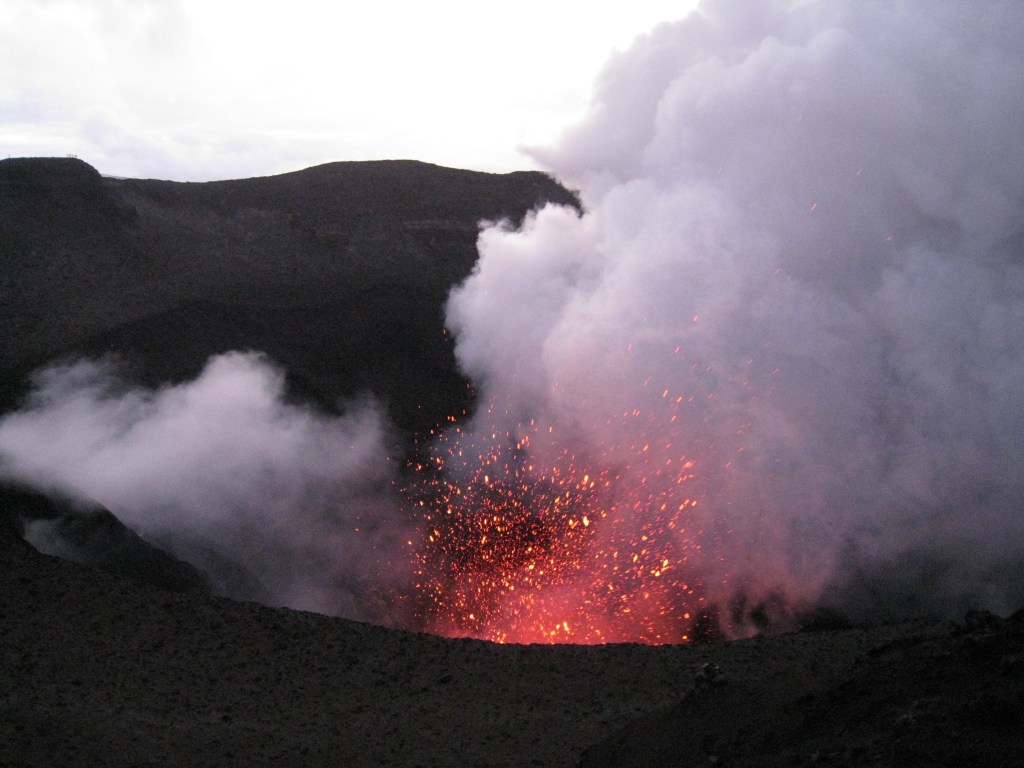
Watching the pretty scarlet rubies of molten rock tossed into the air like a Guy Fawkes’ fireworks show, it’s hard to imagine that a single piece of that red-hot debris would kill or cripple a person.

There was a bit of dark comedy in realising when darkness fell us that the half-dozen or so of us up there had no idea where the trail back to the ride in the parking lot was – despite flashlights, the trail wasn’t marked clearly enough to be that visible and it was very dark, with no light other than the volcano crater and a stray beam or two of light in the distance. We kind of gently ambled downwards (firmly away from the glowing crater, as that was the one direction we all knew not to go in), finally managing to find our main trail and the carpark again.

Think safety.

It was very easy to see how you could end up making a horrible mistake and getting lost for days up there. People have died at Yasur by making very bad choices.

There are few places where one can feel so small and so big at the same time than the lip of an active volcano on an island somewhere at the bottom of the world.

Read this piece of adventurous foolhardy behaviour and much more in my new book Clippings: Collected Journalism 1994-2024

Clippings: Collected Journalism 1994-2024 – Free sample 3!

Hey, it’s your weekly reminder I’ve got a new book out! For the release of my new collection of the so-called ‘best’ of 30 years of journalismClippings, every Monday in March I’m spotlighting one of the more than 100 pieces by me gathered up in this hefty tome. I hope you’ll consider grabbing a copy, now available on Amazon as a paperback for a mere US$14.99, or as an e-book download for just US$2.99

This one actually comes from right here on this here website back in the long-ago days of 2021. It’s a sample of the ‘Criticism’ section of the book which gathers up piles of pop culture ruminations I’ve done over the years. Inexplicably, this post about Yoko Ono remains one of the most popular I’ve ever done. I’d flatter myself it’s about the quality of my prose, but more likely because I put Yoko Ono and ‘sorry’ in the headline and it’s hitting some Google sweet spot. Sorry, Yoko haters, but this isn’t a piece about Yoko Ono being sorry she broke up the Beatles!

Why I’m sorry I ever laughed at Yoko Ono

Read it right here!

You’ll find this piece and far, far more collecting 30 years of journalism in my new book Clippings: Collected Journalism 1994-2024. Order it today, baby needs a new pair of shoes!

Clippings: Collected Journalism 1994-2024 – Free sample 2!
In celebration of my new collection of the so-called ‘best’ of 30 years of journalismClippings, each Monday in March I’m spotlighting one of the more than 100 pieces by me gathered up in this hefty tome. I hope you’ll consider grabbing a copy, now available on Amazon as a paperback for a mere US$14.99, or as an e-book download for just US$2.99

I randomly divided this collection up by themes – Profiles, Places, Criticism and the like, and then there was a random selection of more goofy pieces I figured I’d just file under “humour.” This recollection of my very first job in journalism written while I was working at Lake Tahoe is, as best as I can recall, almost entirely true.

Scenes from the route

North Shore Truckee ACTION, September 2, 1998

I have edited newspapers and I have written for newspapers, but my first “real” job in this world was to deliver them.

I was a squirrelly, zit-faced and longhaired 13 going on 14, and I did it for about a year, delivering the Grass Valley Union from door to door in a square mile area several blocks from my home.

The Union is an afternoon paper, and so each day after school I would return home to find a bundle of Unions in our driveway, tightly bound. After an afternoon snack I would kneel busily on our dark garage’s concrete floor, taking my fifty or so papers and wrapping them with rubber bands. If it rained, you had to put them in orange plastic bags first.

The rubber bands sometimes snap if you rush things, and they twang off about the room spastically. Once one smacked me right in the cheek, raising a really embarrassing welt.

Your fingertips become black with ink as the headlines leave a bit of themselves on your skin. The day’s happenings are compressed into a small, dense cylinder of pulp that you lift and hurl repeatedly, trying to achieve a passable imitation of grace with each throw.

It was then, likely, that I began to stumble down the career path I follow tenaciously to this day. I was immersed in the smell of the hot paper, sometimes still steaming with the heat of the press, fascinated with the way the ink can cling to you.

I would ride down my route on my battered yellow bike, the newspaper bag carefully balanced on the handlebars, getting lighter with each block.

It was my first real job, and no one forgets the way that is – the strange freedom I felt riding my bike in the late afternoon on days that always seem cloudy in hindsight, the wind rustling the newspapers in my bag. I delivered news of President Reagan and “Peanuts” cartoons and what was on sale at Lucky’s, and I felt a part of some great system that pulsed beneath my 13- year-old world, a system I was just then beginning to perceive dimly.

I delivered newspapers and took inventory of my customers, the yards with plastic toys and broken bicycles in them, the houses with immaculate hedges and shrubbery whose porches I always aimed for with care.

The most difficult part of being a Union paperboy was collection time. At the end of each month I would go door to door on my route, getting $5.50 per customer per month to ensure they kept receiving their daily dose of news.

Portrait of a young hustler, mid-1980s

It was here you begin to encounter the world beyond lifting and hurling newspapers, and these days I’d dread somewhat. Demanding money from strangers was intimidating – looking briefly inside the anonymous homes I threw papers at, the couches where they read their Union each day.

I rapidly began to learn the language of excuses and rationale used so well in the grownup world.

“I paid you last month, boy, what are you tryin’ to pull?” one beefy guy who always wore too-small t-shirts would say to me every time I came by. And every time I would explain to him that he had to pay every month, he would mutter about what a rip-off it was, and he would finally pull five greasy dollars and fifty cents out of his pocket.

I learned how people wheel and deal, and I learned how people live without luck.

There was a cat woman. Every town has the cat woman, the twisted old lady who lives in a shack with a hundred stray cats. This woman’s house was crumbling and rotten, about to slide down an embankment onto the freeway overpass below. She had no teeth and no hair, and always wore a filthy Oakland A’s baseball cap. She would never have her $5.50 at the end of the month, and would gummily offer me excuses as ten of her bedraggled cats meowed and hissed around her legs. The cat lady had only one eye.

The cat woman would occasionally leave a folded dollar bill for me in her mailbox, toward paying off her slowly rising newspaper debt. I did not know what she did with her Union each day, if she read it or merely used it to line her floors inside what was surely one giant litter box.

And then there was “the towel lady,” as she would be enshrined forever in my pubescent memory. Each and every month when I would come by to get my $5.50, this highly attractive young lady, in her mid-twenties or so I’d imagine, would answer the door wearing a pink towel.

Just a pink towel.

You can imagine the fireworks this would set off in your typical 13- year-old paperboy.

Each month this woman would come to the door wearing just her towel, and she would give me my five-fifty and smile and I would melt into a giddy puddle of goo right on her doorstep.

I never could figure it out. If the towel lady wore just a towel once, I’d understand – she just got out of the shower or something, right? But each month, November or May or August, the towel lady would answer the door in her towel, and I would mature just a little bit faster.

The towel lady probably kept me doing the paper route a few months longer than I would have done – I was entering high school soon, and paper routes seemed too grade-school for my elitist brain then.

But I labored on with the route a few months into my freshman year of high school, always looking hopefully forward to my monthly visit to the towel lady.

The odds of gravity and physics were with me, I knew. That towel had to fall off eventually.

It never did, of course, except in my dreams.

This ink-stained confession and much more can be found in my new book Clippings: Collected Journalism 1994-2024

Clippings: Collected Journalism 1994-2024 – Free sample 1!

Hey, did I tell you I made a book? But did I tell you ten times yet?

In celebration of my new collection of the so-called ‘best’ of 30 years of journalism, Clippings, each Monday throughout March I’ll spotlight one of the more than 100 essays in this hefty tome. I hope you’ll consider grabbing a copy, now available on Amazon as a paperback for a mere US$14.99, or as an e-book download for just US$2.99

It was interesting combing through piles of yellowing clippings and old computer files and trying to figure out what to include in a survey of my so-called career. But this profile from when I worked in Oregon circa 2002-2006 was a definite. As a kid, I always wanted to be a zookeeper, until one day I realised that would involve a lot of blood and animal feces. But getting to shadow an actual wildlife park vet around for a day was pretty darned cool, and one of my favourite job assignments. 

The zebra veterinarian 

The Roseburg, Oregon News-Review, May 2002 

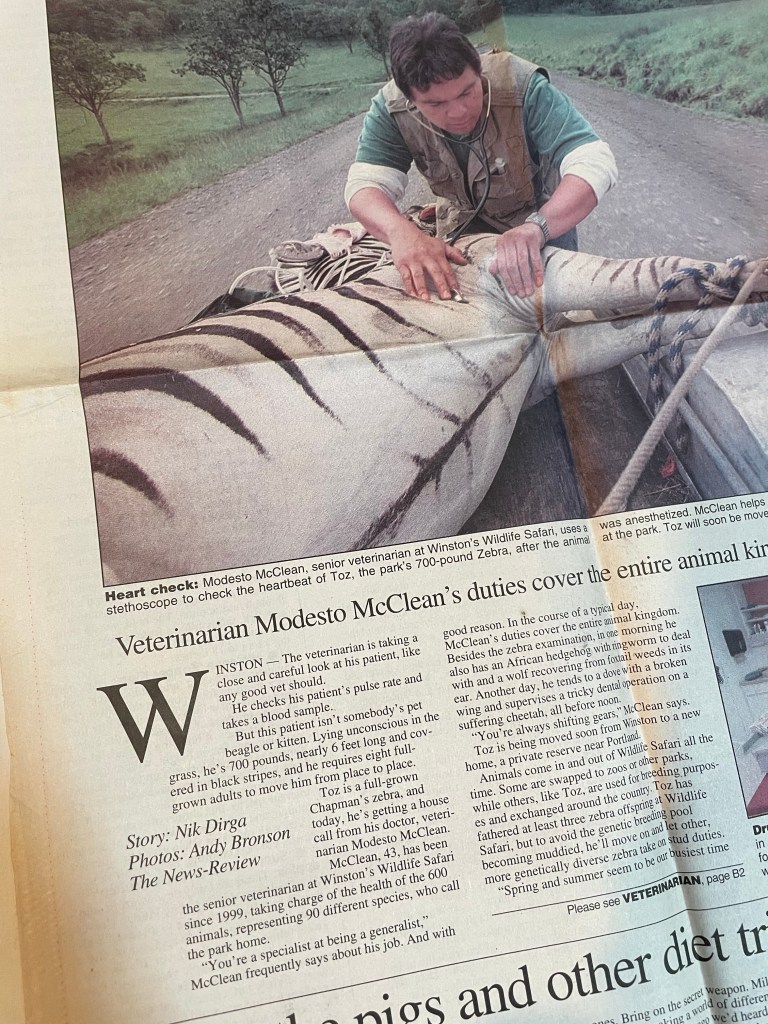
WINSTON, Oregon — The veterinarian is taking a close and careful look at his patient, like any good vet should. 

He checks his patient’s pulse rate and takes a blood sample. 

But this patient isn’t somebody’s pet beagle or kitten. Lying unconscious in the grass, he’s 700 pounds, nearly 6 feet long and covered in black stripes, and he requires eight full-grown adults to move him from place to place. 

Toz is a full-grown Chapman’s zebra, and today, he’s getting a house call from his doctor, veterinarian Modesto McClean. 

McClean, 43, has been the senior veterinarian at Winston’s Wildlife Safari since 1999, taking charge of the health of 600 animals — representing 90 different species — who call the park home. 

“You’re a specialist at being a generalist,” McClean frequently says about his job. 

And with good reason. 

In the course of a typical day, McClean’s duties cover the entire animal kingdom. Besides the zebra examination, on this morning he also has an African hedgehog with ringworm to deal with and a wolf recovering from foxtail weeds in its ear. Another day, he tends to a dove with a broken wing and supervises a tricky dental operation on a suffering cheetah, all before noon. 

“You’re always shifting gears,” McClean says. 

Toz is being moved soon from Winston to a new home, a private reserve near Portland. 

Animals come in and out of Wildlife Safari all the time. Some are swapped to zoos or other parks, while others, like Toz, are used for breeding purposes and exchanged around the country. Toz has fathered at least three zebra offspring at Wildlife Safari, but to avoid the genetic breeding pool becoming muddied, he’ll move on and let other, more genetically diverse zebra take on stud duties. 

“Spring and summer seem to be our busiest time (for moves),” said Deb Ryan, Wildlife Safari’s assistant curator. “Within the next month we’ll probably move 10 animals out, and probably move five to eight in.” 

Toz has to be examined for his health and for a lingering lame leg prior to the move. Bringing the zebra in for an examination isn’t as simple as putting him into a pet carrier. Most wild animals must be sedated before they can be safely examined or treated. 

“The toughest part of zoo medicine is the anesthesia,” McClean said. 

“Zebras are very aggressive,” Ryan added. A variety of drugs are used as tranquilizers, some of which are highly dangerous if not handled carefully. 

“A few drops more and I’m going to kill the animal,” McClean notes as he carefully mixes the solutions together into a dart. It takes a steady hand when dealing with the drugs. They can be administered with a dart pistol, a blowgun or an air gun, depending on the size of the animal and the thickness of their hide. 

A zebra has tough skin — “I say zebras are like horses on steroids,” said McClean — so a rifle is used to administer the knockout punch today. 

Every animal must be handled differently, McClean says. Originally from Southern California, his career has taken him to treat animals he might never have imagined he would. He’s worked with dolphins and chimpanzees, and even anesthetized a towering giraffe — “probably the hardest anesthesia in all of medicine,” he says. 

McClean first came to Wildlife Safari in 1995, where he trained under the previous park veterinarian. He was educated at California Polytechnic State University in San Luis Obispo and Oklahoma State in veterinary medicine, and also served an internship in primate medicine and surgery at Yale University. 

He has also consulted in private veterinary practice for several years. McClean came back to Wildlife Safari in 1999 when he became the park’s senior veterinarian. 

Because the animals mostly roam free at Wildlife Safari, McClean and park keepers have become experts at what they call “binocular diagnosis,” where they carefully observe the animals to detect any sign of a possible medical problem. 

“I don’t have time to go every day to check every animal, so I rely on the keepers too,” McClean says. 

Toz the zebra has been moved out of the park’s general population into a small, half-acre enclosure to prepare him for his move. It also makes it easier for him to be drugged, because Wildlife Safari staff won’t have to chase him down. 

“Some people think hoof stock aren’t all that smart, but they know what a gun is,” McClean says as he watches Toz nervously gallop away from him. 

The doctor raises the rifle, takes careful aim at the retreating zebra, and fires the dart, which brings him to the ground in under five minutes. 

Once McClean is sure he’s fully unconscious, the staff gets to work, popping in an intravenous tube dispensing solution, as well as injections of atropine to keep his heart rate up. A monitor is hooked up to his tongue to check his vital functions, and an oxygen tube is placed in his nostrils. McClean checks out the zebra’s leg, which has been treated previously for weak tendons, and finds that his hoof is suffering some obstructions which he removes. 

While Toz is out, a pint of blood is also taken from him. The blood will be checked and then frozen, kept in store for possible transfusions. 

“This blood someday will save another small zebra,” McClean said. 

Any small checkups that can be done on the zebra are also taken care of. One park employee uses a tool belt set of pliers to scrape a buildup of tartar off the zebra’s large teeth, each the size of a man’s thumb. 

It takes eight park employees to transport the drugged Toz onto an open trailer for his move across the park. He is lifted onto a rubber mat, as one employee holds his IV and McClean monitors his vital signs. Toz is taken to a holding stall where he will live and be watched closely for a few weeks before his trip to Portland. 

The entire procedure, from the dart being fired to Toz waking up in his new quarters, has taken just under an hour. 

“I’m going to rate it as for a zebra, an excellent anesthesia,” McClean says. 

The rest of this delightful yarn and much more can be found in my new book Clippings: Collected Journalism 1994-2024

Hello, I wrote a book, and it’s only taken me 30 years

Greetings! I wrote a book. Well, I’ve actually been writing it for about 30 years, believe it or not. Introducing Clippings: Collected Journalism 1994-2024, a hefty compendium of my columns, essays, feature profiles and much more over the course of my so-called career!

I’ve written an awful lot of words over the years, but I wanted to put together something that was a little more permanent than a bunch of yellowing newspapers and broken website links. Clippings is, much like many journalism careers, an eclectic mix, from long features to blog posts to deeply personal essays to in-depth pop culture criticism, spanning from Mississippi to California to New York City to New Zealand. 

From interviewing governors and rock stars to climbing active volcanos and adjusting to life on the other side of the world, this book is me saying, “Hey, I was here, and this is some of what I did along the way.” Doesn’t everyone want to say that at some point about their life’s work, whatever it is? Throw it all together, and it’s probably as close to a sort of autobiography as I’ll ever get.

It’s got many of my works from long-ago newspapers and magazines, websites and even some fine pieces from this very website in a handsome curated form sure to be adored by your family for generations.

I hope you’ll consider grabbing a copy, now available on Amazon as a paperback for a mere US$14.99, or as an e-book download for just US$2.99! 

Get it here: Clippings: Collected Journalism 1994-2024 by Nik Dirga