Look, the world kind of lost its mind in 2020, didn’t it? And we’re all still dealing with that.
We’re all very much living in the aftermath of the pandemic, which seemed to break apart the bonds we imagined held the world together. Everyone’s got a relative or friend whose opinions seemed to go down weird rabbit-holes, or topics you just don’t discuss anymore. Covid, culture wars, digital disinformation – a dozen tangled threads all seemed to bloom and spread beginning in 2020.
But so far, there haven’t been a lot of major motion pictures looking at this age of weirdness. We need satire and storytelling to process the societal earthquakes that hit us. After Watergate in the 1970s we saw a surge in paranoid cinema, while it took America until the 1980s to really unpack its Vietnam traumas with films like Platoon, Full Metal Jacket, Born On The Fourth of July and the like. There were even a slew of (mostly kind of dire) 9/11 reenactment movies after those 2001 attacks or smarter ones like The Hurt Locker processing how terrorism spreads.
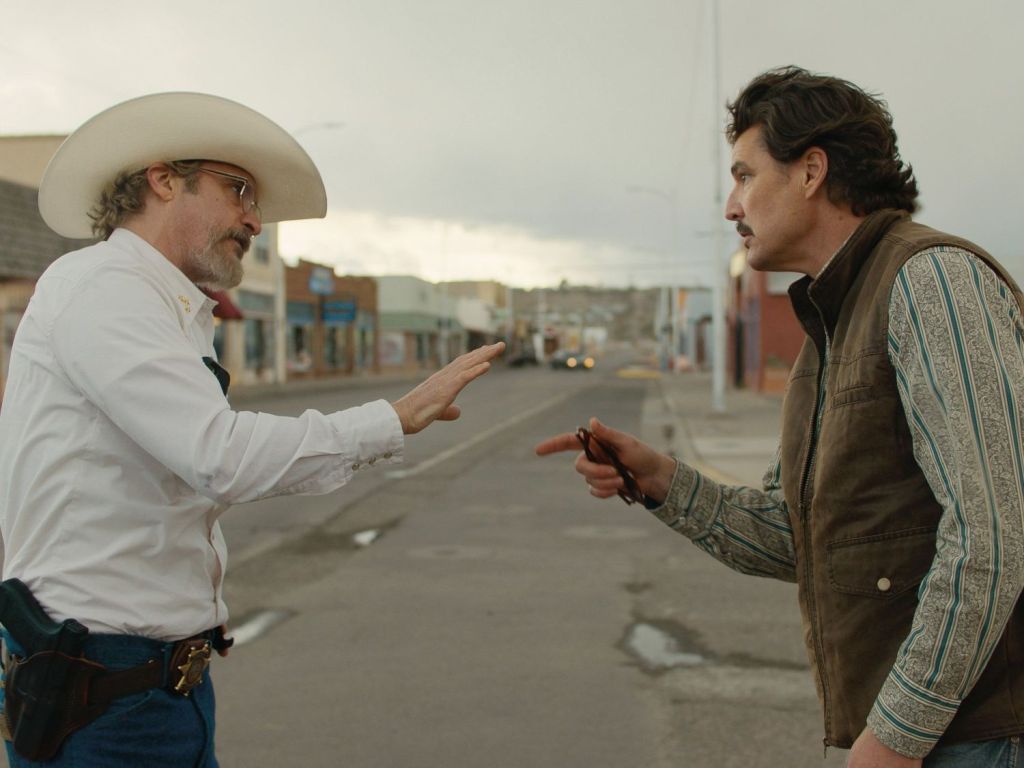
But on Covid, lockdowns and the fractured, polarised world that’s come out of it all, Hollywood’s been pretty silent. Ari Aster’s new film Eddington – a black comedy Western pandemic dystopian frenzy of a film – boasts two Oscar winners and a hot director and seems to be the first major Hollywood take on the year everything went, for lack of a better word, batshit.

Even now, I don’t like thinking back to the strangled tenseness of the pandemic years, to masks fogging up my glasses, to queues at the supermarket, social distancing and the lurking rise of protest movements galore and the latching on to conspiracies. No matter what your views are on how it’s all turned out, it ain’t a time anyone fondly remembers now.
The pandemic still feels raw, the culture war battles are still raging strong under Trump 2.0, so is it really time for satire? Yet Eddington feels like the movie America deserves in 2025. It’s shocking and slapstick in equal measures. “More distance will make it easier to laugh,” the LA Times’ Amy Nicholson wrote in her positive review of Eddington, and I can’t disagree.
Joaquin Phoenix stars as New Mexico sheriff Joe Cross, a tense conservative who doesn’t care for masks and social distancing and who despises the town’s charming mayor (Pedro Pascal) and decides to run against him. His wife (Emma Stone) is going down online rabbit holes and Joe feels like everything in his world is changing. Black Lives Matter protests come to town, Covid is here, and big tech is making a play for a giant start-up facility in town. Because this is an Ari Aster movie, and Aster is the patron saint of dread in film right now, everything escalates very quickly into a violent, unpredictable mess.

Joe posts Facebook campaign videos saying “we need to free each others hearts” but soon starts ranting about sexual predators and driving around in a truck plastered with slogans like “Your (sic) being manipulated.” Pascal’s perky mayor slaps up pandering inclusive videos featuring smiling Black extras in a town with almost no Black population. A lovestruck white teenager who dives into BLM activism to win over a girl ends up bemoaning his white privilege to a crowd, yelling “My job is to sit down and listen! As soon as I finish this speech! Which I have no right to make!”
Eddington is an equal-opportunity satire that sees the absurd in all viewpoints. It hits all the bases – mask mandates, pedophiles, artificial intelligence, police racism, Bitcoin and Antifa – offending left and right with equal measures.
But ultimately, Eddington is really about how social media has rotted our brains, turning us all into circus animals hooked on dopamine and conflict. It’s bad here in New Zealand but exponentially feels far worse in the far bigger America, where politicians and celebs now spew conspiracies and hate speech that felt unthinkable 10 years back.
America doesn’t make much sense to me at the moment, and Eddington is an exhausted grim chuckle at how fractured it’s all gotten.
“I am a much better human being than you,” Joe sneers at one point to his opponent, and that arrogant phrase seems to capture so much of the vibe of America 2020 and Social Media 2025.

I wouldn’t argue that Eddington is a masterpiece – it’s too long, a bit scattered and overstuffed, the ending ramps up the violence to a kind of incoherent mess, and Aster’s “everyone’s an idiot” worldview will probably rub some the wrong way … but in its bleakly comic way, it captures the moment in a way that cinema kind of needs to help us process whatever the hell has happened to the world the last few years. And Phoenix, who never feels better on screen than when he’s falling apart, is terrific.
Eddington shows how community and dialogue vanishes as we all get sucked into our little tech bubble windows, how performative our lives have become and how lonely we’re all getting as a result. “All of these people are kind of living on the Internet and they are sort of all seeing the world through these strange, individualized windows,” Aster said in an interview.
Sometimes you just need to see it all splayed out before you under a hot desert sun, and marvel at the endless foibles of humans and how easy it is for the things that hold us together to prove as flimsy as a tumbleweed in the breeze.
Eddington is not here to make conclusions, other than that perhaps we’re all kind of ridiculous creatures. At the moment, still trying to process the world we all live in now, laughing a little about that feels like enough for me.








 Nik Dirga