
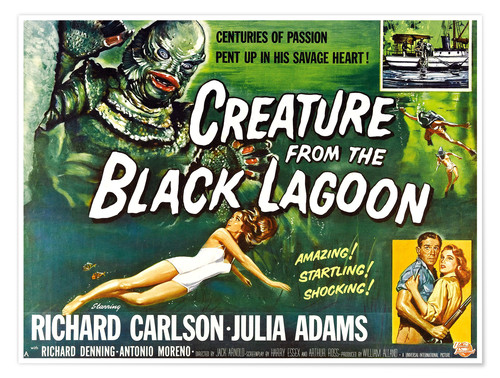
I’ve written many a time before about my love of the classic 1930s-1950s Universal Horror monster movies, which almost a century on still cast a spooky spell. And my sentimental favourite has always been Creature From The Black Lagoon, whose 1954 debut came at the end of Universal’s classic run.
Creature is in my mind an almost perfect old-school horror movie – it’s got exploration of the unknown, man meddling where he shouldn’t, a sexy lady in a swimsuit and a monster who is ultimately a tragic figure. In a tidy 79 minutes it tells a classic beauty and the beast story with a kind of haunting elegance (especially those gorgeous underwater scenes) and gives us one of cinema’s most memorable monster designs. I’ve watched it countless times and get a kick out of it every time.
It’s a shame the two sequels never felt very essential, although in one choking last gasp, the franchise finale The Creature Walks Among Us is almost a good movie.
Universal Horror movies were the best, but they weren’t usually very good at sequels. Other than the original Frankenstein, which boasted great follow-ups in Bride Of and Son Of Frankenstein, most of them fumbled at sequels. They foolishly didn’t bring back the iconic Bela Lugosi for a sequel to 1931’s Dracula until 1948’s Abbott and Costello Meet Frankenstein, which while fun, isn’t exactly top-tier. Lon Chaney Jr’s melancholy Wolf Man ended up as a supporting player against other monsters after the first Wolf Man, Claude Rains’ Invisible Man died and sequels to that were bland bores, while Boris Karloff’s Mummy was reborn again and again without Karloff in a series of increasingly silly riffs. By monster mash House of Frankenstein – where the monster barely does a thing until the final 5 minutes – everything was increasingly played out.
The same problem befell the Creature of the Black Lagoon, who was enough of a hit to come back for two more sequels. The uninspired 1955 quickie Revenge Of The Creature is basically a remake with a Florida aquatic park setting and a brief cameo by Clint Eastwood in his movie debut.
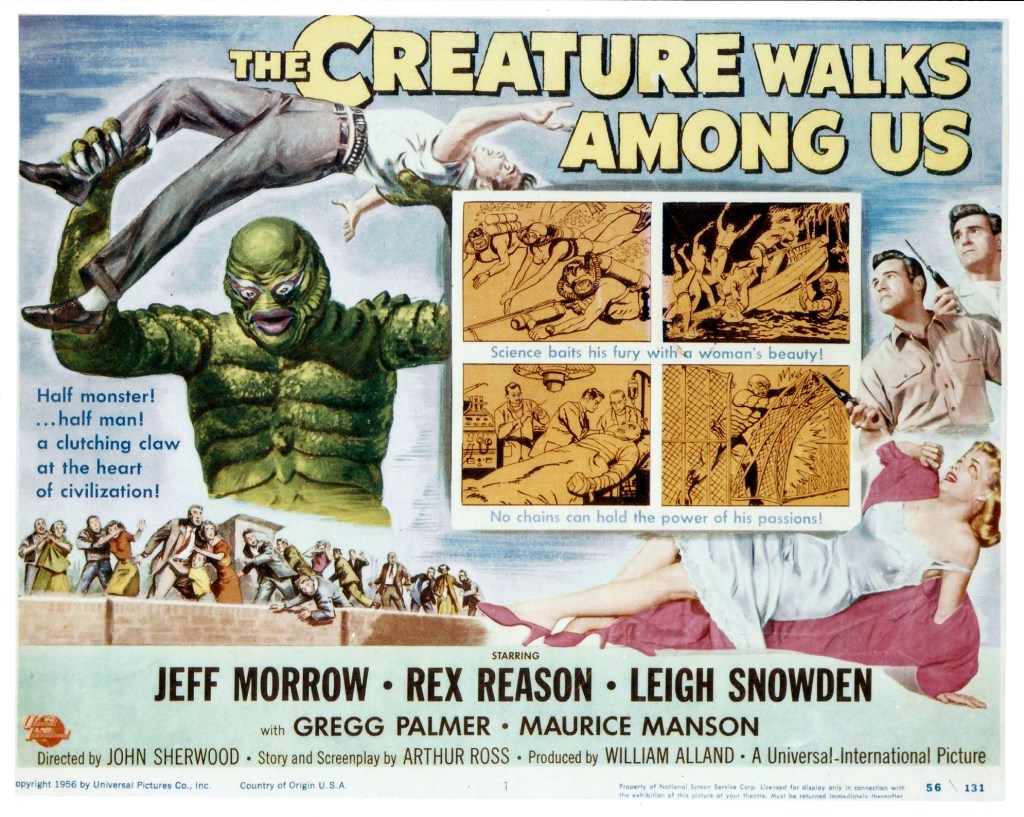
The last sequel – and the last of Universal’s classic monster era in general – was 1956’s The Creature Walks Among Us, which took an intriguing idea and dropped the ball, but left us just enough hints to imagine a much better movie.
In this one, the Creature is once again captured by pesky humans – but this time by a fanatical scientist, Dr Barton (Jeff Morrow), who wants to experiment on him, turning him into from an aquatic creature into a more human organism. (The pseudo-science explanation given is this would somehow prepare humans for interstellar travel.) The Creature is captured but badly burned, which gives Barton the excuse to alter his genetics. Of course, being a monster movie, things go badly for everyone in the end.

It’s an interesting idea but the execution is limp – far too much time is spent on irritating scientist Barton’s marriage troubles, and the Creature feels like an afterthought in his own movie. Also, the end game appears to simply be to set the Creature up in a kind of petting zoo enclosure, so not sure what all that science was really for.
In the encyclopaedic book The Creature Chronicles by Tom Weaver – an insanely comprehensive green-scaled bible that’s a must for any fan of the movies – it’s revealed that earlier drafts had a fair bit more Creature action and debate over what it means to play god with such a being. Little of that shows in the finished movie, which is workmanlike and slow and padded out with dull humans. Only the Creature himself – despite the alterations, still an unforgettable look – is worth paying attention to. The Creature’s sad journey – given short shrift in the film – is the movie that should’ve been made.
There is something haunting about the repeated images of the mutilated monster, who now has very human eyes, reduced from a sleek underwater god to a hulking, out of place figure in a world he doesn’t fit in. Creature Walks is a monster movie with very little monster action – the final minutes kick in with the Creature framed for a murder by nasty Dr Barton – who he then, of course, kills himself. The Creature evades punishment, unusually for a monster movie – he is last seen lonesomely on a beach, advancing towards the ocean, where in his altered form he will surely die. Is this the end of the Creature? It’s a pleasantly open-ended and evocative ending.
And even though the movie is a pale imitation of the original Creature and much better Universal Monster movies, those final moments feel like they could sum up the appeal of classic monsters in general – a misunderstood creature alone, on a beach, staring at the sea, trying to find a place to belong.


 I’ve written
 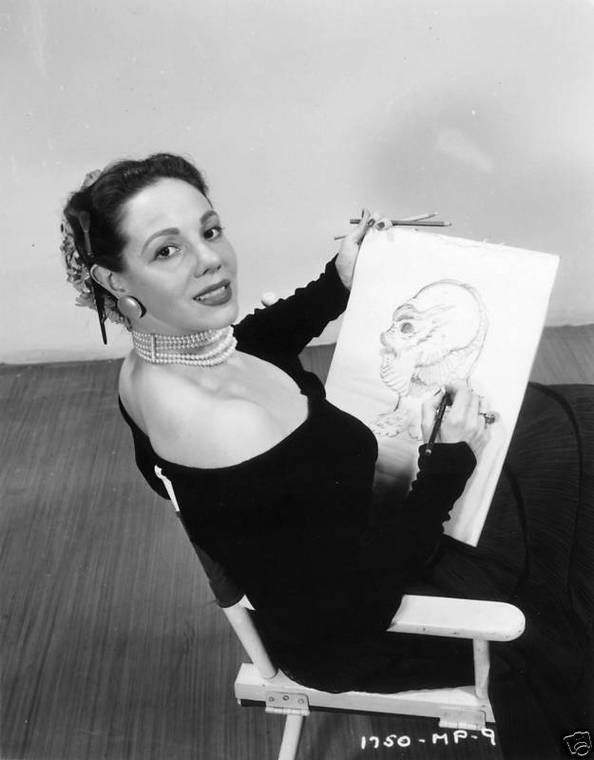 But her biggest claim to glory today is that she designed the epic look of the Creature From The Black Lagoon. The Creature is, I’d argue, the second-best monster design of all time (sorry, but Karloff’s Frankenstein’s monster has to take the top crown). It’s alien, yet human; terrifying, yet captivating.
 In “Lagoon,” O’Meara also shows the hard work that goes into the biography of a somewhat obscure person, hunting down leads and tracing dusty steps in the past. The story is as much about her and her experiences as a young woman in Hollywood as it is about Milicent Patrick. Some of the anecdotes O’Meara tells of her own treatment are truly dismaying, especially because they are all too common. The real monsters are still out there in Hollywood, hiding in broad daylight.
 Julie Adams wasn’t a household name, but she was legendary in her own way as one of the last surviving “scream queens” of the classic Universal Monster movies of the 1930s-1950s.
 Nik Dirga