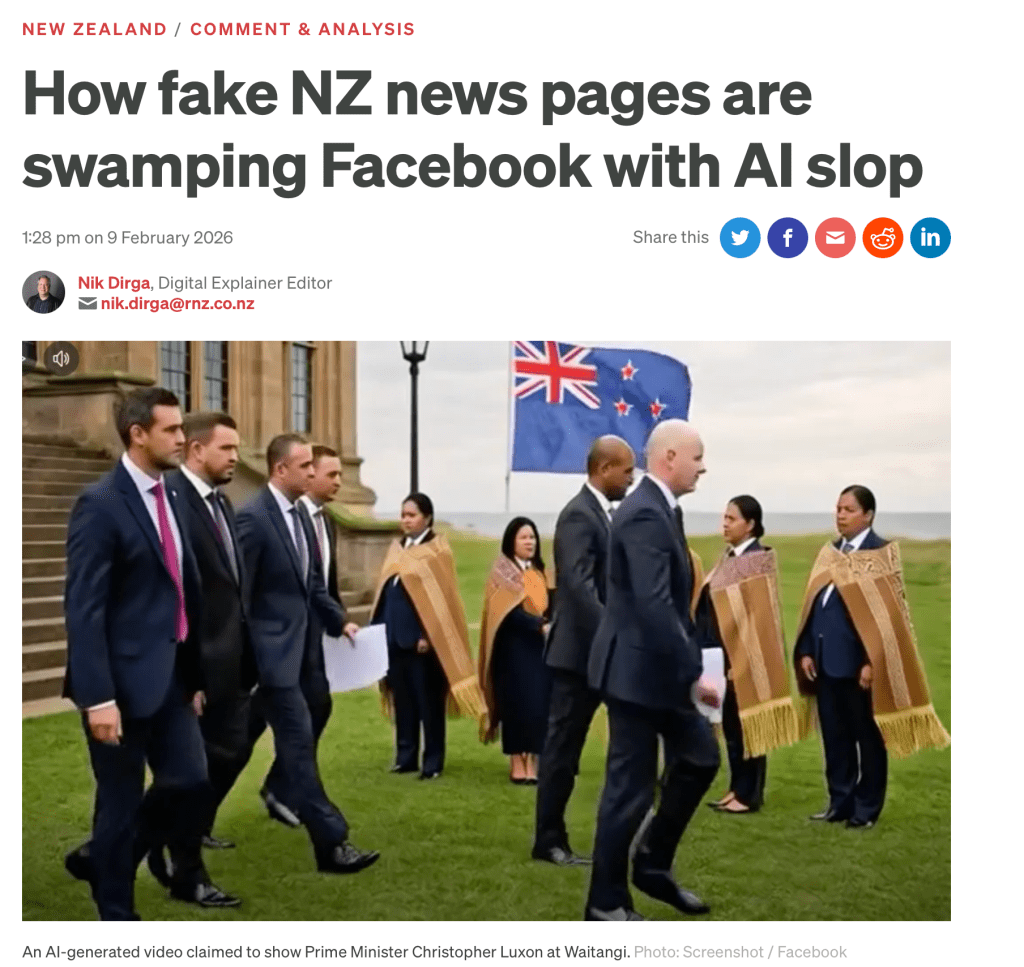
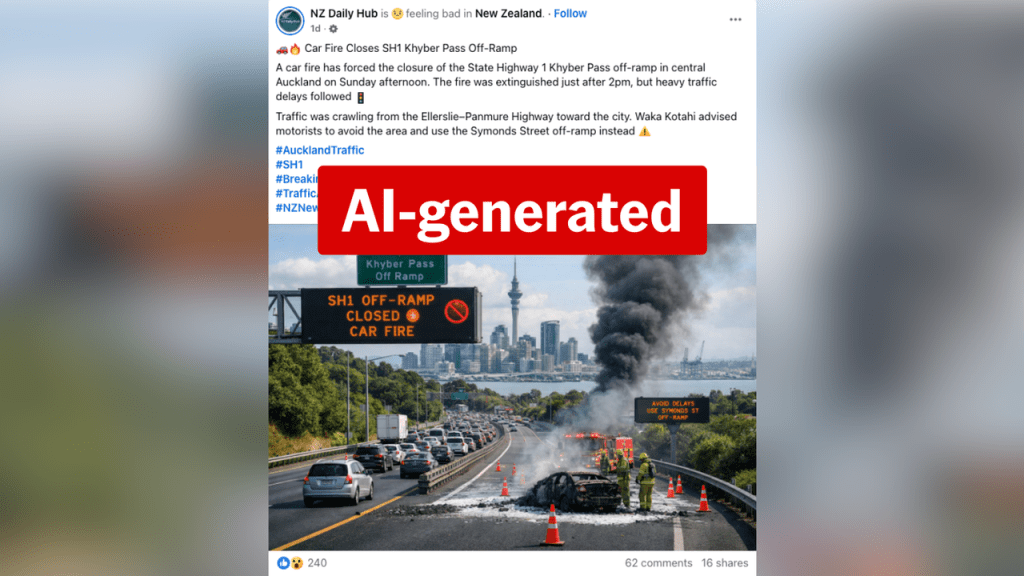
In my day job, a project I’ve been working on for the last couple weeks across both Radio New Zealand and the Australian Associated Press is debunking a slew of “fake” NZ news sites on Facebook. Many of them specialise in taking legitimate work by NZ reporters and running it through AI, stealing other reporters’ work, adding fake AI-generated images or misleading video as they go. One such post included grotesquely using AI to animate a still photo of a dead teenage Mt Maunganui landslide victim.
This slop is everywhere on social media now – literally any time a news event happens, a horde of pages will serve up AI-generated garbage about it instantly, from Australian shark attacks to the arrest of Venezuelan leader Maduro to the assassination of Charlie Kirk. Now, smaller pages are spoofing nearly every car crash and weather event that makes the news in New Zealand with AI content.
I was pleased to see my reporting got a lot of attention this week and made appearances on RNZ’s Afternoons and Mediawatch programmes to talk about it some as well in my very un-Kiwi accent.
It is depressing – like a lot of people, I think, I’m recoiling more and more from social media and what once seemed to be “fun” diversions, as FB becomes overwhelmed by slop and algorithmic nonsense and loses all its usefulness, X, which I quit long ago, became a Nazi bar, and most other sites are either annoying or infuriating. I even got to say the word “enshittification” on national radio this past week, a phrase which really does seem to sum up the vibe in the room on the internet these days.
My advice is – don’t trust anything you see on social media without verifying it first, and legitimate journalists are still the best source of information out there, not your mates on Facebook. I don’t know if there’s an end in sight to this flood of misinformation that’s reached tsunami heights in the past six years or so, but the most important tool you have to fight against it is your own brain and credulity.
There’s something spooky about watching a documentary covering events you lived through and still haven’t quite processed yourself.
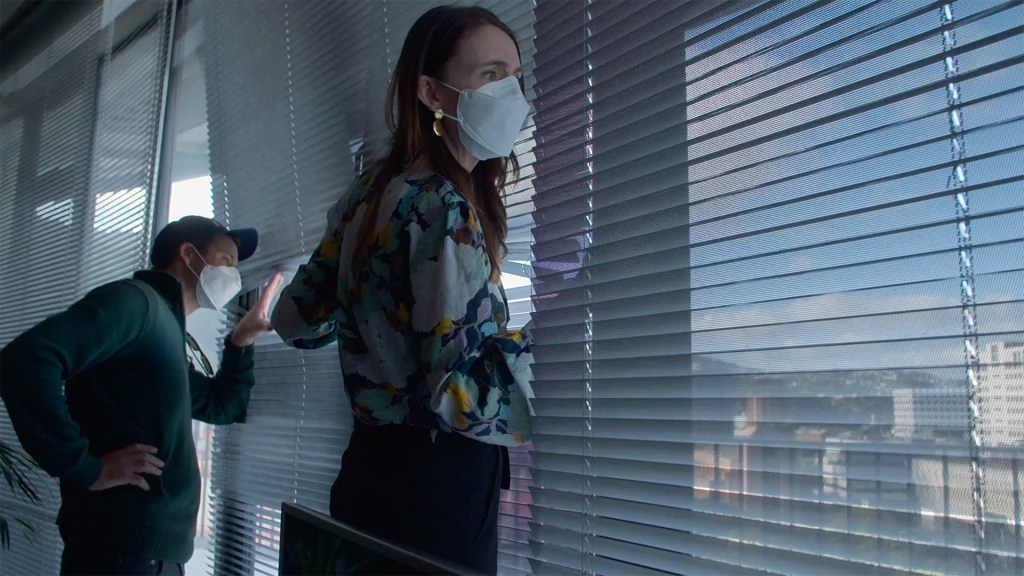
Jacinda Ardern was New Zealand’s leader up until about 2 1/2 years ago, but somehow that already feels like a few centuries ago in the current grim timeline. Watching the excellent, if starry-eyed, new documentaryPrime Minister takes us back through the whirlwind of 2017-2023, when New Zealand was often buffeted by a series of tragedies that all felt sadly outside our control.
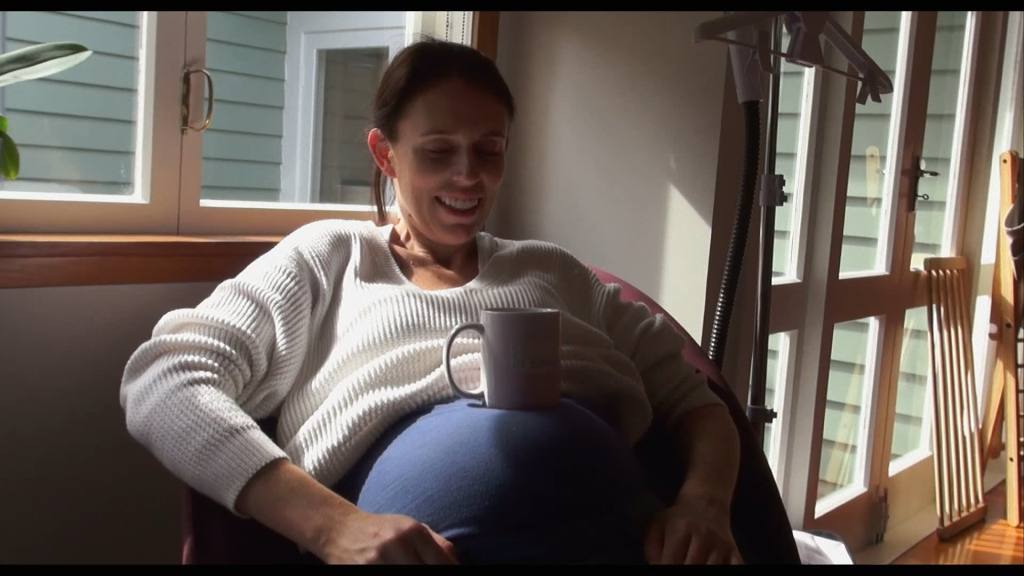
Prime Minister is a startlingly intimate portrait of the Jacinda years, and what it’s like to be a young pregnant woman suddenly lifted up to the corridors of power. Whether or not you agreed with Ardern’s administration – and it was ultimately as flawed as most governments, in the end, but not as bad as some – Prime Minister is a movie that is somehow bittersweet and optimistic all at the same time.
So it’s weird watching Prime Minister and seeing the history of your country retold when it feels like it’s all not even quite ended yet, to see everything unfold again as it did in those crazy five years.
I was in the thick of the Ardern years as a journalist, typing away news alerts and quick takes from the day she surprisingly came out on top of government coalition negotiations in 2017. I watched with horror the shocking mosque shootings of Christchurch in 2019, helped cover her massive re-election win in 2020 and watched as Covid crept in and everything in the world seemed to grind to a blurry halt. We journalists waited for the “1pm update” on what the pandemic had to say today, and saw the creeping dissatisfaction grow in some corners.
I watched Parliament’s grounds become occupied by a collection of protesters for weeks in 2022 and I had the curious fortune to be running a live-blog the morning that the police came and that occupation came to a violent, fiery end. For a journalist, the moments when you think, “I’m watching history right now” come with an electric charge.
We’re very much all still living in the societal and cultural upheaval the pandemic left behind and the swamp of populist rants, conspiracy theories and anger-fueled online bile feels like it will never end. Did New Zealand get everything right? Probably not, but the overriding fact is that all the rewriting of history going on at the moment ignores that at the time nobody knew what might happen, and in the end, a whole lot of people could have died in a small island country like ours. Ultimately less than 6000 died of Covid-19 here – while in America, 1.2 million did.
Prime Minister boasts a candid access that it’s hard to imagine a lot of political leaders allowing. Ardern’s partner Clarke shot lots of footage of her over the years, as she sits in bed worn out after long days or works through the exhaustion of pregnancy. Even though I spent so much time covering Ardern and writing about the events of the day, it’s all a very different perspective that sheds new light on the burdens of power and Jacinda’s – perhaps impossible – attempts to remain kind at heart in a world that frowns on that.
Again, I won’t argue New Zealand was some magical utopia when Jacinda Ardern was in power. But to be honest, a lot of politicians running the world at the moment seem barely human, let alone humane to me. We dehumanise politicians, and Prime Minister aims to correct that. Ardern has been turned into some unrecognisable demon avatar in some corners of NZ to this day. It’s hard to reconcile that with the images of a young mum playing with her daughter we see in Prime Minister. It’s also easy to see why Jacinda quit when she did, having no more petrol in the tank.
Prime Minister isn’t a deep investigative dive into NZ politics. It’s glossy and aims to make Ardern the hero without really diving into the intricacies of politics here. And yet, in its own way, it feels a bit like an elegy for a lost world. Why would anyone want to be a politician these days?
Power costs, and in the end, you have to wonder if, in a timeline crowded with blustering authoritarians, grim bottom-liners, hucksters and grifters and outrage merchants, that the eminently human scale of Jacinda’s politics is something we may never see again.
Golly, but I’ve been busy writing everywhere but this blog lately.
I’ve been doing a lot more assorted fact-checking and explaining work for cash money so it’s time for another roundup of stuff what I wrote:
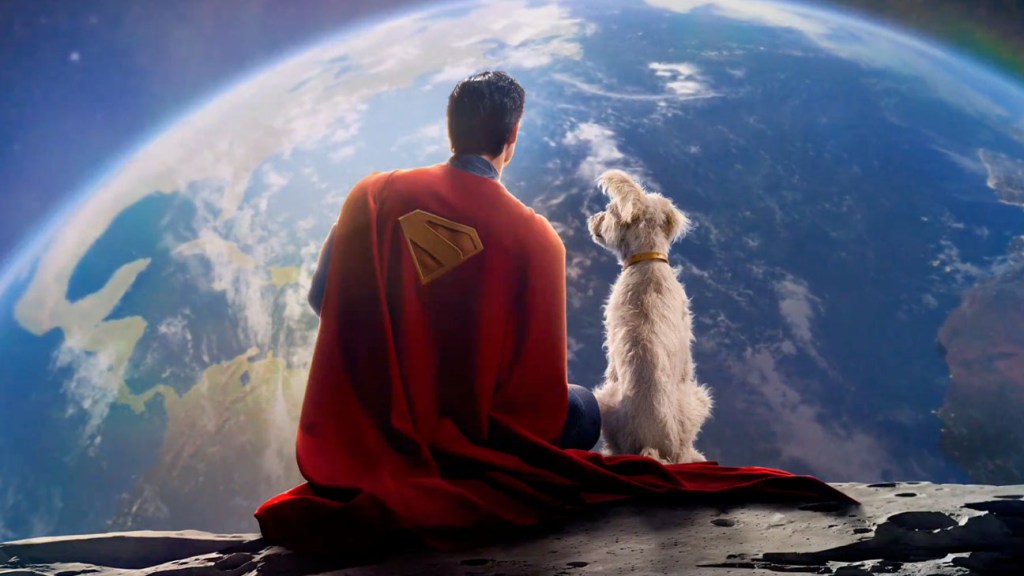
Just in time for the hopefully good new movie opening this week, I did a recap for Radio New Zealand on Superman’s best (and not so best) moments on screen to date and some comics recommendations!
Over at AAP FactCheck, I did a deep dive into the disturbing and increasingly surreal world of bizarre AI slop infesting your social media feeds. The “conjoined twins celebrity scam” posts are the ones that finally broke my brain for good, I reckon:
And finally pivoting back again to the murky world of AI and how it’s slowly eroding all that is fair and decent on social media, here’s another explainer:
Coffee and journalism generally go together like fish and chips. But somehow, I’m slowly becoming a journalist who doesn’t drink coffee.
Not to get all medical on you, but I’ve had irritating recurring problems with Laryngopharyngeal Reflux or LPR the past year or so, and it’s been increasingly obvious to this middle-aged git that I need to reconsider things I used to eat or drink without even thinking about it.
Troubling things like raw tomatoes or bacon have slowly slid from my diet, but I was reluctant to give up coffee because it was a habit, and we love our habits. But back in January I made the call to give up coffee and see how I did.
It hasn’t erased the problem, which is irritatingly random at times, but it’s definitely made a little bit of a difference.
The surprising thing for me is that I haven’t really even missed the actual drink all that much. I had expected coffee having been a regular part of this journo’s diet since about 1990 or so would be like oxygen or sunshine, something I’d wither up and die without.
But instead, I’ve discovered that I rather enjoy green tea for a caffeine hit, or a can of my once-beloved Pepsi a couple times a week (which also isn’t great for me, admittedly). I have had mornings where the foggy whispering in my brain takes quite a while to recede, but I’ve had other mornings where I felt fairly human from the start. And it’s definitely helped my throat issues.
I know coffee is a fetish in this problem-plagued world, but the abstinence has made me realise I didn’t really crave the coffee itself. Perhaps it’s because I’ve had more than my share of truly awful coffee – most of the newsrooms in America I worked in over the years specialised in grimy coffee machines exuding a watery brown gruel that probably led to the gradual erosion of my esophagus decades later. Newsrooms, at least in the bad old days, had horrible coffee. Despite that, I used to suck down three, four, five cups a day but for a long time now my max had been two cups, tops.
And of course, if something you’re used to starts to make you feel like garbage, it can take a while to break the habit, but in the end, I didn’t love coffee enough to put up with everything else that came with it for me.
When I’ve had a truly good coffee, I appreciate the skill that goes into it, but in retrospect, I guess I’ve never really fallen in love with it – more than anything I just liked the caffeine jolt. (I have literally never understood the reason for the existence of decaffeinated coffee. What’s the point?)
I stopped my daily coffee in January and dipped briefly back in a few weeks ago just to see if it really was problematic for me. Both mornings my throat swelled up to the point where I started to wonder if I was actually allergic to the blessed bean now. I don’t think I am, but it was enough to make me think I’d stick to tea, like a good New Zealander, for the duration.
I can still do journalism without coffee, it turns out – case in point the rather frantic events of Easter Monday when I was running the Radio New Zealand website and about an hour before the scheduled end of my shift, Pope Francis died. Once upon a time I would’ve grabbed a few cups or cracked open some Pepsi to get through it all, but instead I let the adrenaline breaking news buzz – still the best pick-me-up there ever was – carry me through.
We pick up lots of habits in life and then you hit the point where you have to start to give up these habits to ensure an easier go of things. I don’t think I miss my morning cup all that much, but I guess I miss the idea of it. But I’ll get used to it.
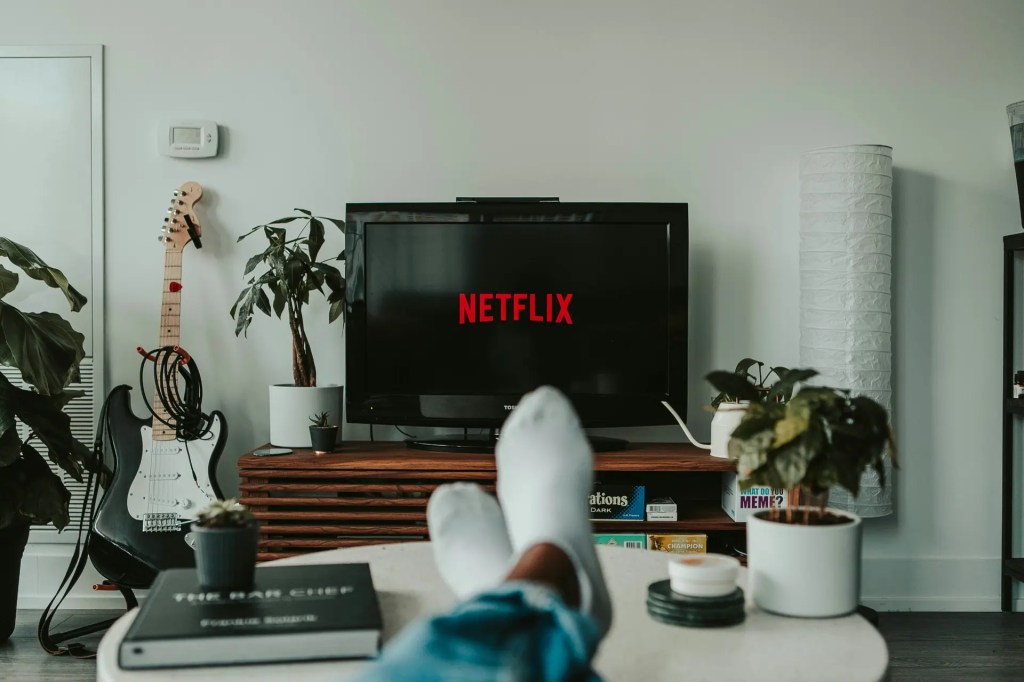
So it’s been ten years this month since Netflix streaming came to New Zealand, the tipping point that changed how we watch so-called “TV” forever down here at the bottom of the world. New by me over at Radio New Zealand, a look at how life’s changed in the streaming wave – go read here!
This one actually comes from right here on this here website back in the long-ago days of 2021. It’s a sample of the ‘Criticism’ section of the book which gathers up piles of pop culture ruminations I’ve done over the years. Inexplicably, this post about Yoko Ono remains one of the most popular I’ve ever done. I’d flatter myself it’s about the quality of my prose, but more likely because I put Yoko Ono and ‘sorry’ in the headline and it’s hitting some Google sweet spot. Sorry, Yoko haters, but this isn’t a piece about Yoko Ono being sorry she broke up the Beatles!
You’ll find this piece and far, far more collecting 30 years of journalism in my new book Clippings: Collected Journalism 1994-2024. Order it today, baby needs a new pair of shoes!
I randomly divided this collection up by themes – Profiles, Places, Criticism and the like, and then there was a random selection of more goofy pieces I figured I’d just file under “humour.” This recollection of my very first job in journalism written while I was working at Lake Tahoe is, as best as I can recall, almost entirely true.
Scenes from the route
North Shore Truckee ACTION, September 2, 1998
I have edited newspapers and I have written for newspapers, but my first “real” job in this world was to deliver them.
I was a squirrelly, zit-faced and longhaired 13 going on 14, and I did it for about a year, delivering the Grass Valley Union from door to door in a square mile area several blocks from my home.
The Union is an afternoon paper, and so each day after school I would return home to find a bundle of Unions in our driveway, tightly bound. After an afternoon snack I would kneel busily on our dark garage’s concrete floor, taking my fifty or so papers and wrapping them with rubber bands. If it rained, you had to put them in orange plastic bags first.
The rubber bands sometimes snap if you rush things, and they twang off about the room spastically. Once one smacked me right in the cheek, raising a really embarrassing welt.
Your fingertips become black with ink as the headlines leave a bit of themselves on your skin. The day’s happenings are compressed into a small, dense cylinder of pulp that you lift and hurl repeatedly, trying to achieve a passable imitation of grace with each throw.
It was then, likely, that I began to stumble down the career path I follow tenaciously to this day. I was immersed in the smell of the hot paper, sometimes still steaming with the heat of the press, fascinated with the way the ink can cling to you.
I would ride down my route on my battered yellow bike, the newspaper bag carefully balanced on the handlebars, getting lighter with each block.
It was my first real job, and no one forgets the way that is – the strange freedom I felt riding my bike in the late afternoon on days that always seem cloudy in hindsight, the wind rustling the newspapers in my bag. I delivered news of President Reagan and “Peanuts” cartoons and what was on sale at Lucky’s, and I felt a part of some great system that pulsed beneath my 13- year-old world, a system I was just then beginning to perceive dimly.
I delivered newspapers and took inventory of my customers, the yards with plastic toys and broken bicycles in them, the houses with immaculate hedges and shrubbery whose porches I always aimed for with care.
The most difficult part of being a Union paperboy was collection time. At the end of each month I would go door to door on my route, getting $5.50 per customer per month to ensure they kept receiving their daily dose of news.
Portrait of a young hustler, mid-1980s
It was here you begin to encounter the world beyond lifting and hurling newspapers, and these days I’d dread somewhat. Demanding money from strangers was intimidating – looking briefly inside the anonymous homes I threw papers at, the couches where they read their Union each day.
I rapidly began to learn the language of excuses and rationale used so well in the grownup world.
“I paid you last month, boy, what are you tryin’ to pull?” one beefy guy who always wore too-small t-shirts would say to me every time I came by. And every time I would explain to him that he had to pay every month, he would mutter about what a rip-off it was, and he would finally pull five greasy dollars and fifty cents out of his pocket.
I learned how people wheel and deal, and I learned how people live without luck.
There was a cat woman. Every town has the cat woman, the twisted old lady who lives in a shack with a hundred stray cats. This woman’s house was crumbling and rotten, about to slide down an embankment onto the freeway overpass below. She had no teeth and no hair, and always wore a filthy Oakland A’s baseball cap. She would never have her $5.50 at the end of the month, and would gummily offer me excuses as ten of her bedraggled cats meowed and hissed around her legs. The cat lady had only one eye.
The cat woman would occasionally leave a folded dollar bill for me in her mailbox, toward paying off her slowly rising newspaper debt. I did not know what she did with her Union each day, if she read it or merely used it to line her floors inside what was surely one giant litter box.
And then there was “the towel lady,” as she would be enshrined forever in my pubescent memory. Each and every month when I would come by to get my $5.50, this highly attractive young lady, in her mid-twenties or so I’d imagine, would answer the door wearing a pink towel.
Just a pink towel.
You can imagine the fireworks this would set off in your typical 13- year-old paperboy.
Each month this woman would come to the door wearing just her towel, and she would give me my five-fifty and smile and I would melt into a giddy puddle of goo right on her doorstep.
I never could figure it out. If the towel lady wore just a towel once, I’d understand – she just got out of the shower or something, right? But each month, November or May or August, the towel lady would answer the door in her towel, and I would mature just a little bit faster.
The towel lady probably kept me doing the paper route a few months longer than I would have done – I was entering high school soon, and paper routes seemed too grade-school for my elitist brain then.
But I labored on with the route a few months into my freshman year of high school, always looking hopefully forward to my monthly visit to the towel lady.
The odds of gravity and physics were with me, I knew. That towel had to fall off eventually.
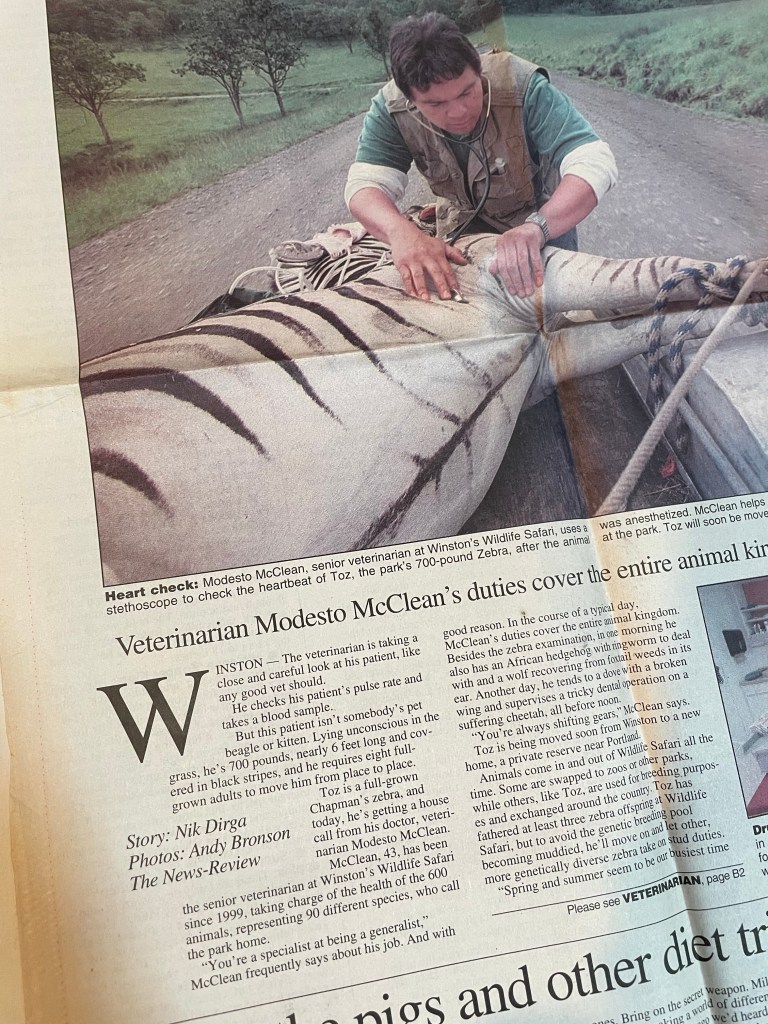
It was interesting combing through piles of yellowing clippings and old computer files and trying to figure out what to include in a survey of my so-called career. But this profile from when I worked in Oregon circa 2002-2006 was a definite. As a kid, I always wanted to be a zookeeper, until one day I realised that would involve a lot of blood and animal feces. But getting to shadow an actual wildlife park vet around for a day was pretty darned cool, and one of my favourite job assignments.
The zebra veterinarian
The Roseburg, Oregon News-Review, May 2002
WINSTON, Oregon — The veterinarian is taking a close and careful look at his patient, like any good vet should.
He checks his patient’s pulse rate and takes a blood sample.
But this patient isn’t somebody’s pet beagle or kitten. Lying unconscious in the grass, he’s 700 pounds, nearly 6 feet long and covered in black stripes, and he requires eight full-grown adults to move him from place to place.
Toz is a full-grown Chapman’s zebra, and today, he’s getting a house call from his doctor, veterinarian Modesto McClean.
McClean, 43, has been the senior veterinarian at Winston’s Wildlife Safari since 1999, taking charge of the health of 600 animals — representing 90 different species — who call the park home.
“You’re a specialist at being a generalist,” McClean frequently says about his job.
And with good reason.
In the course of a typical day, McClean’s duties cover the entire animal kingdom. Besides the zebra examination, on this morning he also has an African hedgehog with ringworm to deal with and a wolf recovering from foxtail weeds in its ear. Another day, he tends to a dove with a broken wing and supervises a tricky dental operation on a suffering cheetah, all before noon.
“You’re always shifting gears,” McClean says.
Toz is being moved soon from Winston to a new home, a private reserve near Portland.
Animals come in and out of Wildlife Safari all the time. Some are swapped to zoos or other parks, while others, like Toz, are used for breeding purposes and exchanged around the country. Toz has fathered at least three zebra offspring at Wildlife Safari, but to avoid the genetic breeding pool becoming muddied, he’ll move on and let other, more genetically diverse zebra take on stud duties.
“Spring and summer seem to be our busiest time (for moves),” said Deb Ryan, Wildlife Safari’s assistant curator. “Within the next month we’ll probably move 10 animals out, and probably move five to eight in.”
Toz has to be examined for his health and for a lingering lame leg prior to the move. Bringing the zebra in for an examination isn’t as simple as putting him into a pet carrier. Most wild animals must be sedated before they can be safely examined or treated.
“The toughest part of zoo medicine is the anesthesia,” McClean said.
“Zebras are very aggressive,” Ryan added. A variety of drugs are used as tranquilizers, some of which are highly dangerous if not handled carefully.
“A few drops more and I’m going to kill the animal,” McClean notes as he carefully mixes the solutions together into a dart. It takes a steady hand when dealing with the drugs. They can be administered with a dart pistol, a blowgun or an air gun, depending on the size of the animal and the thickness of their hide.
A zebra has tough skin — “I say zebras are like horses on steroids,” said McClean — so a rifle is used to administer the knockout punch today.
Every animal must be handled differently, McClean says. Originally from Southern California, his career has taken him to treat animals he might never have imagined he would. He’s worked with dolphins and chimpanzees, and even anesthetized a towering giraffe — “probably the hardest anesthesia in all of medicine,” he says.
McClean first came to Wildlife Safari in 1995, where he trained under the previous park veterinarian. He was educated at California Polytechnic State University in San Luis Obispo and Oklahoma State in veterinary medicine, and also served an internship in primate medicine and surgery at Yale University.
He has also consulted in private veterinary practice for several years. McClean came back to Wildlife Safari in 1999 when he became the park’s senior veterinarian.
Because the animals mostly roam free at Wildlife Safari, McClean and park keepers have become experts at what they call “binocular diagnosis,” where they carefully observe the animals to detect any sign of a possible medical problem.
“I don’t have time to go every day to check every animal, so I rely on the keepers too,” McClean says.
Toz the zebra has been moved out of the park’s general population into a small, half-acre enclosure to prepare him for his move. It also makes it easier for him to be drugged, because Wildlife Safari staff won’t have to chase him down.
“Some people think hoof stock aren’t all that smart, but they know what a gun is,” McClean says as he watches Toz nervously gallop away from him.
The doctor raises the rifle, takes careful aim at the retreating zebra, and fires the dart, which brings him to the ground in under five minutes.
Once McClean is sure he’s fully unconscious, the staff gets to work, popping in an intravenous tube dispensing solution, as well as injections of atropine to keep his heart rate up. A monitor is hooked up to his tongue to check his vital functions, and an oxygen tube is placed in his nostrils. McClean checks out the zebra’s leg, which has been treated previously for weak tendons, and finds that his hoof is suffering some obstructions which he removes.
While Toz is out, a pint of blood is also taken from him. The blood will be checked and then frozen, kept in store for possible transfusions.
“This blood someday will save another small zebra,” McClean said.
Any small checkups that can be done on the zebra are also taken care of. One park employee uses a tool belt set of pliers to scrape a buildup of tartar off the zebra’s large teeth, each the size of a man’s thumb.
It takes eight park employees to transport the drugged Toz onto an open trailer for his move across the park. He is lifted onto a rubber mat, as one employee holds his IV and McClean monitors his vital signs. Toz is taken to a holding stall where he will live and be watched closely for a few weeks before his trip to Portland.
The entire procedure, from the dart being fired to Toz waking up in his new quarters, has taken just under an hour.
“I’m going to rate it as for a zebra, an excellent anesthesia,” McClean says.
Greetings! I wrote a book. Well, I’ve actually been writing it for about 30 years, believe it or not. Introducing Clippings: Collected Journalism 1994-2024, a hefty compendium of my columns, essays, feature profiles and much more over the course of my so-called career!
I’ve written an awful lot of words over the years, but I wanted to put together something that was a little more permanent than a bunch of yellowing newspapers and broken website links. Clippings is, much like many journalism careers, an eclectic mix, from long features to blog posts to deeply personal essays to in-depth pop culture criticism, spanning from Mississippi to California to New York City to New Zealand.
From interviewing governors and rock stars to climbing active volcanos and adjusting to life on the other side of the world, this book is me saying, “Hey, I was here, and this is some of what I did along the way.” Doesn’t everyone want to say that at some point about their life’s work, whatever it is? Throw it all together, and it’s probably as close to a sort of autobiography as I’ll ever get.
It’s got many of my works from long-ago newspapers and magazines, websites and even some fine pieces from this very website in a handsome curated form sure to be adored by your family for generations.
I hope you’ll consider grabbing a copy, now available on Amazon as a paperback for a mere US$14.99, or as an e-book download for just US$2.99!
Let’s get negative! There is, admittedly, far too much complaining on the internet, but sometimes you gotta vent. Following up my 10 favourite pop culture moments, here’s a handful of things that I found most disappointing about the year almost gone:
Maybe that Rocky XXXVIII was a bad idea after all: The top 10 movies at the US box office of 2024 were all sequels (or prequels). That doesn’t necessarily mean they all sucked – I enjoyed Beetlejuice Beetlejuice a lot and Dune: Part Two was great, but while last year had a brief blip of creative hope when movies like Oppenheimer broke records, this year it just feels like we’re wringing the intellectual property towels out until they are stone dry. When you have sequels that nobody demanded revisiting flicks like 1996’s Twister or 2000’s Gladiator or yet another Alien movie, or when you put out another ‘meh’ Ghostbusters sequel that’s almost immediately forgotten – it’s a sign you’re running out of properties to revive again and again. Remembering how chaotic and alive Bill Murray seemed 40 years ago in Ghostbusters, seeing him drag it all out again for a few scenes in 2024 for a fifth instalment in a franchise just felt… tired.
The Bear spins its wheels: I’ll admit it. I haven’t finished The Bear Season 3 yet. The tale of a talented but troubled Chicago restaurant chef and his crew has been gripping, but it’s sliding quickly over into prestige fatigue. I quite liked Season 1 and 2 even when the show pushed the limits of how tense and angry you could make things, but the first half of Season 3 is repetitive and dull. It’s a very bad sign when the first episode of Season 3 is a largely wordless, drifting swamp of self-indulgence that felt like a never-ending 30 minutes opening credits sequence. It sets up a season which barely advances the overall plot so far and which seems high on its own supply, hitting the same beats – yelling, repetitive flashbacks, emotional breakdowns, kitchen disasters – we’ve already seen. The Bear has been as much drama as comedy but this season the balance tipped. There are good moments, and I’m sure I’ll finish it… eventually … but what a comedown from the first two binge-worthy seasons for me.
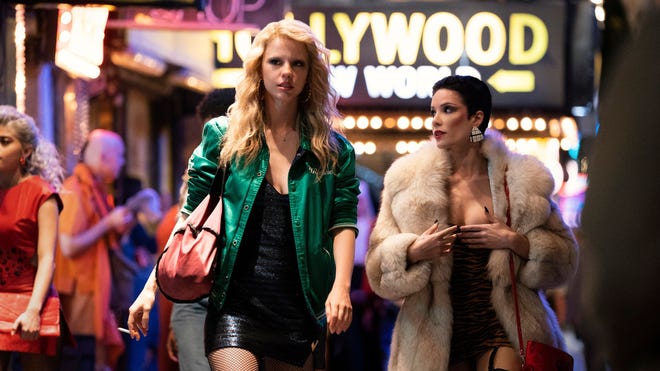
MaXXXine doesn’t mark the spot: Speaking of sequels, I really enjoyed director Ti West’s creepy, generational horror mood pieces with Mia Goth, X and Pearl. But the trilogy “capper” MaXXXine, featuring Goth’s hopeful movie star Maxine trying to make her way in Hollywood after the violent events of X, was a big confused miss. Set in the day-glo ‘80s, a distracting cast of “spot that star” cameos like Kevin Bacon and a bizarre plot twist that made the first two movies seem sane left this sequel feeling like a tired cash-in, the exact sort of movie I think it was trying to make fun of. Even Goth, so good in the first two, seemed bored by it all.
The “return” of EC Comics. EC Comics dazzled and shocked the industry with top-notch art and edgy storytelling back in the 1950s. Periodically, someone tries to bring the IP back, and so it is with this year’s Oni Press revival. Technically, they’re not horrible comics – just highly mediocre product. They look great – boasting a cool retro design with some of the best covers out there. But where they really fell down is the dull and cliche-ridden writing, which felt like ham-handed cosplay of the original EC. The stories either have facile modern-day attempts at limp satire, dumb gory twists or uninspired morality tales. Yeah, the original EC had a lot of that too, but somehow it’s not the same in 2024, and the talents here are no Wally Wood, Harvey Kurtzman or Will Elder. The art is often good but lacks that cohesive feeling the EC Comics “house style” had. I get what they were trying for here, but maybe you can’t go home again.
The rise of AI slop: I work in media, and am probably more worried about the future of this industry than I’ve ever been. The endless plague of misinformation is bad, but the AI “slop” – never has a phrase been more apt – starting to seep in on every corner of the internet feels like it’s just getting started, whether it’s shit fake trailers for movies or “pink slime” viral crap or sleazy grifters out to make a viral buck. This year saw it being shoved at us all over the show without any chance to opt out – Google front-loading AI-juiced searches at us, Facebook saying I can “imagine” a new profile photo, the Washington Post giving us “AI generated highlights” or LinkedIn telling me, a writer for 30+ years, that I can use AI to write an amazing post – it’s all crap to me, and I don’t care if that makes me a gosh-danged Luddite. We all feel like much of the internet has turned into garbage the last few years. The slop is speeding up the techpocalypse. Every word of this website was actually written by me, a human. I wish that didn’t have to be said.









 Nik Dirga