Well, after 17 years in this country I finally got asked to write about Thanksgiving, specifically, what we Americans down here do to mark this very American holiday on the other side of the globe.
Over in the bustling world of freelance journalism, I’ve got two new pieces out there this week!
At Radio New Zealand, I dug into the hip world of used book fairs like this past week’s GABBS 24 Hour Fair, where hundreds of folks pack stadiums in search of everything from Lee Child to Shakespeare at bargain prices. Finally, I have weaponised my own addiction to buying books into freelance material!
Meanwhile, over at the New Zealand Listener magazine, my latest book review published there in this week’s Nov. 11-17 issue is a scary thing indeed – a look at a fascinating study of fear, Fear: An Alternate History of the World by Robert Peckham.
One of the best kinds of voyage is one where you never quite know where you’re going to end up.
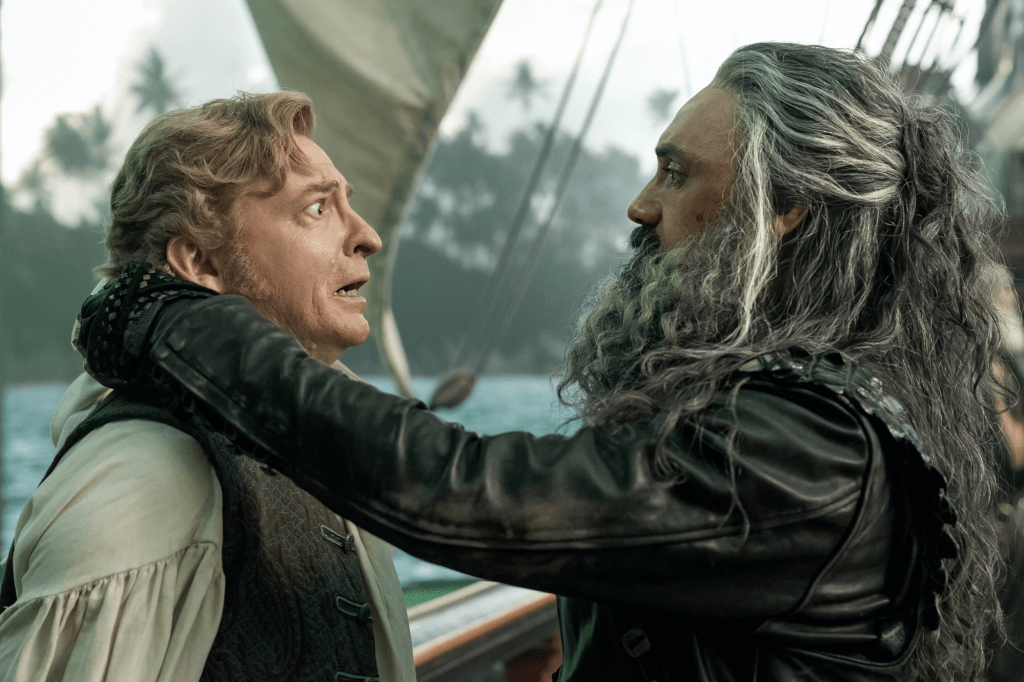
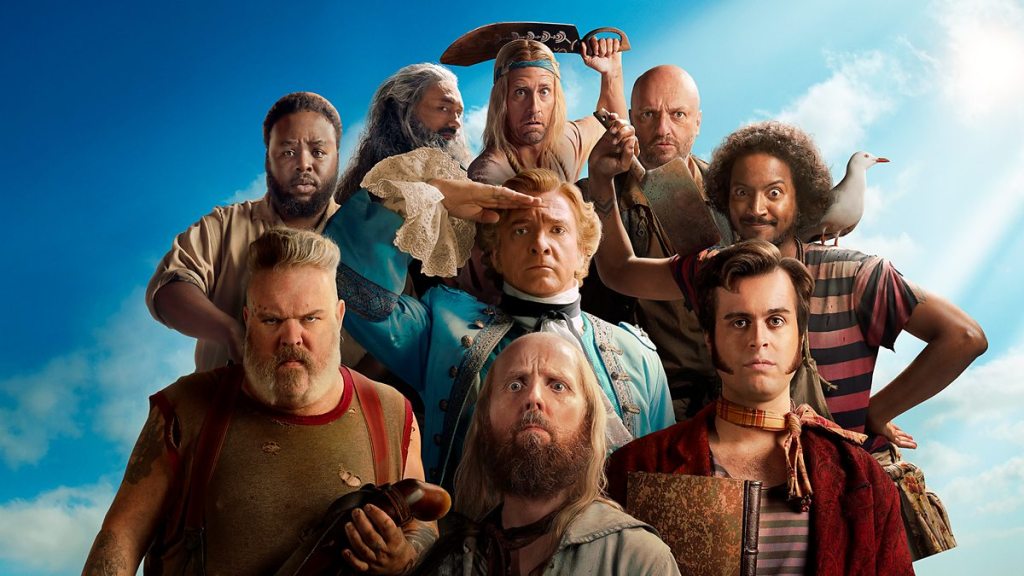
So it is with Our Flag Means Death, which kicked off last year as what seemed to be a goofy send-up of pirate adventures starring NZ comedian Rhys Darby as a foppish “gentleman pirate” and a cast of oddball crew members.
Yet Flag quickly changed course, developing into, of all things, a sweetly understated and respectful gay romance between Darby’s Stede Bonnet and show producer Taika Waititi as a sultry take on the legendary pirate Blackbeard.
In its second season now, it’s become one of the most LGBTQ-friendly mainstream shows out there and while often hilariously funny, it’s also turned out to have a heart as deep as the Sargasso Sea.
Flagmoved to New Zealand to film season two, and it’s great to see the local creative influence, from familiar faces and crew to showcasing gorgeous locations I’ve been to many a time.
In its dense, witty second season, Flag has come into its own once it wrapped up the will-they-or-won’t-they arc of Stede and Blackbeard and let them settle into their own distinct kind of couplehood. Stede’s a wildly optimistic, extroverted and yet insecure pirate while Blackbeard is a tangled mess of rage, regret and self-destructive tendencies. Somehow, Darby and Waititi make it all work.
In its second season, a lot of the focus on Our Flag Means Death is coping with trauma – not the lightest of topics for a pirate comedy, but nobody ever said pirating was a gentle life. Everyone, from Stede to Blackbeard to the crew members, seem to be, bluntly, working out their shit this season, dealing with mutinies, injuries and painful memories. Despite all this, Flag has kept a mostly light touch. I mean, it’s got Rhys Darby as a mermaid in one memorable dream sequence.
Darby’s been great fun ever since he made it into the public eye with Flight of the Concords, but Stede is by far his best performance, still keeping his eager-to-please hangdog charm while adding welcome soul to his character’s coming out. And while yes, we all felt like things got a bit too peak Taika for a while there and some of his recent projects have been a bit mixed, he’s terrific as Blackbeard. It’s his best performance since his cad of a deadbeat Dad in his own movie Boy, and perhaps that’s because both roles come from a slightly wounded place, instead of the more flippant kiwi joker he often plays. The sweet-and-sour, dark-and-light pairing of Blackbeard and Stede makes for a terrific comic team you can’t help but root for.
But the rest of the cast, who include several New Zealand actors like the awesome Dave Fane, Rachel House and Madeline Sami, have all also stretched out to fill in their own sketchy parody characters as Flag has gone on. What was a kind of stock crew of madcap weirdos has turned into a group of distinct individuals, many of whom have their own queer romance stories brewing in the background.
Yet the show never goes for lame stereotyped punchlines, or treats its queer characters as jokes, no matter how silly everything around them.
It’s a voyage all about love, and when you get down to it, that’s the only treasure in the world really worth sailing the seven seas for, isn’t it? Our Flag Means Death certainly isn’t the show it seemed to be when it started to set sail, but somehow, it’s all the better for that. It’s worth dropping an anchor for.
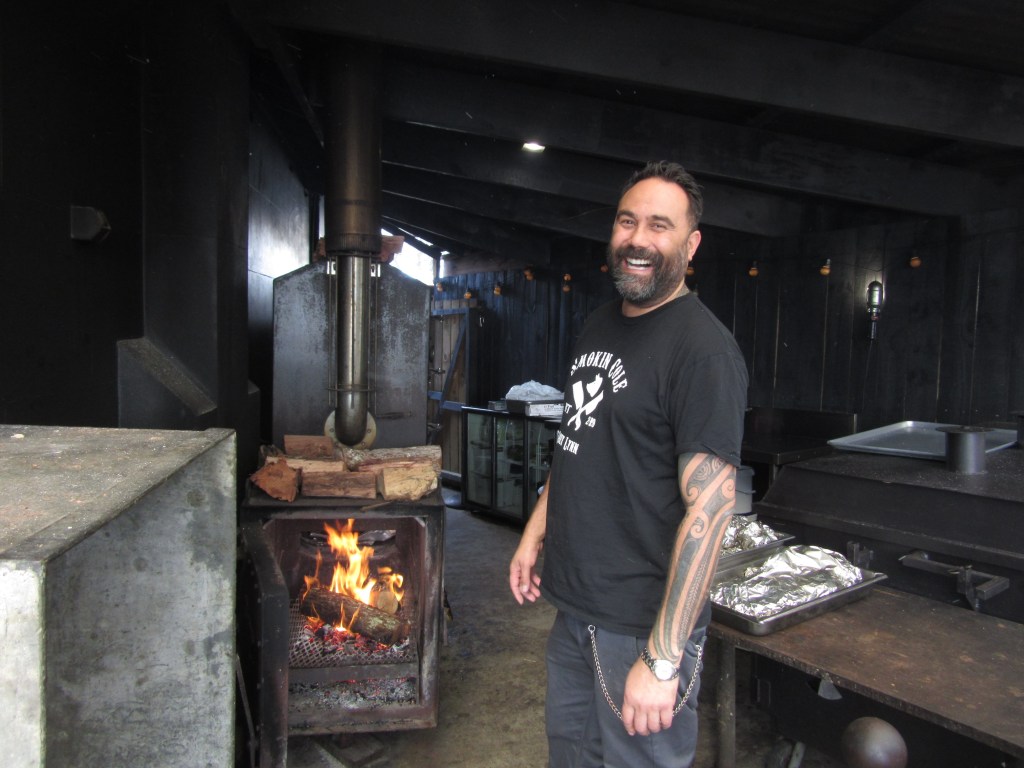
Here’s a new feature by me over at Radio New Zealand up this weekend – a look at how American style ‘low and slow’ barbecue cooking is making a splash way down in this part of the world, and a talk to several leading NZ barbecue pit masters! Go read:
So we’ve got an election coming up here in about 8 weeks, which will determine who will run New Zealand for the next three years. Right now, multiple polls seem to indicate it’s still quite a toss-up between the current, left-leaning Labour government seeking a third term, and the more conservative National Party which led the country from 2008 to 2017. I’d hesitate to bet on the results on October 14 at this point.
But as imperfect as it all is, as I’ve written about before, I still enjoy voting in our Mixed Member Proportional or MMP Parliamentary system much more than I ever did in the American system. There’s simply much more choice to a system where five or six parties have a good chance of making into Parliament and having a voice in government.
Here, you vote for both your local electorate candidate AND a separate party vote, meaning I could vote for a National local candidate but give my party vote to the Greens or somesuch. If a party gets 5% of the vote – a fairly high threshold to meet which rules out true fringe parties – they’ll get into Parliament, or they can also get into Parliament by winning a single electorate.
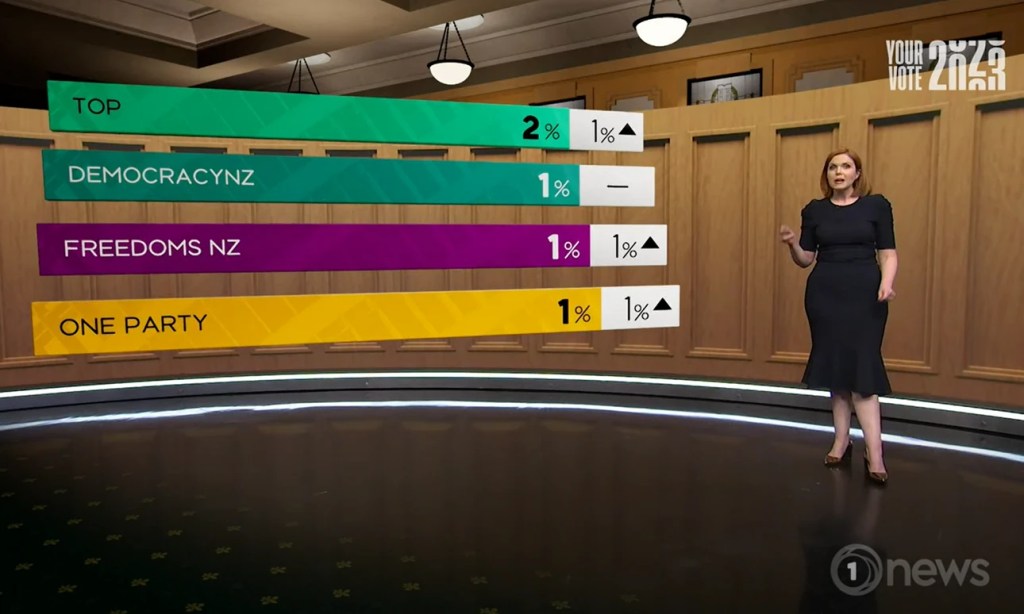
Smaller parties matter more here, and that’s something I appreciate. While National and Labour roughly remain the biggest gorillas in the jungle there’s a lot more shade on the sidelines, with the progressive Green Party, the indigenous rights Te Pāti Māori, the libertarian leaning ACT and the kinda nationalist populism of New Zealand First. Toss in a whole pile of super-minor parties – this year, an awful lot of the conspiracy / “freedom” / anti-vaccine crowd have formed conflicting tiny parties with hopes of getting in there somewhere – and you’ve got quite a stew to pick from.
Unlike in the US, where 95% of the time any vote for a candidate who’s not Democrat or Republican has zero impact, here, the smaller parties can build up enough steam to get a voice in power. The Greens and ACT, the two largest of the smaller parties, have yet to run the country but they’ve both been part of governing coalitions helping set the agenda for the nation.
I’m not saying I agree with all of these parties myself but I like the broader picture it paints. Look at America where, basically, you’re either forced to vote for a Democrat or a Republican to pick someone who’s going to win (independents do exist, here and there, but they have yet to make any kind of major impact on the national scene). On the state level, state legislatures are increasingly becoming redder or bluer. It’s a recipe for legislative overreaching, dictatorial heavy-handedness and corruption, IMHO.
Our system is hardly perfect, and with the creeping craziness and political swerves the last few years have brought I don’t imagine a lot of people will wake up super happy in New Zealand on October 15. But I do just like seeing a lot more colours on my polling and election graphics than you ever do in the USA, because life really should be about more than just blue and red.
I’m running around getting ready for a holiday and juggling deadlines like they were howler monkeys escaped from the zoo, but here’s a quick look at some other things by me elsewhere on the internets:
It’s just about time for Whānau Mārama New Zealand International Film Festival, the bestest time of the year if you love movies, and I have already bought far too many tickets. You can read my preview of all the film fest action right here at Radio New Zealand, and it also doubles as a bit of a tribute to film festivals in general, which we all know are the best-ivals.
Meanwhile, I’m also keeping up an occasional book reviewing side hustle over at NZ’s best weekly current affairs magazine, The Listener, which after a few pandemic-plagued years without a web presence has recently launched a bigger digital footprint.
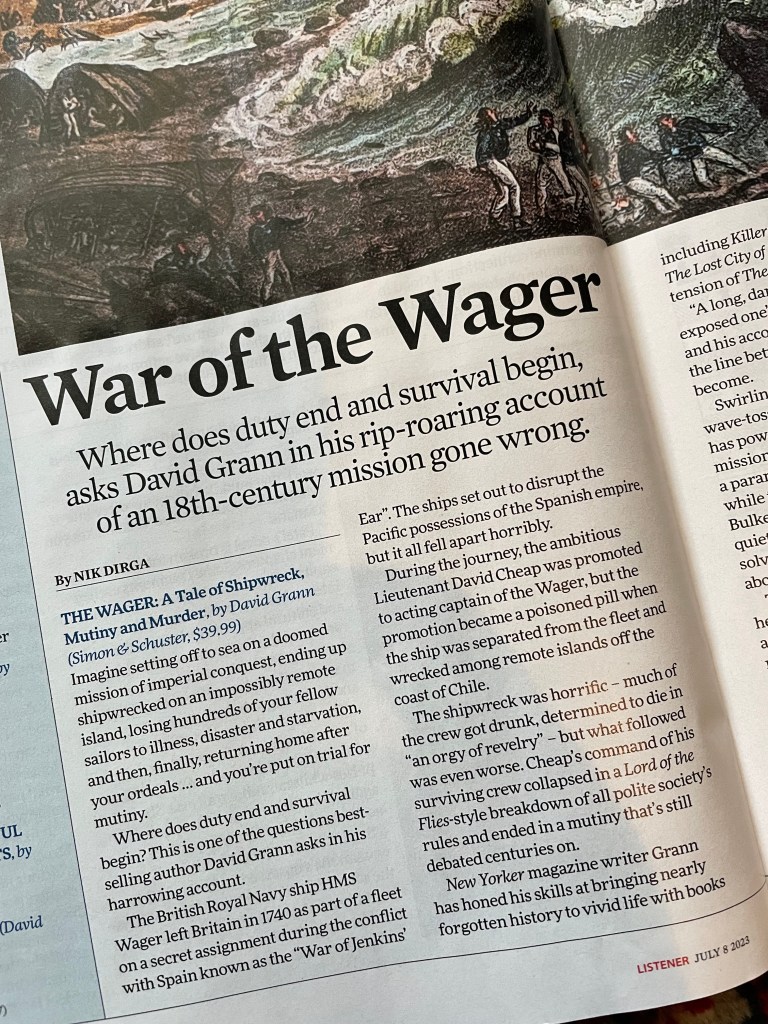
You can read my latest book review of David Grann’s excellent historical page-turnerThe Wager: A Tale of Shipwreck, Mutiny and Murder right now in the latest issue at good newsstands everywhere in New Zealand, and the review is also online right here (paywalled):
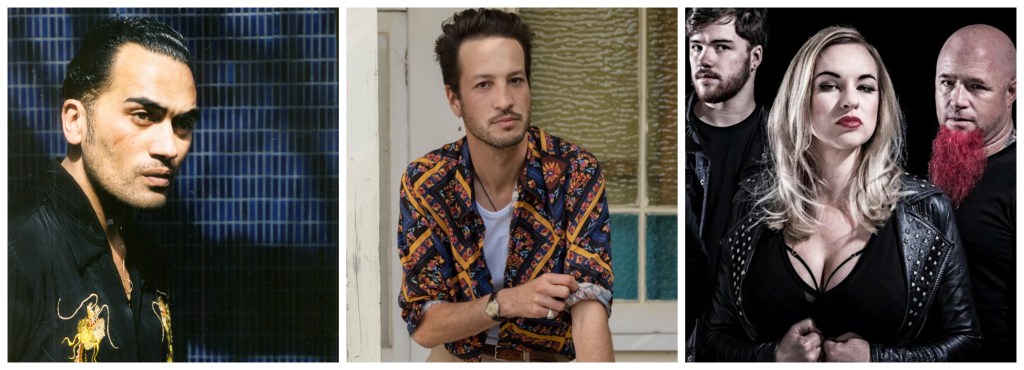
From left, OMC’s Pauly Fuemana, Marlon Williams, Devilskin.
Once again, it’s nearly the end of another New Zealand Music Month, where all kiwis get up and dance to kiwi music all the month long.
People who were born here and those who came to live here from far away will all tell you that the music of New Zealand – from rough garage punk to delicate singer-songwriters to rich Māori waiata – feels special, somehow. We’re a small country, and yet, we make a mark on the global music scene. We’re the bottom of the world, so maybe we try harder.
Up in the hills of California, I didn’t grow up listening to a lot of the more obscure New Zealand music, and part of the fun of living here is constantly discovering fantastic songs that never made a splash in America, spanning gritty alternative rock to South Auckland soul.
Darcy Clay.
I dug making a playlist of 30 or so of my favourite New Zealand songs last year, and figured I’d give it another go this year picking out work by another bunch of great local musicians – celebrating everyone from Flying Nun legends like the Chills to rich young talents like Vera Ellen and Kane Strang or classic old-school psych-pop nuggets from The Fourmyula and Larry’s Rebels.
I love a song list that can encompass both the elegantly formal craft of Don McGlashan and the chaotic anarchy of the late Darcy Clay, so get ready for a wild ride through NZ sound. It really just scratches the surface of the talent, weirdness and beauty to be found in Aotearoa music. Here’s my playlist More Noisyland Music: NZ Music Month 2023 which you can hear over on Spotify:
Everyone knows that Boris Karloff played Frankenstein’s monster. Most horror fans remember the late, great Christopher Lee, as well. Benedict Cumberbatch has played the creature. Heck, even Oscar winner Robert DeNiro has played the monster.
But did you know about the New Zealand wrestler who once played Baron Frankenstein’s horrific creation?
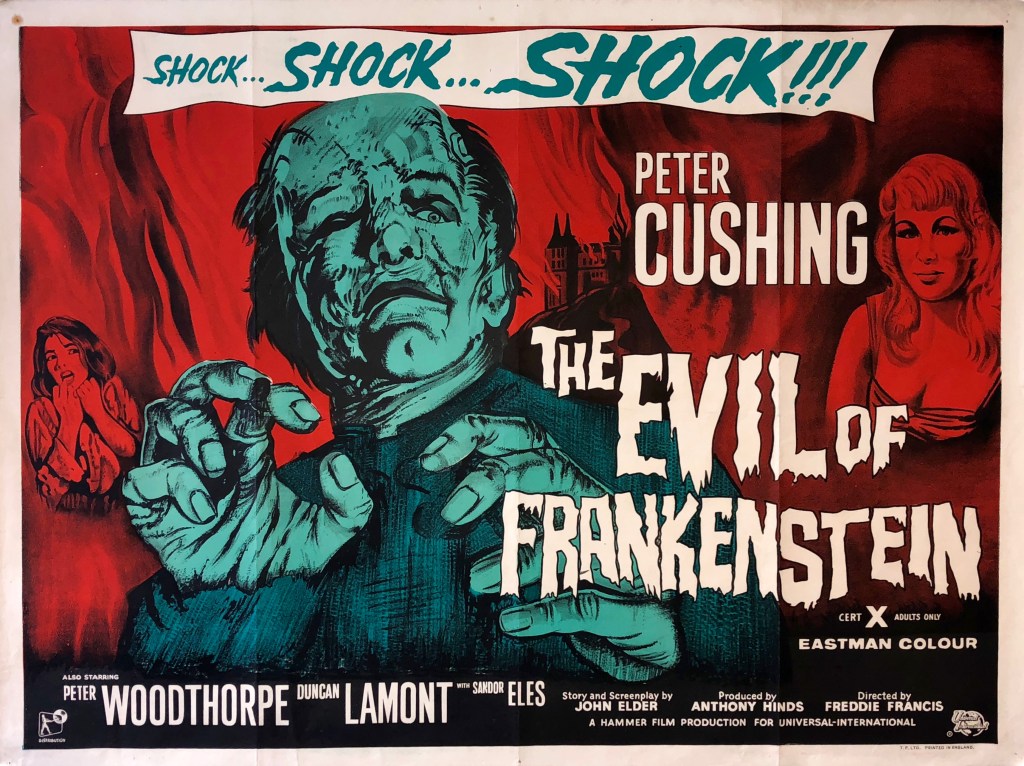
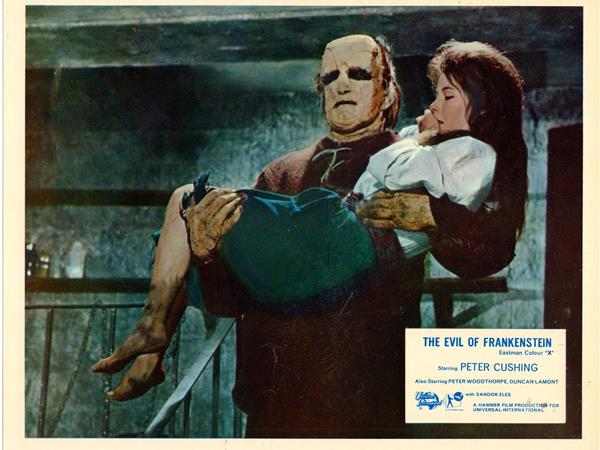
Ernie “Kiwi” Kingston’s turn as the monster in 1964’s The Evil Of Frankensteinby Hammer Films earned him a small but notable place in horror history, but the wrestler’s acting turn is shrouded in obscurity, nearly 60 years on. It was pretty much the only film he performed in.
The Hammer Frankenstein cycle of movies from 1957-1974 still hold up well as a colourful Gothic series of chilling tales about man’s desire to play God, led by the inimitable Peter Cushing as Baron Frankenstein. Unlike the earlier Universal Frankenstein films, the focus on these was squarely on the evil doctor himself and his mad obsessions as he creates monster after monster in his quest to unlock the secrets of life and death.
Evil of Frankenstein was the third of six films Cushing starred in, and a kind of weird outlier – the story didn’t seem connected to the two previous movies, and it’s the only one of the series not directed by Hammer maestro Terence Fisher.
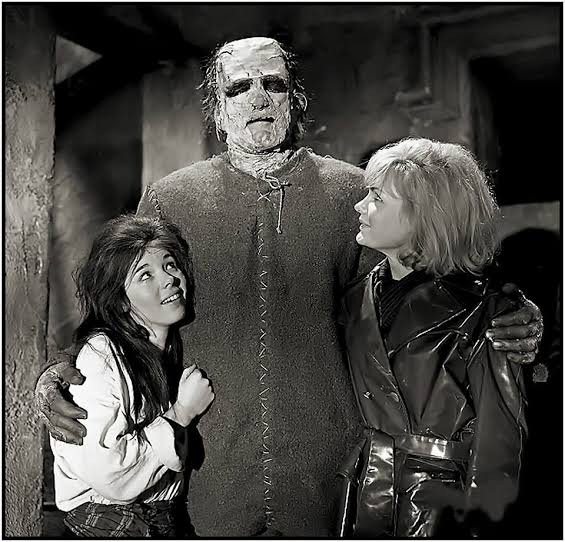
A professional wrestler, 6 foot, 5 inch “Kiwi” Kingston, as he was credited, played a hulking, grotesque version of the monster, freed from frozen ice and abused by a rogue hypnotist (as you do).
“As a person to work with, quite timid, gentle, quite reserved,” costar Katy Wild, who played a mute girl that befriended the monster, in a documentary on the Evil of Frankenstein blu-ray.
Unfortunately for Kingston, his turn as the monster is hampered by what is probably the worst makeup in any major Frankenstein movie I’ve seen. Inspired by Karloff’s iconic look, it’s a sloppy, blocky mask that looks a bit like a grocery bag soaked in papier-mâché. The too-huge brow and lack of mobility prevents much in the way of facial expression. You can just barely see Kingston’s eyes poking out from under all the goop.
It’s a shame because it’s possible less oppressive makeup might have given Kingston more to work with other than lurching around a lot … although he wasn’t exactly a trained actor.
“Kiwi Kingston was actually cast for his hulking frame and not his acting ability,” the documentary on the movie notes.
While he was indeed a Kiwi, he seems to have spent most of his life overseas.
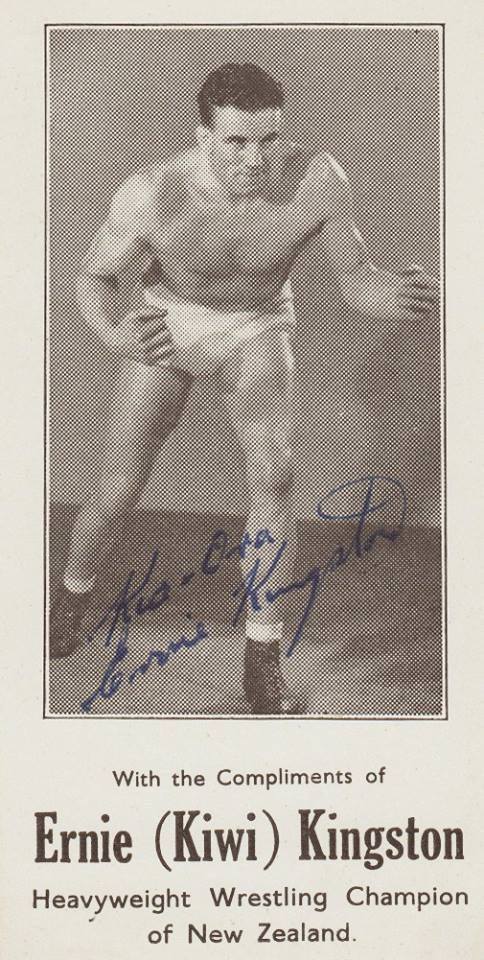
A Christchurch history page says he was “born in 1914, to Ernest John Kingston and Edith Emily (nee) Hammond. As an amateur boxer in New Zealand Ernie had been runner-up in the heavyweight division at the N.Z. champs in 1938. He was also a top rugby player and general all round sportsman.”
He made a name for himself in NZ sport, as seen in a very fit photo from 1940 in the national archives. Like a lot of kiwis, Kingston went on a big OE (overseas experience) but in his case, it sounds like he never really returned. A wrestling blog from 2005 tells a little of his background:
“… Towards the end of the 30’s, a big strong rugby player, boxer, and wrestler, did some service in the air force and ended up in Britain. He was a (wrestler) Anton Koolman pupil in Wellington in the late 30’s, and it is sad that he was almost unknown in his own country. I refer to big Ernie Kingston, who ended up a huge name in Britain and all over Europe. He became known as ‘Kiwi’ Kingston, a big rough diamond from Banks Peninsula.”
He loved horses – “he had a pony field where he collected ponies that had been discarded and looked after them until they died,” his Evil co-star Caron Gardner remembered.
Evil of Frankenstein was just about it in terms of movie stardom for Kingston, who only appeared in a tiny role in another Hammer film, Hysteria. He did apparently later wrestle under the stage name “The Great Karloff” which is a kind of awesome tip of the hat to his Franken-forefather, though.
Ernie Kingston died in 1992, and there’s not much out there on the internet about his life in later years I could find.
But there’s only a handful of people out there who can say they played Frankenstein’s monster in a major Hollywood movie over a century or so of films. Kiwi Kingston’s turn as the monster long before Peter Jackson helped put New Zealand horror movies on the global map is a small but fascinating little piece of film history. Not bad for a lad from the bottom of the world.
I used to see this guy occasionally when I returned to visit America from New Zealand, and every single time he saw me, he’d unleash a stream of lame dad jokes about hobbits and orcs.
…Because that’s all some Americans know when they think of New Zealand, you see, is Peter Jackson’s admittedly excellent Lord of the Rings movies (and the rather less excellent Hobbit follow-ups).
New Zealand movies are so much more than that, of course, from Oscar-winning director Jane Campion or the askew comedy of Taika Waititi to the awesome talents of Bruno Lawrence, Karl Urban and Sam Neill to some brilliant Māori filmmaking. The now-New Zealand-based James Cameron films his gazillion-dollar Avatar movies here and Wēta Digital’s special effects are all over screens from Marvel superheroes to Cocaine Bear.
But also, New Zealanders are really good at scaring the crap out of you.
A pre-hobbit Peter Jackson made some of the first NZ horror movies to gain notice worldwide with the splatter-horror/comedy low-fi genius of Bad Taste, Brain Deadand Meet The Feebles. Many other great NZ horror movies have followed ever since, including Black Sheep, Deathgasm and Housebound.
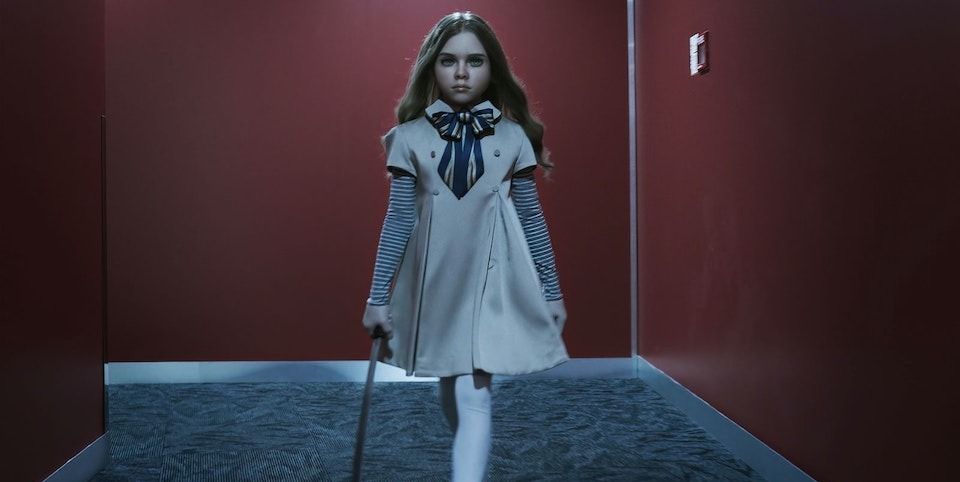
But in the last year or so, even more New Zealand-made horror has kind of taken over the world, with four well regarded scare-fests topping the box office or winning critical acclaim – M3GAN, Evil Dead Rise and Ti West’s XandPearl.
These films aren’t generally entirely made by New Zealand directors, actors and writers or explicitly even about New Zealand, but by simply being filmed down here and using a hefty amount of local cast, crew, and behind-the-scenes personnel, they’ve got a heavy kiwi sensibility packed into their DNA – a little alienation, a little finding horror in everyday objects, a little wry black humour.
Scary robot doll movie M3GAN is deeply silly but fun spin on the whole “evil technology fears” trope, and while its generic America suburbia and offices setting doesn’t scream New Zealand, big chunks of it were filmed here and NZ director Gerard Johnstone gives the material a nice, creepy edge and added in the viral dance scene that helped make the movie a surprise hit.
I haven’t seen the intensely gory brand new Evil Dead Rise as it looks a little too much for me, to be honest, but I love that a blood-soaked elevator scene prominent in the trailers was filmed near the mall I used to go to all the time. The whole Evil Dead franchise has many ties to New Zealand – producer Rob Tapert has been with Sam Raimi’s goopy undead franchise since the very beginning, co-created ‘90s kiwi TV sensation Xena: Warrior Princess and is married to its star Lucy Lawless, and the excellent Ash Vs. Evil Dead TV series was all filmed down here.
But the best of the lot of recent NZ-shot terror for me are the psychosexual horrors of Ti West’s X and its prequel Pearl, which after many delays is finally being shown in NZ cinemas. Both films were filmed at a spooky Whanganui farm, and feature many familiar NZ acting faces.
X is a proudly sleazy movie about a 1970s porn movie being filmed at a sinister farm that plunges into unexpected depths of emotion amidst its gore and sweat, while the prequel Pearl shifts back in time to tell the story of the elderly woman at the centre of X as a young, hopeful girl with dreams of escaping her stifling family farm. Both movies star Mia Goth, one of the most unique presences on screen in quite a while (without spoilers, she plays multiple roles across the two films).
I think Pearl is the first great movie I’ve seen to take on the COVID pandemic and all the uneasy, awkward feelings of fear and anxiety churned up by it. Set during the 1918 flu pandemic, it’s a world of recovering trauma where young Pearl (Goth) fears she’ll never fulfil her dreams. Much of Pearl was written while West and Goth were in quarantine here in New Zealand, and the script richly evokes how uncertain the world felt in those early pandemic days.
An awful lot of movies are shot in New Zealand these days – we’re a hip, cool place, we’re cheap, got a lot of great screen talent built up here, but really, enough with the hobbit jokes, already.
It’s OK if you want to start thinking of New Zealand as the place you go to get scared, too.
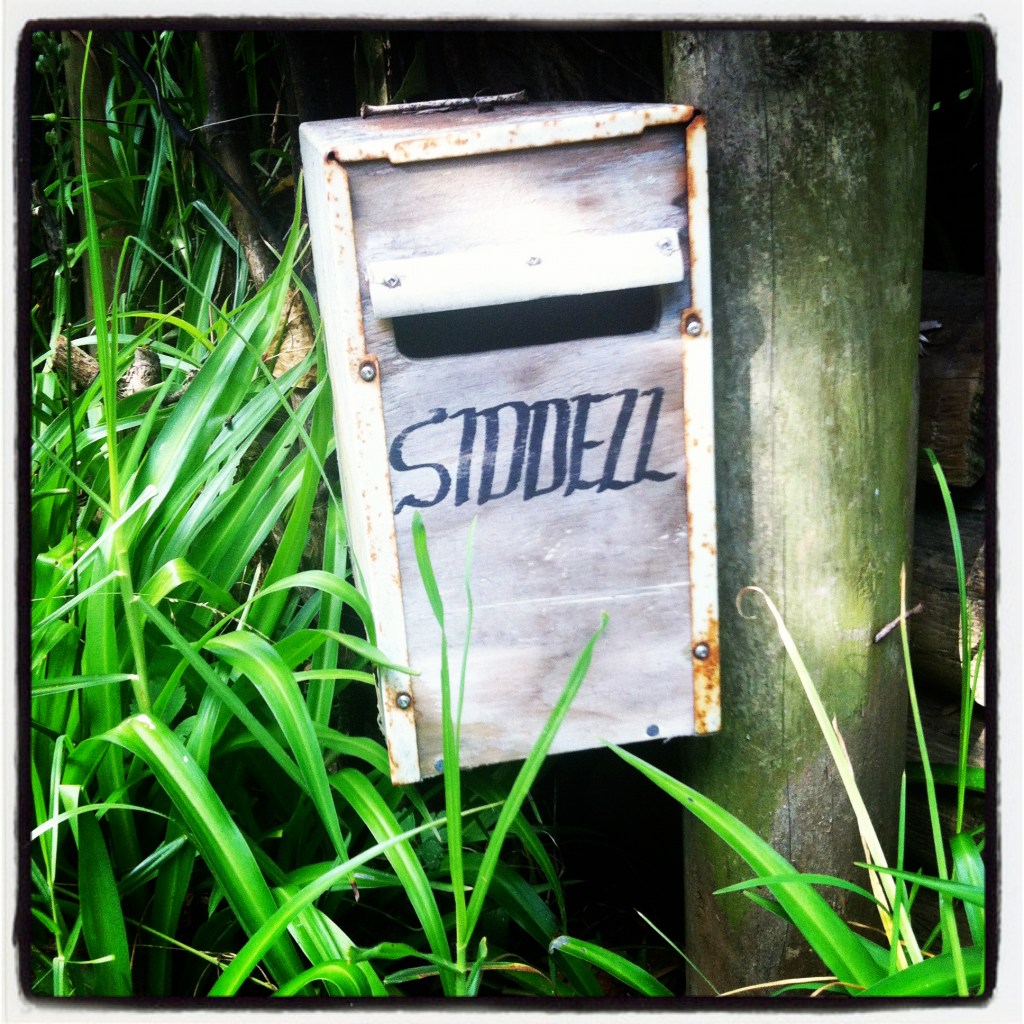
It wasn’t fancy, I guess, but we liked it. My late father-in-law Peter Siddell built this bach, or beach house, more than 50 years ago now, from a garage kit-set. It was tucked away in the bush way out in West Auckland at Karekare a relatively short walk from the beach, and somewhat hidden from the world down a narrow plant-lined path.
Now it sits red-stickered and smashed, like so many other houses and baches after Cyclone Gabrielle’s wrath last week. At least 11 people are dead and countless lives shattered, in ways big and small.
For decades, this unassuming bach, or beach house – no TV, no phone, a rather rugged outhouse toilet – was the centre of one family’s life. As children my wife and her sister spent weeks at a time out there, only going back to the city occasionally, sunburnt and sandblasted by long days on the black sands. It wasn’t a flashy place – it was a space to doze and read magazines in between beach adventures, to while away the long summer nights under starry skies.
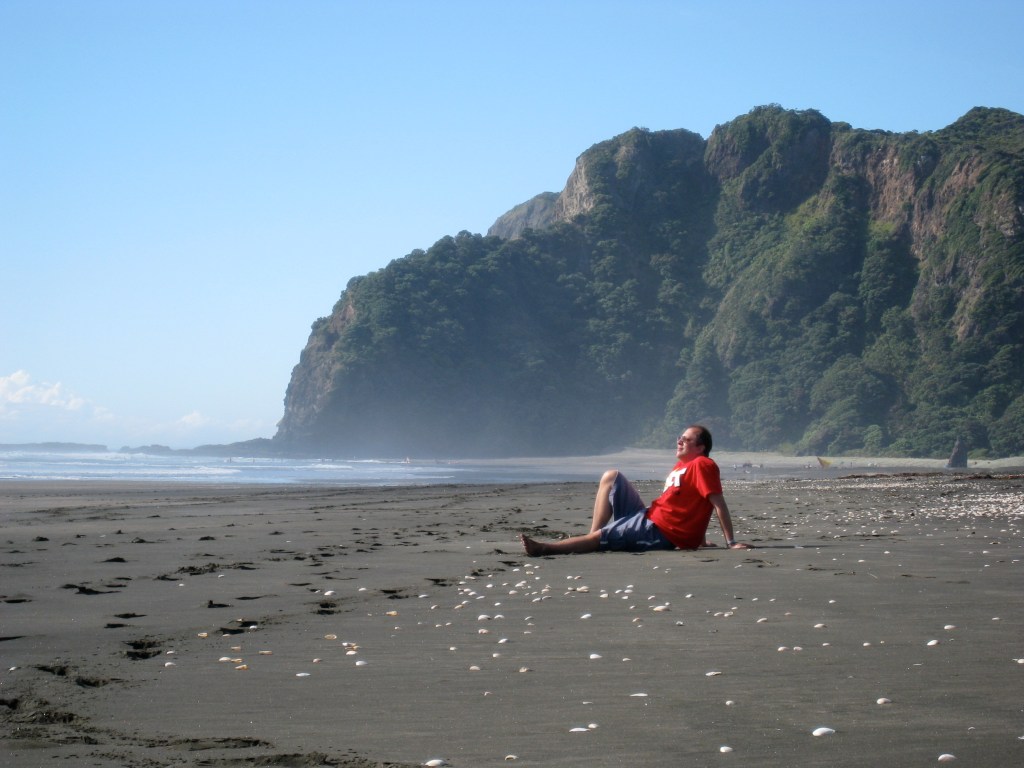
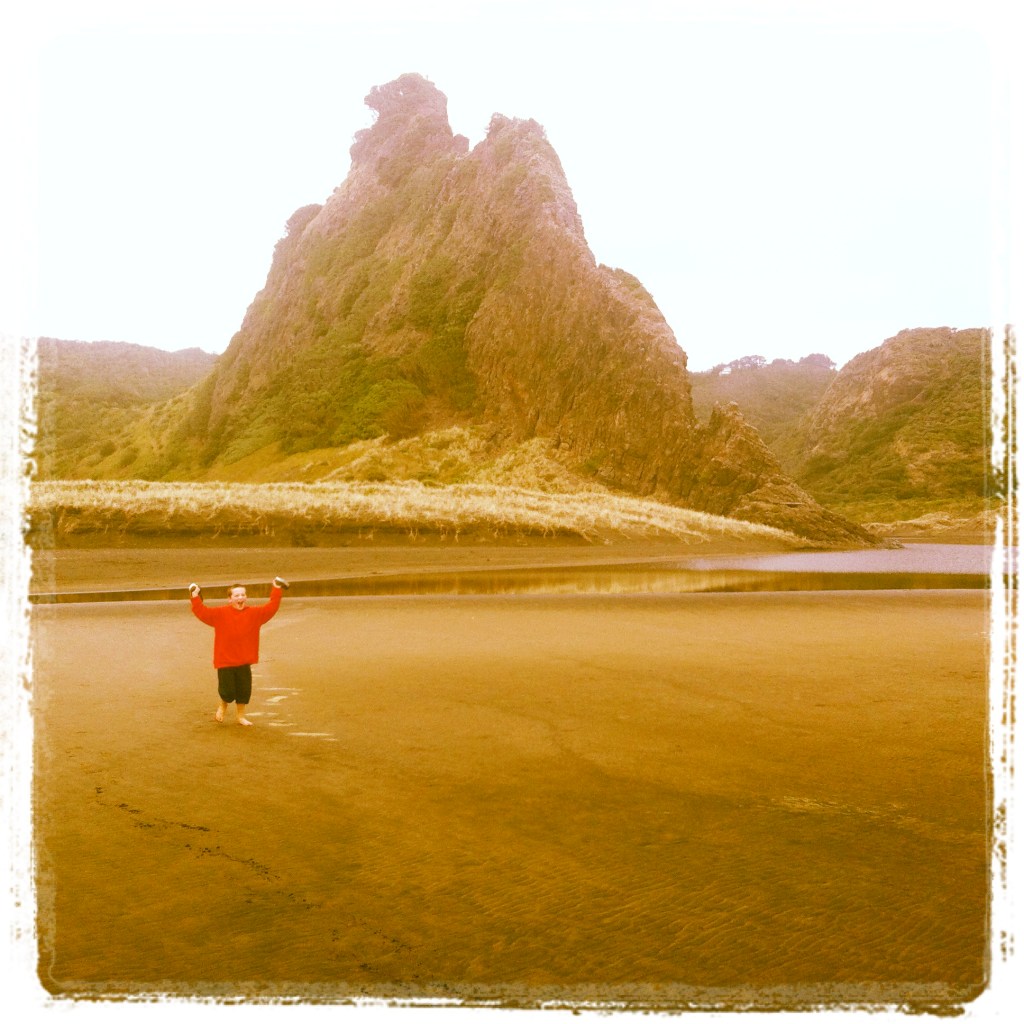
My in-laws Peter and Sylvia held frequent parties, the bush ringing with laughter and the sound of clinking wine glasses. You could see Karekare’s grand ominous rocky outcrop the Watchman from the deck, and before the dunes shifted and trees grew, you could see the sharp lines of the Tasman Sea against the horizon.
When I first visited New Zealand with my new wife in 2000, the bach she’d talked about so much was one of the first places we visited.
After my in-laws died in 2011, the bach passed to the next generation. It became a bit quieter without Peter and Sylvia there, but was still regularly used. The grandchildren grew up and became old enough to go out for a night with their mates. It may have been a little less busy than it once was, it may have been starting to take a lot of work to keep it in good nick, but we still loved our little humble bach.
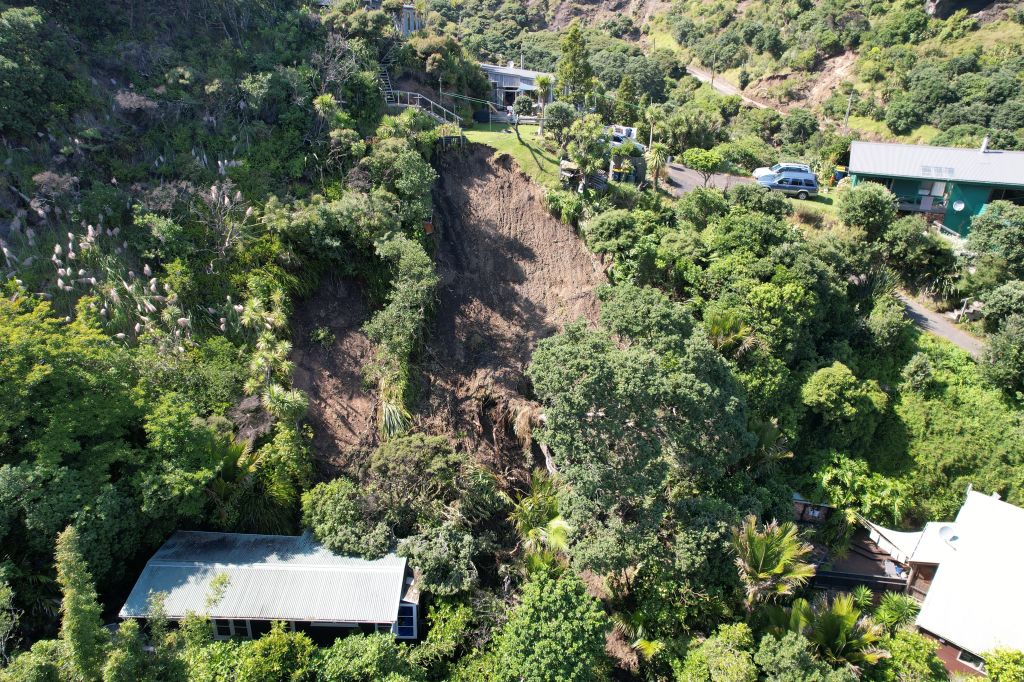
Then sometime on the evening of February 13, Cyclone Gabrielle smashed through Karekare and the rest of the country, and tonnes of mud and trees slid down the steep hills, knocking our old bach aside like it was made of cardboard.
It is a story repeated hundreds of times around Aotearoa this week – a family place, a special taonga, taken away in a rush of water and wind.
We are so very lucky compared to so many others, we know, and whānau all over are feeling that strange and empty kind of pain a disaster like this carves out of ordinary life.
In photos seen from above, twin slips gave way on either side of the bach, endangering it and other houses around.
We don’t know yet what will become of it in the end, but it doesn’t look good. Photos captured by neighbours show a building knocked askew, the sturdy deck timbers warped like they were rubber by the sliding foundation. The musty long-drop toilet we kept meaning to replace has seemingly been wiped from the face of the earth. The makeshift bath has fallen away from the house. Yet weirdly, some tiny pots on a bench on the slanting deck haven’t moved at all, and the windows appear intact.
Karekare is a tiny place that’s only a permanent home for 300 or so people, best known for having several scenes from Jane Campion’s The Piano shot there. Like a lot of people, I’m over much of social media these days, but community groups online have proved invaluable for getting information out from the closed-off coast.
The people stuck out there have gathered for cheery barbecues, as the mud is swept up and the cracked and battered places surveyed by engineers and insurers. They have rustled up ways to get children to school somehow despite shattered roads.
One woman lost her beloved home, but in the middle of the crisis she reached out to offer some of the donated clothing she received to others.
“Karekare has always been the best place in the world, and it is the people that make it next level amazing,” she wrote on the local Facebook page.
It is true these are just places and things, and the horrifying loss of life in Gabrielle is by far the worst thing about the cyclone. Muriwai, just up the coast, is still grieving the death of two volunteer firefighters. Everyone is starkly aware things could have been even worse.
But each place and thing that has been lost in the cyclone also has meaning for people, whether it’s a grassy back yard children have played in for years, a beloved tree that shaded people as they dozed in the sun, a battered old chair that was a comfortable companion every evening for someone.
Any kind of natural disaster, whether it’s flood, fire or earthquake, takes away things you felt were certain in life.
I don’t quite know yet what it replaces them with, but I keep finding myself thinking of that rustic little bach, now abandoned and the days of wine and parties for it probably over. I think of my son’s first visit there when he was barely a year old and of a photo taken circa 2006 of my late father-in-law with his three grandsons on the porch, reading a book together.
My son grew up playing on those beaches, those black sands, summer after summer. My son’s now a university student and it sometimes feels like everything has changed since that photo was taken.
But those moments – for us, for all the victims of Karekare, for all those wounded by Gabrielle – are still there, floating somewhere, and I like to think that no storm can ever really take them away for any of us.













 Nik Dirga