I published a lengthy piece back in September just before Carter turned 100, by far the longest lived US President in history. (Funnily, I actually first wrote it back in 2023 sometime, thinking it would be as a nice obituary tribute to run somewhere, but old Jimmy just kept on going!)
Anyway, it says all the things I feel about Carter, who was perhaps not the best of presidents if you measure his term, but, as his long life and endless service shows, he was one of the best of men. It’s a kind of life that seems very, very far away at the dawn of this next presidency, but it’s one that I keep hoping that someday perhaps will influence a braver, smarter generation.
To quote that great Blue Mountain song, which I sure hope an awful lot of people will get to hear in the coming days,
“Well he said I’d never lie to you, and what’s more he never did. Though the times grew mighty tough, he never flipped his lid. So shake the hand of the man, with a hand full of love. The one and only Jimmy Carter.”
I get it. You’re stressed out. This is life in 2024.
But instead of doomscrolling political news all week, how about taking a break with a presidential movie?
The presidency has been the subject of countless movies, good and bad, from lofty biopics to action-packed romps. Here are 15 movies about American presidents and politics that are worth firing up to divert your brain for a few hours as Election Day approaches.
If you want to feel a little bit of optimism:
The American President (1995): A genuinely sweet romantic comedy about a widowed president finding a new love, starring a luminous Michael Douglas and Annette Bening, and written by Aaron Sorkin, who later went on to create The West Wing TV series.
Lincoln (2012): Daniel Day-Lewis’ Oscar-winning performance takes Abraham Lincoln out of the realm of cliche and makes him a complex human being again, wrestling with how to end slavery in an America torn by the Civil War and trying to do the right thing.
Mr Smith Goes To Washington (1939): Jimmy Stewart’s naive young US senator comes up against Washington corruption. The thing that makes Frank Capra’s classic still relevant today is its fierce determination to make politics better.
If you just want to wallow in political intrigue:
Frost/Nixon (2008): There have been a lot of movies about Richard Nixon, but this tightly focused film sticks to one post-presidential interview where the disgraced president tries to redeem himself. Tense dialogue and terrific acting makes the spectacle of two men mostly sitting in chairs talking seem riveting.
All The President’s Men (1976): Nixon never appears in this Oscar-winning Watergate drama, but hovers over it like a malignant ghost as journalists Robert Redford and Dustin Hoffman uncover a labyrinthine scandal that led to America’s first and only presidential resignation.
JFK (1991): Oliver Stone’s mammoth three-hour epic is a twisted knot of conspiracy theory, paranoia and grifters, so it’s a perfect vibe for Election 2024. It’s a complicated, indulgent sprawl of a movie that’s still somehow fascinating, with an all-star cast.
If you think politics is ridiculous:
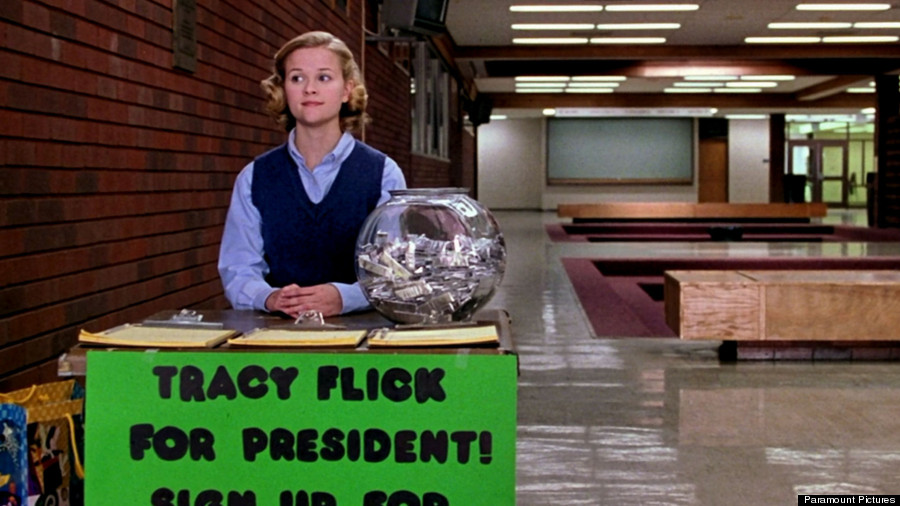
Election (1999): Strictly speaking, not quite about a president, but this classic story of an American high school student election that goes horribly awry sums up how much the desire to win can eat away at a person. With a never-better Reese Witherspoon and Matthew Broderick.
Don’t Look Up (2021): The US hasn’t had a female president – yet – and they’re pretty thin on the ground in movies, too. (Television is a different story, where women presidents have been seen on Veep, Scandal, Homeland and many other shows.) This hit-or-miss satire about panic over a comet destroying Earth has its amusing moments and features Meryl Streep as the president – unfortunately, she’s a shallow, poll-obsessed fool who bungles the end of the world badly.
Mars Attacks! (1996): Love Beetlejuice? Tim Burton’s underrated comic book epic features a rogue’s gallery of oddball Americans battling Martians, and one of the funniest turns is Jack Nicholson as a vaguely sleazy, cocky and utterly unprepared president.
If you’ve given up all hope on America:
Dr. Strangelove, Or How I Learned To Stop Worrying And Love The Bomb (1964): Stanley Kubrick’s Cold War satire still stings today, with the magnificent Peter Sellers in multiple roles, none quite so indelible as the wishy-washy President Merkin Muffley, who very apologetically starts a nuclear war.
Vice (2018): Christian Bale makes an unlikely Dick Cheney in this biopic of George W. Bush’s vice president, which in a broadly comic way shows just how much ambitious power can be wielded behind the scenes.
Civil War (2024): A movie about a traumatised band of journalists travelling through an America torn by an unspecified civil war, it’s not one to watch if you want to feel cheerful about the possibilities of the USA, with Nick Offerman as a crazed, out-of-his-depth president presiding over the country’s collapse.
If you just want a president to kick butt:
Air Force One (1997): Harrison Ford lives the American dream – that is, the dream of being a take-charge military hero who also happens to be president and fights back against terrorists on his own airplane.
White House Down (2013): Mix Die Hard with Air Force One, shake, stir and settle in for explosions and gunfire at the White House as terrorists attack and only the humble everyday policeman Channing Tatum can save the day.
Abraham Lincoln: Vampire Hunter (2012): Sure, you’ve seen a president fight terrorists, but how about vampires? This very silly alternate-history horror movie takes itself far too seriously, but does provide some ridiculous, bloody laughs as Honest Abe stakes blood-suckers. Considering how bizarre the 2024 election campaign has been so far, this might just not be the strangest thing about American presidents you see this week.
Jimmy Carter is the longest-lived American president, and as he turns 100 years old, it turns out he was also pretty much the last of his kind.
Growing up in California, I was just a kid when the former peanut farmer from Georgia became an unlikely president in 1976, aiming to wipe away some of the disillusioned taint of the Nixon years. He’s the first president I have memory of, smiling away from the tiny TV in our kitchen.
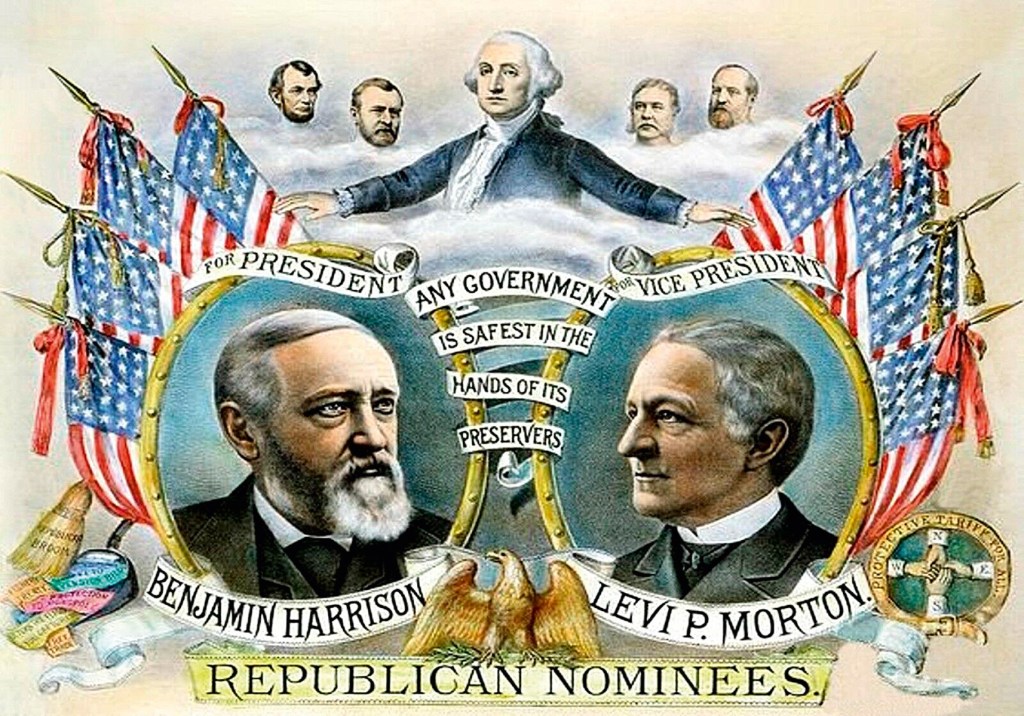
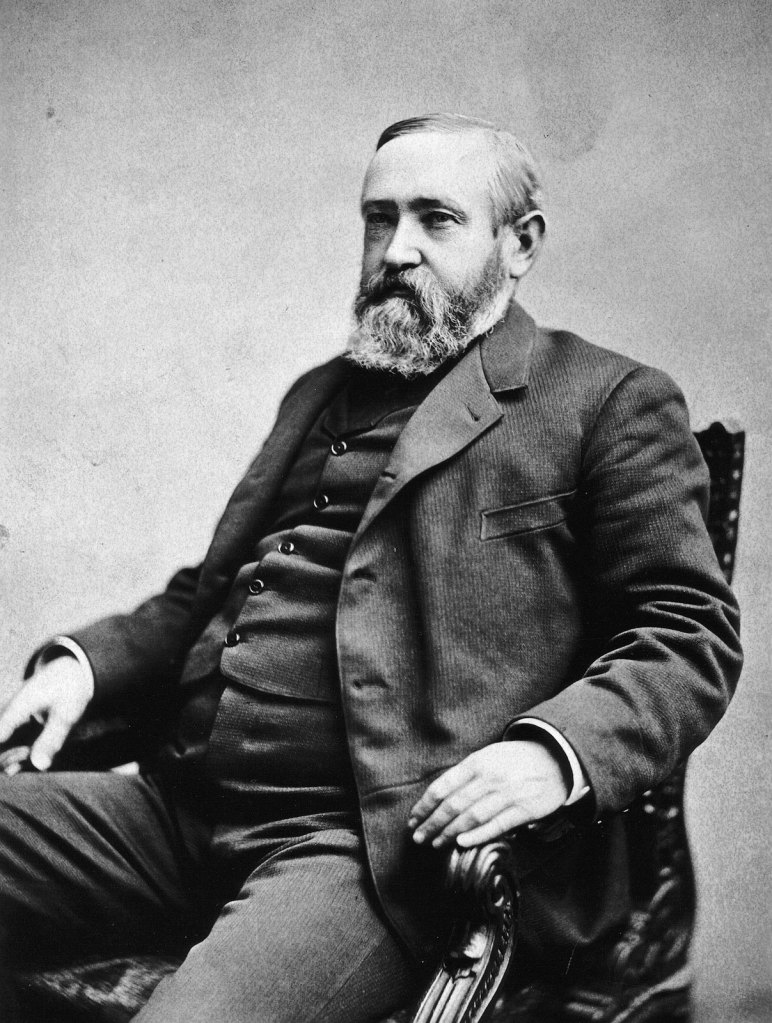
He turns 100 years old today, and despite his single term, he will never quite be the footnote of other presidential one-termers like Benjamin Harrison and Chester Arthur.
Carter is the last living American president from the 1970s and 1980s, the last World War II veteran to take that mantle, and nobody under age 50 now will have any real memories of his term in office. Yet, he was unique among recent American leaders and marked a sea change from the stern likes of Lyndon Johnson and Richard Nixon. Jimmy Carter wore blue jeans and denim shirts and cracked a disarmingly wide grin that quickly became iconic in politics.
He was the last true “dark horse” presidential candidate to win, almost unknown outside of Georgia a mere 18 months before the election. His opponents asked, “Jimmy who?”
In contrast, Barack Obama had already made the keynote speech at the national Democratic convention four years before his own election, and TV host and self-promoter Donald Trump was long a household name.
Other than Trump, there have been few other presidents who have been quite so visible a force in American history after their term ended. Carter won the Nobel Peace Prize for his efforts to forge peace agreements and awareness of human rights in 2002, long after he left office humbled by a landslide defeat to Ronald Reagan.
Compare that to, say, George W. Bush, who practically vanished from public life after 2009. Carter kept on being a voice for what he believed in, even when it ticked off the current presidents.
His post-presidency has lasted an astonishing 43+ years, the longest ever by more than a decade. That in large part accounts for his historical redemption. You outlive your enemies.
Carter’s humility is part of his brand – he continues to live in the house in Plains, Georgia he moved into in 1961, and until his health deteriorated, taught at the local Sunday School for years.
Even back in the 1990s, Carter’s reputation was gradually recovering, as his work for Habitat for Humanity and diplomatic efforts became more widely known, and Reagan-mania receded into the past.
I was living then in Oxford, Mississippi, and was friends with one of the best local bands, Blue Mountain, led by Cary Hudson and Laurie Stirratt, who were delivering great alt-country rock at the local bars on a regular basis.
One of Blue Mountain’s best barnstormers was the anthem ‘Jimmy Carter,’ a twangy country-rock romp that instantly makes you want to stomp up and down with glee. It’s hard to imagine a cheery, apolitical ode to any US President as a hit pop single in this seething era of angry hot takes, but ‘Jimmy Carter’ has a gleeful optimism that recasts the dark horse’s presidential victory in 1976 as the ultimate American small town boy makes good story.
“In the bicentennial summer of our faded glory land a bright new face appeared upon the scene. Of an honest peanut farmer by the name of Jimmy Carter. His eyes were set on every schoolboy’s dream.”
I must have heard Blue Mountain play ‘Jimmy Carter’ a hundred times in the 1990s. It always brought the house down, in the Deep South where a crowd full of Republicans and Democrats alike bounced around singing that catchy chorus saluting a Democrat – “Shake the hand of the man with a hand full of love” – and its hopeful promise of a politician who actually cared – “Well he said I’d never lie to you, and what’s more he never did.”
Bombastic myth-making? True. A great song? Also true.
An excellent biography a few years back, His Very Best: Jimmy Carter – A Life by Jonathan Alter, makes a compelling case that Carter’s presidency mattered more than we thought. He brought the language of environmentalism into the mainstream and spoke up for human rights. He worked to end nuclear proliferation – a policy followed up by Reagan – and pushed for more diversity and equality in government positions.
Yet he was far more of a micro-manager than a leader, a quality which ultimately sealed his defeat in 1980. The fumbled attempts to solve the Iran hostage crisis ensured his fate. Carter couldn’t match Reagan’s inspiring if often insubstantial rhetoric and seemed small compared to the ex-Hollywood star’s breezy confidence.
Optimistic Reagan was memorably described by historian Rick Perlstein as an “athlete of the imagination,” while Carter is recalled by Alter as “a visionary who was not a natural leader.” While Carter, more than 10 years younger than Nixon or Gerald Ford, was arguably the first “modern” President, in the end he was replaced by the first “Hollywood” President.
Carter was hardly a perfect president – he could be abrupt and too pious and faltered dealing with some of the crises in his administration. That famous grin could drop quickly and reveal a cold, frosty side.
Yet his own ego always seemed a little less in the service of raw greed and power-mongering like certain recent presidents we could mention, and more a driving fundamental core of his character fuelled by a deep religious faith. Carter wanted a perfect world.
Did he succeed? Well, no, but Carter speaks more to the good side of much-mythologised American can-do spirit – and his unwavering dedication to seeing that better world through the next 40-plus years of his life tells us it wasn’t just an act.
Jimmy Carter was neither the best nor worst of American presidents, but he had a quality that feels rare in an America torn apart by division, outrage merchants and an entire generation of politicians that now seems to be competing to see who can be the biggest jerk.
The presidency has been full of con men, before and after Carter. There have been elements of Carter in his successors – Clinton’s boundless energetic attempts to sow his own charitable legacy; Obama’s cool intellectual approach to governing; George W. Bush’s down-home mannerism, Biden’s soft-spoken optimism.
Yet in the past century, there has never been another president quite like the unique combination of humble Southern charm and faith-filled confidence that animates all the long years of Carter’s life.
“Today almost every politician wants to be seen as an outsider,” Alter writes. “Carter was the real thing.”
Hey, remember when we all thought the 2024 presidential race would be a dire, dull rematch?
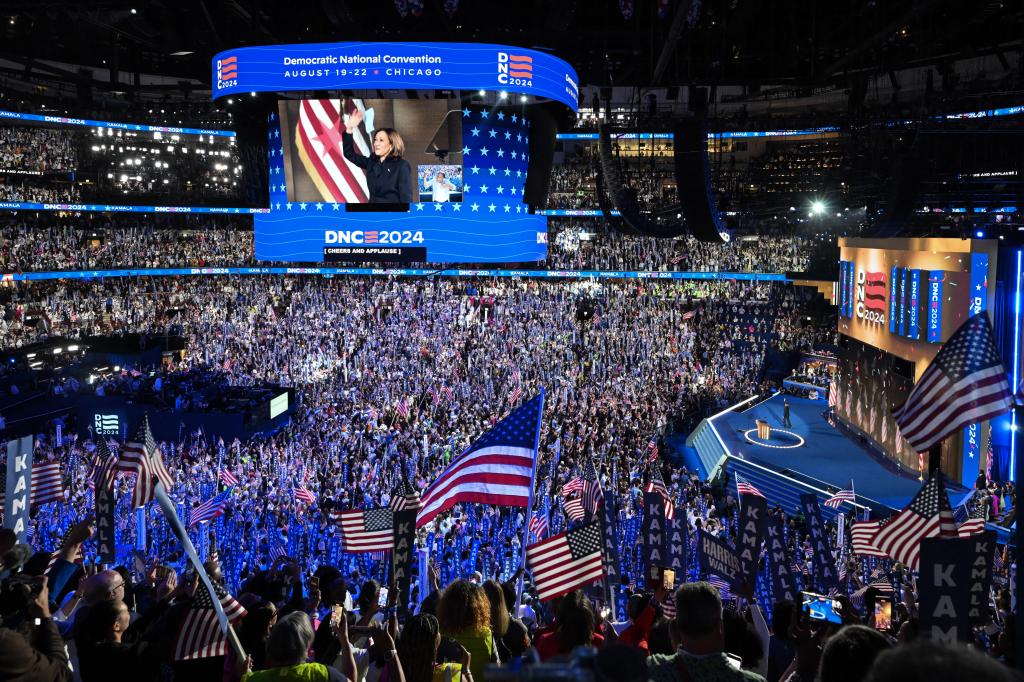
The last two months or so of US politics has been a head-spinning whirl, and watching Kamala Harris take to the stage and deliver a confident, concise acceptance of the Democratic presidential nomination this week has capped off the frenzy nicely.
I’ve been an American political convention tragic for far too many years, dating back to the Reagan era. They’re bombastic commercials and insanely wasteful propaganda, but they also do sometimes provide unforgettable moments. They’re a snapshot of where the country stands every four years, and how it’s looking ahead.
The Republican convention with its Hulk Hogans and the Democratic convention with its Oprah Winfreys set the stage for November’s battle between Harris and Donald Trump. They also had very different vibes. For my day job I ended up exhaustively live blogging both convention speeches, and while some years people say the candidates are all the same, you couldn’t get much different than Harris and Trump in both approach and message.
Even the speech lengths were a contrast – about 40 minutes for Harris vs more than 92 minutes for Trump (the longest convention acceptance speech of all time, apparently).
I admit my biases: I found the Democrat convention more hopeful, and more representative of the multicoloured, freedom loving America I want to believe in. There was simply a sense of joy, a word everyone from Tim Walz to Bill Clinton has attached to the Democratic campaign this year. I’ve watched lots of those endless state roll call of delegate votes at conventions, where dull guys stand up and say things like “From the great state of Idaho, home of the nation’s finest potatoes and the world’s biggest ball of twine, we proudly cast our 27 votes for….”
But I have never, ever seen something at a convention as effortlessly silly and cool as Lil Jon introducing Georgia’s roll call at Chicago this week:
I have to admit I’ve watched this clip a good dozen times because there’s something so overblown and yet quintessentially American about it all. A bit irreverent? A bit egocentric? Sure. But also, it was fun as hell. “Fun” is a vibe that seems sorely lacking in American politics the last eight years.
In my political lifetime, the candidate who was more optimistic and, for lack of a better word, cheerful, has typically won. It’s not even a party thing – Reagan’s sunny demeanour overwhelmed Jimmy Carter, as George W. Bush’s down home aw-shucks vibe took down Al Gore and John Kerry’s patrician sternness. Bill Clinton’s good cheer beat the first President Bush while Joe Biden’s warmth edged past Trump in 2020. Joe Biden, for all his merits, was a shaky deliverer for the joy vibe these days, while his vice president seems to have easily stepped up to the task.
I mean, I’m in a bubble. We’re all in bubbles, really, so the world I’m seeing maybe isn’t what a Trump supporter in Mississippi is. But, it’s hard to envision the Republican nominee smiling so easily, playing baseball, petting a dog, embracing his children, all those everyday things that make up most American lives away from the echo chambers.
— 🪷 Madam Auntie VP Kamala Harris for PRESIDENT! (@flywithkamala) August 18, 2024
I have lost a lot of faith in my home country these last few years, to be honest. Perhaps it’s being an American who’s lived abroad nearly 20 years now, but I often felt like I didn’t recognise it anymore. The whitewashing spin of what happened January 6, 2021 and the ensuing forgiveness and rehabilitation of Trump by too many people who should know better was the final straw for me. I felt baffled.
I don’t make firm predictions about US politics anymore, because it’s too easy to get your heart broken. I know what I would like to see happen in November, but I’m very aware that it could go either way still. I don’t think America would simply die if Trump was re-elected, after everything we’ve seen, but what a big bloody wound that would be.
I saw a lot of optimism this week that I’d like to believe in myself. A sense of hope might go a long way in this election, particularly when the other side seems mired in conflicting messages and a consistent willingness to bemoan everything, blame everything on other factors and make apocalyptic prophecies.
I sure would like to see something to chip away at the endless tension and anger infecting so much of America these days, although you might only get there by deleting the internet and the algorithm-fuelled outrage machine of social media, to be honest.
In the end, what sways things might be this – do you want a smile or do you want a glower? I just want my country of birth to be a place again that looks forward, rather than backward, one where a sense of fair-minded kindness drowns out the endless hate. Will we get there? Stay tuned.
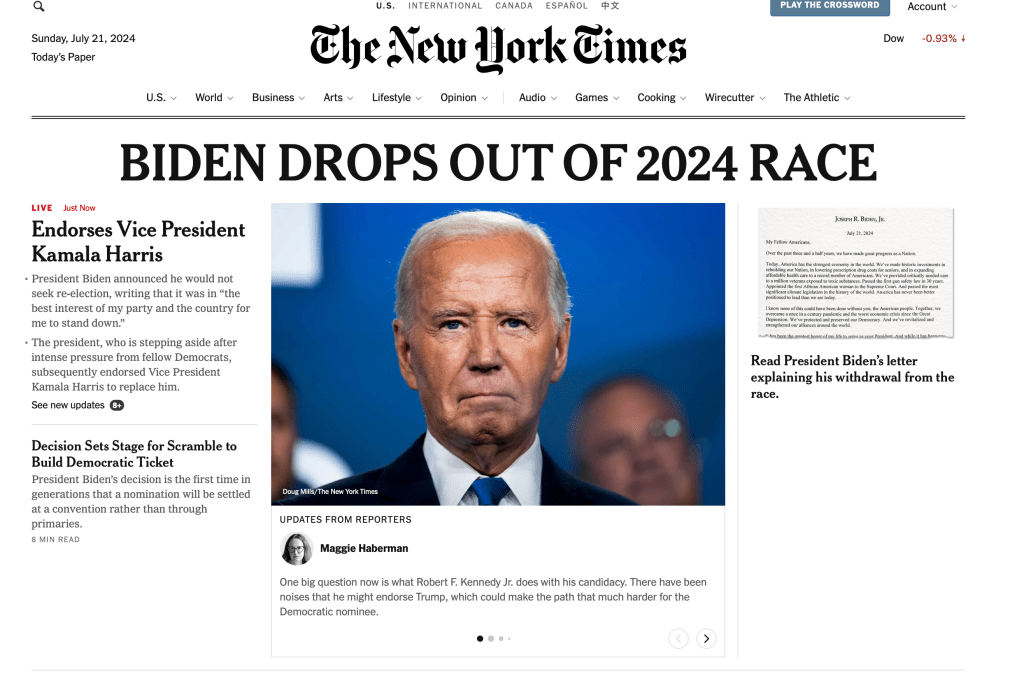
Joe Biden, who channeled perseverance and grit into a 50-year run in American politics, finally met a foe he could not beat.
His opponent in the November presidential election was technically former President Donald Trump, but it was also a much, much harder one to beat – age and perception.
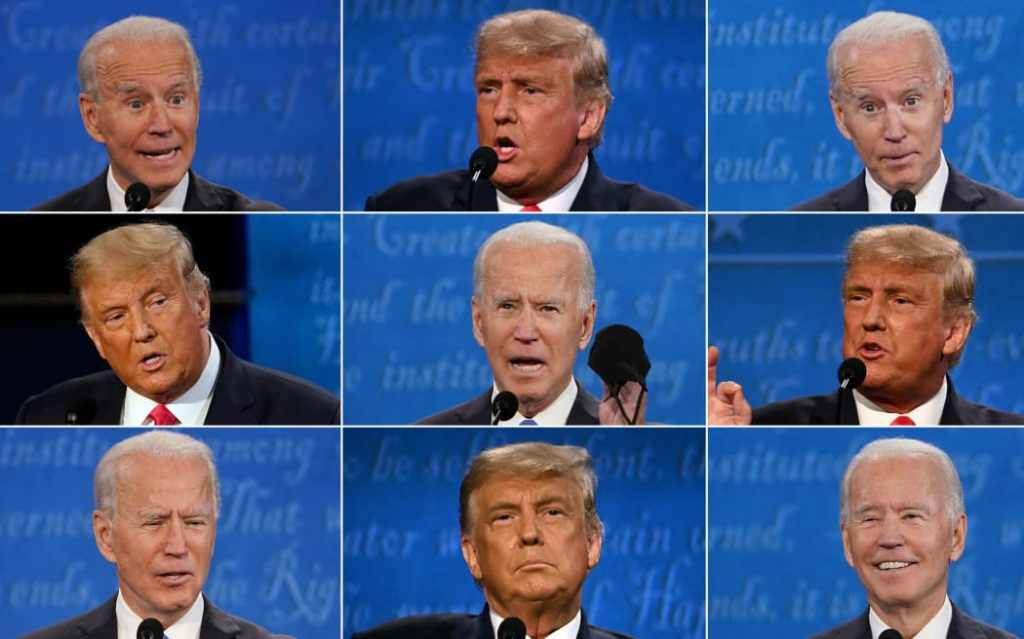
The disastrous June debate performance – the worst I’ve watched in 40 years of viewing these frustrating, fascinating American events – laid bare the harsh reality of age on America’s oldest president, and in US politics, image is everything.
At 81 years old – 82 in November – Biden finally recognised today he could not win this one.
My own father died in May at 83 years old, just a little bit older than Biden. Up into his eighties, he was a tremendously strong, vital and charismatic man, until one day, he wasn’t.
Dad did many great things in his life but as he battled pancreatic cancer, he would often repeat one of our family’s favourite sayings: “It is what it is.”
The events of the past month have taken on the feeling of a slow moving car crash, and Biden’s decision today has shaken up the 2024 race in a way that may have many Americans exhaling with relief, while others will fume with frustration.
The cascade of senators and congressional leaders from Biden’s own party stepping away from his campaign was something unprecedented in presidential races of the past 40 years. A media avalanche of calls for Biden to give up – some fair, some cruel – never ceased, despite attempts to beat it back. We saw plenty of articles with doctors doing long-distance diagnoses of Biden’s possible medical conditions.
Age is not a scandal. It’s not something you can beat back with good coms, or perky memes. (The “Dark Brandon” attempts to make Biden some sunglasses-wearing superhero were cute at first, but rapidly started to feel a bit cringe.)
Every US president has aged dramatically in office – but for Biden, already past an age most people have retired, the optics were hard to overcome.
Contrary to armchair doctors all over the internet, I have never thought that Joe Biden has dementia. I have family members with dementia, and frankly, the overwhelming tsunami of hot takes online that apparently, everyone over the age of 65 has dementia, were pretty insulting.
But Biden has slowed down, as all of us do in the end.
The biggest obstacle to his run for a second term was the realisation that Americans weren’t just being asked to vote for the Joe Biden of 2024, they were being asked to vote for the Joe Biden of late 2028 who would be 86 years old and all the Joe Bidens in between.
While Trump, 78, manages to still summon up a fierce energy at his rallies, now that he will be the oldest candidate in the race, he may face far more scrutiny than before about how Trump 2024 and Trump 2016 are different. Even Trump has to face age in the end.
The obvious comparison to be made now is Biden – reluctantly, but civilly – giving up the ongoing power of the presidency, and Trump, on January 6, 2021, doing everything he could to hold on to it.
Nobody quite knows what will happen this November, but the playing field has changed forever today. For Biden, it has to be a somber, frustrating day, but in the end, age cannot be explained away easily.
As my late great dad would have said, “It is what it is.”
It’s been another rather turbulent week if you’re a bit of a presidential history and politics nerd, in case you’ve been hiding in a dark cave somewhere in the Andes. There’s nothing quite like getting a news alert about a presidential assassination attempt at 10.30am Sunday morning to quicken the blood.
So, haven’t had much time for my usual pop-culture meandering this week (I know, all three of my fans are sorely disappointed), but I have had a few pieces reflecting on the chaos for my day job over at Radio New Zealand:
I’ve monetised that nerdy niche American history knowledge to write lots of pieces over the years, although I’ve really tried to do less of that in recent times. I wrote a piece four years ago which it turns out was far too optimistically called “The last thing I’ll ever write about Donald Trump.” Hah, we were so young and innocent then. (Getting plentiful hate emails, creepy social media stalking and the like from T**mp fans after one piece also kind of cured me of giving hot takes.)
But, we live in unprecedented presidented times, don’t we? The first presidential debate of 2024 a week ago was a shocker – I wrote a preview, live-blogged the actual event and did a bit of a historical deep dive analysis afterwards all for Radio New Zealand. While live blogging it, I had the strange sinking feeling that I was watching history, rather than just another forgettable debate. Here’s what I wrote, with gratuitous arcane Benjamin Harrison and Woodrow Wilson references galore!
I’ve been watching presidential debates for 40 years now, ever since Ronald Reagan and Walter Mondale crossed swords … and I’m afraid President Biden’s performance was the worst I’ve ever seen at one of them.
Will Biden hold the course or step aside? The clock is ticking and just over the last week, while I’ve been on a lovely holiday down south, the narrative keeps changing.
I gave up on making presidential predictions after the 2016 fiasco, and am not entirely sure what the coming days will hold – but I feel 90% sure that if Biden stays in, he actually lost the election on that June evening long before the first vote. It doesn’t matter how well he’s done or not, because, I think, for far too many voters, perception is everything. As far back as last Christmas I did not think Joe Biden should have run again and this whole year has been like a slow-motion car crash, but the thing about car crashes is sometimes, they don’t go quite like you think they would.
So it is with America, shakily, here in 2024. I wonder what precedented times feel like.
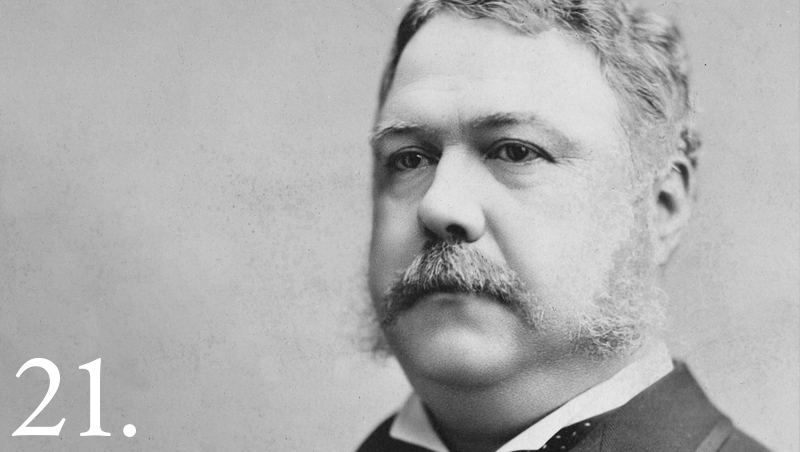
I’ve always been curious about the underdogs in life, and few presidents were bigger underdogs than Chester A. Arthur, perhaps the most forgotten of American Presidents.
Arthur served less than a full term after the assassination of President James Garfield in 1881, and died just over a year after leaving office. The most distinctive thing about the 21st President to most casual history buffs is his truly prodigious set of mutton chops, a fulsome flowering of facial hair that bloomed from his sideburns to give him an almost leonine appearance. Presidential facial hair was big in the 1800s, but Arthur, like the dandy he was in life, was perhaps the most stylish of them all.
Yet Arthur’s legacy is mired in a time when corruption was so endemic in US politics that a President actually died because of it. Garfield was assassinated by a crazed, disgruntled office seeker in an act that disastrously capped off an era of failed attempts to reform the patronage system where jobs and bribes were handed out like candy to political operators.
I began my fascination with Arthur years ago with a rather bizarrely entertaining weird novel from 1983 called The Chester A. Arthur Conspiracyby William Weigand. The wacky plot of this book is that John Wilkes Booth was not killed after Lincoln’s assassination, but instead taken in by Confederate sympathisers including one Nell Herndon – wife of the New York Customs House official Chester Arthur. Nell and Booth fall in love, and in a series of escalating contrivances, Arthur dies (weak heart) and fugitive Booth, who of course was an actor before all that assassinating business, takes his place. He assumes the career of Arthur right up until his unlikely ascension to the presidency, and beyond. The tragedy of Booth (besides all the obvious stuff) is that he gives up his own identity and true love along the way.
I know it sounds bizarre, and the preposterous Chester A. Arthur Conspiracy is not really a great book – Weigand makes Booth rather too sympathetic – but it’s a rather bold yarn in its implausible ideas, and there’s something to the idea of Booth, the haunted assassin who actually ends up becoming the president himself. Arthur is enough of a cipher to the public imagination that the idea of an actor actually playing him kind of works.
There’s not a lot of books on Arthur, compared to Lincoln or JFK, but Scott S. Greenberger’s recent The Unexpected President is a good, breezy look at Arthur’s sudden rise. Chester Arthur was born in Vermont (still the only President from there) to religious fundamentalists, but when he grew up he left for a career as a lawyer in New York City, developing a taste for the finer things in life and falling in with the Republican Party of the time. He became a key player in “boss” Senator Roscoe Conkling’s fiefdom of corruption and control in party politics, and whatever idealism he possessed in his youth seemed to be consumed by the desire for power, instead of principle.
Nobody would have picked Chet Arthur to rise from running the New York Customs House to the second-highest office in the land, but in a series of behind-the-scenes wrangling at the 1880 Republican convention, he was picked to be “dark horse” James Garfield’s running mate, in an attempt to balance things between reformers and “stalwarts” like Conkling. It was a cozy job for a cozy kind of fellow, the ultimate patronage reward.
But just a few months into his term, Garfield was shot, and after an agonising few months, he died. The reaction from many was summed up with this popular quote from the time: “‘Chet’ Arthur president of the United States! Good God!’
Arthur was described as shattered by the reality of the presidency falling upon him. “He is sitting alone in his room sobbing like a child,” one of Arthur’s staff reported his reaction upon hearing the news. He’d never been elected to any political office before the vice-presidency, and was one of the least experienced chief executives in history. Arthur actually did quite a lot of weeping about his fate, according to Greenberger’s book, which maybe isn’t the reaction Truman or LBJ had in the same situation, but at the same time, it kind of humanises poor old Chet.
Arthur burned much of his papers and letters before his death, probably in an attempt to avoid his reputation becoming more scandalous, but the net effect of that is that Arthur now feels like a spectator in his own story, a Zelig or Chauncey Gardner at the heart of democracy. Others who loomed large in Arthur’s life like Roscoe Conkling or James Garfield feel more vivid. It doesn’t help that Arthur died of Bright’s Disease at just 57, not even two years after he was failed nomination for a second term.
The curious thing about Arthur is, he actually turned into a bit of a reformer when he became President. He balked at Conkling’s attempts to run his presidency and ticked off a lot of his old friends. He wasn’t a revolutionary, but he also wasn’t the pliable puppet many of his old pals expected him to be. Arthur remains opaque, but in Greenberger’s book he comes across as a man trying to make up for his past sins in his brief time as president.
One pivotal point in The Unexpected President is the correspondence an invalid woman and fan named Julia Sands sent Arthur. The Victorian age equivalent of an internet commenter, Sands sent Arthur at least two dozen letters over the years, most of them praising and berating him at the same time, always encouraging him to do better and rise above his controversial past.
Greenberger and others have picked these letters as a reason for Arthur’s change in heart as President, which might be an exaggeration, but it’s hard to know. A lot of theories about her are mere speculation. None of Arthur’s letters to her – if he sent any – survive, and the two only apparently met once in a rather stiff and awkward encounter where it seems Arthur just came to see who the heck this crazy lady who kept mailing him was. But the image of a random woman acting as the conscience of a president is appealing.
Despite not being anywhere as weird as the fictional one in Conspiracy, the Arthur at the heart of The Unexpected President is a bit of a void as well. He’s often described as an amiable, glad-handing friend, but his inner life remains mysterious. He mourns the early deaths of his wife and an infant son, but we can never know what he really felt.
“I may be President of the United States, but my private life is nobody’s damned business,” he once said.
And yet there’s something interesting about Arthur to me – almost alone among Vice-Presidents turned Presidents, he apparently never really aspired to the office – he wasn’t a lifelong office-holder like Truman, LBJ or Gerald Ford – as his very human fears and worries over the responsibility are something you can still identify with.
“Making a man President can change him!” Sands wrote in one of her letters:
“Your name now is on the annals of history. You cannot slink back into obscurity, if you would. A hundred years hence, shool [sic] boys will recite your name in the list of Presidents & tell of your administration. And what shall posterity say? It is for you to choose whether your record shall be written in black or in gold. For the sake of your country, for your own sake & for the sakes of all who have ever loved you, let it be pure & bright.”
So I’m a massive Presidential history nerd, a hobby which has felt more than a little shameful the last four years under President Asterisk*, he-who-shall-not-be-named. Fortunately, it feels OK to admit this in public again now.
I love a good presidential history book, and I’m fascinated by the lives and times of most of the men (so far, all men and happily, now one female vice-president) who’ve held the office, even if I loathed their politics at times. February is when the US celebrates Presidents Day – hopefully a little less bleakly this year – and it’s the month during which the birthdays of George Washington (1732) and Abraham Lincoln (1809) fell. It’s a great month to look back at the presidency over nearly 250 years and remember that despite the current troubles, there’s still a lot to learn from history.
Of the dozens of Presidential books I’ve read over the years, here’s some highlights:
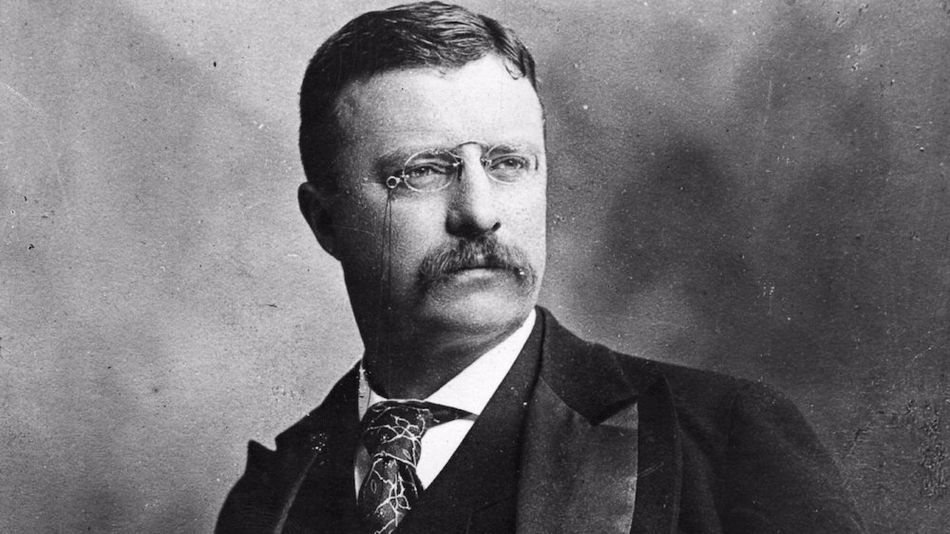
Most interesting president to read about: Theodore Roosevelt was a cowboy, a policeman, a rancher, a war hero, naturalist, historian and still, at 42, the youngest President in American history. You pretty much have to work to make his life story boring, and there’s many fascinating books about ol’ Teddy’s life and presidency. The king of these is the late Edmund Morris’ three-book trilogy, with the first volume, The Rise of Theodore Roosevelt, probably the best book about a President’s early life I’ve ever read. Teddy built himself up from an asthmatic child into a swaggering pile of masculine, determined ego, and while he was frequently overbearing, he also was surprisingly progressive in many areas. You can’t go wrong with Morris’ trilogy, or for a great side story, Candice Millard’s The River Of Doubt is a terrific manly travel tale about TR’s near-fatal trip deep into the Amazon after his presidency. And Teddy himself also wrote some great books about his adventures. Runners-up: Abraham Lincoln, Barack Obama, Thomas Jefferson
Greatest writing about a President: Robert A. Caro’s epic multi-volume look at the life and times of President Lyndon Johnson is held up as the gold standard of biographies, having won the Pulitzer Prize twice. I won’t be contrarian. It’s an absolutely stunning, authoritative piece of work that shows the countless hours of research and shoe-leather reporting Caro has put into his masterpiece over the decades, from evocative portrayals of the dirt-poor Texas hill country where LBJ came from to untangling the ins and outs of the US Senate works without boring the pants off readers. It now sprawls for thousands of pages, but every word of The Years of Lyndon Johnson is essential. The fifth and final volume is in progress now and like many other readers I am hoping Caro, now 85, sees it all through to the end. It’s a blueprint for how to tell the full story of a life and the times they lived in. Runners-up: The Rise of Theodore Roosevelt; Grant by Ron Chernow; Team of Rivals by Doris Goodwin; Truman by David McCullough; the excellentNixonland series by Ron Perlstein which I’ve written about before.
President you wouldn’t think would be interesting: Grover Cleveland is mostly remembered as being the only President to serve two non-consecutive terms, so he’s technically the 22nd and 24th President. But he also had one of the greatest cover-ups in Presidential history, a top-secret cancer surgery held in the middle of the night on a boat at sea. Matthew Algeo’s fast-paced The President is A Sick Manis a great concise history of the somewhat forgotten Cleveland and one of the bigger medical scandals in US history. It reads like a thriller. And Presidents have certainly never stopped being cagey about their health, from Woodrow Wilson’s crippling stroke to Tr**p’s still mysterious COVID hospitalisation.
Best books not quite about the Presidents: Doug Wead is a conservative activist and Tr*mp booster, which I’m not wild about, but I do rather like the two books he’s written about the children and parents of Presidents, All The Presidents’ Children and The Raising of a President. They dig into what makes a leader and what a leader’s legacy is and are chock-full of interesting trivia about the Presidential families. Not surprisingly, there’s a lot of awful tragedy in the families of many Presidents, perhaps it comes with the job. Runner-Up:Alice by Stacy Cordery, a biography of Teddy Roosevelt’s outspoken daughter, who lived a remarkable life in the middle of the Washington scene that spanned from the presidency of Cleveland to Jimmy Carter.
Goofiest book about Presidents:How To Fight Presidents: Defending Yourself Against the Badasses Who Ran This Country by Daniel O’Brien. If you want offbeat, here’s a book that looks at presidents through the filter of how good they might be at kicking your ass. It’s very silly but amusing stuff, and the only book I own that features the phrase “Ulysses S. Grant is the drunken, angry John McClane of Presidents.” The joke gets a bit old, but it’s still a pretty funny breezy, fisticuff-filled march through history. I’d still put my money on Teddy Roosevelt to smack them all down, though.
Best overall look at the Presidents: When it comes to overall presidential trivia, nothing compares to William DeGregorio’s massive Complete Book of U.S. Presidents. How tall was Calvin Coolidge? What nasty health ailments did Chester A. Arthur have? Who, for the love of God, was Millard Fillmore’s Postmaster General? It’s a great done-in-one resource for history nerds. Unfortunately, since DeGregorio died a while back, later editions have been notably lacking in detail and accuracy regarding the more recent presidents, which is a shame, but from Washington to Clinton or so, it’s a great guide.
Most morbid book about Presidents: Dead Presidents by Brady Carlson. What happens to Presidents after they die is sometimes more interesting than their administrations. Take Zachary Taylor, first president to die in office, who was famously exhumed in the 1990s to prove he wasn’t poisoned. Dead Presidents is a great tour of presidential demises, resting places and of their legacies, looking at things like Thomas Jefferson’s children with his slaves or the long strange journey of Abraham Lincoln’s corpse. Runner-up: Assassination Vacation by Sarah Vowell.
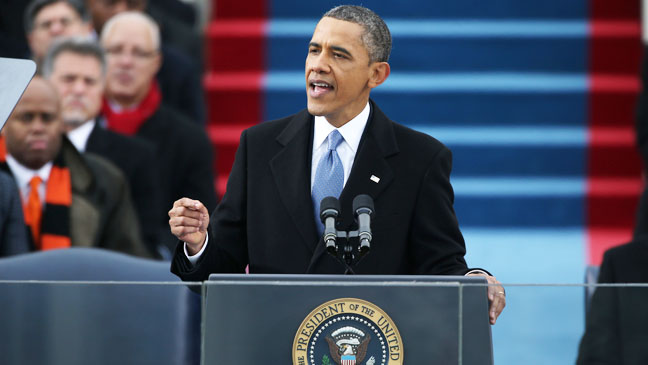
Best presidential memoirs: People talk about how great the Personal Memoirs of Ulysses S. Grant are, but I’m afraid I haven’t made it around to them quite yet. Most of the memoirs are famously stiff and reveal little about the men themselves. They tend to start strong and fizzle out, such as Bill Clinton’s My Life, which is nicely evocative about his Arkansas boyhood and difficult family life, but turns into a blur of names and places when he becomes President. Even Barack Obama’s recent A Promised Land, although eloquent and featuring great moments of detailed insight, succumbs somewhat to this problem, although I’d still probably rank it as the best memoir that I’ve read so far in a flawed genre. (But his wife’s is even better.) To me the best presidential books are the ones not written by the subjects themselves, but by talented historians.
Sorry, but you can’t make these guys interesting: I’ve read a few books about some of the lesser-known presidents and it can be hard going. Some near-forgotten ones are surprisingly captivating to me – I’ve always had a thing for the hapless Franklin Pierce, for James Buchanan, usually considered the worst President until quite recently, or the overwhelmed Warren Harding. However, I don’t want to name-and-shame authors as it’s not always their fault if a subject isn’t Teddy Roosevelt, but let’s just say it’s pretty darned hard to make Calvin Coolidge interesting, and despite James K. Polk presiding at a pretty fascinating time in American history as the nation expanded, as a person, he seems as dull as dishwater to read about. And don’t even get me started about Benjamin Harrison.
These are just a few of the veritable mountain range of presidential literature out there to dig into around Presidents Day. Happy reading!









 Nik Dirga