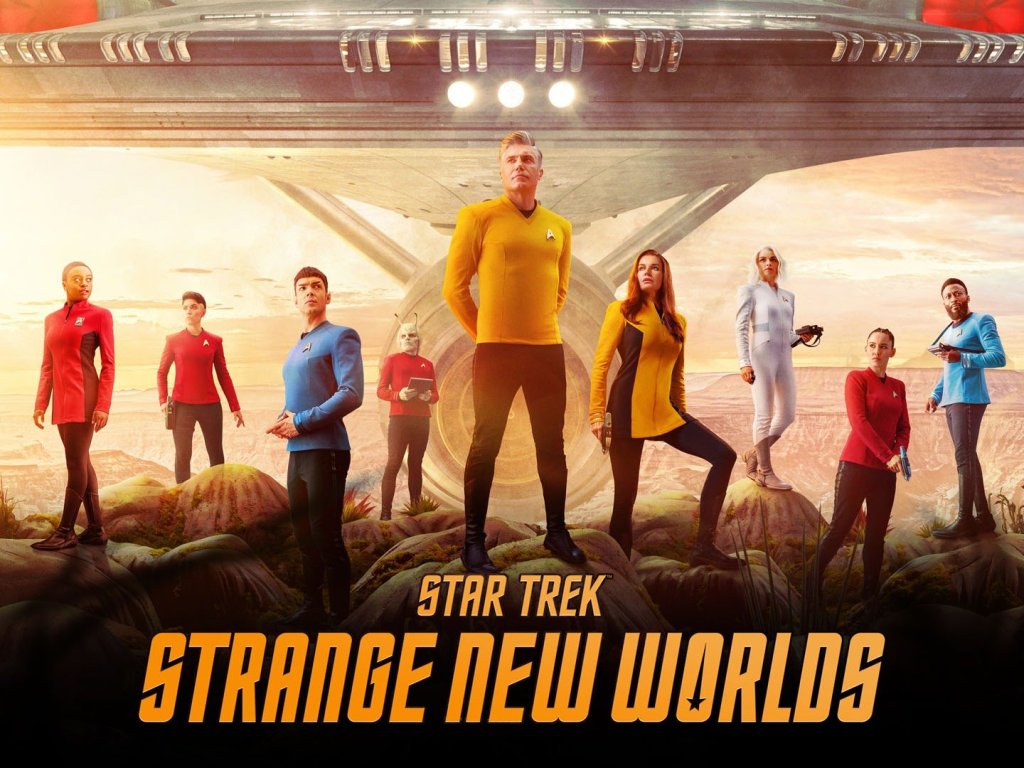
Someone finally remembered to put the Trek back into Star Trek, and Star Trek: Strange New Worlds has arrived just in time for weary fans of the franchise.
Star Trek has had a mixed decade or so – ever since the Star Trek: The Next Generation movies faded out with the underwhelming Nemesis, there’s been a growing sense that Star Trek isn’t quite sure what it wants to be.
Will it reboot and start over entirely, like the three Chris Pine-led movies? Will it boldly go in a new direction like the ballyhooed Star Trek: Discovery, or return to well-loved old friends like Star Trek: Picard? Will it make a hard swerve into animated satire like Lower Decks? With the latest spin-off – the eighth live-action Star Trek series, if you’re counting – Star Trek goes back to the basics, and Strange New Worlds is all the better for it.
Retro without being camp, Strange New Worlds is set on the USS Enterprise several years before Kirk became its captain. It follows Captain Christopher Pike (first seen in a few episodes of the ‘60s series) and his science officer Spock as the ship boldly goes to explore strange new… well, you get the idea.

Although it’s a prequel and weighed down by existing canon (including Pike’s grim ultimate fate), so far it’s a breezy ride that evokes the spirit of TOS – the original series – far more successfully than anything since The Next Generation.
I maintain that one of the worst developments for television series was Buffy The Vampire Slayer’s embrace of the serialised “Big Bad,” in which the entire season leads up to a final confrontation with some menace. While Buffy was pretty great, it didn’t mean every single series needed to have a ‘Big Bad.’ The ‘Big Bad’ has become a plague on serialised television. Its bad influence can be seen in shows like the Arrow-verse superhero franchises, which were weakened by Big Bad envy and a constant desire to top themselves and up the menace. ST: Discovery and Picard are both guilty of this too (along with other flaws) and it’s kept these shows from living up to their predecessors.
I gave up on Discovery after the third season, where despite a lot of potential, the show seemed determined to be “the Michael Burnham Show” and never let any other characters have a chance to breathe, never let up from its bludgeoning insistence that it was deep and it mattered. It wasn’t fun.
Strange New Worlds is fun. We’re only five episodes in, but already it feels like the best Trek in years. The rainbow-coloured uniforms inspired by the original series set the tone from the start. Anson Mount’s Captain Pike is charismatic and stalwart, while Ethan Peck has the hard job of shadowing Leonard Nimoy’s inimitable Spock, but pulls it off pretty well. The crew is a mix of familiar characters – a very young Uhura, a spunky Nurse Chapel – and new, like Rebecca Romjin’s dynamic Number One and Christina Chong‘s La’an Noonien Singh, who shares an ancestry with a very famous Trek villain.

Strange New Worlds is confident about what kind of Star Trek it wants to be from the word “engage.” Unlike Discovery, which flailed and reinvents itself each season, SNW is fully formed. In five episodes, we’ve already learned more about the crew’s bridge characters than I did over three seasons of Discovery. Star Trek is about the entire crew, not just a captain, and so far the old-school Enterprise’s team are an enjoyable group of well-worn Starfleet cliches and intriguing newcomers.
What’s wrong with a good done-in-one story, anyway? So far, SNW has had a blast on the “mission of the week” stories The Next Generation and original series excelled at – miniature action movies with hefty doses of character development, humour and an epic sense of wonder.
After 50-plus years, it’s hard to find new life in a franchise. While excavating the past and nostalgia are prime reason for Strange New Worlds’ existence, it wouldn’t work if the show itself wasn’t so darned endearing. It may stumble – after all, it’s only halfway through its first season – but at the moment, Star Trek: Strange New Worlds is roaring along at warp speed.


 Nik Dirga