I’ve always been fascinated by the edge of the world.
Regrets, I’ve had a few, but one of them is that I’ve never travelled as much as I would like. In my free-wheeling 20s I was dead broke, and then marriage, parenthood, et cetera. Now, I’m teetering on the edge of old. But when I do travel, I’m always interested in those spaces that feel like the edge of the world.
New Zealand is all edge, really, a handful of wee islands bobbing away out there on the far reaches of the South Pacific, surrounded by wide wide seas on every side. I’m always vaguely aware that hunched on the horizon below us like a yeti is Antarctica, which is a mere 2500 or so kilometres (1500 or so miles) to the south.
We took a recent road trip around the very bottom of the South Island recently, a place I hadn’t been to in far too many years, all mountains and long empty roads and sheep, everywhere sheep. We stopped for a visit at Slope Point, a stark little bit of cliffside that happens to be the southernmost point in mainland New Zealand. You cross a sheep paddock and brave never-ending winds to stand there on the edge of all things, a lighthouse and scrubby plant growth for company. If you’re lucky like we were, you get to experience it by yourself, only the jaunty yellow directional sign pointing out you’re closer to the South Pole than the Equator.
You can’t see Antarctica, of course – it’s still very far away – but you can feel it, lurking like a Norse ice giant. That’s what I mean by edge of the world.
I’ve been to several places I would consider edges, even if they aren’t next to the ocean. Places that feel ancient and pre-civilisation, bigger than our squabbly little day-to-day human concerns and doomfears. Uluru, perched in the Red Centre of Australia, is definitely one of them, magical and awe-inspiring even with other tourists wandering about in the hot desert emptiness.
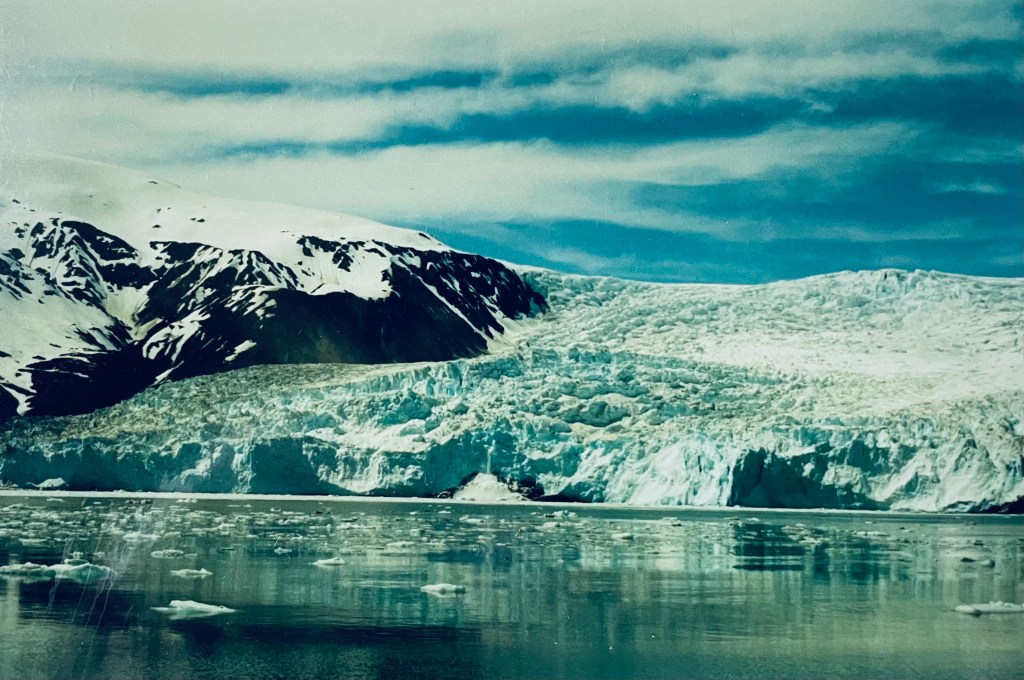
Another is Alaska, the place I was actually born half a century ago at an icebound Air Force Base. I’ve only been there once since I was a toddler, but it was enough to feel the edges that exist everywhere there in the last frontier, watching a glacier slowly rumbling into the sea, dropping chunks of ice the size of houses in the frozen ocean.
Or the Badlands in South Dakota, another spot that feels untroubled by the world of humans, rippling and strange.
Or New Zealand’s northernmost point, Cape Reinga, which is where it is said spirits of the Māori dead begin their journey to the afterlife by leaping off the edge of the shore. I like that image – on the edge, a new beginning.
The thing about an edge of the world is that it should make you feel proper small, a speck of dust floating around in a world far bigger than we can ever really comprehend.
Mucked up as life often seems these days, there’s still an awful lot of world edges out there. I hope to get to more of them and teeter happily on the abyss a few more times in this brief little life we get.
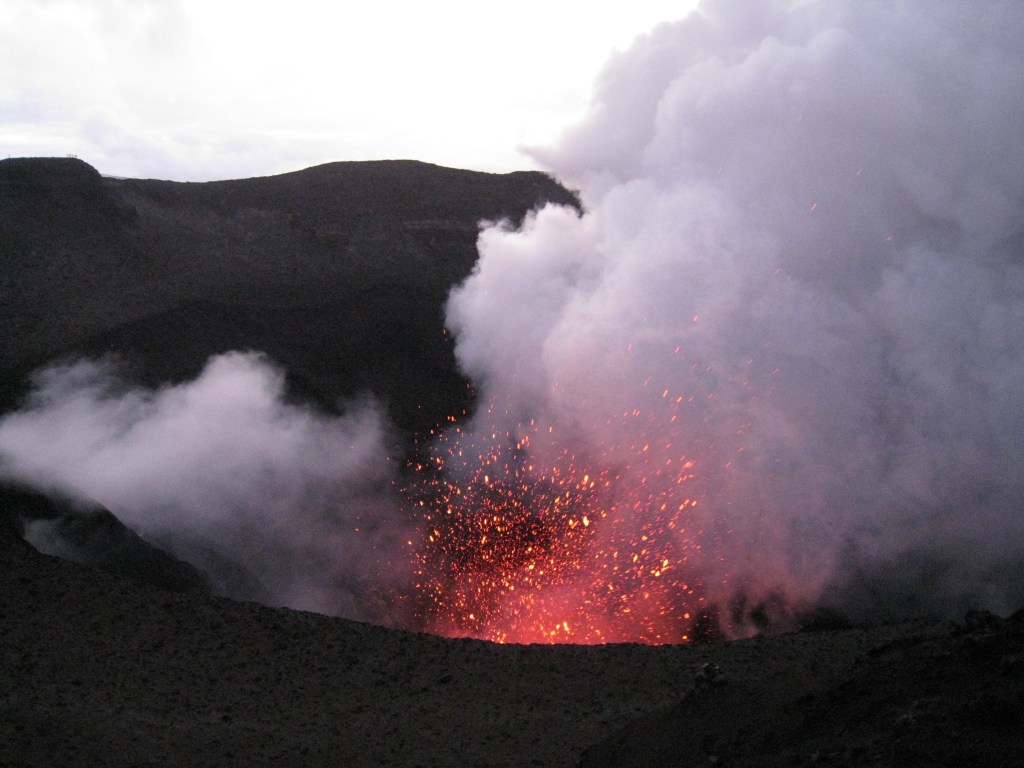
This one comes from a period of time when I wasn’t writing as much journalism and got lost in the labyrinthine mazes of management work. From the “Places” section of ‘Clippings,” I attempted to put down some words to capture one of the most remarkable holiday experiences I’ve ever had, and hopefully I got some of the feeling of what it was like to stand on top of a mountain with lava bouncing around your face!
Standing on the edge of a volcano
October 2014
As you climb up to the rim of a very active volcano, it’s hard not to feel a little bit like a human sacrifice in the making.
Vanuatu’s Mount Yasur is one of the scariest places I’ve ever been.
It’s one of the most accessible volcanos in the world, but it’s still not all that easy to get to Yasur. It’s located on one of Vanuatu’s southernmost islands, Tanna, meaning a jaunt on a small plane from the capital Port Vila and then another two to three hours of bumpy four-wheeling across jungle and ashy volcanic plains.
At 361m, Yasur towers over the low-lying Tanna plains. You see it long before you get there.
Many ni-Vanuatu live here in the shadow of the volcano – groups of teenagers idly walking in its vast shadow like they’re on a trip to the mall.
Climbing up some of New Zealand’s dormant or extinct volcanic cones, it’s easy to forget about the staggering power that they can have. Yasur won’t let you forget that for a moment, burbling and billowing like a bull chained.
The final walk up to the rim is humbling and eerie – you are able to basically get as close to the volcano as you want to, although nobody sane would venture past the rim edge around it. There are pretty much no safety precautions or ropes besides a sign saying “THINK SAFETY.”
It is impossible to capture in photos or even words really the experience of being up there.
The first thing that hits you is the sound, an endless chest-shaking booming and roaring.
My small group stood on the rim and watched the smoke rolling forth, punctuated by sudden and scary rolling booms and lava actually erupting out in “small” bursts. As darkness began to fall, the colour and mood of the volcano changed. Clouds of sulphuric smoke washed over us, the colour changed from a white to orangey glow out of the crater and we were favoured by a massive bang that filled the whole crater in front of us as we neared total darkness. We stood as night fell, on the edge of the infinite.
Tourists have been killed here by volcanic “bombs” of rock hurled into the air. These days close seismic monitoring keeps an eye on volcanic activities, with a scale of 0 (low activity) to 4 (run for your lives). Yasur was at Level 1 when I was there, and access to the crater is closed when it hits Level 2.
Watching the pretty scarlet rubies of molten rock tossed into the air like a Guy Fawkes’ fireworks show, it’s hard to imagine that a single piece of that red-hot debris would kill or cripple a person.
There was a bit of dark comedy in realising when darkness fell us that the half-dozen or so of us up there had no idea where the trail back to the ride in the parking lot was – despite flashlights, the trail wasn’t marked clearly enough to be that visible and it was very dark, with no light other than the volcano crater and a stray beam or two of light in the distance. We kind of gently ambled downwards (firmly away from the glowing crater, as that was the one direction we all knew not to go in), finally managing to find our main trail and the carpark again.
Think safety.
It was very easy to see how you could end up making a horrible mistake and getting lost for days up there. People have died at Yasur by making very bad choices.
There are few places where one can feel so small and so big at the same time than the lip of an active volcano on an island somewhere at the bottom of the world.
I moved to New Zealand years and years ago, but secretly, I’ve had a longstanding crush on Australia.
I just got back from my ninth trip ‘across the ditch,’ which I guess isn’t a lot compared to many Kiwis, and I feel I’ve only begun to scratch the surface of the vast sunburnt expanses of Australia.
As part of my so-called career, I’ve worked for Australian journalism on and off for more than 10 years now from the comforts of NZ. It’s something that would’ve been impossible in the pre-internet age, but I’ve written headlines and copy edited from Sydney to Cairns, Darwin to Melbourne, Shepparton to Townsville, and “worked” remotely in far more of the places in Australia than I’ve ever visited. It does the head in a bit, actually, to think about this too hard. I’ve worked with a lot of Australians and visited scrappy newspaper offices in rural Victoria and deep in the vast Northern Territory, and it’s always kind of cool to realise journos are basically the same no matter where you go.
Australia has sparked my imagination since I was a kid, bopping along to Men at Work songs and was caught up in the brief weird wave of Australia-mania in the US in the ‘80s, when Olivia Newton-John, Mel Gibson, Crocodile Dundee and Koala Blue took over. Since I moved to New Zealand, I’ve managed to meet both Midnight Oil’s Peter Garrettand Men At Work’s Colin Hay, both totems of my youthful fascination with all things Aussie, and in my stumbling geeky way got to tell them both how much their music helped shape my brain.
I first made it to Sydney circa 2007 and if it weren’t for a combination of pandemics, expensive trips back to American family, and juggling life, work and school back here in Auckland, I imagine I might have gone a lot more. Some of those things have changed in recent years and the wife and I are hoping to make hops across the ditch a more regular thing. After a mere three hours or so flight, you can explore a whole different world. Australia contains multitudes, from sprawling big cities to rugged bush to staggeringly beautiful wide horizons.
Australia and NZ are both allies and “frenemies” and while there’s a lot shared between our two countries there’s a lot of differences as well. Australians are a bit brasher, bolder and louder, with more of that American-style frontier spirit combined with a very Aussie informality, sometimes crudeness. It can, like everywhere, be an ugly place at times and has a rough and raggedy history. Unfortunately, like America, Australia’s indigenous culture was largely suppressed and exterminated for decades, but is still alive in the heart of the Dreaming and it’s not quite like anything else in the world.
But hey, I’m no expert, mate. I just like it there. I like that you can see these huge iguana-sized water dragons in city parks strolling around, hear kookaburras in the trees, towering gum trees everywhere you look, the rocks in the Red Centre that hum with ancient whispers. I like that for now, Australia still has a robust newspaper industry in the cities even if it’s mostly the Murdoch Empire, I love the scrappy sounds of young Australian punk bands and the writing that tries to capture the mysterious meaning of the bush.
There’s so much more I want to see – I’m desperate for another trip to the haunting Red Centre, want to check out the famed Ghan train ride across the desert, still haven’t been to Adelaide or Cairns, or just wandering along the bush and the Outback and heck, maybe even ridiculously far away Perth. I’m curious about the steamy weirdness of Darwin and really want to check out the Mad Max-style badlands of Coober Pedy and Broken Hill. And Tasmania! What about Tasmania?
Don’t get me wrong – New Zealand is swell, comfortable for us, with a lot cooler temperatures and a whole lot less creatures that can kill you. But the grass is always a little greener on the other side – or perhaps, the dirt is redder. I’m always excited to explore that forever frontier just across the Tasman Sea.
I had always wanted to live in New York City. I’d seen Woody Allen movies, I’d been addicted to Seinfeld, I’d watched Ghostbusters and King Kong and Do The Right Thing.
The internship at Billboard magazine was great fun, but living in New York City as a perpetually broke 22-year-old? It was a bit scary. I was put up at New York University dormitories in the East Village, as part of my internship. I was stuck in a utilitarian multi-bedroom apartment with a few other starry-eyed interns, although my actual roommate ended up being a friendly Black 40-something military veteran. I didn’t spend a lot of time in my room, really – there was too much to see and do.
My late dad was very smart with how he taught his spendthrift son to spend money, although it took me years to realise this. He’d never let me starve to death, but neither would he give me an infinite line of credit to spend on books ’n’ CDs and delicious knishes.
So with the paltry paycheck from Billboard and a limited allowance from Dad, I got by. I ate an awful lot of Top Ramen and peanut butter some weeks, as my bank account regularly dropped to two figures. Truth be told, I couldn’t imagine how one could actually afford to live in the city without being a millionaire.
Times Square, where I went to work each day, hadn’t been quite so gentrified then, and was a buzzing, sleazy place with wide-eyed tourists mingling with businessmen, hookers and panhandlers. Cheap trinket shops mixed with fancy Broadway theatres and bizarre shadowy tombs showing all kinds of porn.
In those pre-digital, pre-streaming glory days, New York was a wonderful arcade of eccentric gritty book stores, record stores and junk shops. I discovered the amazing sprawling Strand Bookstore not a few blocks from my dorm room and fell in love in the intense way that only a really good used bookstore can make you feel.
I spent a lot of time in the East Village, where a dirt-poor intern on his days off could just spend the days people-watching in Washington Square. I sat listening to a cassette of Elvis Costello’s Get Happy on my Walkman and reading a paperback of cheap Chekhov plays and imagining how cool I must be. Sitting on the edge of the fountain I’d see people of all races and colours and lifestyles washing by, a far cry from college in rural Mississippi.
The city could be scary at times, but I was six foot two, able to fake an intimidating stare for strangers and knew enough not to take dumb chances.
The author, far right, wearing what history would judge, poorly, as quite possibly the most incredibly 1990s bohemian outfit of all time – tie-dyed shirt, black vest and most likely cut-off jean shorts as well.
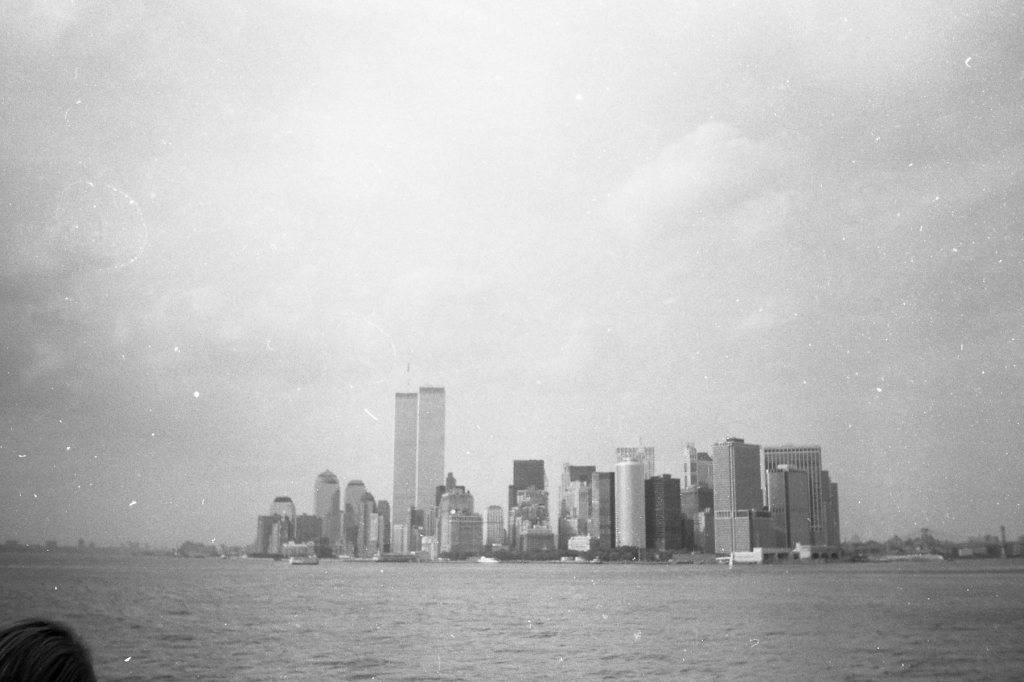
But I also had friends there – pals I’d made in the small press community I got to hang out with for the first time – jumpin’ Joe Meyer, trippy Tim Kelly, amicable Amy Frushour and several more who helped guide me around the crazy, confusing labyrinth of New York. We ate cheap Sbarro’s pizza and wandered the endlessly fascinating streets doing cheap things and visiting museums. I marvelled at the World Trade Center, not knowing it’d be gone in seven years.
It was a summer that felt filled with weird coincidences. My oldest childhood friend happened to be touring the country post-college and we met up and climbed the Empire State Building together. On a busy random Manhattan street corner, I literally ran into an acquaintance from Mississippi. On a train heading upstate, the woman sitting next to me was a young writer I knew at Billboard.
I kick myself today over missing some things – never made it to the Statue of Liberty, never got to Harlem or Brooklyn, didn’t have the money to bounce to all the hip clubs and shows that were going on all around me. I was 22, and I didn’t know all the things I could have been doing. I’m sure I missed a lot.
In hindsight, I wish that maybe I’d seen more and done more in my time in New York – not knowing that 30 years later, having moved to the other side of the world, I’d still never have returned there. Maybe I shouldn’t have bought so many dog-eared paperbacks at the Strand and bought so many CDs at St Mark’s Sounds. But heck, that was part of the experience, wasn’t it?
I was young and naive and the city was a playground of novelties. But it was also exhausting in a certain way, and after three months I longed for a little Mississippi calm and the sound of crickets on a humid Southern night. I didn’t become a seasoned, sarcastic Manhattanite like I’d imagined I might, but I had a taste of the city that never sleeps. That was enough, and 30 years on, unforgettable.
Somehow, 30 years ago this summer, I had my New York City adventure, a near-college graduate from Mississippi who ended up working at a major international magazine.
In my last few months of university, I stumbled into an internship with Billboard magazine, the music industry bible. I’d been signed up for a “trade magazines” internship program and apparently the few awkward music reviews and pieces I’d slapped together as clippings was enough for me to get a three-month tour aboard one of the industry’s biggest magazines. (Later, I met other people who were part of the same trade internship who ended up at magazines with titles like Tractor Parts Weekly, and who were a bit jealous of my fumbling luck getting a “cool” internship.)
For a college boy from Mississippi, it felt like I’d dropped into another world. I had never been to New York City or even America’s East Coast, and suddenly I was tossed into a real Manhattan magazine office which was both more and less than I expected. It had the warren of cubicles like you’d see on TV and movies, the bustle of constant weekly deadlines, but while it was magical, it was also sometimes mundane and in the end, a place where people just worked.
Each day I would put on presentable clothes (the tie and slacks, I discovered in the very first week, were a bit much) and take the subway from my dorm room at NYU up to Times Square, where I’d grab a New York Daily News and coffee and head up to the Billboard office.
In 1994, the music industry was a very different place than it was in 2024. Sure, you still had hustlers and hopefuls all angling to make it big, but there was no Spotify, there was no social media. There was cold black ink on glossy magazine print worth its weight in gold to any musician. Billboard told the world what the number one song was, what the biggest selling album was. It mattered, in an age before media splintered into a million subsets.
The CD was king, and it’s hard to explain now how these shiny disposable discs were valuable hard currency to music lovers for a while there. We’d get dozens of CDs a day from bands hoping for a line or two of print, and each day, dozens of them that the editors were either done with or never listened to at all would be “dumped” on a small “free” shelf right across from my cubicle. Like a dinner bell ringing, the “dump” would be accompanied by other office workers scurrying to the shelf from all over the building, scooping up the glorious free music, no matter what it was, hoping to find treasures.
I ended up with several boxes full of CDs stamped with “promotional copy” on the front to ship back to Mississippi. That summer I discovered bands I would love for years to come – the surreal rock of Guided By Voices, the lonesome beauty of Freedy Johnston, the Britpop charms of Blur – along with dozens of other bands whose names I’d soon forget, whose CDs I’d eventually trade in for credit somewhere.
I worked, briefly, with some music legends there who are now all gone, like the warm-hearted late Irv Lichtman, a true New Yorker to his bones, or Eric Boehlert, a genial young editor only a handful of years older than me who went on to become a fiery critic of online misinformation before his terribly early death in an accident in 2022. The Billboard editor-in-chief, Timothy White, was a bow-tied wearing blur who zipped past my desk several times a week. We exchanged maybe a dozen sentences but that was enough for a striving wanna-be journalist to soak up. He was hugely respected in the industry, but died suddenly of a heart attack at only 50 years old a few years later.
Billboard was full of kind and crusty journalists in equal measure – one of the editors never addressed me with anything more than a grunt, while another often took me out to lunch and once regaled me of tales of the interview he’d just had with Erasure’s Andy Bell that morning. One rain-soaked weekend half the staff went upstate to Woodstock ’94 and I vicariously took in all their madcap stories of this rather muddy fiasco the next week. I was an observer on the edge of it all, but it confirmed for me this weird, pressure-filled life of journalism was where I wanted to be.
Please note my magnificently disheveled makeshift cubicle at 1515 Broadway, Times Square complete with prominent trash can and empty bag of bagels.
I lived the true intern’s life of being the office errand boy, in that pre-digital era – helping sort the massive sacks of mail of review CDs and books that were dumped out daily, answering phones, working in a tiny storeroom jammed with file cabinets to organise the horrifyingly cheesy band photos sent in by every would-be superstar in the land, and sometimes, getting to write short pieces.
I had maybe 10 bylines in Billboard that summer, each one feeling hard-won.
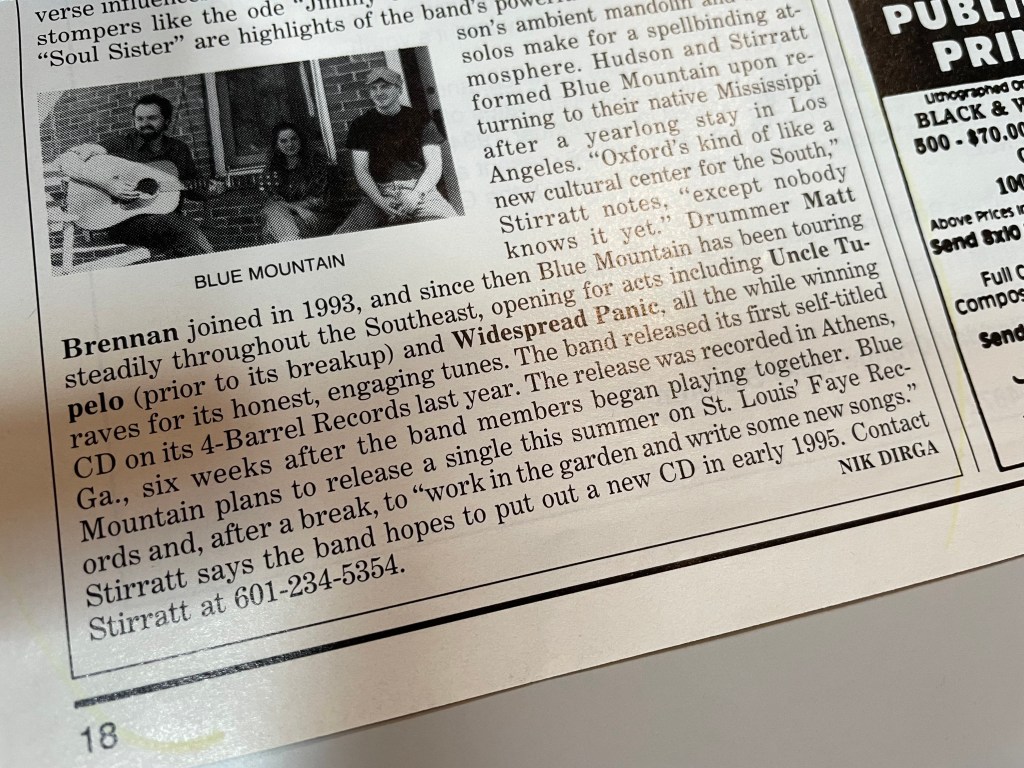
An article on Oxford, Mississippi band Blue Mountain was a Billboard highlight for me.
I was briefly, part, of a newsroom and a team, and all the years since then I’ve found myself drawn to that weird companionship of the news. It gets in you.
I never got a front-page scoop or anything. I was an accessory, a kid learning the ropes. One tangled industry piece I did ended up being rewritten so comprehensively that I think I recognised a dozen syllables as my work in the final product, but I took it all in – you were there to learn, after all, and the 22-year-old intern couldn’t afford to get angsty about credits.
I did not end up staying and working in Manhattan – I had one semester of college to finish, and ended up getting hired by the local Mississippi paper that fall and working there for a few years before fleeing back to my native California and continuing my quixotic career.
Since the summer of ’94, I have never been back to New York City, and now live almost on the opposite side of the world. I’d like to go back, someday.
But it was enough to be there, for a summer in Manhattan, walking through Times Square every day eating a bagel and feeling like you were part of something greater.
I’m roaring through the Australian Outback, more than 100km/h, past red dirt and yellow grass and under blue skies, and I’m listening to the Kinks.
Every day I look at the world from my window – Waterloo Sunset, The Kinks
I’d always wanted to go to the Red Centre, the wide-open Outback sung about in songs by Midnight Oil and ancient, enigmatic and empty. I went a few years back to Alice Springs, isolated and strange, and Uluru, the massive sandstone monolith hunched right at the heart of the old country.
There was no internet, and a few CDs I’d grabbed in Sydney in my rental car for the 4-hour drive from Alice Springs to Uluru. One of them was the Kinks’Something Else, their fifth album, from 1967.
Uluru stands out alone in the middle of a vast plain of red dirt, a giant unopened eye half-peering over the horizon, expanding in your car windshield from a distant hill to a towering monolith, all the more impressive for its isolation.
This is my street and I’m never gonna to leave it / And I’m always gonna to stay here if I live to be ninety-nine – Autumn Almanac, The Kinks
The Kinks are a band that grows on me more and more the older I get. Perhaps it’s because of all the big ‘60s bands, The Kinks are the ones who seemed middle-aged even when they were young. Oh, they were hell raisers, don’t get me wrong, but Ray Davies’ lyrics always looked inward, introspectively. They were nostalgic for a world that’s never been. Ray Davies’ world view always seemed perpetually middle-aged.
Time is as fast as the slowest thing – Wonderboy, The Kinks
The Beatles looked back at the past either with droll mockery (“For The Benefit of Mr. Kite”) or soul-baring pathos (“Eleanor Rigby”). The Stones generally only looked back at things that involved them getting laid. The Who looked back, with anger.
But The Kinks often looked back with rose-coloured glasses, with wistful thoughts of the way things used to be, or should’ve been. “Waterloo Sunset,” “Death of A Clown,” “Victoria,” “Celluloid Heroes,” “The Village Green Preservation Society.”
I miss the village green, And all the simple people. – The Village Green Preservation Society, The Kinks
The Australian Outback humbles you. It’s vast, sprawling, primordial and raw. It’s the oldest place I’ve ever been. Hiking through 40C+ heat, desert black flies pickpecking away at all your exposed flesh, the world reduced to prime colours – red, blue, brown blending into yellow. You feel a weight. You feel history, and the weight of something that’s been around way longer than you, or anybody you’ve ever known.
Nobody has to be any better than what they want to be – Australia, The Kinks
The Kinks felt a weight too, even if they would never articulate it precisely as that. It’s the weight of what might’ve been, what was, what could never be. Sometimes music and a place blend together in your mind, and you can’t separate the two in your memory.
The Outback is an old, old place, older than just about anywhere else, and Ray Davies sings for me.
As long as I gaze on Waterloo Sunset, I am in paradise.