 I’m a sucker for a good presidential biography, even as I loathe the orange troll currently occupying the White House. There’s something about the life sagas of America’s leaders that fascinates me, from the legends like Lincoln or Roosevelt to the sad sacks like James Buchanan.
I’ve read dozens of ‘em, but if I had to pick the best, I’d single out Robert A. Caro’s sprawling four-volume (so far) life of Lyndon B. Johnson. I’m re-reading the first book, The Path To Power, for the first time in years.
Caro is having a moment right now, with a short memoir (“Working”) just out as he labours away on the fifth and final book of LBJ’s life and times, a monument in prose he’s been working on for an astonishing 45 years or so now. At 83, Caro is in his autumn, but many a fan like me hopes he makes it to the finish line on what is one of the finest examinations of a leader and his times ever written. Forget Game of Thrones, this is the saga I want to see finished off.
 As a researcher and a journalist, Caro has few peers. The man is a human vacuum cleaner, sucking up every single factoid possible to craft fully rounded tales – he famously moved to the Hill Country of Texas with his wife to research LBJ’s boyhood years, and The Path To Power shows the painstaking time he took in its vibrant invocation of a long-gone era of hardened farmers and struggling families in a hostile land.
Re-reading The Path To Power, I’m struck by Caro’s digressions and how they never feel like digressions. In most biographies a straight line is drawn from “A” (brief sketches of parents and family history, birth of subject) to “B” (subject’s life and career begins). But Caro lingers in the telling details, making us understand the infertile dirt which birthed LBJ, such as a short chapter about what life pre-electricity really felt like for the Hill Country farmers and wives – and that’s where his work comes most alive. Thirteen pages painstakingly detailing the work Hill Country women would do to wash and iron clothes without electricity is riveting:
More than once, and more than twice, a stooped and bent Hill Country farm wife says, “You see how round-shouldered I am? Well, that’s from hauling the water.” And, she will often add, “I was round-shouldered like this well before my time, when I was still a young woman. My back got bent from hauling the water, and it got bent when I was still young.”
 Caro takes the time to get it right, and while 5 volumes and 5000 or so pages about one man’s life may seem excessive, other, shorter biographies I’ve read about LBJ seem like Cliff’s notes skimming over the surface compared to the richness of this work.
You don’t have to be a fan of LBJ to admire Caro’s work, which frequently points out Johnson’s selfish, ambitious and often cruel narcissism – but always counterpoints it with his knack for the common touch, or how the haunting memory of his poverty in the Hill Country never, ever left the man, even when he became President of the United States. The first book of the four so far only takes us to 1941, but in its 700+ pages is the story of an entire cosmos.
I’m dying for Caro’s final volume because it will at long last tackle the Vietnam years, an era which scuttled forevermore much of LBJ’s achievements and blotted out his remarkable civil rights work with blood in the jungle. There’s something Shakespearean about the lives of most of our presidents, but never more so than with LBJ – a poor boy from Texas who always wanted to be President, who got there in the worst way possible, and who lost everything over his intransigence on a war on the other side of the world.
Caro is our guide through a life that evokes everything good and bad about the American dream, and it’s a pleasure to dive again into his works.
 So when soul legend Mavis Staples came to town, I made sure to be there because I didn’t want to miss what might be my only chance to see her way down here in NZ.
 Today, Mavis Staples is a few months away from 80 years old, she’s barely five feet tall, and she was obviously nursing a sore throat, but she still tore the roof off the Civic Theatre in Auckland with her soaring voice and inspirational message.
 Opening for Mavis was the wonderful
  I’ve written
  But her biggest claim to glory today is that she designed the epic look of the Creature From The Black Lagoon. The Creature is, I’d argue, the second-best monster design of all time (sorry, but Karloff’s Frankenstein’s monster has to take the top crown). It’s alien, yet human; terrifying, yet captivating.
 In “Lagoon,” O’Meara also shows the hard work that goes into the biography of a somewhat obscure person, hunting down leads and tracing dusty steps in the past. The story is as much about her and her experiences as a young woman in Hollywood as it is about Milicent Patrick. Some of the anecdotes O’Meara tells of her own treatment are truly dismaying, especially because they are all too common. The real monsters are still out there in Hollywood, hiding in broad daylight.
 So the first autumn cold of the season hit the household, and I spent most of a day prone on the couch undertaking a surefire cure for the blues: Cartoons.
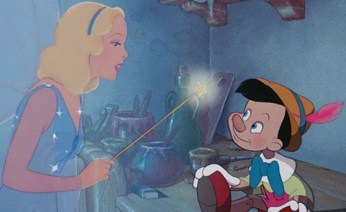
 I’d forgotten how bloody DARK “Dumbo” and “Pinocchio” are. There’s runaway children sold into slavery, a mother placed in chains, cruelty from the cartooniest of funny animals. (And we won’t even talk about “Bambi.”)
 I watched the upcoming “Lion King” trailer and I just felt bored. I don’t hate these remakes, but they seem pointless, just more grist for Scrooge McDuck’s vaults. They’re stretched out (1941 “Dumbo” 64 minutes; 2019 “Dumbo” 112) and excessive elaborations of the gorgeous simple lines of the originals. What’s cute becomes creepy rendered in vivid CGI — blue Will Smith in the also upcoming “Aladdin” remake is something I never really needed to see, and it’s kind of freaking me out.
 There’s nothing I’ve seen yet in a CGI cartoon remake that approaches the stunning surrealism of the original “Pink Elephants on parade” sequence of “Dumbo” or the explosion of colour and passion of “Fantasia.” There have been lots of great original CGI cartoons from Pixar and the like of course, but Disney’s flood of redundant remakes is like a gift nobody really asked for.
 Therefore, since brevity is the soul of wit, And tediousness the limbs and outward flourishes, I will be brief. — Polonious
 As I’ve said before, I find Shakespeare bottomless – an infinity of meanings can be found in his works, and new twists reveal themselves in every new look. Hamlet is perhaps his crowning jewel as an artist, a play about a young man who asks the question every single one of us asks at some point in our lives: To be? Or not to be?
 What does it all mean? After hours and hours of Hamlet this season, I’m still not quite sure.
 Doom Patrol have always been weird, a team of misfits and outcasts kind of like the X-Men, but more so. Their original 1960s comic adventures are a bizarro Silver Age blast, but “my” Doom Patrol really burst into being with Grant Morrison’s seminal late 1980s reinvention of the concept. Morrison’s twin masterpieces of Doom Patrol and Animal Man back in the day blew my teenage mind.
 One of the newer of the approximately 419 streaming services out there, DC Universe premiered last year with Titans, which was a mixed success for me – I dug seeing the “Teen Titans” come to life and there were some great parts, but the show had very scattered storytelling and a self-consciously adult tone that felt forced (Unless you really thought we needed to have a blood-soaked Robin muttering “F—- Batman” to make the character work better). Doom Patrol is more adult by nature, so the swearing and mature themes work better (I’ll never get tired of hearing Cliff Steele aka Robotman saying, “What the F—-!?!?” in response to Doom Patrol’s never-ending parade of weirdness).
 Nik Dirga