Meanwhile, elsewhere on the internet…

Monty Python voice: I’m not dead!

Regular posting will resume soon after the difficulties of the past six weeks or so. In the meantime, here’s a few things to catch up with by or about me that have been circulating out there elsewhere on the internet:

As part of RNZ‘s occasional “What To Watch” series highlighting the quirky and obscure corners of the streaming cinematic universe, I wrote up a little review of the extremely weird offbeat Korean comedy Chicken Nugget: What To Watch – Chicken Nugget

Over at the New Zealand Listener magazine, I did a review of Everest, Inc., a fascinating new book by Will Cockrell that looks at how the world of daring mountain summiteers has changed since Sir Edmund Hillary and Sherpa Tenzing Norgay first conquered Everest. You can read it over here (paywall).

And elsewhere, friend Bob had a very kind post the other day about my long-running obscure small press comic Amoeba Adventures, in which he compared my timid scribbling to Scott McCloud’s awesome Zot! which is high praise indeed. (And by the way, if you’re one of those folks who haven’t gotten around to ordering my hefty compendium of classic Amoeba comics over on Amazon, go grab yourself The Best Of Amoeba Adventures right now!)

Back with more pop culture rambles soon!

Sunward I’ve climbed: Goodbye, Dad.

We bid a final goodbye to my father Richard Dirga this week, at a memorial service underneath the tall pines he loved so much in the California foothills. Thank you so much to everyone who came, friends and family and people I hadn’t seen in years. We had to break out the extra chairs in the end, but Dad was worth it. And thanks to all those who have reached out via message, email, letters and more these last few weeks. Every kindness is appreciated.

Myself, my brother and two beloved family friends all spoke to honour Dad’s remarkable life.

Here is what I said:

Dad didn’t want a funeral, or a big fuss made of him, but we decided we couldn’t let him go without doing something.

We received so many messages, emails and calls after Dad died, and the words that kept coming up again and again were about his kindness, his fundamental good heart and eagerness to help whenever asked. He was part of a vanishing breed – the humble but confident man. He never bragged, never boasted, but everyone who knew him knew that he could command attention when it was called for. He was a born leader who chose to be a helper rather than a commander.

Dad had an extraordinary career with the Air Force that began long before my brother and I were even born. He signed up when he was only 17 years old – when I was 17, I could barely drive a car. He rose to the rank of lieutenant colonel in an almost 20-year career, and he probably could have risen even higher, but he said he never liked the ‘playing politics’ that came with the highest ranks.

Some of the things he did are still classified and the stories he told us are pretty amazing – up to 24-hour missions flying over the North Pole, over Soviet space and over Cuba during the missile crisis, his 6-foot frame crammed into a tiny space the whole time. He would fly with nuclear weapons on board at the height of the Cold War, ready for any sudden escalation. He worked with the B-58, the SR-71 and others during his career, all these clandestine spy missions. It took me years to realise that when we used to watch James Bond movies on the TV as a kid, he wasn’t just watching a fun adventure – he was critiquing it against his own life! (I always thought he looked just a LITTLE bit like Roger Moore, too)

We weren’t even born when he did some of these things, but he carried that calm authority with him his whole life – how many fathers do you know who had the responsibility of flying with active nuclear bombs? It’s not for the nervous.

Mom and Dad always encouraged us to have adventures, to see the world and not be people who spend their whole lives in one small town. When I was nearly 8 years old, they packed up the house and took us to Europe for an entire year, traveling around in an increasingly rickety and mildewy tiny motorhome. It’s fair to say that year changed my life. When I moved to New Zealand with my family nearly 20 years ago, they could have objected. I mean, we were taking their only grandson to the other side of the world, after all. But Dad, who spent a lifetime saying yes to people, never said a word against it. It was a great adventure, and he loved those.

My son Peter is 20 years old now and in his third year studying history and art history at university back in New Zealand. He wouldn’t be there without Dad. When Peter was just four or five years old, Dad took him out to fly remote controlled planes, and that was it – Peter went on to become a military history buff, to build dozens of intricate planes and military models himself, to constantly be excited by the past. Dad’s military career fascinated Peter, and the two of them had a great and wonderful bond. Every time we visited for years, from barely kindergarten age until the beginning of college, Peter and Dad would spend some time flying planes out at Beale. Dad helped set the path of my son’s future.

In the last few years, despite the obstacles life threw at him, despite some of the suffering he had to endure, Dad somehow just kept becoming a better person all the time. It’s as if in his final years, he was distilled down to his purest essence – a kind and curious man whose first thoughts were often about others. At his heart he wasn’t judgmental, and I think he believed that our ultimate goal is just to be decent.

There was a moment when we visited in February that I took a mental photograph of, that I can’t quite forget, and all it was was a simple look Dad gave Mom, as they were sitting together on the couch. It was a look filled with such pure love and admiration, a look that maybe you only get to see when you are married more than 50 years, through thick and thin, the good and the bad. We should all be so lucky to have someone give us a look like that once in our lives.

The last lesson he had to show us was how to go – not with anger and rage at the unfairness of things, but with gratitude. He said again and again these last months how glad he was for an extraordinary life, how lucky he was. The very last conversation I had with him was just a day or two before his final illness, and one of the last things he said was how incredibly proud he was of my brother and I and our families and children.

He fought, hard, and for days after I think whatever made him him left, his body kept on, that mighty heart pumping away. He would never boast, never swagger into a room, but he showed us how strong he really was until the very end. If things had gone differently, I like to think he could’ve made it to 100. He was like a redwood or a towering oak tree in the grand forest of our lives – steady, reliable and protective of us all until his final days. Those who knew Dad know he was a planner, and so it’s probably no surprise that he left a very, VERY detailed to-do list after his passing, to provide for Mom and to make things easier for Chas and I. He’d probably have planned this event too, if he could.


I am sad, still, deep down, and I guess part of me will be that way for a long time. And that’s OK. But right now, right here, I just keep thinking of his smile, the smell of his aftershave, the scratchy stubble I felt on his cheek when he picked us up as kids, the enormous “Dirga dimple’ on his chin that always fascinated me. He always felt like the biggest man in the room to me, even when I grew up to be just a LITTLE taller than him; the way he always felt like he was lifting us up rather than pushing us down. I wouldn’t have been a writer without him; Chas would not have become a nurse. And I am grateful to have had him, for as long as we did, even if it would never quite have felt like enough. How lucky we were.

He loved flying, and the wide open blue skies of California. In an email to a military historian several years back, he wrote that “One benefit I found in flying aircraft was I always felt closer to God. I can’t tell you how many times I felt like I was ‘touching the face of God’ while flying missions over or around Vietnam, Korea or Russia.”

He always liked this poem, High Flight by John Gillespie Magee, Jr, and while Dad didn’t want a funeral, I know that he wouldn’t mind one bit for me to read it here today:

Oh! I have slipped the surly bonds of Earth
And danced the skies on laughter-silvered wings;
Sunward I’ve climbed, and joined the tumbling mirth
of sun-split clouds,—and done a hundred things
You have not dreamed of—wheeled and soared and swung
High in the sunlit silence. Hov’ring there,
I’ve chased the shouting wind along, and flung
My eager craft through footless halls of air ….
Up, up the long, delirious, burning blue
I’ve topped the wind-swept heights with easy grace
Where never lark nor ever eagle flew—
And, while with silent lifting mind I’ve trod
The high untrespassed sanctity of space,
Put out my hand, and touched the face of God.

For family, friends and those who are interested, the entire memorial service can be viewed here on YouTube as well:

Richard Dirga, 1940-2024

My father Richard Dirga died on Monday, May 13.

Tall and strong, he was the oak at the center of our family tree. He had a precise mind, an easy smile and a gentle, firm heart.

For years he flew on Cold War missions for the U.S. strategic air command, doing things like taking off from Alaska and flying over the North Pole on Soviet reconnaissance. After retiring from the Air Force as Lieutenant Colonel, he earned degrees in English literature and electronics.

He never stopped wanting to know more. Our house was full of books. He believed we should know about the whole wide world. He was always there for my brother and I with advice, encouragement and love.

One of his best friends of the past 50 years told him at the end, “You’re the pilot.” He really was. He told us a lot the last few months how grateful he was for all that he got to have, and he fought so very hard to stay.

There’s so much more I could say, but all I can tell you now is how much we will miss him. He was the pilot.

Obituary: My father.

Beneath the Escape from the Battle of the Ranking of the Planet of the Apes series!

…Look, I’m an ape man. I dig King Kong, I dig comic books with apes on the cover, and I really dig the Planet of the Apes saga. 

As I’ve written about before, I’ve always loved the Apes series, with its distinctly bleak and apocalyptic vision. It’s versatile enough as a concept that we’re seeing the tenth Apes movie opening this week, the very nifty looking Kingdom Of The Planet Of The Apes. 

Unlike several other long running sci-fi series, the Apes saga generally has had a higher success rate for its sequels, which generally haven’t felt like laboured intellectual property cash-ins (I’m looking at you, Terminator and Alien franchises). There’s only one, maybe two truly bad movies in the whole series, in my humble opinion.

That said, in honour of the 10th Apes extravaganza, here’s my entirely personal Beneath the Escape from the Ranking of the Apes movies (pre-Kingdom!):

9. Planet of the Apes (2001) – Tim Burton’s oh-so-millennial reboot showed that you should never try and just remake the original POTA (which, I hope, the current series isn’t working its way towards doing, either). A wooden Mark Wahlberg stars in a strange sideways version of the original’s astronaut journey. Like many Burton movies it often looks great but the story is a bit of a mess with a legendarily dumb ending. The single best thing about this movie is the excellent makeup for most of the apes, especially sneering Tim Roth. (A freakish design for Helena Bonham Carter, on the other hand, manages to look worse than the female apes did in the 1960s.) 

8. Battle For The Planet Of The Apes (1973) – The least of the original series is also by far the cheapest. Made for what looks like about $25, it’s got an OK plot that revolves around the final days of man and ape attempting to live together kind of peacefully, touches on the mutants from Beneath The Planet Of The Apes, and as always Roddy McDowall is worth watching in his fourth turn in an Apes film. But the sluggish movie lacks any scale – the “battle” of the title is about a dozen humans puttering around in off-road vehicles, and everything just feels a bit exhausted by this point. 

• Everything from here on up is still a very good Apes movie, in my humble ape-inion – just varying degrees of personal preference and heck, my rankings might change on a daily basis. 

7. War of the Planet of the Apes (2017) – Up until now the latest in the series, this concludes the Caesar reboot ‘trilogy’ in a typically bleak, cynical Apes fashion. Humanity is truly falling apart now, and even starting to lose their voices in a callback to the first movie. Woody Harrelson’s fanatical, scenery-chewing Colonel is one of the series’ best human villains, and Caesar truly becomes a Christ-like figure with all his suffering in this one. At nearly 2 1/2 hours it’s a bit overlong and does bog down a bit in the prison camp scenes, and there’s a little too much torture and cruelty, even for an Apes movie, but it rallies for the biggest battle seen yet in the climax. 

6. Conquest Of The Planet Of the Apes (1972) – So how did the Apes take over the world? This bleak (surprise!) third sequel to the original attempts to fill in the blanks by showing a subservient class of apes basically used as slaves one of those fascist-looking stark 1970s movie urban futurescapes. The parallels with the civil rights movement aren’t subtle, but mostly effective. Led by Roddy McDowall’s Caesar, the apes rise up to overthrow their masters. Hamstrung by a lower budget – the ape masks look particularly grotty in group scenes, and most of the action appears to take place in a few office blocks – Conquest is still a solid, hardboiled franchise entry, with probably McDowall’s best performance. The “theatrical” cut went for a neutered ending; if they’d used the darker original ending it’d probably go up a place or two here. 

5. Escape From The Planet of the Apes (1971) – The most “light-hearted” of Apes movies, until of course everything goes horribly wrong. Blow up the Earth in the last one? No problem! Sending ape survivors Cornelius and Zira back in time makes for some great broadly comic 1970s culture clash moments, but as always in the Apes timeline, darkness beckons. An inventive way of continuing the series and creating a time loop, but the comedy and tragedy make for a somewhat uneasy mix. Still, I always get a kick out of watching a charming ape couple swaggering around ‘70s California. 

4. Dawn of the Planet of the Apes (2014) – After series reboot Rise Of The Planet Of The Apes, the world as we know it is crumbling due to war and pandemic, as Caesar and his apes form their own world in the redwood forest and come to clash with human survivors in San Francisco. Like most Apes movies, it’s about people and apes trying co-exist and failing. The modern-day special effects are remarkable – no masks here! – as we start to see ape society splinter between hard-liners and moderates, while the human characters are sympathetic and well-rounded. It’s epic, but full of sharp character moments too.

3. Beneath The Planet of the Apes (1970) – Sure, this one is a strange, strange first sequel, muddled up by Charlton Heston more or less refusing to return except in a cameo, a whole goopy mutant human society being introduced seemingly out of nowhere, and one of the darkest, most cynical endings a mainstream G-rated movie has ever had. Yet I still love it precisely because it goes so hard – that final fade to black scarred me as a young ape-lover and still blows me away to this day. Whatever its complicated origins, Beneath the Planet of the Apes is a sequel that feels like it isn’t just about making more money and plotting easter eggs for sequels. There’s an eerie, doomed tone to the entire movie – that fiery vision of crucified apes and bleeding statues! – that carries me over some of the clumsier plot holes. Despite the end of the world thing and all, of course, it was only the beginning for this unkillable series.   

2. Rise of the Planet of the Apes (2011) – Rewatching this series reboot recently, I was amazed at how gripping the emotional journey of young Caesar (Andy Serkis in the first of three astoundingly good motion-capture performances) is. Set pre-apocalypse, this one aims to tell us how we ended up with a “Planet of the Apes” through a combination of chance and human-created plague. Unique in this entire series, it’s recognisably set in “our” world, and it’s really the only movie where we see a human and an ape truly have an affectionate familial bond (James DeFranco’s turn here is superb). Perhaps it has less “action” than some of the movies, but the Golden Gate bridge climax remains thrilling and for me it’s one of the best of the saga. It’s no wonder that unlike Burton’s flop, this energetic reimagining enabled the series to carry on for four movies and counting. 

1. Planet of the Apes (1968) – The original and still the standard for this series. Charlton Heston’s aggressive, cynical spaceman, that dissonant and unforgettable soundtrack, the still amazing makeup work, Roddy McDowall and Kim Hunter’s endearing apes, those vast desert vistas, Maurice Evans’ conniving Dr Zaius and what is probably the greatest twist ending in movie history. No wonder we’re all still returning to apeland 50-plus years on. 

Great Caesar’s ghost! Eight of my favourite journalism editors in fiction

Somehow, I’ve ended up working in journalism an awfully long time. And in that time, I have had many good editors, a great editor or two, and couple of terrible editors. I’ve also been an editor myself many times (I’ll leave it to others to judge where I fell on the scale myself). 

An editor isn’t as glamorous as the headline-chasing feisty street-level reporter, perhaps. But in this age where journalism seems to be constantly under siege from all sides, editors do matter. They guide, they teach, they question, they correct, they set the tone and they can make or break a media outlet. My industry has changed a hell of a lot in the years since I started, but no matter how many apps, algorithms and pivots you throw at it, you need an editor in the mix to make quality journalism. 

So here’s a tribute to the bleary-eyed, coffee-fuelled, rage-filled and yet quietly inspirational editors, with a look at eight editors portrayed in fiction who have always inspired me in my own wayward journalism journey, for good or bad. 

Lou Grant, The Mary Tyler Moore Show (1970-1977) played by Ed Asner. When I think of a newsroom editor, the rumpled face of Ed Asner leaps to mind. No-nonsense, idealistic and gruff but with a heart of gold, Asner’s Lou Grant was the comic anchor of the still-classic Mary Tyler Moore Show. “Spunk? I hate spunk!” he growls at Mary in the very first episode. Asner played a sitcom character who was still a believable editor, and after the delightfully wacky Mary Tyler Moore Show ended its run he went on to play the exact same character in a very different drama that lasted for five seasons. Now that’s adapting your skill set to changing times. 

Perry White, Superman comics: The greatest editor in comic books, even when his newspaper staff appeared to only consist of Clark Kent, Jimmy Olsen and Lois Lane in the glorious Silver Age days.  White is old-school journalism to the max, firmly pushing for truth, justice and the American way, just like the Daily Planet’s office mascot Superman. White is constantly shoving his reporters out the door on wacky circulation-boosting assignments, hunting for that story that will make him shout “Great Caesar’s ghost!” In a world filled with kryptonite, Bizarros, giant alien gorillas, fifth-dimensional imps and more, Perry White is a glorious constant. I would work for Perry White any day of the week. 

Jane Craig, Broadcast News (1987) played by Holly Hunter: I can’t pretend I know what it’s like to be a woman in a newsroom, but in this classic ‘80s romantic comedy, we watch Hunter’s intense and driven Jane Craig rise through the ranks and juggle relationships with two good but flawed journalists (the amazing Albert Brooks and William Hurt) while never giving up on her own goals. Hurt’s vapid pretty face and Brooks’ charisma-challenged newsman represent the two sides of journalism that never quite come together, while Hunter – trying to keep her principles in a constantly changing industry – is the one who really succeeds in the business.

Charles Foster Kane, Citizen Kane (1941) played by Orson Welles: Is he a good editor-publisher? After all, Welles’ masterpiece is about the rise and fall of Charles Foster Kane. Yet while he’s an egotistical, perpetually unsatisfied tyrant, what we see of Kane’s managerial skills in Citizen Kane also shows us that he’s a darned good newspaperman, hustling for scoops, scandals and attention. Yeah, he bends ethical lines a fair bit, but I’m willing to cut him a little slack as he dates back to the peak era of yellow journalism led by Hearst, Pulitzer and the like. I don’t imagine I’d like to work for Kane, but I’d sure as hell read any newspaper he put out. 

Charles Lane, Shattered Glass (2003) played by Peter Sarsgaard: Shattered Glass remains one of my favourite, still rather underrated journalism movies, about the plagiarist liar journalist Stephen Glass and his unravelling. Sarsgaard is fantastic as the unassuming editor who begins to smell a rat in Glass’ fabulist copy, and doggedly purses the loose ends to discover what the real truth is. Calm but determined and intensely offended by Glass’s stream of lies, Sarsgaard’s Lane makes the dull business of factchecking seem like a spy thriller. 

Ben Bradlee, All The President’s Men (1976) played by Jason Robards. Robards is the only one on this list who won an Academy Award for playing an editor, and rightfully so – his inscrutable, steel-eyed Bradlee is the axis around which Dustin Hoffman and Robert Redford’s Watergate investigation revolves in All The President’s Men. Without Bradlee’s guiding hand and consent, the story wouldn’t be told. Like the best editors, he’s kind of terrifying, too. 

Robbie Robertson, Spider-Man comics: Look, Spider-Man’s nemesis J. Jonah Jameson is undeniably entertaining, but firmly belongs on the worst editor list. How worst? He fires Peter Parker about twice a week, lied repeatedly about Spider-Man in print, hired supervillains to kill him, and on several occasions personally piloted giant robots to beat up Spider-Man. That’s a bad editor. But shift your gaze slightly to the side to consider Jameson’s managing editor at The Daily Bugle, Robbie Robertson, who for decades has been a calm, firm but steady presence in the newsroom, frequently dealing with his impulsive boss’s rants and focused far more on truth than agendas. Jameson makes all the noise; Robertson gets the damn paper out. 

Dave Nelson, NewsRadio (1995-1999) played by Dave Foley: As the news director of WNYX, perky Dave Nelson is a sweet-faced rube thrown into a lion’s den of ego, eccentrics and mania. Surrounded by blowhards like Phil Hartman’s anchor Bill McNeal and a variety of other kooks including Stephen Root, Andy Dick and Maura Tierney, Foley as an editor spends almost the entire run of this classic sitcom putting out fires. And you know, that’s often what an editor’s job is – dealing with your staff and juggling all the balls at once. While he occasionally snaps, Dave Nelson simply being able to survive in a radio newsroom bubbling over with complicated personalities is an accomplishment all by itself. 

Concert Review: The Dandy Warhols, Auckland, April 22

The 90s are having a moment. 

There’s something about this year in particular, where every time I turn around I see headlines blaring the 30th anniversary of things I lived through and considered cultural touchstones in my life – the death of Kurt Cobain, OJ Simpson’s freeway chase, the release of Pulp Fiction, the debut of Friends, whathaveyou. Watching elements of your life turn into nostalgia is always strange. 

And then there’s the Dandy Warhols, Portland, Oregon’s psych-pop cult sensations, who hit Auckland on their 30th anniversary tour this week. How is a band I still kind of think of as new-ish turning thirty, for crying out loud? But the Dandys still put on a spirited and rollicking old-school rock show at Auckland’s Powerstation, even if the band is – cough cough – like yours truly entering their 50s now. 

The Warhols never quite ascended to the level of superstars like Pearl Jam or Green Day, but in some ways that’s their strength – they’ve felt free to play around in the murky area between hummable pop nuggets and sprawling psych-jams.

Live or on record, the Dandys have never quite settled on one signature sound – the impossibly catchy stuff of singles like “Bohemian Like You” and “We Used To Be Friends,” the yearning drone of druggy anthems like “You Were The Last High” and “Godless” or the clattering, Velvet Underground-adjacent jam of “I Love You.”  Most of their hits got a workout in Auckland as well as some twisty new gems from their latest album Rockmaker. (The bouncy single “Summer Of Hate” really captures that caught-in-purgatory 2024 vibe well.)

Courtney Taylor-Taylor still has the easy charm of the pin-up frontman, while terrific drummer Brent DeBoer, guitarist Peter Holmström and keyboardist / bass / singer Zia McCabe all clicked with an effortless precision. The show perhaps lacked that spark of unpredictability and closing without an encore sapped the buzz a bit, but at their best the Dandys cooked up a warm singalong atmosphere with the honed skill that comes with having done this for (gasp) 30 years now. 

The Dandys are always married in the popular imagination with another 1990s band, The Brian Jonestown Massacre, whom they costarred with as the subjects of one of the great music documentaries, 2003’s DIG! The documentary follows the steady rise of the Dandys and the clattering collapse of the Massacre and its unhinged frontman Anton Newcombe, and it’s a classic time capsule of 1990s alternative rock struggles. 

Both bands started together and hung out a lot, but while the Dandys courted major labels and huge European crowds, Newcombe’s violent eruptions left that band a heap of “what ifs” in music history. 

Rewatching DIG! again, the music scene has changed so much in the more than 20 years since that documentary came out that it’s like watching an alternative universe – no TikTok, no viral fans, just the hard graft of touring, magazine profiles and both bands constantly worrying about “selling out” (a concept which, as Chuck Klosterman has pointed out, has pretty much ceased to exist these days when everyone’s selling themselves in bite-size video pieces). 

Long after DIG! the Warhols are still steadily driving along and while true music superstardom seems reserved for the Taylors and Beyonces of today, their big NZ/Aus tour is sold out and the Powerstation was jammed with appreciative fans Monday night. The Brian Jonestown Massacre are also still going, to this day, with their own fanbase, but carnage still follows them – they recently ended a New Zealand/Australian tour with a massive brawl on stage – the kind of thing that might have seemed edgy in your 20s but seems kinda sad when the band members are all well into middle age, frankly.

With DIG! it kind of felt like the story was that Anton Newcombe was some underappreciated genius and the Warhols too eager to court fame with their chill professionalism. (A failing of DIG! is we’re constantly told about Anton’s genius without really ever seeing evidence of it.) As I watch it now, Anton’s clear mental illness seems starker and his rambling music honestly lacks the snap and charm of the Dandys’ best tunes. Did the Dandys “sell out” and the Massacre get betrayed by corporate frauds? Or did the Dandys knuckle down and do the hard work and the Massacre succumb to its own pretensions? 

At one point in DIG!, Newcombe rants, “I’m here to destroy this fucked up system. I will do it. That’s why I got the job. I said let it be me; I said use my hands. I will use our strength. Let’s fuckin’ burn it to the ground!”

Meanwhile, the Dandys opened up their Auckland show with the still stinging little satire “Not If You Were The Last Junkie On Earth,” where Courtney croons, “I never thought you’d be a junkie because heroin is so passe.” And so we all sang along about heroin. The Dandys gently mock the culture that spawned them, and somehow, they’ve survived. Does anyone care about selling out anymore?

Also in that same song: “You never thought you’d get addicted, just be cooler in an obvious way.” 

Part of us is all still about chasing cool, whether it’s the 1990s or the 2020s. Hey hey hey. 

There’s a Tom Ripley for every generation

Everyone loves a good psychopath, and although she’s been dead for nearly 30 years now, Patricia Highsmith’s elegantly amoral creation Tom Ripley is having a moment.

Thanks to a shiny new Netflix series and continuing interest in Highsmith’s prickly, propulsive novels, Ripley is still everywhere. After all, we’re in an age of con men, grifters and people who consistently refuse to apologise or show remorse… really, it’s like 2024 was a time made for Ripley.

There have been many different Ripleys on screen over the years, with Andrew Scott’s tense performance in the Netflix miniseries just the tip of the murderous iceberg.

Still, for my money, you can’t go past Highsmith’s taut original five novels, which still hold up terrifically well as the story of a man without a conscience.

The first, The Talented Mr Ripley, is the one that has been adapted multiple times. Tom Ripley is a small-time criminal who ends up recruited by a rich businessman to persuade his dilettante son Dickie Greenleaf to return to America from Italy. But once in Italy, Ripley finds himself consumed with envy over Dickie’s easy life and thus begins a series of events that leads to the birth of one of fiction’s most memorable murderers. 

Anthony Minghella’s 1999 movie of The Talented Mr. Ripley is the gold standard of Ripley on screen – with honestly one of the best casts of the past 30 years – Matt Damon as Ripley, bronzed Jude Law as Dickie Greenleaf, Gwyneth Paltrow, Cate Blanchett and Philip Seymour Hoffman all basking under the sun-drenched Italian skies. It’s a gorgeous movie which makes its violence all the more harrowing and Damon’s subtle, yearning performance remains one of his best. 

But while Minghella’s Oscar-nominated hit is Ripley’s biggest cinematic moment, the character actually made his film debut way back in 1960 in René Clément’s French adaptation Purple Noon. It shares much of the same colourful excess and elegance of Minghella’s take. Many people think Alain Delon was the most handsome actor of all time, and how could one argue? More controlled and less human than Damon’s Ripley, he’s a living work of art. While it deviates a fair bit from the book, Purple Noon in my mind stands close to Minghella in depicting Ripley’s first, most awful crime.

The new Netflix series Ripley eschews colour for a glittering black and white look. Like most Talented Mr Ripley adaptations it’s beautiful to look at, and full of sharp little details as it unfolds over a leisurely eight hours, which gives the story room to breathe (although it can be a bit too slow-moving at times). Andrew Scott of Sherlock and Fleabag fame has a nice haunted charisma about him as his Ripley slides into murder, although at 47 he’s a little on the old side to play young Ripley. 

Yet, I have to admit, while I quite like The Talented Mr Ripley in all his film incarnations, I really enjoy the other four novels in the series, where a slightly older Ripley has settled down with a gorgeous, enigmatic cipher of a rich wife at an estate in France, living the life of leisure he so adored in Dickie Greenleaf’s day. The “origin of Ripley” in the earlier books is a great yarn, but there’s something even more alluring to me about a Ripley who’s settled into luxury and yet still has dark urges he has to give in to. Much of the ‘charm’ of the Ripley novels is seeing how this sociopath lures you into rooting for him as he attempts to get away with his various crimes. 

Highsmith’s second book, Ripley Under Ground, a twisty narrative revolving around art forgery, suicide and deception, introduced the adult Ripley, juggling his comfortable life and his homicidal habits, and is a fine introduction to his changed circumstances. It received a pretty obscure adaptation in 2005 starring a rather awkward Saving Private Ryan’s Barry Pepper – and I have seen it, but so long ago that I barely recall it. 

Ripley’s Game, the third novel, has gotten two high-profile adaptations over the years, both departing a bit from Highsmith’s original but nicely capturing the sick morality game Ripley plays with a victim after an unintentional slight. It’s a great example of how Ripley plays the ordinary man, but conceals a beast within.  

As a very offbeat take on Ripley’s Game, Wim Wenders’ 1977 The American Friend is quite a good movie, but casting Dennis Hopper as Ripley – in a cowboy hat! – turns it into something rather different than the source material. Hopper’s Ripley is twitchy and eccentric, and it feels like there’s far more Hopper than Ripley in the mix. 

The 2002 version of Ripley’s Game was not a huge success, but has held up fairly well – its main charm and detriment is the casting of sinister John Malkovich as Ripley. His Ripley is blatantly malign, pushing the story a bit harder in the direction of making Ripley a supervillain rather than a man without a conscience. But Malkovich is, as always, great fun to watch as the sneering Ripley, and unlike Hopper, he doesn’t feel miscast – just a bit on the unsubtle side. 

Meanwhile, the final two books in Highsmith’s series are ripe for the plucking – The Boy Who Followed Ripley features a twisted young ‘fan’ of Ripley, while Ripley Under Water closes out the series by having all of Ripley’s past ghosts come back to haunt him in a solid thriller. They’re all great quick reads that linger in your mind. 

I’ll always lean towards Highsmith’s tightly controlled novels over all the Ripley adaptations, I reckon, but Ripley has still proven remarkably endurable over the decades for film. None of the adaptations have been terrible and some, like the glossy Minghella epic, Alain Delon’s peerless sculpted beauty and Malkovich’s sneering elder statesman, have been great. 

There’s a little Tom Ripley in most of us, I believe, and sometimes, there’s nothing quite like watching a murderer get away with it, and pondering the strange charms one can find in the evil that men do. 

Meanwhile, elsewhere on the internet…

Here’s a brief look at a few other things I’ve been working on recently!

One of my favourite, somewhat underrated TV/streaming shows of the last couple years is the hilarious, bawdy and rude semi-historical comedy The Great. (It’s by the writer behind Poor Things and The Favourite and if you haven’t seen it, it’s highly recommended!) I wrote about my love for this gorgeous and filthy series looking at the corruption of power over for Radio New Zealand‘s occasional series of shows to watch in this age of peak content – read it here:

What We’re Watching: The Great

Meanwhile, while I’m slowly working away on the next issue of Amoeba Adventures – more to announce soon! – you can find an all-new one-page Prometheus the Protoplasm strip in the latest issue of Phoenix Productions’ Strange Times anthology magazine!

This issue’s theme is “My Best Joke” and well, I’ve never been shy about telling a joke, so I’m pleased to take part in a crew of small-press all-stars that includes Teri S. Wood, Matt Feazell, Alan Groening and many more! You can order the print copy right now on Amazon or you can get a PDF version downloaded from Phoenix’s website!

The Best of Amoeba Adventures Book – still available on Amazon!

…I’m a bit consumed by work and life at the moment, but let’s take this moment to remind all three of my faithful readers that my life’s work, my magnum opus, THE BEST OF AMOEBA ADVENTURES, is still available over on Amazon! If you haven’t bought this fine collection of nearly 350 pages of my long, long-running Amoeba Adventures comics, why the heck not? 

Buy it in handsome paperback or deluxe hardcover right here!

Here’s what they’re saying about it – 

“One of the best small press comics of the 1990s!” – Tony Isabella, creator of Black Lightning and writer for Ghost Rider, Hawkman, Daredevil, Iron Fist and a heck of a lot more!

“This book is awesome! I’ve been a fan and reader of AA since issue #4 and I’ve seen the growth in both story and art over the years by Nik.” – Tony Lorenz, creator of Futuro Tierra

“My all-time favourite small press book!” – Terry Flippo, creator of Marbles, Axel and Alex and much more!

The official blurb:

Nik Dirga’s Amoeba Adventures was one of the most critically praised small press comics of the 1990s. Now, for the first time, the best of long out-of-print stories by Nik with additional art by Max Ink are collected along with bonus rarities and more, including guest pin-ups by Dave Sim, Sergio Aragones, Matt Feazell and Stan Sakai. Dive on into the story of Prometheus the Protoplasm, Rambunny, Spif, Ninja Ant and Karate Kactus, and meet some of the strangest heroes and villains of all time as they battle toxic mushrooms, gorilla gangsters, time travel to the dinosaur age and even appear on David Letterman!

Collecting material from Amoeba Adventures #1, 4, 5, 8, 9, 11-13, 16, 17, 21, 22, 27, Prometheus The Protoplasm #4, Prometheus: Silent Storm; Prometheus Saves The Earth and Amoeba Adventures Fifth Anniversary Special.

Thanks as always for your support and to those who’ve already grabbed a copy!

The journalist’s dilemma: What to do with the box of clippings

Once upon a time a million years ago, your worth as a journalist was measured by your “clippings file.” It was your best interviews, your sharpest breaking news, your most erudite commentary, all painstakingly clipped from whatever newspaper/magazine you were published in, kept in a file, photocopied and sent off whenever you applied for a new gig.

That’s all jurassic-era stuff now, to be honest, and these days my “clips” are 90% composed of bits and bytes. My “clippings file” of recent work is basically just a link on this webpage, really. 

But, because I’m an old hand in the business, I’ve got a hefty box of clippings that still, for some reason, I’ve carried around the world with me and which I periodically pull out once a decade or so to tidy up – some of the clippings now nudging past their 30th birthday.

When I first moved to New Zealand 18 (urk!) years ago many of these clippings seemed a bit more current, to be fair, and we were still moderately in a print-favourable environment for journalists then. You never know, a feature profile I wrote back in America might’ve been just the thing to impress a new boss. 

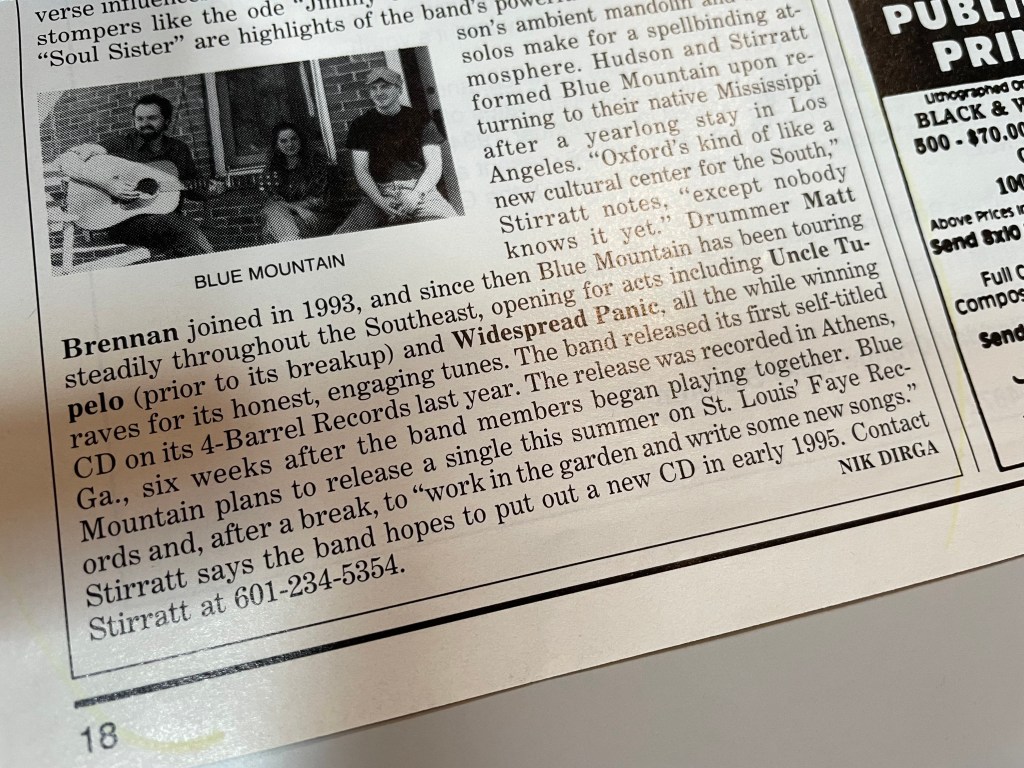
The box contains the very first paid journalism I did for The Daily Mississippian college paper 30 years ago now, like the time I interviewed California Gov. Jerry Brown (and accidentally stepped on his foot) or that time I had a daily newspaper strip. It contains more than 100 issues of the local “free alternative weekly” newspaper I worked at and then became editor of, Oxford Town. I kept all the issues I edited, because I still, 25 years on, remember every silly story, every goofy design choice, every snarky pun I tried to sneak past the publishers. You never love and hate a job quite like the very first job you feel truly good at, you know. 

The box endures, newsprint archaeology of a so-called career through my college days in the 1990s and into the early 2000s, to a tiny newspaper in Oakdale, California where I lasted an anaemic 8 months, to the newspapers in Lake Tahoe I edited for years, to the great little paper in Oregon I worked at just after I got married and had a kid. 

There’s feature interviews I wrote about Pulitzer-prize winning authors and Russian painters and zoo veterinarians and chocolate makers. There’s endlessly navel-gazing columns spanning my optimistic 20s and early 30s that I’m both kind of proud of and embarrassed by these days, lots of random music commentary, a long run of video review columns (hey! remember video stores?) and more. If you want to know what I thought of Terminator 3: The Rise of the Machines, the box is the place to go! Hell, there’s even a couple of journalism awards I won! 

None of this is remotely useful to me in my alleged career these days, working as a digital journalist and factchecker and freelance writer and whatever the heck else it is I do in an industry that’s changed an awful lot in the 30 years I’ve been doing it. A lot of my writing was very of-the-moment stuff that matters little today. So I could just toss all of this stuff that’s gone from Mississippi to California to New Zealand with me. 

But, still. If I throw out a newspaper I edited 25 years ago, that’s it. It’s essentially erased. There’s no website carrying most of its contents, no scanned repository of most small-town newspapers. Heck, even most newspapers unless they’re The New York Times barely have any kind of online archive past the last decade or so. Contrary to what sometimes feels to be the case, all of life isn’t online. 

I can pare it down. I have no earthly reason to keep three copies of an issue of a newspaper I edited in 1997 that I was particularly proud of at the time, really. 

The box is hefty and awkward and old-school, but even long after the ink has dried on those pages, it feels like it still means something, somehow. Journalists live by their words. 

I’ll whittle the box down a little bit more again in this go-round, but will end up keeping most of it still, where it’ll end up in the back of a closet for another several years, a silent testament to the stories I once told and the deadlines I once met. Heck, maybe one day my son will inherit it and either treasure or trash it all. 

You can just throw out the stories of your life, but why would you?