 The comic book medium has had lots of highs in its nearly 100-year history. We’ve had Maus, Watchmen, Love and Rockets, Sandman, and much, much more.
But if I had to choose one comic book to send to Mars as the true pinnacle of the comic art form, I’d pick the adventures of Jimmy Olsen and Lois Lane.
Superman was so darned popular in the 1950s and 1960s that even second-bananas got their spin-off titles. Hence we have Superman’s Pal Jimmy Olsen and Superman’s Girl Friend Lois Lane, which both managed respectable 100+ issue runs up into the 1970s.
For me, these comics are the pure crack cocaine all other comics aspire to. They’re the pop-art manic energy of Jack Kirby wrapped in suburban clothing, they’re everything Grant Morrison has homaged throughout his career.
The insanely goofy adventures of Lois and Jimmy typically follow one pattern – hapless Jimmy and Lois get into far-out trouble, and their pal Superman has to rescue them. But in this simple pattern a world of utter insanity is kept. Jimmy Olsen becomes a werewolf, a giant Turtle-Man, a human flamethrower, a Bizarro version of himself. Lois Lane becomes a witch, a mermaid, even a black woman in a misguided attempt at relevance in the early 1970s.


I’d argue these lowly spin-off comics in some ways serve Superman even better than his own solo adventures did – there’s rarely a fistfight or a cosmic clash, and instead the world’s most powerful superhero is often pictured as a kind of benign goofball god constantly at the beck and call of his irritating friends.
There’s something very primal about these adventures, which all take place in a Daily Planet newspaper that seems to have about five staff, where human bodies are twisted like putty and genies, aliens and magic potions are around every corner, but everything will be back to normal by the end of the story.

 These comics are a product of their time – Lois is too often portrayed as a scheming meddler with marriage to a man (usually Superman) the only thing on her mind; but by the same token Jimmy Olsen is a gibbering goon who’s constantly getting himself into trouble as well. Yet I’d take a single Jimmy Olsen comic with their endless invention and amiable good cheer over a dozen of comic books’ latest attempts to strip-mine their past and reinvent the wheel.
You’ll never, ever see a Jimmy Olsen movie that captures a tenth of the insanity and colour of these comics. And that’s why they’re quite possibly the peak of the comic book form.
 One of my favourite comics from the ‘80s into the early ‘90s was Marvel’s
  The biggest geek-appeal of What Ifs were that in retelling classic stories with a twist, characters could die – hell, everybody could die. “What if The Hulk Went Berserk?” was an issue that scarred the heck out of teenage me because I walked in expecting a typical Hulk story and then characters like Iron Man and The Thing started dropping like flies… oh, and it ended with Thor snapping the Hulk’s NECK which is pretty darned grimdark, ain’t it?
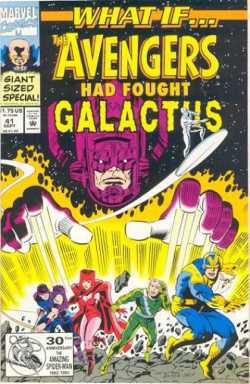 A cursory look at comics from the last few months turns up “Infinity Wars” (Marvel characters like Captain America/Dr. Strange mashed up, again!), “The Batman Who Laughs” (what if Batman was REALLY dark?), “Spider-Gwen,” “Spider-Noir” and a hundred more variations of Spider-Man. Not saying these are all terrible stories (although a lot are), but the main thing is that the novelty is gone. Whoa, you just showed me an alternative world where Superman is DEAD? I’ve seen that six times this week already, son.
 All right, it’s time to post again and stop hanging out at the beach and such. It’s 2019, oh man oh man, and that means 1999 was 20 years ago, which means the ‘90s ended 20 years ago, which means my 20s ended 20 years ago and I am officially old.
 I’ve been collecting comics for (gulp) nearly 40 years now, but the 1990s was the closest I ever came to abandoning my monthly fix. Marvel and DC’s mainstream comics hit their gaudy nadir, and I was dead broke a lot of the time anyway. But there was an awful lot of brilliance to be found in the spirit of independent comics – Hate, Eightball, Cerebus, Yummy Fur, Naughty Bits, Dirty Plotte, DC/Vertigo’s Sandman – and that kept me going.
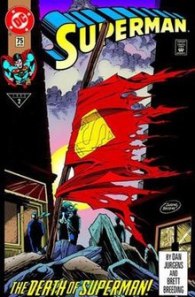 Throughout ACBC, we see the twin poles of creative independence and corporate greed battle, greed usually winning. Marvel sells 8 million comics and goes bankrupt a few years later. DC kills Superman, breaks Batman’s back, makes Green Lantern a mass murderer, chops off Aquaman’s hand (spoiler: they all get better). Image Comics is formed in 1992, and despite beginning with some pretty awful clenched-teeth superheroic angst, it’s still here in 2019 and publishing a diverse and intelligent line of books. Former Marvel editor-in-chief Jim Shooter, on the other hand, keeps popping up throughout the book starting up new companies that quickly fade away.
 I’ve always considered myself a pretty adequate comics history nerd, but there were entire publishing companies unearthed in this book I’d never heard of. Sacks and Dallas keep the constant flow of information moving in an entertaining way, and there’s tons of juicy comics-biz gossip peppered throughout.


 My first real deep dive into Stan Lee’s own writing came when Marvel Tales, a reprint mag, began running the original Lee/Steve Ditko issues of Amazing Spider-Man from the beginning in 1982. I’d never read them before, and while my pre-teen eyes took a while to get used to Ditko’s more primitive-feeling artwork, I was sucked in to the stories as Spider-Man fought Dr. Doom! Met the Lizard! Battled Doctor Octopus and the Living Brain! Reading these marvellous tales, I realised what all the fuss about “Stan Lee Presents” was really about.
 If you want to really examine the seismic effect Stan Lee had on comic book storytelling, read one of DC Comics’ musty early Justice League of America issues from around the same time the Fantastic Four launched. While they’re charming enough, the stiff, military-precise characters are interchangeable and conflict is nonexistent. They fight crime with a smile and brisk efficiency.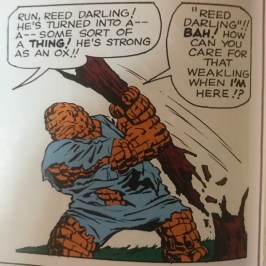

 Nik Dirga