Godzilla Vs Hedorah, or the grooviest kaiju flick ever

Brothers and sisters, let’s rap about Godzilla’s strangest trip of all time, the crazy, freaked-out madness that is 1971’s Godzilla Vs Hedorah (also known as Godzilla vs the Smog Monster in the US). 

I love me some Godzilla, but the psychedelic 11th Godzilla movie is, um, divisive among Godzilla fans, and even landed a spot in The Fifty Worst Films of All Time. 

Yet there’s something nervy and loose about Godzilla Vs Hedorah that the mostly formulaic 30-something other movies in the franchise lack. It’s a Godzilla movie, so there’s smashing and screeching. But it’s also without a doubt one of the strangest Godzilla movies ever made, a dogged attempt to be topical and hip as Godzilla fights the evils of … pollution. 

The “smog monster” Hedorah is, to put it mildly, disgusting. He’s a shapeshifting blob of goop and tendrils whose most imposing form has a strong Cthulhu vibe, with one single sideways staring eye that never fails to creep me out. At one point Hedroah gets blissfully stoned sucking on factory smokestacks. He’s constantly leaking and spurting out his bodily fluids, raw toxins and disease. Unlike say, Rodan or Mothra, he isn’t cuddly at all. A scientist at one point says he comes from “a negative world of death.” He looms over the movie far more than Godzilla does. 

A trippy movie that’s soaked in 1971 vibes, from the go-go hippie music sequences to the inexplicable brief animated cartoons that pop up between scenes, Hedorah is firmly planted in its time. It boasts many of the familiar Godzilla cliches – an evil monster to fight, buildings toppling, an incredibly annoying little kid who keeps screaming “Godzillaaaaa!” – but there’s something spartan and weird about Hedorah. Godzilla himself seems half drunk, introduced with a bizarre woozy horn fanfare in each scene. (One of the most infamous scenes in Hedorah has Godzilla flying, backwards, using his nuclear breath to propel him. It’s mental as anything, and yet it’s another one of the weird touches that give this flick the feeling of a strange fever dream.) 

Unlike pretty much every other kaiju monster in the Godzilla series, Hedorah doesn’t flinch in showing the body count. At one point his toxic goo invades a boardroom of Japanese businessmen, who are then shown in a rapid cutaway all dead, soaking in ooze and oddly evocative of some of the horrors of Hiroshima. In several scenes, Hedorah swamps civilians and leaves them nothing but smoking bones. In most Godzilla movies, carnage is abstract, smashed buildings. Hedorah dissolves you.

Godzilla movies mostly stick to the basics, but some of the other films have tried to be topical – the 1954 original is all about nuclear fears, while 2016’s innovative Shin Godzilla, made in the shadows of the Fukushima disaster, is one of the boldest movies in the series since Hedorah. Hedorah is definitely preachy, but it’s hard to pretend its environmental message isn’t still in the right place nearly 50 years later. 

Director Yoshimitsu Banno was trying to shake up the Godzilla franchise from its kiddy-movie reputation. He didn’t really succeed in the long run – he was actually fired from the franchise! – but yet his goopy masterpiece still stands out from a line of assembly-line kaiju clashes. Most Godzilla movies are just popcorn fun, which is totally cool, but Godzilla Vs. Hedorah is the only one of them that really leaves you feeling a little creeped out over the horrors we can’t always see. 

Sometimes you can go back, and it is most excellent

So a few weeks ago I had a bit of a rant about inessential sequels, the never-ending Terminators and Predators and remakes which plague Hollywood.

But then on the flip side, there are the revivals that bring something new to their franchise, and when it works it’s like the best school reunion ever. 

Exhibit A: Forget Tenet, I am so here for Bill And Ted Face The Music. It was the first new movie I’d seen in theatres since March, and the first time the whole family went to a cinema since gosh, maybe Avengers: Endgame.

After nearly 30 years, was the return of Bill and Ted really necessary? Turns out it kinda was. Face The Music is goofy, silly and big-hearted, just like the other two Bill and Ted movies, and even if I kept squinting and seeing John Wick when I looked at Ted now, it was ultimately a mighty fine palate-cleanser for the sour stew that is 2020. 

These movies about time-travelling doofuses are not high art – and don’t think too hard about the plot mechanics – but they’re effortlessly charming, thanks to a never-goofier Keanu Reeves and the spunky Alex Winter (who is always fun despite a pretty low-profile acting career). When writing about Terminator: Dark Fate and other encore sequels the other week, I lamented how they just keep repeating the greatest hits. Bill And Ted 3 does a bit of that too, but it still feels scrappy, surprising and less machine-made than Terminator 6 or Predator 4 – and has a great subtext about what it’s like to be a middle-aged dude and still not quite made it. Its message of unity makes Bill and Ted feel weirdly relevant in 2020. It won’t win Oscars, but most of the unashamedly feel-good Bill And Ted 3 left me smiling like seeing a friend I hadn’t seen in years. That’s what any long-in-the-works sequel should do, rather than just straining to keep the intellectual property alive. 

Meanwhile, I’d have laughed if you’d told me a decades-on sequel to The Karate Kid would be some of the most enjoyable TV in ages, but Cobra Kai, which recently landed on Netflix, is absolutely a blast. I grew up with Ralph Macchio’s cheesy inspirational Karate Kid series, and even had one of my quasi-first dates at a screening of The Karate Kid Part II. (Peter Cetera’s goopy power ballad The Glory Of Love still slays the memory of pubescent me every time.) Cobra Kai is brilliant because it flips the script to tell us the story of Karate Kid Danny LaRusso’s nemesis from the first film, Johnny Lawrence (a terrific William Zabka), now a washed-up alcoholic trying to make one last go at his dreams. By turning the heel into a troubled antihero and giving returning Karate Kid Macchio (now a car salesman!) some much-needed moral ambiguity of his own, and tossing in the same stirringly motivational karate kicks of the original films, Cobra Kai turns out to be the model for how a franchise can come back from the dead and really have something to say. 

Even a once-adapted, beloved novel can have some new life in it, like Hulu’s recent take on Nick Hornby’s High Fidelity. The 2000 film starred John Cusack, but the recent TV series flipped the switch and cast Zoe Kravitz as “Rob” Robin, record store owner and confused romantic. Switching genders doesn’t always improve a story – see the forgettable Ghostbusters remake – but Kravitz’s excellent performance finds new depth in Hornby’s tale, and the grittier, more lived-in feeling of the series elevates it above the movie. It’s a shame the show was cancelled after just one season as it was very promising stuff and moving well beyond just being a cover version of its predecessors. 

I still think there’s way too much strip-mining of popular movies of the past in hopes of striking gold twice. But Bill And Ted, Cobra Kai and High Fidelity show that if you’ve still got a good story to tell, there’s still hope for the future in the past.

Chadwick Boseman, and the stories left to tell

The death of Chadwick Boseman at just 43 from cancer hurts, coming as it does in a year when there’s been so much hurt already. 

Just over two years ago, he was the star of the biggest superhero movie ever at the time, the first nominated for Best Picture. But he was eye-catching and charismatic in everything he appeared in during his too-short starring film career, which spanned just seven years. To most of the world’s shock and dismay, we learned that he was fighting colon cancer for much of the time he was starring in some of the biggest movies on the planet. Unimaginable. 

He’s going to always be remembered for Black Panther, but he starred in several wonderful films, carving out a bit of a niche career as a chameleon portraying famous inspirational Black figures. Legendary baseball star Jackie Robinson. Soul star James Brown. The first Black U.S. Supreme Court Justice. He was very different, dazzling in each role and was much more than just T’Challa, the Black Panther. He leaves us these stories. 

I always loved the Black Panther as a kid. He was mysterious and cool, and back in the 1980s, he didn’t actually appear all that often in comics. And Chadwick Boseman brought him to life wonderfully on screen, capturing the Shakespearean tumult of a Prince-turned-King wrestling with his own power. I would’ve loved to see what he did in future films. 

Boseman’s pivotal place in Black film history is not my story to tell. But his starring as the Black Panther – telling millions of Black kids and adults that yes, a superhero could look like anybody – changed the parameters. He made the world bigger, and broader.

Some of us mourn actors and musicians because we see the storytellers they are, and when one of them dies suddenly or too young all you can see are the stories yet untold. Chadwick Boseman should’ve had a career stretching for decades, and it’s unfair. The last sudden film star death that hit me like this was Philip Seymour Hoffman, and I felt much the same thing – I wanted to see more. I felt cheated. 

Two scenes from Boseman’s turn as the Black Panther keep ringing in my head, neither one of them your typical superhero punch-ups. One is the quiet moment at the very end of Black Panther between T’Challa and his vanquished foe Killmonger, which achieves a kind of graceful sadness. The other came at the very end of Captain America: Civil War, where T’Challa confronts Baron Zemo, the villain who assassinated his father. 

Both scenes are notable for the calm centeredness of Boseman. At the end of Civil War, T’Challa decides not to kill the man he’s been hunting the entire film, and stops him from killing himself. 

He tells Zemo, “The living are not done with you yet.” Yes, it’s a line by a superhero to a murderous villain, yet somehow it echoes to me so much as I think about Chadwick Boseman today. 

He is free from pain now, but the living were not done with you yet.

There were so many stories left to tell. 

I’ll be back. And back, and back, and back again.

So I finally got around to watching Terminator: Dark Fate the other night, the sixth in a series of films that have been going since I was 13 years old. I am now pushing 50.

And it was … fine. Good action, bit of Arnold and Linda Hamilton, hitting all the right Terminator beats. But was it essential?

It’s not like this is any startling revelation, but the field of genre films is littered with unnecessary sequels that are only there for one reason – cash and “protecting the brand.” So many of these sequels fail to pass the pub test – do they tell a story that is worth telling? 

Terminator and Terminator 2 together tell a concise apocalyptic story, one that has been exhumed every few years with diminishing returns ever since. Instead of it becoming a story of humanity changing a dark future, seen over six films it’s actually a tale of how no matter how many robots you kill, everything is still going to go horribly wrong somehow in the end. 

Take the Alien movies. I had to do a double-check to actually see how many there have been now – eight if you count the spin-offs! Yet the story of Ellen Ripley is actually told pretty well through the first two or three movies alone, and all else is papering in cracks and investigating corners that didn’t turn out to be that interesting in the long run. 

Or Predator, one of those franchises that they just can’t let die. One perfect bloody brawler of an action movie. Five increasingly nonessential reboots, sequels and prequels.

And, as I said, Terminator: Dark Fate was fine. It was certainly better than the fourth and fifth Terminator movies, not quite as good as the rather underrated third. But for all intents and purposes, the story of Sarah Connor and Terminators trying to kill her was told perfectly well in the first two movies. 

The marketing machines gear up these nonessential sequels and reboots every few years and they become a blur. Just in the last 15 years or so we’ve had airy reworkings of Total Recall, Fright Night, Robocop, Tron, Ghostbusters, Point Break and more that evaporate almost from the moment you think of them. It doesn’t mean a franchise can’t carry on indefinitely – the Marvel movies machine franchise manages to keep you wanting to know what’s happening next in the sprawling tapestry, and even if the movies aren’t all of the same quality, you generally feel they were worth telling. And even a years-later sequel to an old idea can still bring something new, such as Mad Max: Fury Road or Blade Runner 2049. 

I know it won’t happen in Hollywood, but just wish sometimes the question would be asked, is the story worth telling? Most of the time, the answer is that it was told fine the first time. 

The world may be screwed, but we’ve always got the movies

Everyone’s got their social routines that have been buggered by this abominable year to date. Even though life is a lot more normal now here in New Zealand than it is in other places, it’s still a bit shaky. 

But at least, we’ve still got the movies, even if it isn’t quite the same. I know it’s a stupid thing to focus on in a world with so much pain and loss and stress going on right now, but I have to admit I think a fair bit about how in a brighter alternate timeline, I’d have seen the new Black Widow, James Bond and Wonder Woman movies by now, not to mention a handful of other wonders new and old. 

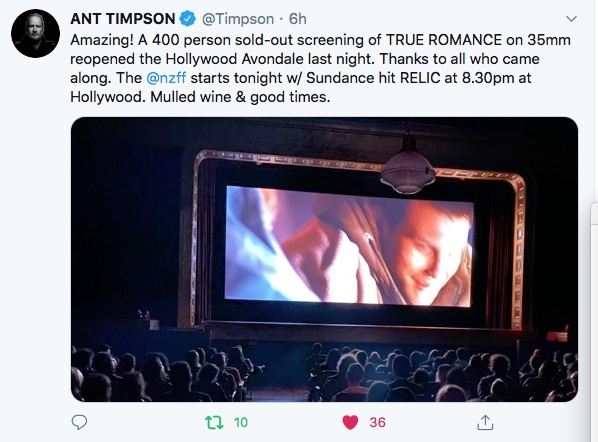
But my very cool local retro cinema finally reopened this week, with what turned out to be a sold-out showing of 1993’s True Romance. Driving up to the theatre last night, I saw crowds of people outside and had trouble finding a parking space. I was a bit confused by all the bustle. For a 27-year-old movie starring Christian Slater! (And written by Quentin Tarantino, I might add.) People were clearly starved for the magic of the movies. It was great to be back, and appreciate the strange communion of the cinema, which streaming just can’t quite recreate. 

It still feels a bit decadent, a bit strange, to be able to be crowded in a sold-out theatre with hundreds of others, nobody wearing a mask, in the age of COVID. But we’ve fought a hard battle here to get to this place of near-containment, and that does make the little victories like hanging out at the movies with a mate, a soda and a popcorn taste that much sweeter. 

The New Zealand International Film Festival is mostly online this year, which is understandable, but also a bummer – some of my best theatre memories in recent years have revolved around the bustling, diverse wonders of the festival, where you can pivot from a gory crowd-pleaser to a touching Tongan documentary with ease. New Zealand’s tentative reopening meant the festival had to stick to mostly online showings this year, which sadly isn’t quite the same. Fortunately, my local retro cinema is also showing a few of the movies in person in limited viewings this season, which I won’t pass up.

New movies are thin on the ground in 2020 and it’s kind of looking like it might stay that way all year long – this year’s summer movie season, a gaudy showcase of spandex, explosions and spaceships for as long as I can remember, simply does not exist. But hey, True Romance was pretty fun to see again for the first time in ages. And everything old is new again. 

Lights, camera, action. A crowd of strangers and a flickering screen. It may not be 100% normal life, but I’ll take what I can get. 

Harold Lloyd, hanging on for nearly a century

Harold Lloyd isn’t quite the household name the other silent clowns of his generation are – Charlie Chaplin, Buster Keaton, Laurel and Hardy. But doggedly, cheerfully, he endures, and in some ways he’s still the most modern of the lot.

It’s a strange feeling watching a movie made nearly a century ago and knowing that everyone in it and who worked on it is long dead. But 1923’s Safety Last, even at 97 years old, still speaks to today’s world with its singular image, of a man frantically trying to keep his balance in a changing world. 

That’s not to say Harold Lloyd was quite the genius Chaplin or Keaton were – but at his best, his work comes mighty close. I adored Chaplin and Keaton from the moment I first discovered “the silent clowns”, but Harold Lloyd was almost forgotten after his death in 1971. It’s mainly thanks to that remarkable imagery from Safety Last that he hasn’t become as obscure as some of his peers. 

Keaton was famed for his stone-faced expression, and Chaplin for his childlike innocence. Lloyd started out as a second-rate Chaplin imitator, but his character “Glasses” is how he broke through into legend. Lloyd smiled more, a genial wide Midwestern-type grin, and Glasses was just an ordinary guy, a striver in the roaring ‘20s trying to make it big, gutsy yet appealingly insecure. He seems a tad more human. And indeed, through the 1920s Lloyd was one of the world’s biggest box office stars.

The Criterion Collection has done a magnificent job restoring Lloyd’s ouevre the last few years with sweeping special editions of Speedy, The Kid Brother, The Freshman and of course, Safety Last, arguably his masterpiece and definitely the film he’s most remembered for. 

Like most silent comedies, Safety is thin on plot and long on pratfalls. Harold is a country boy who moves to the big city and gets a lowly job in a department store, determined to impress his country girlfriend. When she comes to town, he ends up in an escalating series of hijinks culminating in a still-astonishing climb up the department store skyscraper. There’s something captivating about Harold’s struggle – he doesn’t MEAN to climb the whole thing, you see – and yet he battles on, against the odds. Like Chaplin and Keaton, he’s the little guy – and everybody loves an underdog. 

Suspended in mid-air, clutching a clock’s hands to keep from falling to his death, the eternally striving Harold Lloyd feels like a meme before memes were a thing. His struggle pierces the veil between slapstick and genuine feeling, not always easy in the frantic world of silent comedy. 

It’s easy to get jaded in the age of CGI superheroes and wizards, but I’m always astonished when I contemplate the sheer guts and ingenuity of the silent clowns, when every somersault, stunt and crash were carried out by fragile blood and bone. Crowds reportedly fainted and fled the theatre at some screenings of Safety Last. Lloyd’s climb in Safety Last isn’t ENTIRELY what it appears to be – some great documentary footage on the Criterion disc shows how it was done – but it was still dangerous, challenging work.

Almost a century on, it still dazzles. 

Charlie Chaplin spoke out, but the world didn’t listen

A movie where the lead actor suddenly drops character at the end and delivers a passionate 5-minute speech directly to the audience shouldn’t work. But somehow, Charlie Chaplin’s The Great Dictator endures, and his plea for kindness still seems revolutionary nearly a century later. 

Viewed 80 years on, Charlie Chaplin imitating Adolf Hitler doesn’t seem so radical. Mocking der führer has been done since by everyone from Donald Duck to Mel Brooks to Taika Waititi. 

But what separates 1940’s The Great Dictator is he was one of the first, doing it while Hitler was still alive, still in power, on the rise. America wasn’t even at war with Germany yet. Time shouldn’t dim how revolutionary and bold this film was. It pulls no punches about the Nazi campaign against Jews, its warmongering and spreading of hatred. (Even Chaplin didn’t have any idea of how truly horrific the Holocaust was in 1940, and years later expressed some regrets about his film as a result.) 

Chaplin walks a fine tightrope here – he plays two roles, a “Tramp”-like kind-hearted Jewish barber, and the raving Hitler stand-in Hinkel. He’s magnificent in both roles. As the movie goes along the Jew and the dictator’s identities become swapped (never mind that nobody until the end of the movie seems to note the resemblance between the two characters). 

That leads to the grand climax of The Great Dictator, when the little barber has stumbled into the dictator’s shoes and has to address a crowd of thousands of his subjects on the eve of war. After years of silents, The Great Dictator was Chaplin’s first full talkie, and he unleashes a torrent of pent-up words to make up for lost time. 

What happens next is still controversial – it’s a naked act of utterly mawkish sincerity, and from a strict storytelling perspective it barely works at all. Yet it doesn’t matter, because Charlie Chaplin, the mostly mute film star, stands up before the cameras, drops all pretence of acting as the barber, and delivers an impassioned, 5-minute long call for peace and understanding among all people. It’s like Iron Man stopping before the final battle with Thanos and sitting down on a stool and talking about brotherhood in Avengers: Endgame. 

Chaplin starts slowly, almost apologetically:  “I’m sorry, but I don’t want to be an emperor. That’s not my business. I don’t want to rule or conquer anyone.” 

Nobody likes a sermon in place of a climax, do they? And indeed, the first time I saw The Great Dictator years ago it did strike an odd note. It breaks the spell of the story, but that was Chaplin’s intention, as France fell and Hitler’s plan gathered speed. The older I get, the more Chaplin’s no-bullshit appeal stings for me:

“Greed has poisoned men’s souls, has barricaded the world with hate, has goose-stepped us into misery and bloodshed. We have developed speed, but we have shut ourselves in.”

Those words seem to ring even louder in the age of coronavirus and populist blowhards. Or is it just that sadly, humanity’s flaws and foibles haven’t changed a heck of a lot since 1940? 

It’d be nice to say that Chaplin’s big speech made a difference. But history tells us otherwise. The Great Dictator was Chaplin’s biggest hit, but it also was the end of the road for him. The “Tramp” character never returned, and while Chaplin made a few more great films, they weren’t hits. His liberal politics during the McCarthy era saw him exiled from America to Europe. Despite the boldness of The Great Dictator’s final speech, Chaplin ended his career as a kind of pariah. 

Yes, it’s a strange way to end a film. Yet when artifice and bombast and trolling seem to have an unbreakable hold on us, I’ll take kindness over selfishness every single time. 

That one time Bela Lugosi got to be the hero

Poor Bela. 

Bela Lugosi has been cast as a kind of cinematic cautionary tale over the years, with Martin Landau’s indelible Oscar-winning portrait of him in his decline in Ed Wood forever painting the Dracula star as a drug-addicted has-been stuck in terrible no-budget movies. Hell, even Bauhaus sang mournfully for him in “Bela Lugosi’s Dead.” 

While Lugosi certainly had his problems, his career at its peak was fiery, and his presence on screen had a brooding Gothic grandeur that’s been imitated by every Lestat and Twilight sparkle-vampire wanna-be ever since. 

The sad thing is that Bela Lugosi very rarely got to play the hero. His iconic performance in Dracula defined him, for better or worse, and the ensuing typecasting meant that he rarely played non-villainous roles. He was also hobbled by the thick Hungarian accent he never quite shed. 

But in one of his best roles, 1934’s The Black Cat, he got to play a daring kind of anti-hero, teamed with Boris Karloff for the first time in one twisted piece of pre-Code horror. Lugosi is Dr Vitus Werdegast, a former prisoner of war who returns to exact vengeance upon his traitorous commander, Hjalmar Poelzig (Karloff). Dr Vitus’ mission gets tangled up with two fresh-faced newlyweds who become pawns in a showdown between him and Poelzig. 

At a brisk 69 minutes, The Black Cat is Universal Horror near its peak – all razor-sharp shadows and crackling thunder, but with a creepy, real-life edge that foresees the horrors of the Nazi party. The monsters here are all very human. Poelzig, who’s not just a war criminal but a bona fide Satanic cult leader, is one of the more unnerving villains Karloff ever played, all sallow, black-eyed stare and unrepentant malice. 

But it’s Lugosi who steals The Black Cat, looking impossibly handsome and dapper as Dr Vitus, vigorous and strong. (It’s interesting to realise that Lugosi was actually a bit taller than Karloff, who played the towering Frankenstein’s Monster.) He’s a haunted man, but one who wants to do the right thing. The tragedy of The Black Cat is that in doing so, he is seen as a villain too.

There is a scene where Dr Vitus discovers the preserved corpse of his wife, kept in a glass case by the madman Polezig (I told you this was a twisted bit of pre-Code horror!). The agony and shock that plays over Lugosi’s face in this moment is a masterpiece of horror acting. 

Of course, The Black Cat is hokey – the newlyweds are a plot device, Lugosi’s character’s inexplicable hatred of cats is kind of hilarious today (at one point, he straight up murders a cat!). But there’s a primal fear to it too that movies from Texas Chainsaw Massacre to Saw have mined ever since, about good people ending up in a web of unspeakable random cruelty. 

I love the brief image we get of Lugosi as the doomed hero, a good man shattered by wartime cruelties and the sadistic tortures of Poelzig. In the end Dr Vitus gives himself entirely to revenge and cruelty, mutilating Poelzig, and flicking the switch to blow up everything and almost peacefully, intoning, “It has been a good game.” 

In another world, maybe Lugosi would’ve played the hero more often. But when he did, he was unforgettable. 

The endless boozy charms of Nick and Nora and The Thin Man

Nick and Nora Charles never worry about money, politics, or viruses. They sleep in, drink all day and solve crimes at night. Who wouldn’t want to be Nick and Nora? 

During the current troubles, I’ve found solace by rewatching all of the great 1930s-40s Thin Man series of films, featuring husband-and-wife detectives Nick and Nora (and of course their dog, Asta). I first saw these movies as a teenager, and the snappy banter and elegant charms of a vanished black-and-white world won me over instantly. 

The unforced charisma of William Powell and Myrna Loy are what elevate the Thin Man series of six films over dozens of other forgotten screwball pics of the ‘40s. Wisecracking and booze-soaked (in the first few movies particularly), but deeply in love, Nick and Nora are one of the few couples of old-time Hollywood you can actually imagine having a sex life. Powell and Loy’s chemistry is so strong many people assumed they were actually married in real life. 

The first Thin Man sets the stage for the entire series – someone dies in mysterious circumstances, hard-drinking, wealthy, sort-of-but-not-really retired detective Nick Charles and his plucky heiress wife Nora get involved, there’s lots of banter, and in the end the crime is solved. In all the movies, the mystery really is secondary to the boozy, flirty interplay of Nick and Nora. They’re formulaic to a fault – every movie ends with a “Clue” locked-room type showdown where Nick Charles assembles various suspects for this episode’s mystery and there’s a dramatic reveal. But you don’t watch these for the mystery – you watch for the banter and the style they ooze. The first movie features some of the catchiest lines and Nick and Nora are particularly young, sexy and smart.  

1936’s first sequel After The Thin Man might just be my favourite of the series – unlike the first film, it doesn’t take ages to get to Nick & Nora, and the mystery is genuinely engaging, led by a very young Jimmy Stewart in a supporting role. For Nick and Nora, crime fighting is more of a lark in between boozy parties, and After The Thin Man does the best job of the series of capturing their pleasant debauchery while also wrapping in a good yarn. 

1939’s Another Thin Man adds the wrinkle of a baby son to Nick and Nora’s lives. It works here because the baby clearly cramps Nick and Nora’s style, but not so much that the fundamental appeal of the series goes missing. There’s also a bit of pathos behind the scenes as Powell was diagnosed with cancer between films and was in pretty rough shape, physically, but he rises admirably to the challenge. (Dig that lengthy monologue at the end of the movie and imagine how well you could deliver that in his state!)

The series does go on a gentle downward trajectory after the superior first three movies, but every Thin Man flick is worth watching. Shadow of the Thin Man ages up Nick and Nora’s son to around 4 years old and features a rambling murder plot about a racetrack. They always say having a kid is the downfall of romantic couples on screen. Nick Jr is kind of annoying here, to be honest, although I do like seeing Nick adapt his drunken ways to parenthood. Nora, on the other hand, definitely loses some of her spark as a character with her new motherhood. There’s also a rather cringe, broadly portrayed African-American maid character who hasn’t aged well at all, making Shadow one of the lesser flicks. But there’s highly amusing scenes set at a wrestling match and a great restaurant brawl. 

The Thin Man Goes Home is considered the low point of the series by some, but I actually enjoyed it because it focuses a bit more on Nick and Nora’s characters, by bringing in Nick’s aging parents and a change of scene to the sleepy town he grew up in. It’s amusing seeing Nick attempt to go “dry” (by drinking nothing but cider), and Nora remains spunky as all hell, although unusually for the series, this instalment treats her a bit too sexist. (A comic scene where Nick mockingly “spanks” her did not age well.) Their child is nowhere to be seen in this one, thank god, although the murder mystery is even more complicated and incomprehensible than usual. Goes Home gives us an unexpected side of confident, cocky Nick Charles, showing he’s still a son trying to please an unimpressed father. 

Lastly came 1947’s Song of the Thin Man. After 13 years, Nick and Nora have aged a bit and they’re a long way from the boozy, sexy young couple of the first films – Powell was in his mid-50s by now. The son is back, but this time much less annoying, played by a young Dean Stockwell (!), and the mystery this time revolves around a murder in a jazz band. The most amusing parts of this one come from Nick and Nora being dropped into the bebop post-war jazz scene, and being utterly lost amongst the hep cats, daddy-o. Back in the first Thin Man, Nick and Nora were cutting-edge cool, but now, suddenly they’re the aging hipsters adrift in popular culture. It’s a clever move that acknowledges time passing in the series. Firmly positioned in the middle of the series, Song is still a nice little farewell. 

Nick’s last line? Once the murder is solved, Nick says, “Now Nick Charles is going to retire.” Nora asks, “You’re through with crime?” “No,” says Nick. “I’m going to bed.” I like to think of Nick Charles trapped in amber at that point, perpetually toddling off to bed with a stiff shot of bourbon in his hand, waiting for the inevitable midnight phone call of yet another murder in the city, a case that only he can solve.

Movies I Have Never Seen #6: Beverly Hills Cop (1984)

What is it: The biggest box-office hit of 1984, it turned Eddie Murphy into a superstar. Axel Foley is a street-smart Detroit cop who goes to Beverly Hills to uncover the truth about a friend’s murder. Hijinks ensue. 

Why I never saw it: If you’d asked me, I would have thought I’d seen Beverly Hills Cop. After all, it was EVERYWHERE in 1984 when I was a wee tween. Yet when Mr. 16 and I decided to watch it the other day, I realised unless I’ve completely and utterly blanked it from my mind, I’d never actually seen one of the biggest hits of my childhood years. (I’m fairly sure I have seen Beverly Hills Cop II, which I think I confused with the first one.) I felt like I had seen it because it was simply in the air. It’s hard to state just how big Eddie was in 1984, the summer of Ghostbusters and Walter Mondale-mania. (Was that a thing?) My brother owned the soundtrack on cassette tape, but because BHC was R-rated, I, a mere sprat of 12, never saw it in theatres and missed out on videocassette, a medium by which I date myself horribly. Yet like every kid in 1984, I knew the plinky keyboards of Harold Faltermeyer’s Axel F earworm, which pops up in the movie approximately every 30 seconds. 

Does it measure up to its rep? Eddie Murphy’s material is hit-or-miss for me. He’s full of charm, but a lot of his stand-up comedy has dated a lot worse than his idol Richard Pryor (the movies Raw and Delirious are unwatchable to me today, all preening ego and lots of rank homophobia and sexism). Yet in movies like 48 Hours and Coming To America he’s one of the great comic actors. He singlehandedly makes BHC worth watching with his ultra-confident, cocky cop who’s got an answer for everybody.

It’s also worth noting that it was by far the biggest blockbuster of 1984, and the first time a black actor headlined such a smash hit. BHC doesn’t make racism a dominating plot point, but there’s certainly an awful lot of subtext here (Axel Foley keeps getting arrested by cops, for instance). He’s the smartest guy in the room, outsmarting all the by-the-book white cops and crooks. Eddie’s Foley takes the proud black heroic figures from blaxploitation movies of the 1970s like Dolemite and Shaft and plugs them into a more mainstream action blockbuster. It was a winning combination. But seen 35 years on, BHC doesn’t seem quite so revolutionary – and it’s genuinely a bit baffling that the boilerplate script actually got an Academy Award nomination. The murder mystery at the centre of the plot lacks any tension, and most of the other actors are blown off the screen by Murphy. Strip Eddie out of the movie and replace him with Sylvester Stallone (who was originally set to star) and you’ve got Cobra. 

Worth seeing? It’s worth a watch, but I don’t consider it anywhere near as much of a classic as ’84’s other big hit comedy Ghostbusters is in my heart. (Then again, maybe if I’d seen it at the same age as I first saw Ghostbusters, I’d feel differently.) Beverly Hills Cop is an entertaining ride for a cop action-comedy, and it’s full of ‘80s fashion and excess, but to be honest, other than Murphy’s still-dazzling charisma, there’s nothing here that hasn’t really been done better elsewhere.