Movie review: Superman 2025 soars

There’s an impending natural disaster. There’s two countries going to war. There’s a rich, arrogant billionaire tech bro who wants to rule the world. This sounds like a job for Superman!
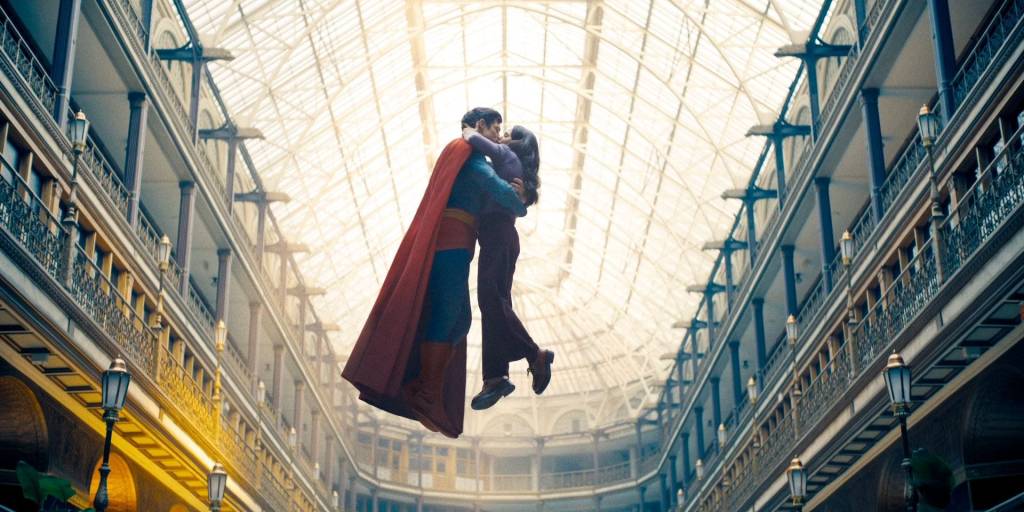
Director James Gunn’s new reboot of Superman brings some much-needed compassion and good humour back to the Kryptonian superhero after director Zach Snyder’s overly grim approach to the character in The Man Of Steel and Batman V Superman

Forget the same Super-origins we’ve all already seen before – baby rocketed away from dying planet, growing up on a farm in the Kansas wheat fields, yadda yadda – Gunn drops us immediately into the middle of the action with a story that starts at full tilt and rarely lets up for two hours. This colourful, pleasantly weird epic is just unpredictable and refreshing enough to stand out from the sea of superhero content. 

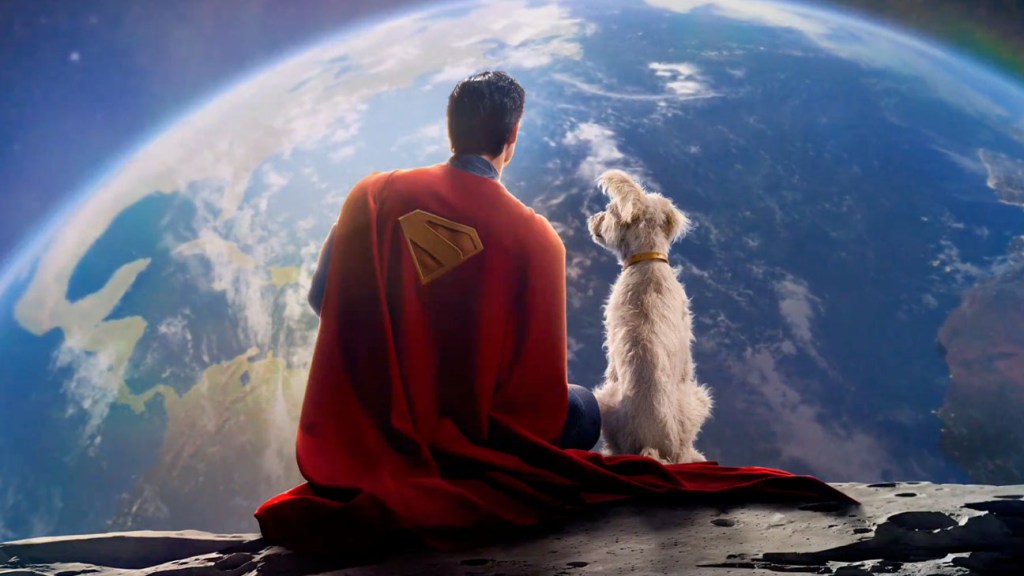
Oh, and there’s a dog – a very good boy by the name of Krypto who very nearly steals the movie right from under Superman’s cape. 

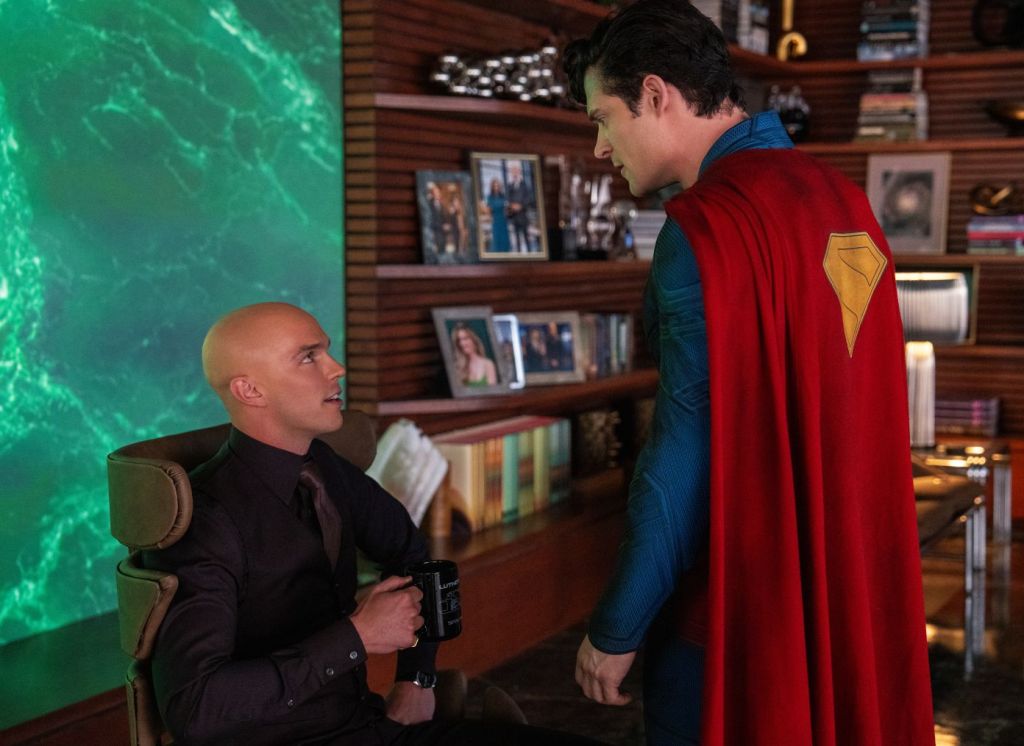
It’s a tangled plot that starts out with the aftermath of Superman (David Corenswet) attempting to stop a war and spins into a broader tale of whether this alien immigrant from another world can truly be trusted. On-and-off girlfriend Lois Lane (a fierce and funny Rachel Brosnahan) is trying to figure out their relationship, while scheming Lex Luthor (a terrific scowling Nicholas Hoult) has gathered some bad guys and sets in motion a plan that aims to defeat Superman once and for all. 

Gunn had already made a splash on the comics movie scene with his quirky Guardians Of The Galaxy trilogy for Marvel and his giddily gory and over-the-top The Suicide Squad. He impressed DC Comics so much they hired him to shepherd their whole rebooted universe of screen projects, in a course correction after movies like Justice League and The Flash underperformed. 

The 2025 Superman is a comic book movie that embraces a fundamentally goodhearted view of the world, no matter how many terrible things happen, and understands what makes Superman work. Corenswet makes a sturdy, likeable Superman, whose fundamental guiding principle is helping others. He’s all about the art of being kind, while Luthor’s preening ego only cares about envy, power and control. 

Gunn channels some of the charming energy of Christopher Reeve’s seminal 1970s and ‘80s Superman films, especially with repeated riffs on that iconic John Williams theme music – still the best superhero movie score of all time. He’s not afraid to get goofy, and embrace the colourful eccentricity of the original comic books. 

Fans who think comic movies should always be super-serious and “realistic” may be turned off by Superman, but a plot that features robot sidekicks, shapeshifting element men and shimmering cosmic scenery feels truer to the wild world of the original Superman comics. A few years ago having that super-dog Krypto in a movie would’ve been seen as campy. These days, it feels like a welcome relief. Why can’t a dog be a superhero, anyway? 

Superman sets up yet another cinematic universe, but there’s a deft touch to the way Gunn introduces a pile of other characters from ratbag Green Lantern Guy Gardner (a hilarious Nathan Fillion) to steely Mr Terrific. By avoiding the well-worn origin stories here this universe feels a bit more lived in. Comics fanboys will be delighted to see even characters like reporter Jimmy Olsen (a fun Skyler Gisondo) get a moment to shine.  

Still, Superman is, intentionally, rather overstuffed. Sometimes Gunn threatens to lose control of the narrative, and a few characters get short shrift – I would’ve loved to see a little more depth to Corenswet’s Clark Kent or some of his Daily Planet co-workers. Yet most of the dangling pieces come together nicely in an action-packed conclusion that features plenty of city-smashing chaos without the nihilistic undertones to it all that 2013’s Man Of Steel had. 

Most importantly, the “man” in Superman is key here. Too many Superman movies starting with 2006’s misfire Superman Returns have focused on the melancholy godlike figure soaring above it all, forever apart from the rest of us. Corenswet’s relaxed, genial Superman bleeds a lot and makes mistakes, while never losing his cheery optimism for long. 

This is the first Superman movie since 1981’s Superman II I haven’t felt a vague sense of disappointment with over compromises or inept plot decisions.

Of course, the usual outrage merchants online are already banging on about how Superman has apparently gone “woke,” as if he hasn’t been fighting bullies and haters for the past 80-plus years. Sincerity is a much better superpower than cynicism, isn’t it? 

For a while, Superman’s reputation has suffered in comparison to edgy heroes like Wolverine, Deadpool or Batman. Is Superman still cool? Sure, he may be a little corny, a little idealistic, but he also refuses to back down and hangs out with an awesome dog. 

I know which hero I’d rather have in the real world any day of the week. 

*This review appears in a slightly different form over at my day job at Radio New Zealand!

Meanwhile, elsewhere on the internet…

Golly, but I’ve been busy writing everywhere but this blog lately.

I’ve been doing a lot more assorted fact-checking and explaining work for cash money so it’s time for another roundup of stuff what I wrote:

Just in time for the hopefully good new movie opening this week, I did a recap for Radio New Zealand on Superman’s best (and not so best) moments on screen to date and some comics recommendations!

Everything you need to know about Superman before his latest movie

Over at AAP FactCheck, I did a deep dive into the disturbing and increasingly surreal world of bizarre AI slop infesting your social media feeds. The “conjoined twins celebrity scam” posts are the ones that finally broke my brain for good, I reckon:

Junk accounts serve up fantasy tennis tales

For RNZ, I’ve also done a few long explainer pieces lately:

Did you know US Customs can legally search your phone? Here’s what you need to know about it

And finally pivoting back again to the murky world of AI and how it’s slowly eroding all that is fair and decent on social media, here’s another explainer:

How to tell if an image or video has been created by AI – and if we still can

Featuring my very own test AI-generated slop image that I was particularly proud of:

Don’t always believe your eyes, is the moral of the story.

Unless it’s something on this website, which in that case is totally 100 percent legit and doesn’t need factchecking.

Now if you’ll excuse me, I need to go and assist in the emergency conjoined twin surgery for my good friend, celebrity Taylor Swift.

The 10 Best Movies of the 21st Century, according to me

What film geek can resist the nerdy pleasures of making a list? 

The New York Times has embarked on a fun project this week listing the best 100 movies of the last 25 years, which 500 Hollywood actors, directors and others voted on. 

All these lists are subjective and should never be taken utterly seriously, but at the same time, they can point you toward movies you’ve never heard of (Patton Oswalt is making me hunt down the obscure to me Coherence, for instance) or make you appreciate those you have seen with a new eye.

One of the cooler features of this project is the NYT allowing you to nominate your own list, which gosh, is almost like being in The New York Times yourself, isn’t it?

Everyone has their own list, and that’s a cool thing. I’m not here for the outrage or the ranty YouTube videos about why that choice or this choice sucks. Art is democratic, whether we like it or not. 

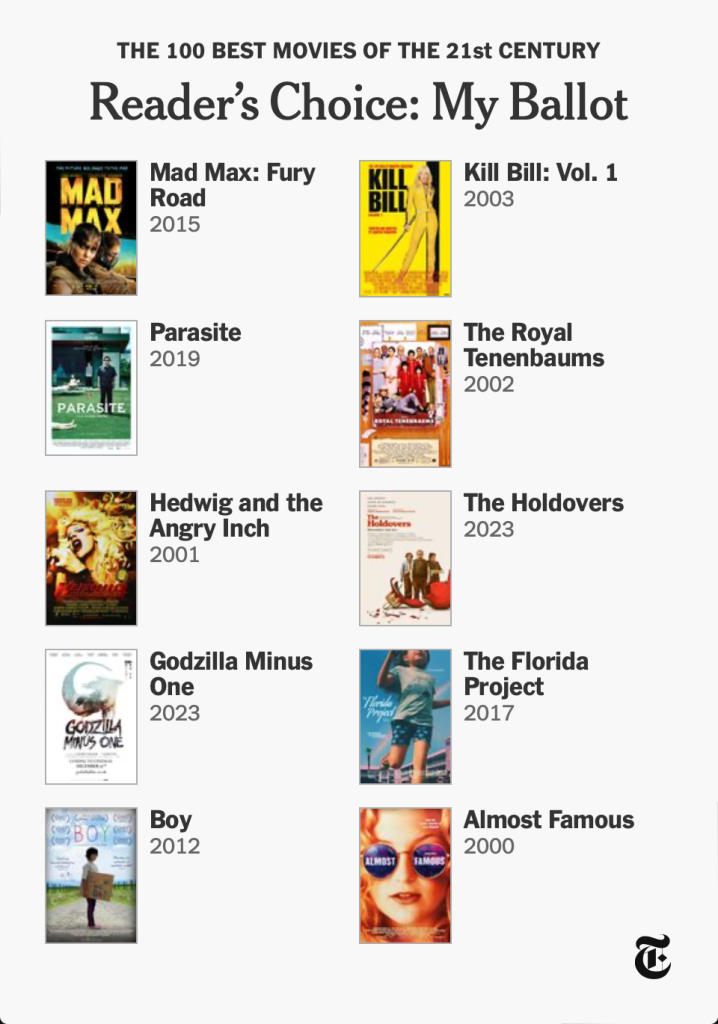
After an hour or so of scrambling, debating and pondering, here’s what I came up with for my favourite 10 movies from 2000-2025: 

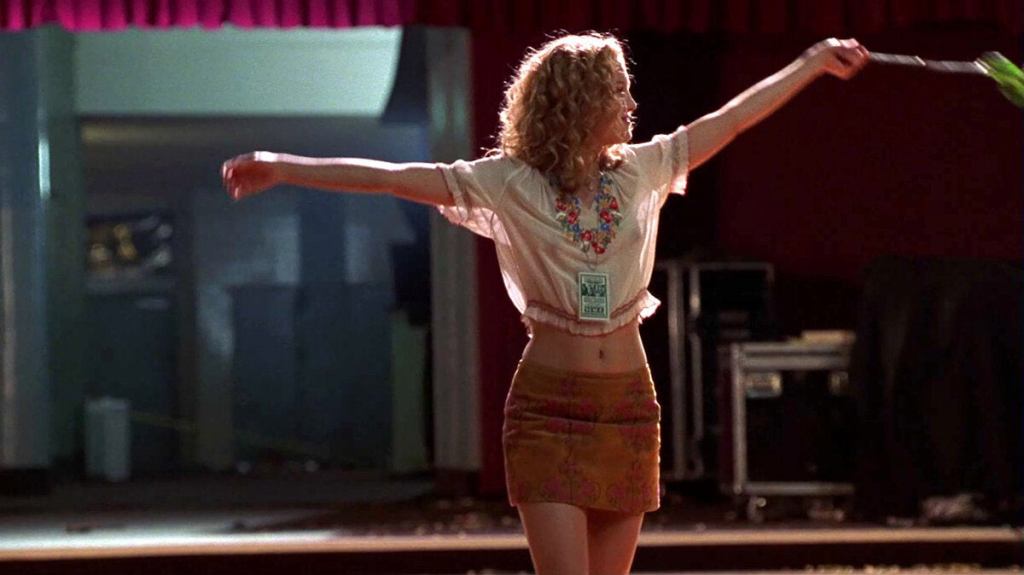
Almost Famous (2000) – Whatever happened to this Cameron Crowe? A movie as sincere and comforting as a bowl of chicken soup that gives us a fan’s view of ‘70s rock stardom through teen journalist William Miller’s wide eyes. 

Boy (2012) – Taika Waititi broke through with this deadpan and witty story of a lonely Māori boy growing up on New Zealand’s remote East Cape, and while Taika’s career has gone up and down since, this is one bloody great Kiwi film, you eggs. 

The Florida Project (2017) – Sean Baker won all the Oscars for last year’s great Anora, but this utterly heartbreaking story of a young girl and her mother living on the edge of the American dream might just be his masterpiece – realistic and raw, somehow both despairing and impossibly optimistic at the same time. 

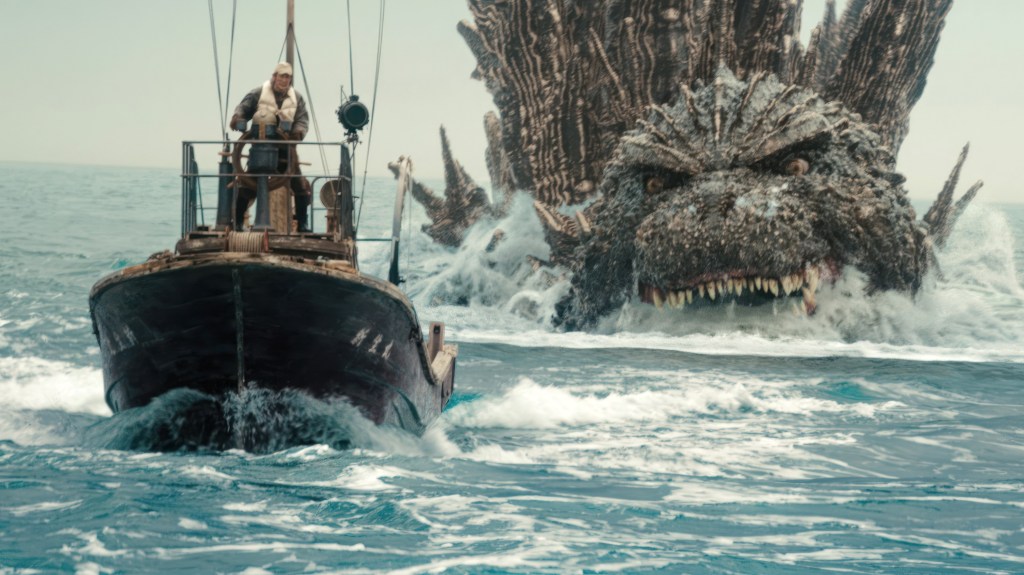
Godzilla: Minus One (2023) – A movie that finally met the full potential of all Godzilla’s world-breaking metaphors, and made it a deeply compelling human story about trauma too, without skimping on the carnage. A miracle of a movie, really, for us Godzilla nerds. 

Hedwig And The Angry Inch (2001) – I am a sucker for a good musical, and John Cameron Mitchell’s gender-twisting odyssey of sexual self-discovery and acceptance only seems to get more relevant with time, especially here from the timeline of the great culture wars. 

The Holdovers (2023) – Some movies you just fall in love with, and Alexander Payne’s cozy comedy-drama about a curmudgeon teacher and a misfit student forced to spend winter break together hits all the sweet spots for me. It’s about who you hope to be and who you end up being.

Kill Bill: Volume 1 (2003) – I sometimes think Quentin Tarantino’s movies won’t age well in the long haul. Yet this one, a fevered homage/rip-off to every sleazy kung fu romp and revenge thriller, really sums up his energy and magpie talent better than almost every other movie he’s made this century. 

Mad Max: Fury Road (2015) – Unexpectedly, George Miller returned to the wastelands without Mel Gibson to make what’s still the best action movie of this century so far – a triumph of sweaty, real life filmmaking before CGI and AI slop rolled over everything. 

Parasite (2019) – There’s a reason Bong Joon-Ho’s groundbreaking foreign-language Oscar winner is on so many other best of lists, and that’s because his tense narrative of class struggle and envy speaks to every person, no matter what language the movie is filmed in. 

The Royal Tenenbaums (2002) – Wes Anderson has only got more stylised with age, but with this, his third film, he hit an emotional peak that was still full of quirky originality – that, and the late, great Gene Hackman in one of his finest performances. 

That top 10 is hardly set firm in time and space, because what’s the fun of doing that?

Ten more that barely missed the top 10 for me and might all end up on it on a different day in a different mood: American Splendor, Anchorman, Captain America: Civil War, Grizzly Man, Mulholland Drive, Oppenheimer, Perfect Days, Spotlight, There Will Be Blood, The Wolf Of Wall Street.

Pee-Wee As Himself: I know you are, but what am I? 

Pee-wee Herman was so uncool that he became cool.

Watching Pee-wee’s Big Adventure in 1985, it felt like nothing I’d quite seen before – a colourful, free-spirited adventure of a peculiar man-boy who was searching for his lost bicycle. It kicked off Tim Burton’s career, and for a while, it and his popular children’s TV show made Pee-wee a superstar. Of course, it all fell apart a bit in the end. 

Up until his sudden death from cancer in 2023, Reubens wrestled with Pee-wee’s legacy – was the character eating him alive? It surely felt so at times. 

The fascinating new 3 1/2 hour documentary Pee-wee As Himself reveals Reubens as never before, in a posthumous tribute and confession from this remarkable, furiously independent man. 

I was one of the weirdos at age 13 when Pee-wee hit the big screen. Gawky, shrimpy and obsessed with comic books and action figures and all that jazz, I didn’t know who I was or wanted to be. Was I the good church-going Presbyterian my folks raised me as, or was I an artsy innovator – or was I both? I got picked on and called “strange” a lot in adolescence and to me, Pee-wee Herman was a revelation. He showed you didn’t have to fit in some “cool” box. Some found him annoying. I found him liberating. 

Even in the ‘80s, a decade filled with eccentric superstars from Mr T to Boy George to Michael Jackson, Pee-wee stood out. Almost never breaking character, Reubens created a kind of Peter Pan for the MTV generation. Pee-wee would never grow up (in his final appearance in the genial 2016 film Pee-wee’s Big Holiday, Reubens was 64 years old, but you’d barely know it). 

Pee-wee, freaky as he was, was a signal for many of us misfits and those struggling with their identity that it was cool to be just who you are. Both in his movies and the kid-friendly Pee-wee’s Playhouse, the ultimate message was acceptance – a vibe which feels more precious and precarious than ever here in 2025. 

What elevates this lengthy documentary is Reubens’ very vocal, opinionated participation, in 40 hours of interviews done shortly before his death. He spars with the director several times over whether he should be taking part at all, whether the documentary would be better if he directed it, and over just how much he wants to reveal. Reubens’ endearingly cranky debating feels like a discussion on the merits and failings of celebrity documentary as a whole, and somehow his tense reluctance makes Pee-wee As Himself feel richer and more multi-dimensional. 

Reubens hid his homosexuality for much of his career and a particularly heartbreaking revelation in the documentary is what that cost him. He abandoned one long-term relationship as a young man for his career, he bluntly admits, and he knew that in 1980s America he could never come out of that closet.

Of course, Pee-wee As Himself hits on the scandals – his 1992 arrest at an adult cinema, the very dodgy attempt to drag him over his collection of erotica in the early 2000s. Seen today when corruption and malice are everywhere, those so-called “scandals” seem pettier than ever and carry a large whiff of homophobia. 

It’s hard to fathom now just how omnipresent Pee Wee was in US culture after Pee-wee’s Big Adventure came out. He’d appear in rock videos and magazine covers and had toy dolls made of him, but he was always slightly, cheekily subversive. (Rewatching Pee-wee’s Playhouse episodes today as a creaky adult, you realise how much he played with the very idea of a kids’ show, and never, ever gave up on pushing those envelopes.) 

Pee-wee As Himself spends a lot of time exploring how Reubens came to create the character, and how the freeform experimentation of art school, performance art and the Groundlings improv troupe formed him. Reubens wanted to become a superstar, and embraced Pee-wee, who subsumed all the other character creations Reubens had been playing with and took over. 

Pee-wee went mainstream for a while, but was firmly a creature of the alternative underground tweaked just enough to “pass”. In today’s culture wars-infested world I don’t think Pee-wee Herman would’ve made it past the workshopping stage, although you can see hints of his wonderful surreal imagination in things like Adventure Time. 

I admit to choking up a little hearing what Reubens recorded the day before he died – even the filmmakers didn’t know about his cancer battle – and his last message: “I wanted somehow for people to understand that my whole career, everything I did and wrote, was based in love.”

The art of Criterion: Judging a movie by its cover

Because a man has got to have hobbies, one of mine is collecting boutique blu-rays of movies you typically won’t find on the anemic streaming services down here in NZ. And the gold standard of fancy-schmancy blu-rays has always been the Criterion Collection, which has specialised in bringing both iconic classics and obscure discoveries to screens for years now. 

Criterions play to the obsessive fans out there – who doesn’t love a good Criterion Closet video? – and one of their calling cards is the often-dazzling artwork they put on their discs. In an age where physical media seems to be becoming an afterthought for so many people whose eyeballs are glued to their phones 24-7 , Criterions are still cool, darn it. Even Natasha Lyonne thinks so:

Sometimes their disc covers play with recognisable imagery, sometimes they go abstract and arty as heck. On a recent trip to San Francisco, I visited my beloved Amoeba Records, which boasts an entire heaving shelf of used Criterions in their movie room. I dove in to fill in my Criterion Charlie Chaplin collection, rare noirs and more, and a few times, I just picked up a movie because I liked the cover.
You probably shouldn’t judge a movie entirely by its cover – or its poster, for that matter – but sometimes, a single stark image can lure you into discovering something entirely new. Take the gritty delights of Burt Lancaster’s prison breakout movie Brute Force, which drew me in solely based on that amazing artwork. Or the incredibly insane gonzo Japanese horror-comedy, 1977’s House, which sucked me in just with that haunting dog/demon/ghost image on the cover. 

I love the Criterions which don’t just do a variation on the movie poster, but instead pick an image from the movie to capture the vibe wonderfully – Clark Gable’s It Happened One Night, or Billy Wilder’s icy cold noir Double Indemnity. Of course, not every Criterion cover is a winner, but when they hit, they hit. 

I know we’ve got an ocean of “content” to navigate these days, but for me, sometimes the best gamble to take is picking a random Criterion based solely on its art, perhaps a movie I’ve vaguely heard of, perhaps one I’ve never heard of. You never know, you might discover your next favourite thing.

You can’t judge a movie by its cover, but you sure can be seduced by it. 

All hail Tom Cruise, the impossible entertainer

Of course, Mission: Impossible – The Final Reckoning is ridiculous. It’s preposterous and excessive and just so very, very much – and that’s kind of why I love it and Tom Cruise’s dogged, determined drive to entertain the hell out of us all for nearly 30 years, whether we want it or not.

It’s insane that Cruise has been playing gritty intelligent agent Ethan Hunt for 29 years. As a point of comparison, if Sean Connery had played James Bond as long as Cruise had played Hunt, he would’ve been in Bond movies from 1962 to 1991, well into his bearded balding Hunt for Red October/Untouchables elder statesman era.

The MI movies kicked off with Brian DePalma’s twisty, relatively restrained 1996 original, and derailed a bit with John Woo’s lavishly dated 1999 style overdose in Mission: Impossible 2.

But for me, the series staged a remarkable comeback beginning with 2006’s Mission: Impossible III, with the late great Philip Seymour Hoffman’s sneering villain and Cruise’s Hunt given just a little more of a personality. Simon Pegg’s twitchy Benji and Ving Rhames’ sturdy Luther coalesced into the heart of a solid little team for Ethan, who is, as more than one character has noted, always going rogue or about to go rogue from his vaguely omnipresent Impossible Mission Force.

Cruise and his creative partner for most of the last few movies, director Christopher McQuarrie, settled into a solid routine of dastardly global threats, sneering villains and incredible stunt scenes that the rest of the plot basically is there to support.

The sixth instalment, 2018’s Mission Impossible: Fallout, reached an improbable high point for the series. This, Cruise whispered in audience ears as he bounced off mountain ranges and airplanes and ran, always ran, to the next plot point – this, is an action movie. 

To bring James Bond back again, Cruise quietly surpassed that franchise for reliable action thrills some time ago. While Daniel Craig starred in some of the best Bonds, studio meddling and creative fumbling also stuck him in some of the worst. Cruise and McQuarrie had a clear vision for their series. Even at the series’ nadir – John Woo, hello – a Mission: Impossible movie has never been less than a good time, check your brain at the door.

I like to think of what I call “the piano move” from 2023’s Dead Reckoning as a symbol of the series as a whole and its amiable desire to please. After surviving a pitched knife battle on the roof of a moving train, after that train then crashes off a cliff, after Ethan Hunt and partner clamber dangerously through the train cars before they fall into a canyon, after all that, in the final car, we see a piano, hanging on by a single strap, about to hurtle down through a train car and into Hunt and partner. Will that piano fall? You bet it will. In Ethan Hunt’s world, there’s always another piano about to fall on you. 

The best moments of the MI movies are nothing but piano moves, where Cruise fascinates you with his ingenuity and escape skills. I’d be dead about 5 seconds into trying to have a knife fight with a madman on the top of a moving train, for instance. For Cruise, that’s just a Wednesday. 

Final Reckoning, at nearly three hours, does suffer a bit of end-times fatigue – the two-part story Dead Reckoning and this comprise, about a rogue artificial intelligence, is timely, but it’s all tarted up with an absurd amount of MacGuffins and missions that are, well, impossible. Watching parts 7 and 8 over two nights, as I did, exposes you to nearly six hours of Tom Cruise running like mad – it’s like mainlining energy drinks while eating popcorn. Gradually, Cruise has become a messiah figure in the movies, as the challenges get ever more impossible. 

You’d expect part 8 of a series to run low on steam, and the opening act of Final Reckoning is a little sluggish, but when it gets going – especially with two stunning set-pieces involving a submarine and a biplane – all your doubts fly away, and you find yourself asking, “how is he doing that?” I don’t care that in real life Tom Cruise would’ve died like 50 times over by now. I just go for the ride. 

Yeah, yeah I know, while Cruise does a lot of his own stunts there is a certain amount of movie magic and digitally erased safety gear behind it all, but that doesn’t distract from the tactile reality of seeing a man scale the Burj Khalifa towers as he did in 2011’s Ghost Protocol or clutching feverishly onto a spinning biplane in this romp. He was there and not just in some green screen studio laboratory. And the fact that the man is now 62 is astonishing. 

In his dogged quest to be the impossible entertainer and singlehandedly save us all as The Last Movie Star, Cruise has largely abandoned some of the more interesting acting choices he made before he went all-in on the impossible. His turns in movies like Magnolia, Edge of Tomorrow, Interview With A Vampire and Collateral showed a brooding range. I kind of hope he might take some more chances if this, as it probably should be, is the last impossible mission.

These movies aren’t deep, but they’re fine machines of movie magic – mostly devoid of the CGI-slathered blurs that are starting to make superhero and action movies all feel like the same unreal videogame slurry. Mission: Impossible movies are ridiculous, absurd, over the top. And I reckon that both me and Tom Cruise wouldn’t have it any other way. 

Watching Robocop with my Dad

The very first R-rated movie I ever saw in a theatre was Robocop, with my Dad and a buddy. 

It was a pretty full-on choice – Robocop goes hard and never stops, but it’s also one of the most brilliant and satirical action movies of the 1980s. Of course, I didn’t have much cinematic expertise then, at the age of 15 or so. We just saw the poster and TV commercials for this heavy-metal policeman and thought, that looks awesome!

Getting into your first R-rated movie as a teenager was a moment. My pal Nate and I tried, on our own, but were embarrassingly turned down by a snarky cashier only a few years older than us when we tried to see Eddie Murphy’s Coming To America

So when it came to Robocop, we somehow talked my Dad into taking us.

Well over 35 years ago now, I can remember cringing a little over the explosion of profanity and violence that pepper Robocop with my Dad sitting next to me. The opening half hour or so, as eager cop Murphy is brutally mown down in torturous detail by cackling psychopaths, is hardcore to watch even today. 

My dad was a good-hearted, church-going and genial guy whose tastes I think ran a little more to Roger Moore James Bond and Tom Clancy books, not splattery sci-fi like Robocop, but he took me anyway. I don’t know quite what he thought as Clarence Boddicker spat invective and people died in inventively bloody ways, but I don’t think he hated it. 

Dad’s been gone nearly a year now, and of course I think about him all the time. 

I re-watched all three Robocop movies recently in a bit of a binge (The very goofy and violent Robocop 2 and the kid-friendly Robocop 3, which I’d actually never even seen, are serious steps down from the flawless polished gleam of the original, of course, but they do have their moments). 

And as memory does, it floats around in your head unasked, and I kept straining to recall that long, long ago afternoon in a movie theatre in ’80s small-town California, watching Robocop with my Dad. It was a very small moment of my time with him over more than 50 years, I know. 

I honestly can’t remember much at all other than how cool Robocop was, but I guess that’s not important. I remember my Dad was there for me, and even if he perhaps quietly thought Robocop was a bit much for his nerdy 15-year-old son, he was pretty cool, too. 

Why I kind of want to live in a western movie town

I’ve been on a Sergio Leone kick lately, watching Clint Eastwood and Henry Fonda stalk impassively through vast open landscapes and ramshackle settlements. Sure, the action is great, the iconic soundtracks slap and even in this highly dubious time in American history, the mythic weight of the western is still strong.

…But half the time I watch westerns, I keep looking at the houses and what it’d be like to live in those sun-bleached outposts, 150 or so years ago now. I study the clattery wooden sidewalks, the creaky balconies dotting the streets (the better for a guy to be shot and fall out of, of course), the home-spun yet vaguely desperate vibe of those infinite saloons poised for violence. 

It’s an odd fixation to have, but as I’ve written before, I grew up in a once-upon-a-time western Gold Rush town, after all, and I think perhaps some part of me is tinged with vague nostalgia for the imagined west I never really saw.

I watch Clint Eastwood and Lee Van Cleef face off in a battle of flinty egos but I also think, gosh, I like the way the grain of the wood sticks out on that old blacksmith in the background, I wonder who’s living behind the faint lights in the windows, I admire the lonely architecture of all those balconies and horse railings, the forlorn ‘Hotel’ sign swinging in the western skies.

Heck, I know half these movies weren’t even made in America or were filmed on studio lots, but it’s the idea that counts.

Of course there’s all the cultural and colonial baggage of America’s settlement to reckon with, and I’d say at least 75 percent of movie westerns are just vaguely one-dimensional frothy cowboys ’n’ indians soap operas. But the ones that aren’t – the Leone, The Searchers or The Wild Bunch or Tombstone or Unforgiven or McCabe and Mrs Miller – they get at the contradictory and violent bloody heart of a nation. The best westerns tell us what America really is, not what it pretends to be. And those long lonesome dirt road main drags lined with hotels and bars and barbers and perhaps a jail or two always evoke a weird yearning in me. 

During my years in America I have been to many famed western towns and they of course are never quite like you’d imagine – there’s no high noon showdowns except for tourists and the quaint shops are all filled with garbage keychains and fart-joke keepsakes now – but if you squint, you can still see a hint of the old dusty ways in places like Tombstone, Arizona, Deadwood, South Dakota or Virginia City, Nevada, I think. You can strain to feel the wind roaring over the plains and deserts and sometimes it feels like a memory. 

You visit an actual abandoned western ghost town like the crepuscular remains of Bodie, California, high up in the mountain plains, and it’s not quite like anything else. 

Bodie, California, sometime in the early 2000s

It’s probably just me, but when I watch those westerns, there’s the story unfolding in front of us, and the second story of the silently evocative imagined past spread out all around the background on every scene.

Would I want to actually live there, 150 years before wi-fi and refrigerators and comfortable tennis shoes? Probably not, but I still fall a little in love with every knot and whorl in those claptrap movie towns, where it’s always high noon somewhere. 

Val Kilmer’s very human Batman

Val Kilmer was a complicated guy, but he left behind a lot of indelible movie performances. Nobody would ever call Batman Forever a good movie, really, but despite all the missteps and terribly 1990s trappings of it all, there are moments when I do think Kilmer’s Batman is one of my favourite takes on the caped crusader.

Kilmer, I think, was the funniest Batman other than ’60s icon Adam West. That’s not exactly something that fans of none-more-dark Dark Knight takes might appreciate.

As a Bat-fan, I’ve always liked the Batman who was a little more human, the one we’d see running around in Brave and Bold comics in the 1970s tossing quips about with Green Arrow and Kamandi. A Batman who is so utterly bleak gets a bit old. 

Director Joel Schumacher took all the gothic weirdness and carnival humour of Tim Burton’s first two Bat-movies and exploded it into full-on camp and neon garishness. Batman Forever, turning 30 in 2025, was a huge hit, lest we forget, the #1 movie of the year. But it all came crashing down with 1997’s flop Batman and Robin, this time starring a far too-glib George Clooney as Bats and ramping up the colourful kitsch about 500% more. Few people look back at Schumacher’s Batman as a peak for the character now. 

And Batman Forever is a mess, don’t get me wrong. It might just boast the two most annoying comic book movie villains of all time in Jim Carrey’s insufferably twitchy Riddler and Tommy Lee Jones’ frantic and undignified Two-Face, who spends most of the movie cackling, grunting and wahoo-ing. The movie shoehorns in an origin for Chris O’Donnell‘s totally ’90s Robin, an incredibly sexed-up Nicole Kidman as a love interest and a kind of incoherent plot about brain-stealing technology.  Whenever I watch it I have to fight the urge to slap Carrey so I can focus on the bits that do work. 

It starts off clearly stating it isn’t going to be Keaton/Burton’s Batman, with fetishistic shots of Kilmer donning the Bat-gear and the first lines of dialogue being a lame joke about Batman getting drive-through for dinner. (Cue that McDonald’s ad, of course.) 

And yet, I like Kilmer as a blonde Bruce Wayne/Batman. There is a sly wit to Kilmer’s performance, which gives us a Batman with a sense of humour without being quite as lightweight as Clooney ended up. Little tics linger like his Bruce Wayne constantly fooling about with glasses (does Batman wear contacts?). His Batman smiles broadly in one memorable scene, which could be cheesy but Kilmer makes it a little, well, charming and sincere. Why can’t Batman smile, occasionally? It ain’t always dark.

His Bruce Wayne is courageous and not just a playboy – brawling with villains without a costume in several scenes, focused with a whiff of arrogance, and smart but also a little scared. 

Michael Keaton was a tense and wiry surprise as Batman (it’s easy now to forget his casting was hated by pre-internet fandom once upon a time) and Bale, Pattinson and Affleck have all given us variations on a very serious, stern Bruce Wayne/Batman. But I still think Kilmer’s Batman is the only one who seems kind of like a Batman you’d want to hang out with, really. 

Kilmer navigates Batman’s dual nature fairly well in Batman Forever – haunted by his past, but wanting to have a life of his own outside Batman. The rickety script doesn’t really serve him well – at one point Batman quits, only to unquit about 30 seconds later – but Kilmer sells story beats like his mentorship of the angry young Robin and his attraction to Kidman’s ridiculously horny psychologist character.

He cracks a few jokes, but he never makes Batman the joke. Kilmer’s movies like Tombstone and Top Secret and Kiss Kiss Bang Bang were great, but his underrated Batman manages the trick of making a mediocre movie almost worth liking. 

My favourite Roger Corman – X: The Man With X-Ray Eyes

Soon, I’ll be able to see what no man has ever seen.” – Dr James Xavier 

When the great movie producer and director Roger Corman died last year at 98, he left one hell of a legacy for film lovers, schlock fans, drive-in movie buffs and anyone who enjoyed the dirt-cheap, hugely entertaining corn he specialised in.

Everyone has their favourite Corman – my first was the Star Wars/Seven Samurai ripoff Battle Beyond The Stars, which was repeated endlessly on cable TV when I was a kid. There’s the colourfully gory adaptations of Poe tales starring Vincent Price. His producing the first films by Martin Scorsese and Francis Ford Coppola. The sexy trashy Big Bad Mama starring Angie Dickinson. The Ramones trashing the joint in Rock ’n’ Roll High School. Peter Bogdanovich’s startlingly still relevant Targets with Boris Karloff. The utterly insane Judge Dredd meets Mad Max dystopia of Death Race 2000. So much more, much of it sexploitation and exploitation and just general titillation.

But my favourite film Corman directed has always been the more restrained and oddly haunting X: The Man With X-Ray Eyes from 1963, starring one-time Oscar winner Ray Milland as a scientist determined to break through the barriers of dull ordinary human vision and see… well, everything. 

It’s got a big fan in none other than Stephen King, who wrote about it in his book Danse Macabre as “one of the most interesting and offbeat little horror movies ever made.”

X is typical Corman with a low budget and ultra-basic stripped-down production values, but there’s something about it that grabs me. It’s got your typical scientist who is determined to explore the unknown whatever the cost, with Milland as Dr James Xavier, whose research into unknown spectrums of vision (“I’m blind to all but a tenth of the universe!”) has him experimenting on himself with dangerous eye drops.

At first, Xavier gets X-ray vision just like in the comics (yep, there’s a goofily fun nude scene, one of the movie’s few lighter moments), but then things get … darker. It involves accidental murder, a sequence as a carny attraction (featuring a rare early serious supporting role by Don Rickles, of all people) and Xavier’s vision gradually changing, with sunglasses and freaky contact lenses giving us a hint of what must be going on behind those eyelids. 

The “special effects” that allow us to see the world through Xavier’s eyes are mostly dime-store gimmicks and blurry psychedelic colours, and yet, their vagueness allows us to imagine what Xavier is actually seeing out there. 

Milland, always a sturdy authoritative presence in movies, gives X a helping of emotional depth as the movie explores questions of morality, religion and hope in its brisk 79 minutes. While Corman’s movies are often a lot of fun, this is the one that always leaves me thinking a bit. What would it be like to see truly everything out there? How much of the world do we miss on a daily basis? And is there some things man is not meant to see? 

Spoiler alert: X ends on a famously bleak note with Xavier, unable to control his increasingly chaotic visions, tearing out his own eyeballs in a shock-cut freeze frame. The story jerks to a halt, the screen frozen in a moment of utter infinite horror. 

King in Danse Macabre went on to claim there was a great lost coda to that scene: “I have heard rumours – they may or may not be true – that the final line of dialogue from the film was cut as too horrifying. …. According to the rumour, Milland screams: I can still see!” 

Now that’s terrifying. Although, nobody has ever really confirmed it existed. Corman himself on the DVD commentary thinks he might have shot that ending, but then again he might not. It’s a cool idea, but even without that lost final twist of the knife, X: The Man With X-Ray Eyes is worth seeing. There’s been talk over the 60 years or so since it came out of a remake, but the creepy and sparse tone of the original is hard to imagine beating. Even the cheapness of the special effects adds something to it all. 

It’s that whiff of cosmic, unknowable horror that makes X: The Man With X-Ray Eyes linger in my mind, I guess. There is no true villain here and there is no hero. Only a strangely pitiable mad scientist, determined to broaden his horizons until he realises much too late there is no end to these horizons. 

“I’ve come to tell you what I see. There are great darknesses. Farther than time itself. And beyond the darkness… a light that glows, changes… and in the center of the universe… the eye that sees us all.” – Dr James Xavier