Movies I Have Never Seen #30: Stop Making Sense (1984)

What is it? “The greatest concert movie of all time,” capturing the Talking Heads at their very best during a series of shows in Hollywood in 1983, featuring frontman David Byrne’s jittery pop-funk songs and directed by future Academy Award winner Jonathan Demme early in his career. 

Why I never saw it: Blame laziness, blame cultural overload, blame the fact there’s only so many hours in the day, but finally seeing this one fills in a major gap in my hipster brain. I’m actually a big fan of the Talking Heads and Stop Making Sense has been on my list to see forever, but the talk about the recent 40th anniversary re-release made me realise though I’ve seen excerpts over the years I still had never seen it in full – despite David Byrne’s more recent theatrical show American Utopia being one of my favourite concert movies of recent years, despite playing my favourite Heads classic Remain In Light on repeat for years now, despite having a well-worn copy of Byrne’s great book How Music Works, I somehow missed out on the movie that captures the Heads at their brilliant peak. 

Also, a confession: Concert movies tend to be a little hit or miss for me. There’s no substitute for seeing music live, the thrum of the instruments shaking the little hairs on your arm, the chaotic buzz of the crowd. And while there have been many terrific concert movies – Gimme Shelter, Amazing Grace, The Last Waltz, Summer of Soul, Sign O’ The Times, etc — to me the best way to see them is still in a crowded cinema so you can get close to the communal experience. All that said, Stop Making Sense is the rare exception that breaks that barrier between screen and artist so thoroughly, even if you’re watching it alone in your bedroom you nearly feel as invigorated as you would if you had actually been there to see the Heads live, four decades ago. (Although probably less sweaty, hopefully.) 

Does it measure up to its rep? The marvel of watching Stop Making Sense so many years after it’s been crowned the “best” concert movie is seeing exactly how it earned that trophy. The staging is tremendous – starting out with Byrne, alone on stage, gyrating through the twitchy “Psycho Killer,” but slowly joined in the next numbers by the rest of the band. It builds the spirit of the music from personal into something broad and communal, a circle of friends that make life better than it is. By the time they’re wheeling out elaborate drum sets and keyboards on risers on stage, you’re filled with glorious anticipation over what escalation you’re about to see next. It’s a building of momentum that means Stop Making Sense keeps rising and rising in energy until the cathartic release of “Take Me By The River” explodes forth.

It’s also fascinating to see how the late, great Demme changes the visualisation and energy of each song, the insanely cheerful energy of “Life During Wartime” where Byrne ends up running entire laps around the stage, the brilliant contrasting shadowy close-ups of “What A Day That Was,” the iconic “big suit” dance of “Girlfriend Is Better.” David Byrne is like an animated cartoon come to life in many of these songs, making moves with his body that seem to defy physics but somehow perfectly fit the moment.

And while Byrne’s wired, brilliant energy is the guiding light of Stop Making Sense, it’s also a fantastic showcase for the entire band – Demme doesn’t ignore the rest of the band, the great backup singers and guest performers, with pretty much everyone getting a showcase. Stop Making Sense is filled with great tiny gestures, from bassist Tina Weymouth’s shy smile to the brilliant grins of guitarist Alex Weir. More than any other concert movie, it shows how music builds, how a great band is a team, a series of parts working together in perfect synchronicity. Music is a remarkable thing that we tend to let wash over us without appreciating the talent and precision that goes into it, and without becoming some kind of academic lesson, Stop Making Sense takes us into the sweet, building mystery of sound. 

Worth seeing? Without a doubt, unless you’ve got stone in your heart, Stop Making Sense is one of the great life-affirming slices of musical cinema humanity has to offer.  Some of the movies in this long-running series I’ve watched kind of dutifully to fill in a film history gap. But this one is the kind of movie that just leaves you feeling good about our silly little species on this silly little planet, and of the things we can make when we’re not busy screwing everything up. I can see watching Stop Making Sense once a year for the rest of my life just to get a dopamine buzz and forget all my troubles for 90 glittering minutes. And somehow, that truly makes sense.

Big Star and how to make a song you never get sick of

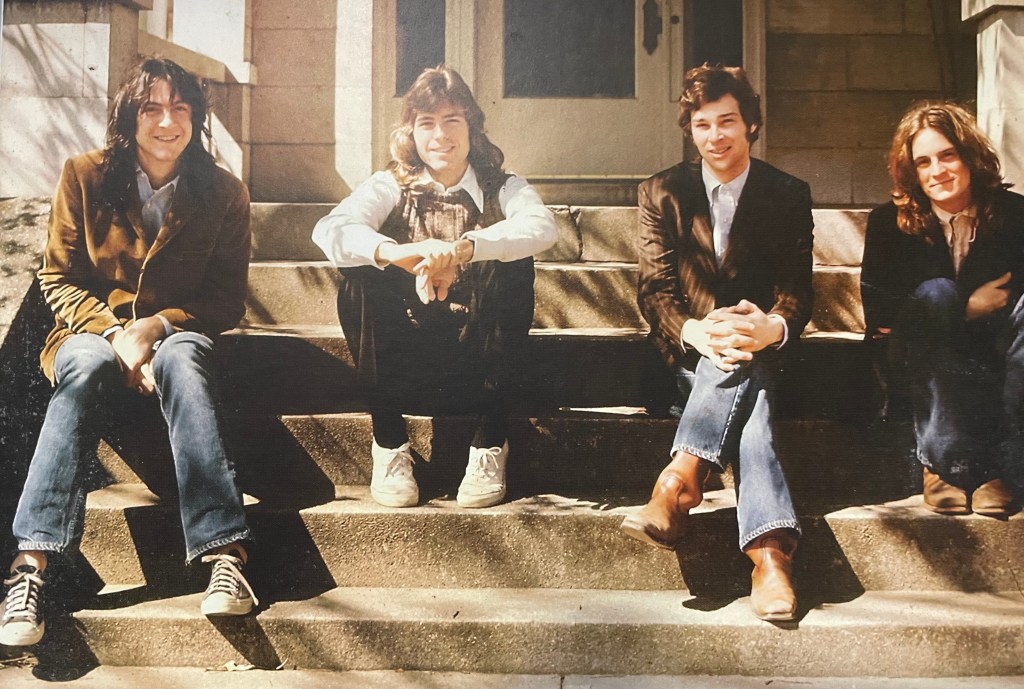
I’ve loved the sounds of Big Star and Alex Chilton for years, and the simple glittering heartbreak of their best songs still gets me with every single listen.

How often can a song do that after dozens, maybe hundreds of spins?

Those Big Star songs shimmer, 50 years on now after the fall 1974 recording of what ended up their final album, Third/Sister Lovers

I can’t listen to the ringing chords of “September Gurls”, without summoning up visions every teenage love affair there ever was, of the burning intensity that, maybe, your life can never quite reach again after 18 years old. The words are deceptively simple – “September girls / Do so much / And for so long / ‘Till we touched.” But the vibe, man, the vibe – that’s eternal.

The genius of Big Star was the utter lack of rock star swagger in their boy-loves-girl pop, a kind of bemused casual sincerity that never really seems to age. Their feelings tapped into the universal, girls, cars and nights of confusion.

Take “Thirteen”, written by Chilton and poor doomed Chris Bell, who left the band after their first album and died in a car wreck at just 27. A fragile and trembling little song, in its first little conversational couplet it sums up a whole world of teenage hopes and dreams – “Won’t you let me walk you home from school? / Won’t you let me meet you at the pool?”

A buried gem for me has always been “Life Is White,” which contains the entire frustrating agony of a breakup in its simple words – “Don’t like to see your face / Don’t like to hear you talk at all.”

Written down, their words don’t exactly leap off the page, but between Chilton and Bell they feel real, in a deeper way than the stadium rock and pompous prog lyrics of the era. 

The true art of Chilton’s lyrics was their plain-spoken language. “Hanging out / down the street” is hardly Shakespeare, but it’s a word picture that worked so well that That ‘70s Show used it to be the theme song for the entire decade. (Still annoyed they drafted Cheap Trick to cover it, though.)

Of course, part of Big Star’s charm is their found mystery – barely registering while they were briefly a band, three albums and done, and only slowly growing in cult power years later. (I first discovered them myself in the early 1990s, when a series of Rykodisc CD reissues hyped up this old forgotten cult band from Memphis, an hour’s drive up the road from where I was going to college. And for once, a band lived up to the hype.) Everybody loves to think they’ve discovered a hidden gem, and Big Star was one of the shiniest for a power pop lover back in the day. 

I’ve written about my love for Alex Chilton’s epic disheveled and messy solo career that unspooled post-Big Star before his sadly early passing in 2010, but while Big Star were sometimes low-fi and unadorned, they were never sloppy. They meant every word, while Chilton in later years would kind of lean into a debauched troubadour vibe, singing songs with a wry smirk. 

I sometimes think that Chilton maybe felt he’d perfected pop music with Big Star so much that he became bored by it, that he never wanted to take a song quite so seriously again. 

There’s a reason people still listen to Big Star more than 50 years after the boys from Memphis started doodling out songs. They strike a chord, and every time I hear that clarion call of “September Gurls” glittering out of the speakers, I hear it ringing still. 

Flashback 1994: Life in New York City, part two – the daily struggle 

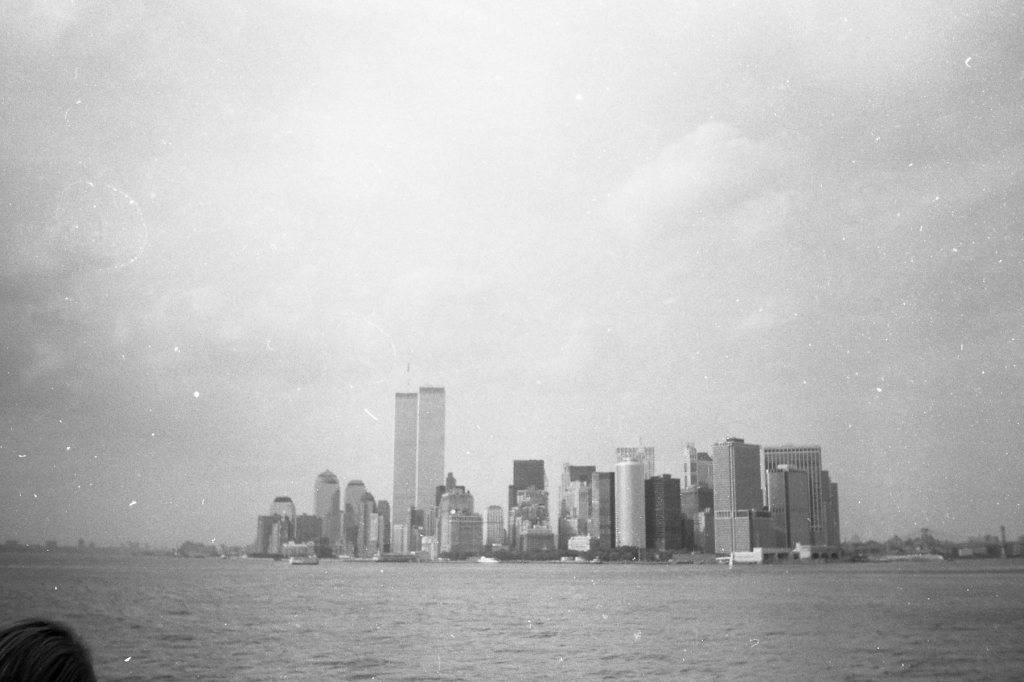
Moody black and white shot of Manhattan, 1994, by someone who had clearly seen Woody Allen’s Manhattan a few too many times.

Part one of this thrilling blog post here!

I had always wanted to live in New York City. I’d seen Woody Allen movies, I’d been addicted to Seinfeld, I’d watched Ghostbusters and King Kong and Do The Right Thing. 

But actually living in New York City was a wake-up call to a young Mississippi journalist. 

The internship at Billboard magazine was great fun, but living in New York City as a perpetually broke 22-year-old? It was a bit scary. I was put up at New York University dormitories in the East Village, as part of my internship. I was stuck in a utilitarian multi-bedroom apartment with a few other starry-eyed interns, although my actual roommate ended up being a friendly Black 40-something military veteran. I didn’t spend a lot of time in my room, really – there was too much to see and do. 

My late dad was very smart with how he taught his spendthrift son to spend money, although it took me years to realise this. He’d never let me starve to death, but neither would he give me an infinite line of credit to spend on books ’n’ CDs and delicious knishes.

So with the paltry paycheck from Billboard and a limited allowance from Dad, I got by. I ate an awful lot of Top Ramen and peanut butter some weeks, as my bank account regularly dropped to two figures. Truth be told, I couldn’t imagine how one could actually afford to live in the city without being a millionaire. 

Times Square, where I went to work each day, hadn’t been quite so gentrified then, and was a buzzing, sleazy place with wide-eyed tourists mingling with businessmen, hookers and panhandlers. Cheap trinket shops mixed with fancy Broadway theatres and bizarre shadowy tombs showing all kinds of porn. 

In those pre-digital, pre-streaming glory days, New York was a wonderful arcade of eccentric gritty book stores, record stores and junk shops. I discovered the amazing sprawling Strand Bookstore not a few blocks from my dorm room and fell in love in the intense way that only a really good used bookstore can make you feel. 

I spent a lot of time in the East Village, where a dirt-poor intern on his days off could just spend the days people-watching in Washington Square. I sat listening to a cassette of Elvis Costello’s Get Happy on my Walkman and reading a paperback of cheap Chekhov plays and imagining how cool I must be. Sitting on the edge of the fountain I’d see people of all races and colours and lifestyles washing by, a far cry from college in rural Mississippi. 

The city could be scary at times, but I was six foot two, able to fake an intimidating stare for strangers and knew enough not to take dumb chances. 

The author, far right, wearing what history would judge, poorly, as quite possibly the most incredibly 1990s bohemian outfit of all time – tie-dyed shirt, black vest and most likely cut-off jean shorts as well.

But I also had friends there – pals I’d made in the small press community I got to hang out with for the first time – jumpin’ Joe Meyer, trippy Tim Kelly, amicable Amy Frushour and several more who helped guide me around the crazy, confusing labyrinth of New York. We ate cheap Sbarro’s pizza and wandered the endlessly fascinating streets doing cheap things and visiting museums. I marvelled at the World Trade Center, not knowing it’d be gone in seven years. 

It was a summer that felt filled with weird coincidences. My oldest childhood friend happened to be touring the country post-college and we met up and climbed the Empire State Building together. On a busy random Manhattan street corner, I literally ran into an acquaintance from Mississippi. On a train heading upstate, the woman sitting next to me was a young writer I knew at Billboard.

I kick myself today over missing some things – never made it to the Statue of Liberty, never got to Harlem or Brooklyn, didn’t have the money to bounce to all the hip clubs and shows that were going on all around me. I was 22, and I didn’t know all the things I could have been doing. I’m sure I missed a lot. 

In hindsight, I wish that maybe I’d seen more and done more in my time in New York – not knowing that 30 years later, having moved to the other side of the world, I’d still never have returned there. Maybe I shouldn’t have bought so many dog-eared paperbacks at the Strand and bought so many CDs at St Mark’s Sounds. But heck, that was part of the experience, wasn’t it?

I was young and naive and the city was a playground of novelties. But it was also exhausting in a certain way, and after three months I longed for a little Mississippi calm and the sound of crickets on a humid Southern night. I didn’t become a seasoned, sarcastic Manhattanite like I’d imagined I might, but I had a taste of the city that never sleeps. That was enough, and 30 years on, unforgettable. 

Flashback 1994 – Life in New York City, part one: The internship

Somehow, 30 years ago this summer, I had my New York City adventure, a near-college graduate from Mississippi who ended up working at a major international magazine. 

In my last few months of university, I stumbled into an internship with Billboard magazine, the music industry bible. I’d been signed up for a “trade magazines” internship program and apparently the few awkward music reviews and pieces I’d slapped together as clippings was enough for me to get a three-month tour aboard one of the industry’s biggest magazines. (Later, I met other people who were part of the same trade internship who ended up at magazines with titles like Tractor Parts Weekly, and who were a bit jealous of my fumbling luck getting a “cool” internship.)

For a college boy from Mississippi, it felt like I’d dropped into another world. I had never been to New York City or even America’s East Coast, and suddenly I was tossed into a real Manhattan magazine office which was both more and less than I expected. It had the warren of cubicles like you’d see on TV and movies, the bustle of constant weekly deadlines, but while it was magical, it was also sometimes mundane and in the end, a place where people just worked. 

Each day I would put on presentable clothes (the tie and slacks, I discovered in the very first week, were a bit much) and take the subway from my dorm room at NYU up to Times Square, where I’d grab a New York Daily News and coffee and head up to the Billboard office. 

In 1994, the music industry was a very different place than it was in 2024. Sure, you still had hustlers and hopefuls all angling to make it big, but there was no Spotify, there was no social media. There was cold black ink on glossy magazine print worth its weight in gold to any musician. Billboard told the world what the number one song was, what the biggest selling album was. It mattered, in an age before media splintered into a million subsets. 

The CD was king, and it’s hard to explain now how these shiny disposable discs were valuable hard currency to music lovers for a while there. We’d get dozens of CDs a day from bands hoping for a line or two of print, and each day, dozens of them that the editors were either done with or never listened to at all would be “dumped” on a small “free” shelf right across from my cubicle. Like a dinner bell ringing, the “dump” would be accompanied by other office workers scurrying to the shelf from all over the building, scooping up the glorious free music, no matter what it was, hoping to find treasures. 

I ended up with several boxes full of CDs stamped with “promotional copy” on the front to ship back to Mississippi. That summer I discovered bands I would love for years to come – the surreal rock of Guided By Voices, the lonesome beauty of Freedy Johnston, the Britpop charms of Blur – along with dozens of other bands whose names I’d soon forget, whose CDs I’d eventually trade in for credit somewhere. 

I worked, briefly, with some music legends there who are now all gone, like the warm-hearted late Irv Lichtman, a true New Yorker to his bones, or Eric Boehlert, a genial young editor only a handful of years older than me who went on to become a fiery critic of online misinformation before his terribly early death in an accident in 2022. The Billboard editor-in-chief, Timothy White, was a bow-tied wearing blur who zipped past my desk several times a week. We exchanged maybe a dozen sentences but that was enough for a striving wanna-be journalist to soak up. He was hugely respected in the industry, but died suddenly of a heart attack at only 50 years old a few years later.

Billboard was full of kind and crusty journalists in equal measure – one of the editors never addressed me with anything more than a grunt, while another often took me out to lunch and once regaled me of tales of the interview he’d just had with Erasure’s Andy Bell that morning. One rain-soaked weekend half the staff went upstate to Woodstock ’94 and I vicariously took in all their madcap stories of this rather muddy fiasco the next week. I was an observer on the edge of it all, but it confirmed for me this weird, pressure-filled life of journalism was where I wanted to be. 

Please note my magnificently disheveled makeshift cubicle at 1515 Broadway, Times Square complete with prominent trash can and empty bag of bagels.

I lived the true intern’s life of being the office errand boy, in that pre-digital era – helping sort the massive sacks of mail of review CDs and books that were dumped out daily, answering phones, working in a tiny storeroom jammed with file cabinets to organise the horrifyingly cheesy band photos sent in by every would-be superstar in the land, and sometimes, getting to write short pieces.

I had maybe 10 bylines in Billboard that summer, each one feeling hard-won. 

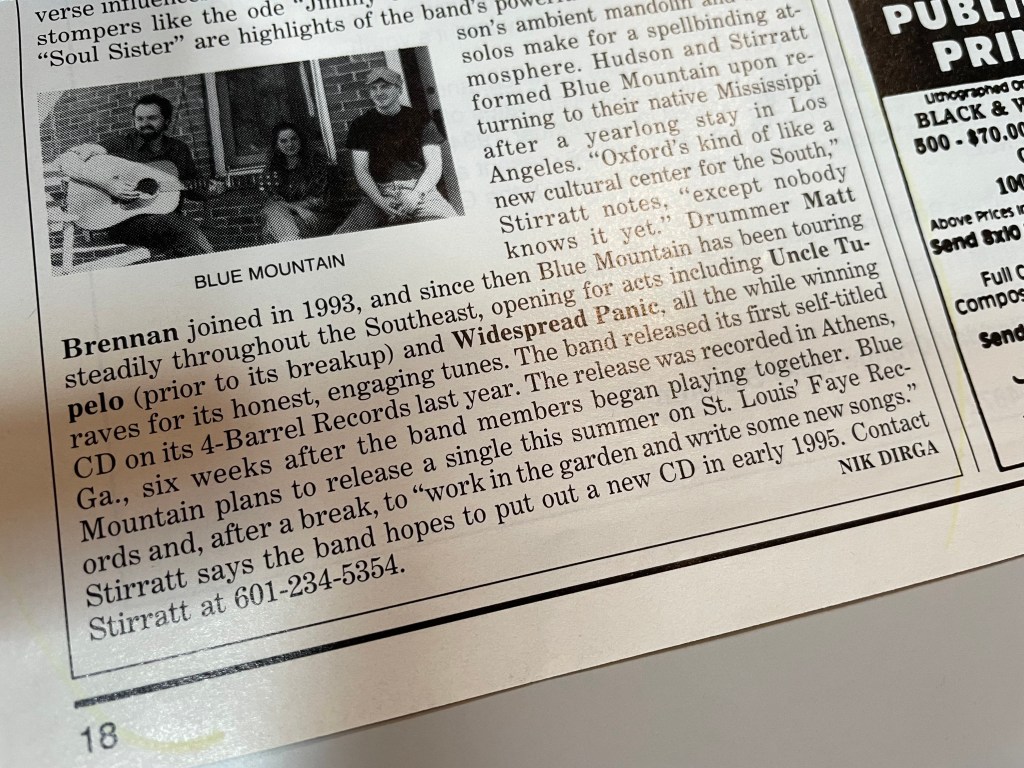
An article on Oxford, Mississippi band Blue Mountain was a Billboard highlight for me.

I was briefly, part, of a newsroom and a team, and all the years since then I’ve found myself drawn to that weird companionship of the news. It gets in you.

I never got a front-page scoop or anything. I was an accessory, a kid learning the ropes. One tangled industry piece I did ended up being rewritten so comprehensively that I think I recognised a dozen syllables as my work in the final product, but I took it all in – you were there to learn, after all, and the 22-year-old intern couldn’t afford to get angsty about credits. 

I did not end up staying and working in Manhattan – I had one semester of college to finish, and ended up getting hired by the local Mississippi paper that fall and working there for a few years before fleeing back to my native California and continuing my quixotic career.

Since the summer of ’94, I have never been back to New York City, and now live almost on the opposite side of the world. I’d like to go back, someday.

But it was enough to be there, for a summer in Manhattan, walking through Times Square every day eating a bagel and feeling like you were part of something greater. 

Next: Part two: Living in the city 

‘Just singing and floating and free’ – RIP Martin Phillipps of The Chills, the sound of New Zealand

When I think of New Zealand music, spawned way down here at the bottom of the world, the very first thing that always pops into my brain is the brooding, bouncy opening chords of The Chills’ “Pink Frost.”

Martin Phillipps, the lead singer and driving force behind the Chills, died this weekend at just 61 years old, and for any fan of NZ music, it hits hard. Gorgeous and mysterious and intimate and epic, the best of the Chills’ music evoked New Zealand for me in a way that nothing else quite ever could. There is a beautiful mystery to it.

I wrote a lengthy post back in 2019 about Phillipps and the Chills after being fortunate enough to see him at the premiere of the excellent documentary on the band’s twisting career: Martin Phillipps and the endless cool of the Chills.

It says everything I still feel now about this wonderful curiosity of a band, who maybe never quite became a household name in the wider world, but who had a knack for perhaps music’s most elusive, perfect quality – the ability to instantly send you away, into a new place.

Thanks for everything, Martin. The music lives on. Crank up “Heavenly Pop Hit” and enjoy what he left behind.

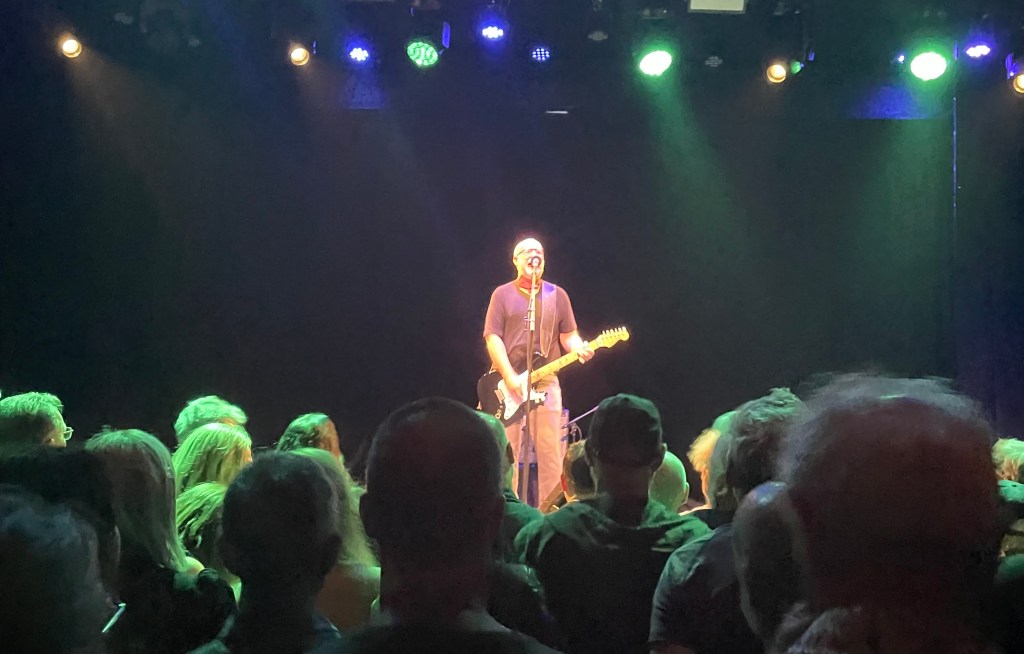
Concert Review: The Dandy Warhols, Auckland, April 22

The 90s are having a moment. 

There’s something about this year in particular, where every time I turn around I see headlines blaring the 30th anniversary of things I lived through and considered cultural touchstones in my life – the death of Kurt Cobain, OJ Simpson’s freeway chase, the release of Pulp Fiction, the debut of Friends, whathaveyou. Watching elements of your life turn into nostalgia is always strange. 

And then there’s the Dandy Warhols, Portland, Oregon’s psych-pop cult sensations, who hit Auckland on their 30th anniversary tour this week. How is a band I still kind of think of as new-ish turning thirty, for crying out loud? But the Dandys still put on a spirited and rollicking old-school rock show at Auckland’s Powerstation, even if the band is – cough cough – like yours truly entering their 50s now. 

The Warhols never quite ascended to the level of superstars like Pearl Jam or Green Day, but in some ways that’s their strength – they’ve felt free to play around in the murky area between hummable pop nuggets and sprawling psych-jams.

Live or on record, the Dandys have never quite settled on one signature sound – the impossibly catchy stuff of singles like “Bohemian Like You” and “We Used To Be Friends,” the yearning drone of druggy anthems like “You Were The Last High” and “Godless” or the clattering, Velvet Underground-adjacent jam of “I Love You.”  Most of their hits got a workout in Auckland as well as some twisty new gems from their latest album Rockmaker. (The bouncy single “Summer Of Hate” really captures that caught-in-purgatory 2024 vibe well.)

Courtney Taylor-Taylor still has the easy charm of the pin-up frontman, while terrific drummer Brent DeBoer, guitarist Peter Holmström and keyboardist / bass / singer Zia McCabe all clicked with an effortless precision. The show perhaps lacked that spark of unpredictability and closing without an encore sapped the buzz a bit, but at their best the Dandys cooked up a warm singalong atmosphere with the honed skill that comes with having done this for (gasp) 30 years now. 

The Dandys are always married in the popular imagination with another 1990s band, The Brian Jonestown Massacre, whom they costarred with as the subjects of one of the great music documentaries, 2003’s DIG! The documentary follows the steady rise of the Dandys and the clattering collapse of the Massacre and its unhinged frontman Anton Newcombe, and it’s a classic time capsule of 1990s alternative rock struggles. 

Both bands started together and hung out a lot, but while the Dandys courted major labels and huge European crowds, Newcombe’s violent eruptions left that band a heap of “what ifs” in music history. 

Rewatching DIG! again, the music scene has changed so much in the more than 20 years since that documentary came out that it’s like watching an alternative universe – no TikTok, no viral fans, just the hard graft of touring, magazine profiles and both bands constantly worrying about “selling out” (a concept which, as Chuck Klosterman has pointed out, has pretty much ceased to exist these days when everyone’s selling themselves in bite-size video pieces). 

Long after DIG! the Warhols are still steadily driving along and while true music superstardom seems reserved for the Taylors and Beyonces of today, their big NZ/Aus tour is sold out and the Powerstation was jammed with appreciative fans Monday night. The Brian Jonestown Massacre are also still going, to this day, with their own fanbase, but carnage still follows them – they recently ended a New Zealand/Australian tour with a massive brawl on stage – the kind of thing that might have seemed edgy in your 20s but seems kinda sad when the band members are all well into middle age, frankly.

With DIG! it kind of felt like the story was that Anton Newcombe was some underappreciated genius and the Warhols too eager to court fame with their chill professionalism. (A failing of DIG! is we’re constantly told about Anton’s genius without really ever seeing evidence of it.) As I watch it now, Anton’s clear mental illness seems starker and his rambling music honestly lacks the snap and charm of the Dandys’ best tunes. Did the Dandys “sell out” and the Massacre get betrayed by corporate frauds? Or did the Dandys knuckle down and do the hard work and the Massacre succumb to its own pretensions? 

At one point in DIG!, Newcombe rants, “I’m here to destroy this fucked up system. I will do it. That’s why I got the job. I said let it be me; I said use my hands. I will use our strength. Let’s fuckin’ burn it to the ground!”

Meanwhile, the Dandys opened up their Auckland show with the still stinging little satire “Not If You Were The Last Junkie On Earth,” where Courtney croons, “I never thought you’d be a junkie because heroin is so passe.” And so we all sang along about heroin. The Dandys gently mock the culture that spawned them, and somehow, they’ve survived. Does anyone care about selling out anymore?

Also in that same song: “You never thought you’d get addicted, just be cooler in an obvious way.” 

Part of us is all still about chasing cool, whether it’s the 1990s or the 2020s. Hey hey hey. 

Concert Review: Shonen Knife, Auckland, March 9, or, finding that happy place

Sometimes I like to listen to depressing songs. Sometimes I like to listen to happy songs.

I’ve got my Cure, my Joy Division, my Depeche Mode and Leonard Cohen. And they’re great when I’m in the mood for it. 

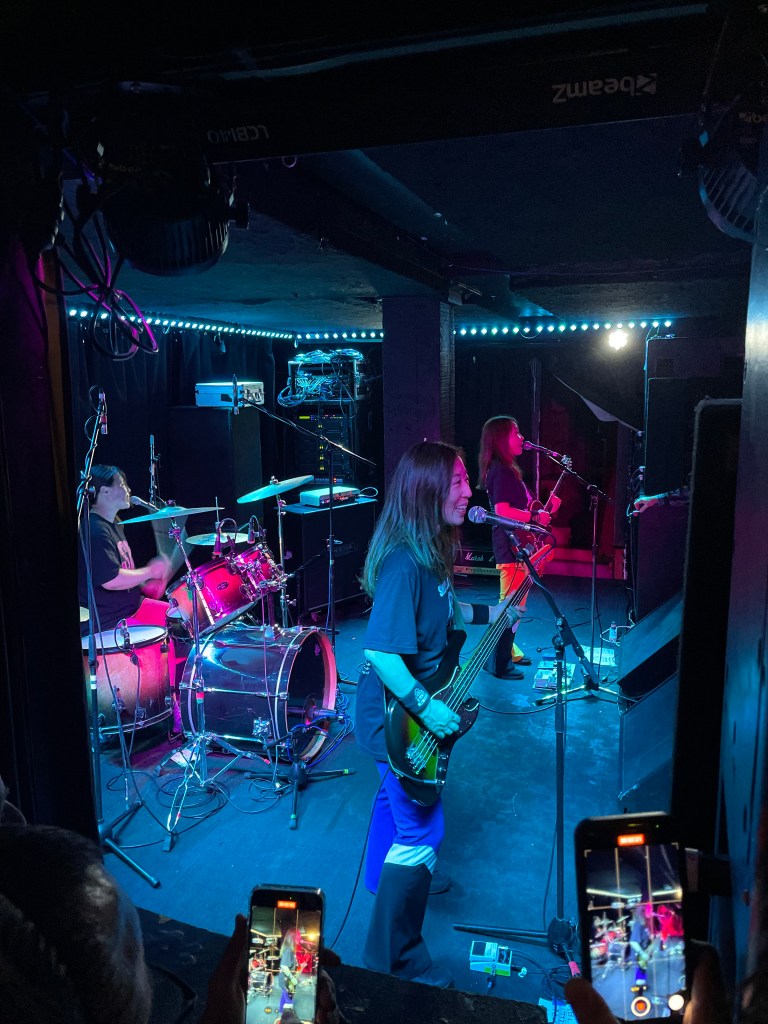
But other times I just want a happy sound – and there’s few more unabashedly happy bands out there in the world than Japan’s Shonen Knife. An all-girl band who marry Ramones thrash-pop with Beach Boys-style wistful harmonies all twisted together with a healthy dose of colourful Osaka charm, they’re a delight to see live. 

Heartbreak? Depression? Shonen Knife don’t do that. They sing about their favourite foods, cute animals, and the silly happy things that, in the end, kind of make this life worth living. And they do it while kicking out some thrashing power chords and rocking with incredible style, dressed in often matching colour-coordinated outfits that seem retro and futuristic at the same time. 

For a band that’s been going for more than 40 years, since the women were all teenagers, Shonen Knife still make a tremendous racket, headbanging hair and all. I’ve been a fan since they broke through a bit in the US in the alternative music-ruled 1990s with celebrity fans like Nirvana and Sonic Youth. They’ve carried on for a pile of albums, rarely altering their sunny, hook-filled sonic approach, and they’re all the better for that. 

Sisters Naoko and Atsuko Yamano have been the core of the band for most of its long run, with excellent drummer Risa Kawano on sticks these days. I’m old and creaky and so I’m kind of out of it with the hip pop music the youth listen to these days, but the appeal of a good cheery song is universal. 

The packed gig at Auckland’s underground Whammy Bar was probably the first time I’d been in a crowded basement club environment since the pre-pandemic era, and it was kind of invigorating to feel that sweaty, borderline uncomfortable shared experience, for a little while. 

Song titles like “Sweet Candy Power,” “Afternoon Tea” and “Banana Chips” give you the overall vibe of a Shonen Knife show. I can’t think of too many rock gigs I’ve been to where the audience is led in an energetic singalong chant of “Candy! Candy!” 

In a fun interview over at my day job RNZ, Naoko said, “I like to make people happy through music and if our audience or listeners get happy through our music, it’s my happiness too.”

Perhaps it’s just my mood in the very stressful vibe the 2020s have proven to have, but sharing a little happiness no longer seems as corny as it might have once to me. 

In a world as askew as this there’s something blissful about celebrating the little things, whether it’s a funny-looking jellyfish, wasabi being hot or one Shonen Knife song whose chorus is simply, “it’s a nice day!”

And you know what, sometimes it is. 

RIP Dick Waterman, keeper of the blues and my favourite columnist

Dick Waterman and Son House. All photos C the estate of Dick Waterman.

Mississippi blues writer, photographer and keeper of the flame Dick Waterman has died, one of the most extraordinary columnists I ever worked with in all my years in journalism. He was 88. 

Dick worked with some of the great blues legends starting in the ‘60s like Mississippi John Hurt and helped “rediscover” the forgotten Son House. He gave many struggling blue legends a second chance at a career and some sort of justice and support. He also photographed and hung out with pretty much EVERYBODY in the music scene at that time – Dylan, Jagger, Bonnie Raitt, Howlin’ Wolf, B.B. King, Janis Joplin. 

This picture of Mississippi John Hurt is probably my all-time favourite photo of a musician. C Dick Waterman.

There will and should be some fine obituaries taking in the whole sweep of his career. (Such as this excellent Washington Post one or this fine one in The New York Times) But when I met Dick Waterman, he was a columnist for the weekly newspaper I started working at in 1994, Oxford Town. It was the very beginning of my post-college career and I knew everything and nothing. The editor Chico had hired him and it was one of the best things he’d ever done. 

Almost every week Dick would drop these fascinating columns and stories about his life in music, tales of the legends and the forgotten geniuses, peppered with his gorgeous black and white photos. His columns were candid, backstage stories of what the blues legends were really like, or about his own life. When I was asked to take over as Oxford Town editor, visits from Dick were always a highlight.

Not that it was always smooth – Dick Waterman would turn in his column as late as humanly possible, shuffling into the old-school layout room close to midnight with a sheath of pages, while the pressmen could be heard loudly grumbling in the back. Once he discovered fax machine technology he pushed it even further. I attribute my skill at editing some copy very, very fast to some of his columns.

But he was unfailingly gentle and kind, with a bit of the “distracted professor” vibe around him. His photograph stash was an astonishing treasure trove that he had really just started to understand and promote in the 1990s. At one point he let us use an amazing photo of B.B. King on the back of an Oxford Town t-shirt. 

B.B. King, 1968. C Dick Waterman

I was just a rather self-important and fumbling 25-year-old editor dude at the start of my own weird journalism career but Dick was always good to me, and honestly, it took me a long time to fully understand what an amazing “six degrees of Kevin Bacon” type character he was in the ‘60s music world. I’ve never met Howlin’ Wolf or Muddy Waters or Arthur “Big Boy” Crudup, but hell, I knew Dick Waterman.  

When I left Oxford Town around 1997 to sow my wild oats back in California, Dick Waterman for some reason singled me out in his column in what is still, coming up on 30 years on, one of the kindest single acts of writing anyone has ever done for me. I include it not to brag, but to show what kind of man Dick Waterman was. 

He wrote about a Mississippi journalism award I won and said, “For the second year in a row, the Best General Interest Column was won by Oxford Town editor Nik Dirga. To appreciate this feat, you have to understand that he doesn’t even think about his own column until the rest of the paper has been completed. Nik has already announced that he is leaving in a few weeks and my sadness at his departure is mixed with the joy of having had the pleasure of working with him.”

“If Tiger Woods is the best golfer in the world at the age of 21, I can only hope that I stick around to see what literary accolades will come forth for Nik Dirga. The best part of working with Nik is that he honestly does not know how talented he really is. I am over twice as old as Nik Dirga and he is the best editor with whom I have ever worked. 

“I wish him well in his travels and know that I will be reading his byline out there somewhere.”

He didn’t have to write all that about me, I know now, and I’m sure no Tiger Woods. But he did write it.

I wish you well in your own travels now, Dick, where ever they may take you. 

Mick Jagger. C Dick Waterman

Meanwhile, elsewhere on the internet…

It’s Oscar nominations day! Let us share in the joy of headlines that aren’t full of sadness, despair and such and celebrate what was actually a pretty good year for film. In my status as Radio New Zealand Official Academy Awards Correspondent (TM) here’s my take on the nominees and a look at a few New Zealand-linked possible winners:

Oscars 2024: Who will win, who got snubbed, and where NZ is in the mix

Meanwhile, I’ve also got a book review in this week’s issue of the New Zealand Listener magazine on Michel Faber‘s excellent new sprawling look at sound and our relationship to it, Listen: On Music, Sound and Us

Review: Music-loving novelist Michel Faber on the psychology and sociology behind the sounds that keep us hooked (Paywall)

Year in Review: My top 10 pop culture moments of 2023

It’s a new year, a fresh start, a hope this year is maybe a bit less suck than the last one! I’ve complained enough about the year that was, so instead let me dive back to look at ten musical, cinematic or literary experiences that rocked my world in ’23: 

Go back to those Gold Soundz: I didn’t check out a lot of live music last year, but what I did was superb, led by the old guard showing they can still blast with the best of them. Indie icons Pavement put on a superb reunion show that left me humming the chorus to “Gold Soundz” for weeks, while I finally saw punk/post-punk legends The Damned for the first time on the back of their excellent Darkadelic album, and they melted my face. And my ears. I don’t quite know if my hearing has ever been the same.

Tonight, a blind woman and a monster came to town: I’ve been getting fewer ongoing monthly comic series these days, but one that’s on my must list is Ryan North’s brainy, witty take on Marvel Comics’ Fantastic Four, which is inventive science-bro action combined with the family heart that is key to the FF. It’s just darned fun, good comics that (so far) don’t have to be part of some sprawling pointless multi-comic company crossover to feel epic. It’s the best the Fantastic Four has been in ages. 

A long long time ago, when I was a little chick: I wrote a whole story recently asking local book lovers for their favourite New Zealand books they read and it reminded me of what an excellent year it was for NZ fiction, led by Eleanor Catton’s wickedly fun satire Birnam Wood and a two-fer by Catherine ChidgeyThe Axeman’s Carnival, an amazing novel about a bird who becomes a social media celebrity, and the nearly as good teenage angst thriller Pet. Go team NZ!

You don’t know the first thing about piracy, do you?: There was a lot of great TV in ’23 – Reservation Dogs, that banger final Succession run, Poker Face, and I’m only just now discovering how fantastic The Bear is – but the one that sticks with me the most is Taika Waititi’s unexpected gay pirate comedy Our Flag Means Death, which in its NZ-filmed second season truly transformed into a delightfully sweet romance mixed with swashbuckling pirate fun. A gem. 

And in an instant, I know I’ve made a terrible mistake: Daniel Clowes has been blowing my mind since long ago when I first stumbled on an issue of Eightball. His comics are less prolific than they once were but they’re worth the wait, with this year’s graphic novel Monica (art at top of post) quite possibly his masterpiece. A sweeping story of one woman’s exploration of her own mysterious past, it’s a technically dazzling (those colours!), assured and layered work that you’ll keep churning over in your head for days afterwards. It’s not a speed-read like many modern comics, but an experience that might just leave you feeling like the world is a slightly different place when you’re done. 

All my life I’m looking for the magic: Yeah, I know, physical media is dying, bla bla blah, but while I’m definitely a bit more choosy about what I buy in the age of internet abundance, I can’t pass up a good mix, and UK record label Cherry Red constantly is putting out fantastic CD box sets of eclectic punk rock from 1977-1982, power pop from the UK and US and ’80 synthpop that spans my mid-1970s to late-80s sweet spot. Sure, you can find a Spotify playlist, but I enjoy the curated, elegant physicality of these great boxes and the buried treasure they contain. Each set is hours and hours of gems waiting to be rediscovered and if I close my eyes I can almost pretend it’s coming from a cassette mix tape as I drive my old Volkswagen Rabbit around town. 

That monster … will never forgive us: This was the year comic-book movies stumbled and became just as cliched as the Will Smith and Tom Cruise action movies they replaced. But look across the seas to Japan and some of the year’s best blockbusters came from there, with kaiju instead of capes in the terrifically oddball Shin Ultraman and the bizarre Shin Kamen Rider and best of all, the monumental reimagining of the biggest beast of all with Godzilla: Minus One. There were decent superhero moments this year, but not one of them compared to the kinetic thrill of watching Ultraman or Godzilla stomp on buildings with fresh energy. 

Dear Allen, thanks for your letters. I was glad to hear from you: William S. Burroughs was not a decent man. A drug addict, the accidental murderer of his first wife, homosexual in a repressed era, his twisted, tormented writings are decidedly not for everyone. And yet, and yet. This year I found myself once again reading Burroughs’ books like The Soft Machine and turning to his nonfiction writings, particularly his collected letters, because the nonfiction shows so well what went into his far-out fiction. The Letters of William S. Burroughs 1945-1959 fascinated me because it revealed the real person behind the sneering, sinister king of debauchery Burroughs became. It’s extraordinary to read how human and lonely Burroughs is in these letters, wrestling with unrequited love, addiction and ‘normal’ society, and his determination to find new shadowlands behind the world we live in. A stoic mask soon settled over his public face, but here we learn how he got there.

To be honest, when I found out the patriarchy wasn’t just about horses, I lost interest: “Barbenheimer” might have been a marketing technique gone viral, but it was a heck of a lot of fun and rewarding to see two very good movies leading the summer box office and showing up the latest dusty, unnecessary franchise-extender Indiana Jones sequels and the like. Barbie was a huge hit, but it was also just subversive enough to charm all but the most cynical, while Oppenheimer was Christopher Nolan’s best movie yet led by a dazzling Cillian Murphy and sequences on the iMAX screen downtown that melted my face nearly as much as a Damned concert. 

The meat goes into the oven: This one’s a bit self-indulgent, but I had a very good year stretching my feature writing muscles this year in my paying gigs, between several book reviews for the NZ Listener magazine and writing for Radio New Zealand about stuff I love like barbecue restaurants, fans of weird movies, used book fairs, film festivals and more. Turn your passions into words, folks, and let’s all have a fine 2024!